On this edition of Iowa Press, Dr. Richard Deming and Dr. George Weiner speak on the topic of cancer in Iowa.


On this edition of Iowa Press, the discussion focuses on cancer in Iowa. Dr. Richard Deming, medical director of the MercyOne Richard Deming Cancer Center, founder of Above+Beyond Cancer, and vice president of the Iowa Cancer Consortium board of directors, and Dr. George Weiner, professor and researcher at the University of Iowa, director emeritus of the UI Health Care Holden Comprehensive Cancer Center, and a founder of the Iowa Cancer Consortium speak on the topic.
Joining moderator Kay Henderson at the Iowa Press table is Stephen Gruber-Miller, Statehouse and politics reporter for The Des Moines Register.
Program support provided by: Associated General Contractors of Iowa, Iowa Bankers Association and Robert and Doreen Sheppard.
Transcript
[Kay Henderson] Rising cancer rates in Iowa. What's causing it and what should state leaders and all Iowans be doing about it? We'll talk with two experienced cancer doctors on this edition of Iowa Press.
[Announcer] Funding for Iowa Press was provided by Friends, the Iowa PBS Foundation.
The Associated General Contractors of Iowa, the public's partner in building Iowa's highway, bridge and municipal utility infrastructure.
The Bob and Doreen Sheppard Family. Proud supporters of educational programing, seen only on Iowa PBS.
Banking in Iowa goes beyond transactions. Banks work to help people and small businesses succeed, and Iowa banks are committed to building confident banking relationships. Iowa banks your partner through it all.
[Announcer] For decades, Iowa Press has brought you political leaders and newsmakers from across Iowa and beyond. Celebrating more than 50 years on statewide Iowa PBS, this is the Friday, February 27th edition of Iowa Press. Here is Kay Henderson.
[Henderson] Let's begin this episode with two bits of news. The good news is that Iowa's mortality rate from cancer is falling. But the troubling news is that Iowa's has the second highest rate of incidence of cancer in the country. Our two guests are cancer experts, and they're here to talk about what's going on in this field. Let me introduce them. They are Dr. George Weiner. He is director emeritus of the University of Iowa Health Care Holden Comprehensive Cancer Center, where he was director for 23 years. He remains a professor and researcher at the University of Iowa. He is a past president of the Association of American Cancer Institutes, and was also a founder and longtime leader of the Iowa Cancer Consortium. Welcome to Iowa Press.
[Dr. George Weiner] Glad to be here.
[Henderson] Joining our conversation, Dr. Richard Deming. He is the medical director of the MercyOne Richard Deming Cancer Center, and he is the founder of the nonprofit Above and Beyond Cancer. He's currently vice president of the Iowa Cancer Consortium Board of Directors. Welcome to you, Dr. Deming.
[Dr. Richard Deming] Thank you.
[Henderson] Joining our conversation is Stephen Gruber-Miller of the Des Moines Register.
[Stephen Gruber-Miller] So I want to ask both of you, but we'll start with Dr. Deming. I know neither of you were involved in the research that the governor commissioned from the University of Iowa into the state's high cancer rates, but you both had really extensive careers in this field. From your experience, Dr. Deming, what are the things that you've seen that have contributed to the cancer rates we see today?
[Deming] Well, the high cancer incidence is not caused by any one thing. It's caused by many things. And this could be an hour-long lecture. But we do know what causes many cancers. So still in the United States, cigarette smoking is the number one cause of cancer. Other things that we know cause cancer are eating too many highly processed foods, eating too many calories, obesity, lack of physical activity, alcohol, infectious diseases. And we might want to highlight HPV because that's a vaccination that can prevent six cancers, including tonsil cancer. But we also know that the environment plays a role. It took decades to figure out that the single act of cigarette smoking caused lung cancer. We're now looking at research, trying to show the association, trying to see the relationship between many different chemicals that we're exposed to and whether it's plastics or PFAS or food dye or agricultural chemicals. And we're looking at the relationship between thousands of chemicals and dozens of different cancers. But clearly, the environment is one of the factors. And I also want to mention radon, because when we're talking about the cancer incidence in Iowa, radon is not a pollutant. It's natural. But because of the way the Earth was formed, we happen to be sitting on a very high concentration of radon in Iowa. So those are some of the things that we know cause cancer. And until we continue to invest in research to determine what exactly is the culprit in the high incidence, we won't be able to come up with public policy that will allow us to mitigate, once we learn that cigarette smoking caused cancer, then we came up with public policy that influenced behavior in the 1950s, about 50% of adult men were smoking, and now it's down less than 20%. And that's because of our knowledge from the research that then got applied with public policy, that reduced cigarette smoking.
[Gruber-Miller] Well, Dr. Deming covered a lot of ground. But, Dr. Weiner, is there anything you want to highlight as far as things that lead us to these cancer rates that we see?
[Weiner] Sure. I think Dr. Deming did cover the key issues. And I do want to say that I'm speaking as an individual and not on behalf of the university. And my comments today. I think looking at the incidence of cancer in Iowa, we can divide it into two broad buckets. One is those things we know about where we need to do a better job as a state to reduce the risk. That includes tobacco use. That includes obesity, that includes radon. The other bucket is those risks that we still don't understand as well as we should. Those include issues related to agricultural chemicals. Those include other risks that that our citizens are experiencing. And if we do research to learn more about those, then then we can address that bucket as well. So, so we need to do more about what we already know. We also need to learn more about what we don't know.
[Gruber-Miller] That's perfect because my next question was where would you like to see some of this research go next?
[Weiner] Well, the research in cancer really can be across a broad spectrum. I'm very involved in what's called basic cancer research, where we take advances in the laboratory, understanding what makes cancer tick, why it occurs, how we can treat it. Very often that begins without really knowing where it's going to head. But the advances we're making against cancer right now, the marked reduction we've seen in cancer deaths, is due to basic cancer research that took place 20 or 30 years ago. We're making progress faster than ever before in understanding cancer. So first and foremost, I think we need to invest in basic research. We need to invest in clinical research, where we test the new cancer treatments that are being developed and new approaches to cancer prevention to to see how we can use them more effectively. And then we need to do research in the community. And that's been the focus of the the discussions related to Iowa's cancer rate. To, first of all, understand why our rates are so high and then start exploring what we can do. Working with communities to reduce those rates. So, there's basic research, clinical research and community-based research.
[Henderson] This past month, Governor Reynolds has suggested raising the tobacco tax and establishing a first ever sales tax on vaping products, which also deliver nicotine. Dr. Deming, do you think that would reduce use, and at what level should the tax go?
[Deming] It absolutely will reduce use of tobacco products. The number one intervention to reduce cigarette smoking is increasing the price of a pack of cigarettes. Most of the studies show that you need to increase it by about a dollar to have a significant impact on reducing use.
[Henderson] And the governor has suggested about a 65-cent increase. So, you're saying, right.
[Deming] I would say that I'm sorry, but yes, need to raise it. And we can then debate how much. But it's clear the more you raise it, the more impact you will have. Most public health experts believe that a dollar is an amount that causes a significant reduction. The American Cancer Society Cancer Action Network, which is the policy advocacy arm of the American Cancer Society, recommends $1.50 increase. So, it's clear that raising the tobacco tax will reduce smoking. And then we don't have a tax on the other products. You're right. They deliver nicotine. They don't cause as much cancer as lighting up something and inhaling smoke. But they do get people addicted to nicotine. And there's a concern that that could increase the future use of cigarette smoking. So, we do favor also attacks on the other nicotine products.
[Henderson] Dr. Weiner, do you have a view on how high the tax should go?
[Weiner] Well, I would agree with Dr. Deming. I think a minimum of one buck for the best bang would be what we would like to see, and I think it would be fantastic if the resulting revenue was reinvested in reducing the burden of cancer as well through smoking cessation approaches, helping support people who can't have access to cancer screening and cancer care and cancer research. So, I would love to. That would be a double win. The price of tobacco would go up and reduce use, and the revenue would be used to reduce the burden of cancer further.
[Henderson] You both have mentioned radon, a naturally occurring gas that sadly, Iowa has a lot of. And homes and businesses and schools in which we spend a lot of time. The legislature has discussed several legislative fixes. I'll start with you, Dr. Winer. If I'm watching this at home, what would you tell someone to do to make sure they're not being exposed to excessive levels of radon?
[Weiner] Well, there's radon testing that you can do in your own home, and it's a very simple kit. You set it up in your basement and you leave it there, and then you mail it in. And when the issue radon first came up, I decided to test in my house and our level of radon was two times above. Above the recommended level. So, we put a little fan in the basement. We had an expert do that, and that abated the increased radon. So, I would say get your home tested. And it's really a pretty easy fix. If radon is high.
[Henderson] Dr. Deming, there have been proposals at the legislature, for example, to require new buildings in Iowa to have some sort of radon mitigation system. What do you think the answer should be in regards to radon specifically?
[Deming] Yeah, I don't think there's one answer. I think, you know, several years ago we passed the Gail Orcutt Radon School Safety Bill, and that's personal to me. Gail was a patient of mine, a teacher who never smoked, had lung cancer because of radon. It took years of advocating for that bill before it crossed the finish line. That's one incremental step is to, you know, test the schools and mitigate. But testing homes. And the more that we encourage people to do it. So right now, it's all voluntary. I think that some public policy that mandates it and perhaps, you know, new homes, it's relatively inexpensive to mitigate when you're building a home. One could also consider other transactions, maybe the sale of a home. So, there are opportunities along the line where it could be mandated, where the cost of it is just minimally additive to the transaction that's happening. So, I think that all of those could result in more people knowing about their radon level and more importantly, mitigating so that the radon level is lower as they continue to live in that home.
[Gruber-Miller] I think you alluded to this at the beginning, Dr. Deming, but there are a lot of people in Iowa concerned about high nitrate levels in water and whether that may be a contributor to cancer. What do we know so far about whether there's a link between those things?
[Deming] Well, there's absolutely a link. There's lots of data that shows the association with nitrates with certain types of cancer, including colon cancer, endometrial cancer. A lot of people want, you know, a smoking gun, a study that shows that the actual nitrate and this amount of level causes this cancer. That's very difficult to ascertain. But we know the association and there's even fact sheets from the Iowa Department of Public Health talking about nitrate in the United States and in Iowa in particular. It's a problem you saw in the news this summer where we couldn't water works, had a difficult time being able to get the nitrate levels low enough to allow all of the people in metro Des Moines to be able to use as much water as they want. Right now, when you look at the nutrient Reduction Act in Iowa. So, we've known for a long time, even if even if nitrates didn't cause cancer, they have consequences. As it gets down to the Gulf of Mexico and the impact there. So, we've for a long time trying to reduce the amount of nitrates that get into the water through voluntary programs with a goal to reduce it. But every year it goes up and up. So, in order to have the proper mitigation, we need to have public policy that isn't always just voluntary but brings into play carrots and sticks or credits and penalties that allow people to do what will eventually mitigate the problem and improve the public health.
[Gruber-Miller] Dr. Weiner, anything you'd like to add about what we know or could know more of about links between nitrates and cancer?
[Weiner] Well, studying these sorts of links is extraordinarily difficult because it's not the exposure you had today or yesterday that determines your risk of cancer now, but your exposure one decade ago, two decades ago, three decades ago. So, I think the one other thing that I would add is we shouldn't be afraid to do the research to try to figure it out because of what we might find. And so, it's very important that researchers be allowed to, to look very carefully for, for what the risks might be. If not for our own sake, for our children and grandchildren, so that we can implement changes. Now, that might, might improve their outcomes many years from now.
[Gruber-Miller] Yeah. And we've been talking about environmental factors, I think at the beginning. Also, both of you mentioned there's some behavioral factors as well that can play a role. Right. Consumption of alcohol, smoking, diet and exercise, things like that. Dr. Deming, how much of a factor can those things play?
[Deming] A huge. So, there's studies that show that if you put the triad of the foods you eat, obesity and lack of physical activity together, that triad causes almost as many cancers as cigarette smoking. So, it's a huge influence on the incidence of cancer. So, you're right. Personal activities, lifestyle matters. It's been studied. And we think that about 42% of all cancers in the United States are caused by modifiable risk factors, things that we have control over. So, if we did everything the way that we know would reduce the risk of cancer, we could probably eliminate almost 42% of cancers. And nearly 45% of cancer deaths. So those modifiable risk factors are very important. And as Dr. Weiner said, you know, we know those we need to continue to work on those, but we need to also continue to look at the factors that were not as certain of. And that is exactly which aspect of our environment is causing the most cancers. Once we know that, then we can come up with public policy to mitigate.
[Henderson] The University of Iowa researchers who are sort of digging into this have released very interesting maps that sort of even let a person go down to a zip code and figure out what their cancer risk might be. Is that misleading, Dr. Weiner? Because as you mentioned, you get cancer genetics. Other factors weigh in. It's not necessarily where you live or where you've moved.
[Weiner] Well, I wouldn't say it's misleading, but I also think it's not the final word. That's where we need to start. And if we're saying there's an increased burden of cancer in some communities, we need to understand that so we can try to figure out why that is and how we can reverse it. So, I think these data are a vital first step. It's almost the basic research of reducing the burden of cancer in Iowa. Let's understand the problem in the most detail. We can figure, we can determine, and then we can dig into it to figure out what is modifiable, what and what can we do in the future to reduce that?
[Henderson] Dr. Deming, you're shaking your head. Yes.
[Deming] Well, Dr. Weiner had talked about the different types of research, the basic research that he does, clinical research that we participated in. My cancer center, where you have a randomized prospective study where you treat cancer with the current best treatment, and then you randomize it to another arm that is oftentimes the best-known treatment, plus adding something else that's clinical research. But the other is this community or epidemiology. So, studying population health, that's not as clear cut takes longer. And you don't often get the actual cause effect. You get associations. But it is very important. Also, a couple of other factors that contribute to the incidence of cancer that we didn't talk about is genetic mutations that you might have inherited from mom and dad. That's about 10%. But then the older you get, the more likely you are to get cancer. Now the incidence when we compare ourselves to other states, that's adjusted based on age. But if you get too granular looking at zip codes and different types of cancer, you know the statistics as you get to the numbers that are smaller, it's harder to sort those out. But aggregating them. And that's why cancer is a reportable disease. We have to report it and we keep track of it. So, the reason we know the incidence of cancer in Iowa and every other state is it is a reportable disease.
[Gruber-Miller] So, we talked a little bit earlier about mortality rates for many cancers being lower than they were before. What are some of the breakthroughs in that basic research, in that clinical research that you have seen, that have contributed to our understanding and maybe some of the lower mortality rates? Dr. Wiener?
[Weiner] Well, this this is the good news that mortality from cancer nationwide and in Iowa, if you adjust for age, has dropped about 30% during my career. And we're helping patients now who we couldn't have helped years ago. One of the areas that I'm very involved in is cancer immunotherapy. We've figured out how cancers hide from the immune system, and we're starting to figure out how to strip away that invisibility cloak so the immune system can move in and fight the cancer. That's one of the areas we've made great progress. We've also beginning to understand why cancers go haywire at the level of the molecule in the gene. And are developing medicines that go directly to what went wrong. So, these medicines are called targeted therapies and tend to be more effective and have fewer side effects than standard chemotherapy. So, these are two exciting areas. And our progress is moving faster now than ever before. This is also one of my frustrations because there are so many great opportunities to make progress. So, few of the projects that are worthwhile are now being funded through various mechanisms. Only about 1 in 10 from the federal government. So, we have such opportunity and our progress in the years ahead is going to be proportional to investment. From a research point of view. So, I do think now is the time for us to double down on investment in cancer research for the sake of our children and grandchildren.
[Gruber-Miller] Yeah. Dr. Deming, what are some of those innovations that you've seen?
[Deming] Yeah. So, another contributing factor to the improvement in mortality is cancer screening. So screening is when you test someone for cancer who doesn't have a history of cancer, doesn't have any symptoms of cancer. So, in the United States right now there are five cancers for which we have validated screening tests. Mammography for breast cancer, colonoscopy and stool testing for colon cancer, pap smears and HPV testing for cervix cancer. CT scans of the chest for lung cancer in cigarette smokers, and then also the PSA blood test for prostate cancer. We have very significantly utilized mammography. So, the reason the screening reduces mortality is you find cancers at an earlier stage where the cure rate is much higher. I do want to highlight the lung cancer screening. So, lung cancer kills more Americans than any other type of cancer. We have a screening test, but it's not utilized fully. So, whereas mammography, almost 80% of women eligible to get mammograms are getting mammograms, fewer than 20% of people eligible for lung cancer screening are actually getting the screening done. So that's an area of improvement. So, we've highlighted how screening reduces mortality. But we need to still emphasize educate individuals about screening. And then make sure that we don't have barriers. So, if you don't have health insurance you're not going to get screening. If you require a lot of preauthorization, which sometimes happens for the Cat scans for lung cancer, you're going to reduce the screening. And also with lung cancer, it's the stigma of cigarette smoking. So, we have to make sure that we're not stigmatizing and blaming those individuals who are smoking so that we can continue to improve the screening and reduce mortality for lung cancer.
[Henderson] Gentlemen, we have just a couple of minutes left. Dr. Weiner, I'll start with you. What's your number one recommendation to someone watching this program who wants to say, I don't want to get cancer? What should they do?
[Weiner] Well, I think common sense lifestyle changes of not smoking, exercising, eating right is first and foremost. And they should talk to their doctor about their particular risk for cancer. And if there are other things that that they could do, I would also encourage them to get involved and advocate. We are at a point where we can reduce the burden of cancer for people who come after us, and the more people, more people in the state that that speak about that, the better off we're all going to be.
[Henderson] Dr. Deming, I know people who have been your patients, and I understand that you encourage people to dance with cancer rather than fight with cancer. Talk about that approach as we close.
[Deming] Yeah, there's two things. So, I like the idea of a dance as a, you know, metaphor rather than a fight. But I also do encourage physical activity that includes dancing as physical activity. Yeah. So how you know, the metaphor, every, every cancer survivor has the right to use whatever metaphor in the United States, this idea of a fight and a battle, you know, is a common one. But it's not very comforting, especially if you're one of the millions of cancer survivors who are living with incurable cancer there. It's more like a climbing a mountain or engaging in a dance, or sometimes the cancer steps on your toes, and sometimes you step on the cancer's toes. But it's how do you live a full life? Finding joy even in the midst of a journey that might include treatment for an incurable cancer. So, cancer survivorship is a very important thing. It's important for cancer centers to be involved with killing cancer cells. But it's not the only thing cancer centers should do. Cancer centers need to pay attention to the entire holistic approach of patients.
[Henderson] Well, thank you both for being here and sharing your views. Appreciate it.
[Deming] Thank you.
[Weiner] Thank you for having us.
[Henderson] Before we leave you on this episode of Iowa Press, just a note that Iowa Press is going on hiatus for a couple of weeks because Iowa PBS will be bringing you the Iowa Girls High School Basketball Championships next week, and the following week, the Iowa Boys High School Basketball Championships. We'll be back with you on March 20th. For everyone here at Iowa PBS. Thanks for watching today.
[Announcer] Funding for Iowa Press was provided by Friends, the Iowa PBS Foundation.
The Associated General Contractors of Iowa, the public's partner in building Iowa's highway, bridge and municipal utility infrastructure.
The Bob and Doreen Sheppard Family. Proud supporters of educational programing, seen only on Iowa PBS.
Banking in Iowa goes beyond transactions. Banks work to help people and small businesses succeed, and Iowa banks are committed to building confident banking relationships. Iowa banks your partner through it all.
Watch More

Zach Lahn (R-Belle Plaine) and Rob Sand (D-Des Moines) will answer questions from Iowa reporters and discuss their priorities and vision for the state during a 90-minute debate.

Iowa State Treasurer candidates John Norwood (D-West Des Moines) and Roby Smith (R-Davenport) discuss key issues and policy positions.

Candidates Dave Dawson (D-Lawton) and Chris McGowan (R-Sioux City) will answer questions from reporters and discuss their platforms, concerns and future plans.
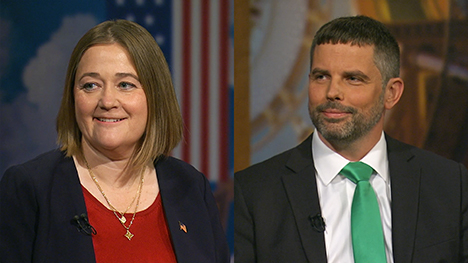
Iowa Attorney General candidates Brenna Bird (R-Dexter) and Nate Willems (D-Mount Vernon) discuss key issues and policy positions.

Lindsay James (D-Dubuque) and Joe Mitchell (R-Clear Lake) answer questions from Iowa reporters and discuss their platforms, concerns and future plans.

Candidates Ashley Hinson (R - Marion) and Josh Turek (D - Council Bluffs) answer questions from reporters and discuss their platforms, concerns and future plans.