Luciano I. de Castro and Christine Hensley discuss the new Center of Intellectual Freedom at the University of Iowa.


On this edition of Iowa Press, Luciano I. de Castro, interim director and professor of economics at the University of Iowa, and Christine Hensley, Iowa Board of Regents member and chair of the advisory council, discuss the new Center of Intellectual Freedom at the University of Iowa.
Joining moderator Kay Henderson at the Iowa Press table is Erin Murphy, Des Moines bureau chief for The Gazette.
Transcript
[Kay Henderson] A new center for intellectual freedom is taking shape at the University of Iowa. We'll talk with two leaders involved about what the center will do on this edition of Iowa Press.
[Announcer] Funding for Iowa Press was provided by Friends, the Iowa PBS Foundation.
Banking in Iowa goes beyond transactions. Banks work to help people and small businesses succeed, and Iowa banks are committed to building confident banking relationships. Iowa banks, your partner through it all.
For decades, Iowa Press has brought you political leaders and newsmakers from across Iowa and beyond. Celebrating more than 50 years on statewide Iowa PBS, this is the Friday, December 12th edition of Iowa Press. Here is Kay Henderson.
[Henderson] Earlier this year, the Iowa Legislature passed, and the governor signed a bill that created a center for intellectual freedom at the University of Iowa. We have two people at the table today who have been instrumental in founding this center and determining what its future may be. They are Luciano I. de Castro. He is the interim director of the Center for Intellectual Freedom at the University of Iowa. He is also the Henry B. Tippie Research Fellow and Professor of Economics at the University of Iowa. Welcome.
[Luciano I. de Castro] Thank you for having me.
[Henderson] Also joining us is Christine Hensley. She is chair of the advisory council for the Center for Intellectual Freedom, and she is a current member of the Board of Regents, which governs the University of Iowa, Iowa State, and the University of Northern Iowa. Welcome.
[Christine Hensley] Thank you very much.
[Henderson] Joining our conversation is Erin Murphy of The Gazette in Cedar Rapids.
[Erin Murphy] So let's just lay some groundwork to start out with, and I'll ask this of both of you. Luciano, we'll start with you very simply. What is the goal of this new venture?
[I. de Castro] So the Center for Intellectual Freedom was created by legislators, and the bill was signed by the governor with the purpose of offering courses and developing research on topics of American history and American culture, constitutional values, and create the students of Iowa. A new set of courses that are not offered before. So one of the aspects that we want to create is actually bring academic excellence to our students. And building this and going for this objective, it's not an ideological objective. It's not a political enterprise. It's academic unit. We are striving for going for, to create academic excellence for students. And in that direction, we borrowed professors from top universities. Our advisory council is made of professors at majority of them, seven from top universities, two from Stanford, two from Chicago, two from Princeton, one from Northwestern University. And we perceive this as a good thing for the people of Iowa, for the family of Iowans that will have now our offering in high quality in these topics that we're creating here in the University of Iowa.
[Murphy] Well, and to that, before I move to you, Christine, so to that is that is that filling a gap that currently exists? Is that not already happening on the Iowa campus?
[I. de Castro] I think a good way to answer this question is to tell you a story. Right. I'm a professor in the College of Business for 11 years. A couple of years ago, I was asked to propose a list of courses that would go for a survey to students to ask if they would be interested in the courses. And one of them I proposals was to create a course on capitalism, just to show why capitalism works and why the other alternatives that do not exist in reality, but are just ideals, do not work. When they try to implement them in reality. And to my surprise, the course didn't even go to the survey to ask the students. So the students didn't have the opportunity to say if they would be interested in this course. And then so your answer is, and I know more on what happens in the economics. Yeah, there are a lot of courses that do not exist. And your viewers can go right now in our website and University of Iowa website and see that some of these costs are missing.
[Murphy] Okay, Christine, what how do you view the goal of of this new center?
[Hensley] You know, I echo what Luciano was saying, but I'd add just a little bit more information. I think, number one, it does provide more balance. And as you talk with alumni, significant donors and parents of students, there is a feeling that there's not enough balance. And to give you a couple of examples, we actually, as a regent, and also from a personal perspective, have received emails from parents and donors very concerned about not having open dialog, diverse discussion about freedom, civics and American history. So I really am excited about the center and that we will have that opportunity and we will have various speakers coming in from time to time, which I think will be really contribute to the dialog and the discussion.
[Murphy] And just some logistical things here. So it is the center a part of the University of Iowa officially. How does that structurally.
[Hensley] Okay, the center is very unique. It's a very unique model as you look around the country. The center actually reports to the Board of Regents, and that is very unique. It is housed at the University of Iowa and the University of Iowa. Will Luciano needs to work with them for administrative purposes, looking through or working through human resources. And, you know, just getting things done within the university. But that really makes it very unique throughout the country. And I know in our discussion during the inaugural event this past weekend, that came up time and time again about how this model was so unique and people were really excited about this and thinking that long term wise, the success was going to be very positive.
[Murphy] And then will courses, will they kind of just be their own I don't know if elective is the right term, but or will they count towards degrees at the University of Iowa? How will that work?
[Hensley] They will receive credit for those courses. And I'm going to let Luciano cover that a little bit more, because he's in the process of putting the curriculum together right now.
[I. de Castro] So we are offering now a red for this spring, two courses, American Political and Economic Institutions. And the other one is American Culture and Values. The first course, each course will run seven weeks. So the first one will run twice in the semester. And the idea of this course is actually to offer students some kind of option that they don't have. And one interesting thing that I think I would like to comment about the center and relate to your question, is the fact that the center is not affecting the current offerings? So if you want, if you like the courses that are already taught by the university, you can continue to have these courses and you don't need. And right now you are not obliged to take any course from the University. The center of intellectual freedom. This means that our offerings is just an additional choice for our students. The students of Iowa, and for the parents also, when they help the students to choose their course. So because of this fact, I see the opposition to the center to say, for instance, that the center should not exist is akin to say that you want to forbid kids from Iowa from taking courses that we are offering. So do you want to do that? You are not touching. You have all the options that you have there. We are just creating more options. Do we want to forbid the kids from Iowa to to take these courses? This is exactly or is equivalent to be against the center of intellectual freedom.
[Henderson] Just a couple of quick questions. So you're hiring faculty, right? So will they be members of the University of Iowa faculty, or are they just part time people who work at the center? Just real quickly? How's that work?
[I. de Castro] So the law that created the center allows the center to hire faculty, and they can even have tenure, and the tenure will be affiliated with the University of Iowa. But the faculty will work in the center, and we may even offer joint appointments. So if a professor of political science or in my case, from economics, right, from the business college, they can have a joint appointment in the center.
[Henderson] Christine, you're conducting a national search for a director. Not this guy?
[Hensley] Well, I'm sure he's going to apply. We hope anyway. Yeah. So the search for the national director will be conducted by the executive committee of the advisory board, and the executive committee is made up of nine members, of which there are four that are not faculty and five that are faculty. And Richard Lowry, who is chair of the scholar committee, will actually be the person that leads that search for the executive director. That would be the permanent individual.
[Henderson] So who is Richard Lowry for people who aren't familiar?
[Hensley] I'm going to let you give his title.
[I. de Castro] He's a professor of finance at the University of Texas at Austin.
[Henderson] Finally, who pays for this? Is it student fees? Is it tuition? Who's financing the center for Intellectual Freedom?
[Hensley] The legislature appropriated $1 million to the center, and so we're very, very appreciative of that. And hopefully in the future, there will be additional appropriations. But we also are very sensitive to the fact that we have to have an established foundation, financial foundation.
[Henderson] It's going to be independent.
[Hensley] It could be independent, and we would look to potential donors. So it would be a combination of that. But the bylaws and the legislation also stipulate that the university will be responsible for funding some funding in the future as well. And that will be determined by the Board of Regents in consultation with the university.
[Murphy] Christine, you said recently when you were talking about the sort of attention that this center is getting because of, as you alluded to earlier, it's sort of a new approach. You said, and I'm quoting you here, we will not fail. I'm curious how you view that. Like what is success then? How do you measure that?
[Hensley] A couple of things I should say several things. Number one, the fact that we have been able to recruit such high level, outstanding faculty from throughout the country and the governor has helped us tremendously with this. The governor actually reached out to every single faculty member that we had identified, and she had identified some faculty. And I thought when we were first starting this process, that if we got half of the 13 that we had identified, that I would be feel very good. All 13 agreed to do it. And to me, that speaks volumes as to what people see and the potential success of this program. I think the speakers that we're able to contact and have come on campus is another item that will let us know success. I think the student participation, we want to make sure that this becomes this course, these courses are really attractive and the students are excited about it, maybe have a waiting list even because those classes are going to have a cap on them and be smaller. And then we also are required by the legislation to give an annual report to the legislature with our budget. And we'll highlight all of the accomplishments.
[Murphy] And sorry go ahead.
[I. de Castro] I will add something about that. One of the measures of success is the academic reputation of the center. And we are already making very strong progress in this area. The last weekend we brought a number of professors from many universities, besides the ones that I mentioned from northwest and from George Mason Washington. A lot of professors came here, and the feedback that we got from them was amazing. They were very pleased with the event. It was a thought provoking, and someone one professor said, it's very rare that I come to an event and I keep looking forward to the next panel because it's so exciting. And this is important because first it brings the academic excellence and the reputation is something that's valuable for the people of Iowa, the families of Iowans can send their kids to the University of Iowa and say, look, they are going to get a great education, and I want I'm passionate about this because last year I talked with a mother who said to me, I told my son not to go to the University of Iowa. And I was surprised. Why? Well, because I think that the kind of offerings that they do, they would offer for my son, there is too much left leaning. So I'd like to see more diversity of intellectual offerings. And this is what we are bringing. And we're bringing and a very high level. And as Chris said, the governor helped us to bring these scholars. She was very active in helping us this. And we are creating value for the families of Iowans.
[Murphy] I just want to go back to something real quick, make sure I understand. Christine. so those 13 professors, are we saying that staff is being hired? Like that process is already happening, or is this like --
[Hensley] The 13 professors are actually on the advisory board.
[Murphy] Advisory board. Advisory staff?
[Hensley] Yeah. And they they will make up five of those. 13 will be on the executive committee, of which the executive committee will lead the interview process for the executive director. And we plan to have our first meeting with that executive committee in the next couple of weeks. We're just trying to get a date. They're all very busy, so we've struggled a little bit with dates, but our goal was to have this process started. By the time the legislative session came in in January.
[Murphy] And Luciano, I wanted to ask you and Christine mentioned the event over the weekend that sort of kicked off symposium. Forgive me what the real title of it was. One of the themes going into that the questions posed was, what is wrong with universities? What was the answer to that question?
[I. de Castro] Well, it was a very lively conversation. And when I was preparing the event, I was thinking about first, I have a diagnostic about what's going on with the universities, and this will inform us what we should do. And there was another session there about the sentence strategy. Christine mentioned that a lot of professors had experience with similar efforts, and we want to see what the issues that they faced so that we can be prepared to overcome and do good things here. So. Your, your your question is like this. There are a lot of things that are wrong. And what we want to do here is to offer things in a training in a very high, rational level so they can kids that go through the University of Iowa and they go training for the Center for Intellectual Freedom are trained to see and seek truth. And one of the problems I would summarize is exactly the lack or the loss. The the loss of track, of the pursuit of truth. And we're going to bring this back.
[Hensley] And I would just like to add again, back to the comment I made earlier, that the real significant difference that we learned with all that discussion over the weekend is the fact that the center does not report to administration at the University of Iowa. It reports directly to the Board of Regents. So Luciano will, as if there are, for example, budgets, finances, potential amendments to bylaws. Those will be approved by the advisory board, but then they have to come to the Board of Regents. And there's only one individual that can be on the advisory board from the University of Iowa. And that was very specific in the legislation that was passed.
[Henderson] I want to talk to you about some research about political ideology and as a child and in adulthood, there's a Pew Research study that shows the majority of parents sort of pass along the ideology, the political ideology and the religion to their children, who then become adults. There's also a University of Nebraska study that shows that political ideologies generally stay pretty stable, like if your parents are Democrats, you're going to become a Democrat. If your parents are Republicans, you're likely as an adult going to be a Republican. So how does that square your complaints about the university being sort of a liberal factory for these students? Square with the idea that the students who responded to the Board of Regents survey said they feel comfortable. I'm in high 80s talking about things in class. They don't feel like they're stifled. How does that square with what the students are telling the Board of Regents?
[I. de Castro] So I don't know this research that you mentioned, and if you ask me, the perception of most of the course in the state of Iowa, they are very high quality. I wouldn't say that they are bad. And actually, even if a professor is left leaning, you can most of the time learn from them. The point is to offer things that go beyond, and one of the aspects, and I want to highlight this, the center is offering courses. So it's getting the teaching but also research. And one of the experiences that I have is observing that in this process of producing research, we have a set of incentives that go directly what the rest of the researchers are doing. And this is a fact. The majority of researchers, not only in the University of Iowa, but in American universities, are very left leaning. And this puts a selection process towards the left. And what we want is to create incentives so that there is some diversity. Nobody wants to be criticized. Right. But in the process of seeking truth, you want to criticize bad ideas. However, the incentives to criticize those bad ideas are not there because the guy that you criticize will be very angry, and the people that will be benefited by the diversity of thought and the criticism are not there to defend you. So all the incentives are against criticism, but it's an important part of making progress in the ideas. And so this is when we create, we go there in the research we are creating this.
[Henderson] Christine, remind us when you joined the Board of Regents.
[Hensley] It was September of ‘24.
[Henderson] Okay. So in the spring of 2024, the Board of Regents followed up with a survey of students, and it found that 79% of them said the university doesn't restrict free speech in the classroom or on campus. And 87% of them said they feel comfortable expressing their views in class. What are your thoughts about those results?
[Hensley] Well, I was, in all honesty, a little bit surprised because I do get emails from students and parents of students expressing concern about it. And I'll be real honest, I had family members that attended the University of Iowa. I graduated and we had regular conversations with them, and they made it very clear that if they wanted to get a good grade in one of the in some of the classes, that they really had to go along with what the philosophy was of the professor, even though they felt it was wrong or they totally disagreed with it. But they said, you know, I need to get a passing grade in this class. And I think what you find from students is that they are hesitant at times to speak up. I think you also hear that from faculty members. They and this came out last week as faculty were talking about what's wrong. They said, you'll hear one discussion publicly, but when you go behind closed doors with those faculty members, that's when you really hear what is happening. And some of the concerns that they have.
[Murphy] So to sort of expand on that. And Luciano, I'll start with you on this one. I consider this a sort of elephant in the room type of question. We've heard things today about balance and diversity of thought is, is that the genuine goal of this center, or is it a de facto conservative counterpoint to what is perceived as liberal bias on college campuses? What would you say to that?
[I. de Castro] Well, I would say, as I said before, the objectives that academic excellence we are going to try to teach and enrich the students, the capabilities of students to seek truth. This is the objective. It's not a political enterprise. It's not for ideology. Actually, what we want is to ask students to think about different aspects. And let me tell you one thing that's interesting. I was driving back here to here, and I was listening to an interview that I gave to a student in the University of Iowa. We sit for one hour, and initially she was skeptical about the center, and I started to ask questions just to say, look, this is something that you could think about. This is a course that we can discuss and offer here, and we're not going to send or to show or say that one thing is correct or the other is wrong. Although we can say when clearly is wrong. But I was asking questions and she was, oh, that's interesting, that's interesting. I didn't I never thought about that. And when you engage the students and I was I remember in this interview, seeing her eyes like like this and she was, oh I, I wanted to have this at the end of one hour interview. She was excited to have this center. And this is what we want to offer these students. This give the intellectual life to question things. This is what we want to its academic excellence. It's not ideological, it's not political. And this is something that we have to highlight.
[Murphy] And Christine, we're inside our last two minutes here already. Same question to you, and I'll ask you maybe in a different way. You know, this is been supported by a Republican governor, a Republican led legislature, even the Board of Regents. Many members were appointed by Republican governor. Can can you break through that perception that this is just a conservative enterprise?
[Hensley] I am confident that by the time we've gone through the first year, that we will have broken through, that based upon the actions and the speakers and the input that we're getting from everybody. So I feel very good about that.
[Henderson] What happens if Iowa elects a Democratic governor and Democratic legislators and they're Democrats in the Board of Regents?
[Hensley] That is very true, because you have to have political balance. However, we have worked very hard on the bylaws, and the bylaws will really set the direction of the center. So Luciano and I spent a tremendous amount of time. We had input from faculty from throughout the country and faculty that had not been successful with their centers. And so we feel like we're in a good place because of the bylaws that have been approved by the Advisory Council and the Board of Regents.
[I. de Castro] I would say --
[Henderson] About 15 seconds.
[I. de Castro] Okay. So very quick. I was not born here in the U.S. I from 11 years old. I was trained in a military school and went to the Brazilian Air Force as well. And from this experience, I got a sense of duty. I'm doing this because I believe I that is the right thing to do and I'm passionate about it, and we are going to continue to do everything that it takes to get it right, to offer this for the families of Iowans.
[Henderson] The thing I have to do now is say our time for this conversation is over. Thanks to both of you for being here.
[Hensley] Thank you.
[I. de Castro] Thank you.
[Henderson] You can watch this episode and others of Iowa Press at iowapbs.org. For everyone here at Iowa PBS, thanks for watching today.
[Announcer] Funding for Iowa Press was provided by Friends, the Iowa PBS Foundation.
Banking in Iowa goes beyond transactions. Banks work to help people and small businesses succeed, and Iowa banks are committed to building confident banking relationships. Iowa banks, your partner through it all.
Watch More
Zach Lahn (R-Belle Plaine) and Rob Sand (D-Des Moines) will answer questions from Iowa reporters and discuss their priorities and vision for the state during a 90-minute debate.

Candidates Dave Dawson (D-Lawton) and Chris McGowan (R-Sioux City) will answer questions from reporters and discuss their platforms, concerns and future plans.
Lindsay James (D-Dubuque) and Joe Mitchell (R-Clear Lake) will answer questions from Iowa reporters and discuss their platforms, concerns and future plans.
Candidates Ashley Hinson (R - Marion) and Josh Turek (D - Council Bluffs) will answer questions from reporters and discuss their platforms, concerns and future plans.
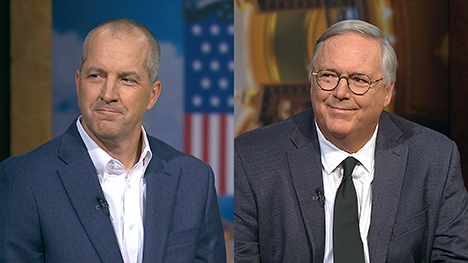
Iowa Secretary of Agriculture candidates Chris Jones (D-Iowa City) and Mike Naig (R-Des Moines) discuss key issues and policy positions.

Jeff Kaufmann, chair of the Republican Party of Iowa, discusses the 2026 election, key races, and the party's work in the final weeks of the campaign.