Iowa State University President David Cook discusses his first few months leading his alma mater and what he hopes to accomplish in the months and years ahead.


On this edition of Iowa Press, Iowa State University President David Cook discusses his first few months leading his alma mater and what he hopes to accomplish in the months and years ahead.
Joining moderator Kay Henderson at the Iowa Press table is Erin Murphy, Des Moines bureau chief for The Gazette.
Program support provided by: Associated General Contractors of Iowa, Iowa Bankers Association and Robert and Doreen Sheppard.
Transcript
[KAY HENDERSON] He's 100 days into the job as Iowa State University's new president. We'll speak with David Cook about how Iowa State's doing and his vision for its future on this edition of Iowa Press.
[MUSIC]
[ANNOUNCER] Funding for Iowa Press was provided by Friends, the Iowa PBS Foundation.
[MUSIC]
[ANNOUNCER] The Bob and Doreen Sheppard Family, proud supporters of educational programming seen only on Iowa PBS.
[MUSIC]
[ANNOUNCER] Banking in Iowa goes beyond transactions. Banks work to help people and small businesses succeed, and Iowa banks are committed to building confident banking relationships. Iowa banks, your partner through it all.
[MUSIC]
[ANNOUNCER] For decades, Iowa Press has brought you political leaders and newsmakers from across Iowa and beyond. Celebrating more than 50 years on statewide Iowa PBS, this is the. Friday, June 12th edition of Iowa Press. Here is Kay Henderson.
[HENDERSON] Our guest on this edition of Iowa Press was born and raised in Ames. He graduated from Iowa State University. He worked for many years at the University of Kansas, and most recently, he served four years leading North Dakota State University. However, on March 1st, he became the 17th president of Iowa State University. David Cook, thanks for joining us here at the Iowa Press table.
[DAVID COOK] Yeah, looking forward to it. Thanks for the opportunity.
[HENDERSON] Joining our conversation is Stephen Gruber-Miller. He is Capitol bureau chief for the Des Moines Register.
[STEPHEN GRUBER-MILLER] So as Kay just mentioned, you are an Ames native and graduated from Iowa State. How much has changed from when you were a student here to coming back now and seeing with fresh eyes?
[COOK] Yeah. So a lot has changed in amazing ways. My parents still live in Ames, and my mother in law still lives in Ames. So we've been going back and forth for our kids to see grandma and Grandpa and all the rest. So while we've been coming back to Iowa and Ames for a long time, we haven't always gone on to campus. And it's amazing. Just the footprint, the new facilities, and some amazing buildings and all the rest that are pretty, pretty exciting. And it looks like a different place. So it's been a lot of fun witnessing that all over again.
[GRUBER-MILLER] Yeah. You're pretty fresh into the new job, I think about 100 days in. What has been taking the bulk of your time? What have you been working on so far?
[COOK] Yeah, so March 1st was day one. I would just first say, really though, a lot of work started before that. President Wintersteen did an amazing job preparing whoever the new person was going to be. She gave me all kinds of homework and all kinds of reading. And so I traveled back and forth. And then there was an interim president, David Spalding, and a lot of people, you know, helped prepare me even before day one. And so I really appreciated that a lot of trips back and forth. But then when March 1st hit, I just sort of set out a 100 day plan to get out and listen and learn. And so getting out across campus, across the community, obviously in Des Moines and looking forward to spending a lot of time across the state this summer. And so listening and learning is probably where I've spent most of my time so far.
[GRUBER-MILLER] What have you learned?
[COOK] Oh, well, I'm still learning. Next -- in July -- next month I'll go in front of the Board of Regents and I'll give them a sense of really where I think the vision of the the university needs to go. But, you know, all the things I'm learning, you know, first and foremost, it's a great institution. I'm going to build on a great foundation. If we look at a lot of these metrics around graduation and retention rates and enrollment, student success, are students getting jobs when they graduate, there's a lot of great things happening. And so I'm very fortunate to walk into a situation where a good foundation is there, but we have to continue to evolve and grow and, and challenge ourselves and think big. And so just thinking about where we want to go there based on all this feedback I'm getting.
[HENDERSON] There are about 31,000 students who completed the semester that just ended, as I understand. When you were at North Dakota State University, you were credited for sort of stabilizing enrollment. And universities across the country are going to be facing an enrollment cliff.
[COOK] Correct. Yep.
[HENDERSON] How should and will Iowa State University prepare for that?
[COOK] Yeah. The the enrollment cliff is is real. And it's here, you know, basically, you know, 18 years ago, fewer babies were born and it hits Iowa and the Midwest and the upper Midwest a little harder than some other places. And so for us, again, we've had success with enrollment. We've been moving in the right direction and growing for a number of years. So that's good. One of the strategies we've used to get there is to really invest in the student experience, to make sure that when they come as a freshman, they come back as a sophomore the following August. And that's all about what we call, you know, retention and progression. And that means you're giving the students the right experience they need. So investing in that student experience is critical. And that's part of the way we need to continue to think deeply about enrollment. But, you know, also for us, it's as the land grant, we care about the state, we care about workforce, we care about producing graduates for the state and who will graduate and add to the workforce. And part of that is just thinking about those academic degrees that align with not only where Iowa needs workforce, but also where that workforce is going. And so reviewing our portfolio classes and standing up new programs, you know, based on need is exactly what we're doing and exactly where we need to go.
[HENDERSON] So what new programs do you envision?
[COOK] Yeah. Well, we've stood up a number of different degrees kind of in health spaces. I think that's critical. We talk about these as degrees of the future, thinking about different modalities. We've not done a lot of online education at Iowa State compared to some others. So we're doing more in that space. I think that's absolutely critical. I think, you know, one of the big questions is the world of AI and what does that look like for all of us? And so new degrees that really figure out how to embrace that is going to be critical. Certainly looking at, you know, our role around agriculture and new degrees in that space based on the evolving economy, are also critical in where we're going.
[HENDERSON] There's also been a rather healthy debate, if you will, about the value of a baccalaureate degree. How do you answer that?
[COOK] Yeah. And so I would say the national narrative about, you know, going to school, getting a four year degree has been out there for a while. And I think it's fair. I would I love higher education. I love what it does to change an individual's lives. And I would say, you know, generations of lives. My parents did not go to college. I went to college and it's worked out okay, you know, in that regard. So I believe deeply in the value of education. But I also believe we need to challenge it and continue to take the criticism and continue to try to get better. As far as the value of a four year degree, I think the numbers really do speak for themselves. Our graduates are earning about $60,000 a year. That's been improving year after year. I think that's very good. If you look at a four year degree versus someone who who didn't receive a degree at all over a lifetime, you're talking, you know, millions in income. If you compare that person versus someone who who had a high school education. But I also want to be, you know, really clear. There's a lot of different paths to success, and there's a lot of different ways to go. And if someone wants to choose to get a high school education and go into the workforce, that's fantastic. If they want to get a two year degree, that's great. But for Iowa State, we're very proud of what we have to offer as well.
[GRUBER-MILLER] So as you talk about the value of that degree and attracting and keeping students, you know, we know tuition is going up by 3%. How do you keep that education affordable for people?
[COOK] Yeah. So student affordability is absolutely critical. When when we when I've been talking to the students in my first 100 days, they continue to come back to that point. I know it's an important topic for our Board of Regents. I know it's an important topic for our legislature. And it's an important topic for me. And so we have to do everything as an institution to continue to be as lean and as efficient as possible. And I think that's part of it. So we can continue to to pass on an affordable education to our students. I'd also say very proudly that our alumni invest in our students. 75% of our students now receive some kind of scholarship. Just about half, just under half of our students graduate with no debt. And when they are going to school at Iowa State, we want to set them up for success. About 93% of our students are getting jobs or going on to graduate school, depending on. It could even be higher depending on the the degree area. So all those things just have to continue to be paramount and front and center for us. And they will be.
[GRUBER-MILLER] Yeah. You mentioned a minute ago the sort of relationship or the differences, you know, people can get a two year degree, a four year degree. There's been some discussion in the legislature, there are some lawmakers who are interested in community colleges being able to offer certain four year degree programs. How would that change the relationship that Iowa State has with community colleges in Iowa?
[COOK] Yeah. So that particular bill did not pass. Yes. So, you know, just kind of for me thinking about the environment, we are currently in and moving forward, we have great relationships, we have articulation agreements with every community college in the state. We have some really exciting partnerships, as an example, with Des Moines Area Community College, where students can start to get access to Iowa State resources, Iowa State advising, you know, get a feel for what it would be like when they do transfer. I think we had over 1300 students at Iowa State who are transfer students, and 60% of those are from Iowa community colleges. So that's a great foundation. I would say our future is continuing to really value the great work that community colleges do, but also value and build on the great track record we have with those partnerships. And so that's where I'm going to focus moving forward.
[HENDERSON] While you were in Kansas, Iowa lawmakers and officials came up with what they called the nutrient reduction strategy, a voluntary effort to reduce nitrates in Iowa waterways. Iowa State has been sort of a hub for collecting the data for that information and making recommendations to farmers. What's your vision for how that moves forward?
[COOK] Yeah. So first and foremost, as part of the 100 days, it's been getting out there and talking with the commodity groups and and growers and producers and just leaders across the state. This is an incredibly important issue. And so I think when I come out with my vision, you're going to find that this is going to be an area that we absolutely need to continue to grow and build on and make sure it's front and center. And so, again, I think part of the strategy will be making sure this is a priority, making sure that priority is informed by the citizens of the state. And I would envision it being a place where we're going to really invest to make sure that we're, I think, delivering on our land grant mission in this particular space, because it's so critical to to our economy, but just to the state as a whole.
[HENDERSON] Do you envision more data collection?
[COOK] Yeah. You know, I would envision absolutely more research happening with with our center. There's no question about that. I would envision there's amazing and interesting things happening now. We have drone technology now that can go do the sampling and immediately, I think it's within seven minutes, do the analysis and get that analysis back to the lab. So continue to invest in technologies that can give us kind of real time data like that's critical. But then also with extension, you know, there's a huge education arm there to continue to let the people of our state know about the latest of what we're learning from that research. So investments in all of those places will continue.
[GRUBER-MILLER] When you interviewed for the job, one of the things you talked about was making sure that students can write, communicate, be critical thinkers. You have a communications degree yourself. Talk about the importance of those skills and how that interacts with maybe changes we see happening in industries with AI.
[COOK] Yeah. So AI is a big topic, you know, across all industries and certainly within higher education. And so that will be a priority for us. And it already is. And one of the fun things about being president is I get to learn something new about what we're doing every day as I even just, you know, work my way across the campus and you kind of trip over what we're doing in this AI space, you know, every day. And so that so that certainly has been fun. And we're going to, we will have to embrace kind of the ethical use of AI. That said, and this has been my experience in all my leadership roles in higher education, I believe strongly in the future has to be tied closely to to industry. I believe that for a long time, industry partners will continue to tell you over and over again, we want people who are good communicators or critical thinkers who are problem solvers, who can think about what's coming around the next turn that might not be right in front of us. And so that's the value of so much of what we do in our first and second years. And what I kind of a classic liberal arts education. So we have to be true to those spaces. And we will we want students who can write, you know, who can communicate, who can work in teams. But also we need to think about the role of AI in all of that. And so actually, one of our top AI researchers is a faculty member in English thinking about, you know, what does it look like to teach English 101 in this day and age with the, you know, the daily evolution of what we can do with AI and what's exciting at Iowa State is those are exactly the kind of things that we're tackling.
[GRUBER-MILLER] You used the phrase ethical use of AI. What. What do you mean by that? Talk about like what you see as its uses.
[COOK] Well, yeah. So for us, I think we will be looking at AI in the classroom, how we can use that in ethical ways. So we're helping students to educate, to think the right way, but not using AI maybe to, you know, to circumvent, you know, traditional approaches to how you educate, how you study, how you take tests, those kind of things. So that will be critical. But then I think within research, thinking about how we can use AI and technology, you know, I think to advance society in ways, though, that we're all, you know, I think comfortable with. So that will be critical. We also don't talk about this enough, but it's the back office, the operational side of any business and industry today. How is AI continuing to create efficiencies to advance the institution? And we're doing that, you know, in how we maybe do, you know, reviews of scholarships or how we're working on enrollment, but also finances and budgets and other things. So it really is, you know, cutting across all aspects of the institution.
[HENDERSON] Moving to a couple of issues that came up during the 2026 legislative session, legislators created a sales tax break for the development of nuclear power plants in Iowa, the Duane Arnold plant near Palos being recommissioned. There may be construction of small modular nuclear reactors in Iowa. Growing up in Ames, you may not have known that there was a really small nuclear reactor at a nuclear engineering program on the campus. It was decommissioned in the late 1990s. There's part of the bill that created that sales tax that would funnel money to Iowa State and the other Regents institutions. How do you intend to spend that?
[COOK] Yeah. So those dollars will go into the Board of Regents, and then the Board of Regents will have an oversight role. And thinking about how those dollars get, you know, I guess, divvied up among the among the Regents University. So there will be a lot of time working with our partners at the other Regents universities and the board and thinking about how that, you know, what direction we go there. But, you know, for us, we have a history of education around nuclear engineering. We have an interest. Our dean of engineering is very interested in these opportunities. So the likely first step in that would be to create coursework, probably minors or certificates to start to educate existing students. And, you know, the possibilities of where we're going to be going with nuclear. Certainly with all the demands of energy on our society, you know, this is where nuclear is kind of coming back in a lot of different places. I will tell you, in North Dakota, we actually started a minor this last year in nuclear, knowing the demands of that were that were coming in that particular state. And so from our perspective, it is probably starting with, you know, some education, some faculty to be hired to teach those classes, but also then thinking about the long term kind of research impacts. And so that is likely where we'll go, but there's a little bit of work to probably this next year, a little bit of work to get that all figured out.
[GRUBER-MILLER] Another new requirement that will be coming in 2028 is civics education. Additional courses in that field. Does this require, I mean, does Iowa State already have the tools to do this? Does it require kind of a rethinking of how you're balancing students time with those new requirements? Or how do you plan to meet that requirement?
[COOK] Yeah, so that just passed and it will be implemented. We have a year to kind of put a plan together. So we're working on the plan, to answer your question, but we do have a Cyclone Civics Initiative Program. Now that's really effective. It provides a very balanced approach to civics education. We actually put our state dollars, about $500,000 directed to that already to really build this, because we do see it as important. And so now we're thinking about how can our Cyclone Civics Program that we're very proud of adopt this new, you know, expectation coming from the legislature? In that case, I think it's two different classes that will be taught, and it will be mandated that all students take those two classes so they have a little bit more of a well-rounded education. And so we will be adopting that through our Cyclone Civics Program and really thinking about the nuances of it this next fall and next spring.
[GRUBER-MILLER] One of the reasons that Republican lawmakers are interested in this is you hear criticism from some of them that higher education broadly has an ideological leaning to the left. How do you address those concerns and kind of reassure people who have that skepticism of higher education, maybe not Iowa State specifically, but in general?
[COOK] Well, you know, and our Cyclone Civics Program is something I think that's a great example of exactly how we're doing that. We have two co-faculty that kind of lean left and lean right a little bit, who have put together the program. I think that's a great format and way to help everybody deeply understand that we're really trying to educate students and give them a balanced experience at the university. And then when they graduate, they have a kind of more diverse background. And so that's something we're already doing even before the bill was passed. And so I'd want people to understand that that's just a part of the DNA of what we're already doing despite some of that skepticism and something we're very proud of.
[HENDERSON] Cyclones sports fans who are watching this program may remember a few years ago, there were some ISU athletes who placed bets on sporting events and were penalized heavily. There's a developing situation at Texas Tech, which is part of the Big 12, Iowa State is part of the big 12, where an athlete poised to be the starting quarterback at Texas Tech has admitted to being a gambling addict with a lot of receipts there. As the leader of Iowa State and part of the athletic conference, what do you think the approach should be in this situation? And of course, we're taping this program on Friday morning. This is an evolving situation.
[COOK] Yeah. It's literally in the last couple of days that's that's been evolving. Although there's a history long before this just was brought to a local judge down in Texas as well. So I can tell you where we're at Friday morning of this week, which is there's been a lot of conversation at the Big 12 office with our athletic directors and then also with the executive team there. And on Monday of this coming week, all the presidents are sitting down and we're going to receive an update from the commissioner on all that's happening and all the information. You know, when things are evolving, there's a lot of information out there. When we sit down, we're going to hear firsthand, you know, everything that's truly happening. And from there, as a group of Big 12 leaders, we're going to move forward and decide how best to proceed. And so right now, there's a lot of information out there that's troubling, but we're going to find out for sure what the information is from, you know, our colleagues. And then from there, we'll decide how best to move forward.
[HENDERSON] Well, obviously, one of the colleagues who'll be sitting in that meeting is from Texas Tech.
[COOK] Correct.
[HENDERSON] You hear all this chatter online and over the airwaves about not playing Texas Tech. Is that an option?
[COOK] Well, I suppose right now everything is on the table. Right. And so that's where, you know, I think we all have a reaction to what we basically know now. I'm going to have better information in the next couple of days. And along with my other colleagues, the other presidents from the Big 12, we'll get together and we'll talk about that, and then we'll determine how to move forward together.
[HENDERSON] Sports has entered kind of a chaotic era in collegiate sports, NIL paying athletes, NCAA really being unable to sort of handle what's going on. In your view, does there need to be congressional action to set some guardrails?
[COOK] Yeah, I've said this a number of times publicly. And I always say, don't make eye contact with me when I say this, but I think this is a time where we need the federal government to step in and help us, because the chaos that we're seeing in athletics is unlike anything we've seen before. And there's a litany of different topics we could probably spend the rest of the time, you know, walking through. There is a Senator Cruz and Senator Cantwell right now have a bill that's looking at this that that's not perfect, but it does address many of the issues that we think are critical. And so it was introduced kind of late in the session in DC, but that's a bill that I would encourage everybody to look at because I think while it it falls short of doing everything we want, it's a great start. And I think we need to get behind that as something that can help move us in the right direction nationally with with athletics. I think we're at that point.
[GRUBER-MILLER] So we've talked about a range of different higher education changes, challenges over the next several years. What do you see as some of those biggest challenges? And how do you position Iowa State to address, you know, like, if you had to pick 1 or 2?
[COOK] Yeah. Well, that's a great question. We already talked a little bit about AI, but I just can't imagine that that's just not going to continue to be front and center in us, continue to evolve and learn how to embrace it. So it's something we've got to get in on early, and I think we're in a really good position to do that. I mean, we often talk about we're the the place where the personal computer was, was invented, right? It's in our DNA to think about technology and things like AI to advance the culture and our institutional mission. And so I think we'll be in a really good place to do great things in that area. So that will be for sure a big priority for us. You know, right now the enrollment cliff is here. I'm it looks like demographically we'll start to get out ahead of that a little bit and that'll be nice. But I think it's continuing to strive for what is it that Iowa State can do for the state of Iowa in terms of economic development and workforce? I think that is always what a land grant is going to be about. And the continued investment in access to education is going to be critical. And that starts with affordability, but it starts with the kind of academic programs that are out there. It starts with allowing first generation students to know that, you know, this is a place where we want you to be. We graduated 4900 students across five commencements. Just under 1000 of those were first generation. So that's where we're, I think, changing lives and generational lives. So it's a little bit about thinking about the future, but also being true to our DNA as a land grant for Iowa.
[GRUBER-MILLER] In the last minute we have here, I mean, is there something specific about being a land grant institution that makes Iowa State better positioned to deal with those things?
[COOK] Well, with the land grant, you're going to have extension offices across the state. So I think you're going to have people on the front line understanding the challenges and opportunities in the state. So I think that's critical. I think when as a land grant, again, just that absolute focus on access and affordability, which is why we were founded, is going to be critical in thinking about the evolving landscape and allowing people out in society to understand that, yeah, the four year degree might be under attack, but we're the ones that are going to be providing opportunity for those students. So I think those are some of the reasons why we're really well positioned to to make a real impact.
[HENDERSON] About 15 seconds left when you were growing up in Ames, did you look at the knoll and say, someday I'm going to be the president?
[COOK] Oh, you brought that up. So it never crossed my mind that I would be the president of Iowa State. And so again, my wife and I were both born in Ames. We went to Ames High. We're both Iowa State graduates. Even now you got to pinch me a little bit, you know, and say, is this really happening? And so we're very blessed to have this opportunity, very proud. And and we got a lot of work to do, and we're excited about doing it.
[HENDERSON] Well, I have to pinch off this conversation because we are out of time for this edition of Iowa Press. Thanks for joining us.
[COOK] Appreciate the opportunity.
[HENDERSON] You may watch other episodes of Iowa Press at Iowa PBS.org. For everyone here at Iowa PBS, thanks for watching today.
[MUSIC]
[ANNOUNCER] Funding for Iowa Press was provided by Friends, the Iowa PBS Foundation.
[MUSIC]
[ANNOUNCER] The Bob and Doreen Sheppard Family, proud supporters of educational programming seen only on Iowa PBS.
[MUSIC]
[ANNOUNCER] Banking in Iowa goes beyond transactions. Banks work to help people and small businesses succeed, and Iowa banks are committed to building confident banking relationships. Iowa banks, your partner through it all.
Watch More

Zach Lahn (R-Belle Plaine) and Rob Sand (D-Des Moines) will answer questions from Iowa reporters and discuss their priorities and vision for the state during a 90-minute debate.
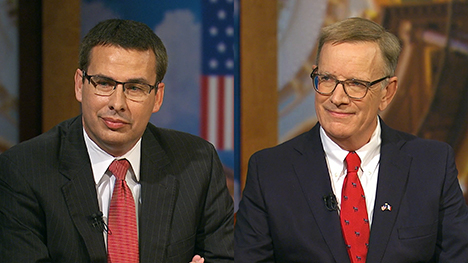
Iowa State Treasurer candidates John Norwood (D-West Des Moines) and Roby Smith (R-Davenport) discuss key issues and policy positions.

Candidates Dave Dawson (D-Lawton) and Chris McGowan (R-Sioux City) will answer questions from reporters and discuss their platforms, concerns and future plans.
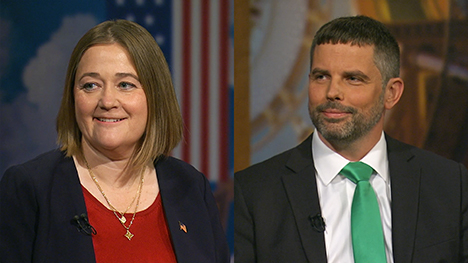
Iowa Attorney General candidates Brenna Bird (R-Dexter) and Nate Willems (D-Mount Vernon) discuss key issues and policy positions.
Lindsay James (D-Dubuque) and Joe Mitchell (R-Clear Lake) answer questions from Iowa reporters and discuss their platforms, concerns and future plans.
Candidates Ashley Hinson (R - Marion) and Josh Turek (D - Council Bluffs) answer questions from reporters and discuss their platforms, concerns and future plans.