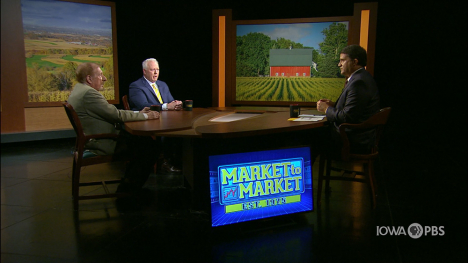
Market analyst Angie Setzer returns to lead the class in puts and calls - two of our most talked about points in the analysis portion of the program. Angie breaks down the lingo, the meaning and what it really provides for those in the commodities.


Options strategies in commodities are a language unto itself. Angie Setzer is at the head of the class for puts, calls and options to navigate any market - volatile or not. Setzer breaks down how a put functions as insurance against falling prices, why it doesn't guarantee a locked-in margin, and why pairing options with a real marketing plan matters more than the strategy itself. The conversation closes with an explainer on Fibonacci retracement — the 38%, 50%, and 62% levels traders watch for signs the market is ready to turn — and an honest discussion of why technical analysis can feel like reading shapes in the clouds, even to the people who use it every day.
Transcript
YEAGER: It's summertime, which means it's summer school. Session two is with our old friend, Angie Setzer. Hello.
SETZER: Hello. I'm so glad to be here.
YEAGER: Golly, it's good to have you here. I was reviewing some of our previous discussions, and there are a couple of topics I want to get caught up on. But before I get into my list, I want to know: what are your customers, clients, and friends asking about right now, in very technical, detailed grain situations?
SETZER: Is this a sign of things to come, or is this going to buck the trend of the last couple of years? I think that's the pretty common question, and I wish I had the answer, because it makes a big difference in what you should be doing. The number one question I'm getting right now is: where do we go from here? What do we expect as we work our way into the last half of summer? What are the biggest things we're watching? Do we see a repeat of the last couple of years? Do we get a $3 handle on the front month of these contracts? Does the December board trade lower? Those are the types of things I wish I knew the answer to right off the top of my head, but that's pretty commonplace of what happens next.
YEAGER: On the technical side of things, with numbers and charts, I think that's a lot of what we're going to discuss. But let me ask this — I ask it most weeks, you know how I like to ask certain things all the time — in these volatile times, how does one protect oneself from a post-bombing, a country doing something with or against us? That's just the world. It's not a political statement, it's just a reality of being protected.
SETZER: There are a lot of different ways you can go about it. To a certain extent we feel like we're discussing a lot of things right now after the horse has already gotten out of the barn — have we missed the opportunity, or is more coming at us? What does this all look like? But the biggest resource, the biggest way, is that there are several different ways to manage risk. That includes hedging on the board, revenue insurance, and all these packages and programs that have been put together. And then you have the old-fashioned options — puts and calls — and different strategies depending on what you're wanting to do. There are a lot of ways you can use all of those together to make sure you're relatively well protected. That's what I see a lot of folks doing these days.
YEAGER: All right, puts and calls — that's where I want to start. I want to heavily discuss puts. Let's do the introduction of the term. What is it?
SETZER: A put option is basically something you buy that helps protect your downside risk — a put gains in value the lower the market moves. A put is a very popular strategy, one that brokers push, or that a lot of people like to use, simply because it keeps your upside open and allows you to keep rolling the dice, so to speak, and see how the rally develops as time moves forward. You're not committed on your bushels. If the market moves lower, the option you bought gains in value. So a put is the opposite of a call — a call gains in value when the market goes up. It's just one of those things folks like to use to protect the downside risk when the market is providing some opportunity they want to cover.
YEAGER: Okay, so talk to me — I am Paul the farmer. Hello, Angie. I have a thousand bushels of corn. Today's price is $4. I want to buy a put. What does that mean?
SETZER: The biggest thing is that your option contracts are going to be 5,000 bushels or more.
YEAGER: Okay, so Angie, I have 5,000 bushels. I want to buy a put.
SETZER: Yes. First off, let me tell you straight up — I'm not a broker, and I'm not here to sell a service or an option strategy by any means. But if you wanted to get a put in place, you'd reach out to your broker and say, “I've got 5,000 bushels worth of risk here. I need to get this covered — I'm afraid the market's going to move much lower.” Let's say the board is at 470, and you look at your put options and where they're trading. A put at 470 would be “at the money” — the board's at 470, your put is at 470, directly at the money. That's usually going to be more expensive. Options strategies are like insurance — car insurance, health insurance, whatever. You can over-insure yourself, spend as much money as you want on whatever options you want, and it just may not end up paying off, or it may not provide the outcome you think you're going to get. In the instance where I'm a farmer with 5,000 bushels of corn and the board today is at $4.70, the first thing you want to look at is: what are you wanting to spend for protection, and what are you trying to accomplish by putting this put in place? You'd look at it and say, “I want to protect this at a 460 price, and I only want to spend about $0.15 to do it.” When you're buying these options, you have to think about what month you're trying to protect, and whether you want to pay for the time value. That's where your broker comes in, to work with you on the ROI of the option — what kind of return you can expect from that strategy. So let's say you end up buying a 460 put and spend $0.15 to do it. Your new floor is now 445 — that's 460 less the $0.15. The more the market moves below 460, the more your put gains in value. That's a very simplified explanation. But basically, if you buy a 460 put and spend $0.15, that value is going to grow if the market moves lower, and then you get to decide how you want to manage that. That's part of the reason folks talk about ninety-some percent of options expiring worthless — most of it is because you have to make a secondary decision on how to manage the option once you have it in place.
YEAGER: So this 460, 455 — when I've bought that... I want to go back. You said something about seeing what my price options are. Is everybody's put price the same?
SETZER: Yes, the market's the same. There it's a whole other market that's trading — you have buyers and sellers, and they're putting a value on what they think those options are worth at any given strike price.
YEAGER: And my 5,000 bushels at 470 on the board — I could sell today, straight up, straight out, and get my 470. But let's say it's my December, my deferred contract. I don't have it in hand. That's usually where I'd use this type of strategy, right? Not on a physical position. So I think this might go lower, but I want to capture what my 470 is. Explain that one more time for me.
SETZER: Basically, what you're doing is buying a put because you think the risk is that the market could go higher, but you want to make sure you have protection in place in case it doesn't.
YEAGER: But doesn't everybody want the market to go higher, if I'm the farmer — not necessarily the end user?
SETZER: But the farmer always—
YEAGER: —tells me the market—
SETZER: Right, that's what a put will provide you. I'm trying to make sure I use my words carefully here so I don't come off throwing the entire strategy out the window. A put provides you downside protection. A put does not guarantee that you've locked in a margin. So if you don't sell at 470, but instead buy a 460 put for $0.15, and the board ends up closing at 450, you spent the $0.15 on the put, which might have finished worth a nickel because your time value eroded, and you'd have your intrinsic value. Say the 460 finished at 450 — you'd have a dime of intrinsic value. You locked in the 460 protection, the board closed at 450, the put you spent $0.15 on is now worth a dime, and your cash corn is worth 450. So there are times when folks say, “Just buy a put — it'll help you sleep better.” And it will, to a certain extent, because let's say you'd bought that 460 put back in the middle of May, when the market was higher, you could have bought it pretty cheap, and the board on its lower side traded down almost $0.30 below that. There are ways it will help you sleep better at night — folks who own puts when the board drops $0.60 are going to feel better than those who don't, even if the put isn't generating enough money to make them whole. A put strategy allows you to keep your upside open and feel like your downside is protected, but it also needs to be paired with a good marketing strategy to actually work.
YEAGER: Okay, we'll get to the marketing strategy in a minute, but I think you just answered my opening question — in volatile times, when things can happen quickly while we're asleep, this strategy helps me sleep, helps me stay profitable, or maybe not profitable, but helps me not lose as much money.
SETZER: Or the other option — the flip side, which I like a little better — in situations where the market is higher, we're talking about insurance, because that's what options are. You're spending a small amount of money for what could be a potentially larger payout if a certain situation arises. That's how options need to be looked at, in my opinion. But the flip side is a lot of folks push for puts because puts fit the farmer mentality — you get to lock in the higher futures price. Say you lock in a 460 put at 470, and the board goes to 530 — who cares about the $0.15? I spent that money, I don't care, because I have the $0.60. The other option is you can lock in the 470, and if you're still bullish, you can spend money on a call instead. So you have two different strategies you can look at — good sleeping insurance, to a certain extent, as long as you're working with someone you trust and managing the money you're spending. I've seen folks in very volatile times spend way too much money wanting to stay continuously engaged in a market when they just needed to move to the sidelines.
YEAGER: Is Farmer Paul going to buy a put and a call on the same 5,000 bushels?
SETZER: No. I mean, you can do anything you want, but it's basically a negative and a positive, and the only person benefiting is your broker — the person getting the commission. That's not a hit against brokers, but if you're buying a put and a call at the same time on the same bushels, you're pushing on the gas and the brake at the same time.
YEAGER: On the same bushels — yes, that's what I wanted to clarify.
SETZER: Yeah, you're buying both on the same bushels at the same time. You're just going nowhere.
YEAGER: And another term that comes up in this discussion — doesn't that mean I'm hedged, because I have a top and a bottom? I've played both sides.
SETZER: Honestly, when I first started, I thought it was easy to protect your risk that way — just buy a call and a put, and there you go, you win if it goes down, you win if it goes up. I mean, sure, you can own both — it's a free world, congratulations, you're 18 and you have a brokerage account, you can do whatever you want. I guess they'd have the risk, but yeah, you can do it. But really, when it comes down to it, a call only costs so much. If you bought both at the same time — spent $0.15 on a call and $0.15 on a put — and the board dropped and your put gained $0.37 in value, all you're out is the $0.15 on the call. It's not the end of the world, but it really doesn't do a whole lot for you in the long run in terms of managing risk.
YEAGER: Okay, so Farmer Paul has 5,000 bushels — it's the first part of July, and I'm talking about December bushels, that December contract. Is it more expensive to buy protection farther out? Am I talking about buying months of physical time, or months on a contract?
SETZER: It's on a contract, but it also involves physical time, and you're paying for that time — that's a factor to take into consideration, and brokers will look at this differently. I have customers who work with someone outside our shop on options, and we all work in collaboration on what makes sense. Some brokers think it makes the most sense to spend more money for more time value and the ability to make more. I look at it like placing a bet — the longer you give it to be successful, the wider the range, the more likely you are to have it hit. So it's the same idea: if you're going to pay extra to have until December to see if the market trades to a certain value, versus waiting until the end of June for a July contract, there are things to take into consideration — option expiration, for one. If option expiration for July bushels is a week away, you're not going to buy a July option unless you know what you're doing and have a reason. And on the flip side, you don't need to think, “I may not move this corn until next July, so I should buy a July 2027 option” — you don't need to do that either. You'll want to work with someone who can factor in the parameters and time frame of your risk when deciding what option to buy.
YEAGER: And there's the concept of rolling down your puts to protect yourself. Walk me through that briefly.
SETZER: You can roll a put or a call either way. Once you have a position in place, the key components of an option are your strike price — the futures price you're betting on, like the horse you've chosen, say the 460 December corn we're talking about. Let's say it's working for you — you bought the 460 put, and the board drops to 440. You paid $0.15 for the 460 put, and it's now worth $0.30 — please don't double-check my math, but it's worth 30 today. What you can do at that point is take the 460 put you own, which is worth that $0.30, and sell it — you bought it, you own it, you sell it, and you put that $0.30 in your pocket. If you roll the option instead, you'd take whatever value it takes — say the board's down to 440 and you want to now own a 430 put, and that costs $0.15. You'd sell the put you own and determine what value you want to re-enter your new strike price at, and what cost you want to allocate to that new position. Basically, you're putting money in your pocket while moving your protection lower as the market moves in that direction. I use a lot of casino analogies when I talk about options with farmers, because to be honest, yes, there are ways it will help you manage risk, but there are also ways you need to look at it as what it really is — a margin enhancer, or an attempt to make additional margin as you're marketing your grain. The adage I always use: when I go to the casino and play the slot machines — I'm a nickel-slot gal — I walk in with $100, and that's my money, and it's gone. I like to look at options the same way. You have a certain amount of dollars allocated for options ahead of the season, and that's your money. The same goes when you're in an option position that's making you money — if I put in $20 and win $80, I take the $60 profit and put it in my pocket, and keep playing on the $20 I came in with. That's how I try to think about options too — we're not continuing to stuff money into the machine, but when you're rolling an option position, you're making it work for you, and making sure you're taking some of that equity out and putting it in your pocket.
YEAGER: I was going to ask you for a review, but you just did it. Let's summarize one more small thing though. You already said it — those who make money on options, puts and calls, it can be Farmer Paul, but it's also the one who takes the order and places it.
SETZER: Yes, and I have zero ill will toward anyone on that side of the business, I want to say that unequivocally. But as a farmer, especially in the current market structure, it's very easy for someone to convince you that you should — or that you still can. So just be really aware of what you're working to accomplish when entering into any option strategy, especially right now, when it's “oh, it's only a nickel, oh, it's only a dime, oh, it's only $0.15” — that's your margin. That's literally the money you're making on the bushels you're producing, and if it doesn't pay out, you're going backwards. I get the desire to stay involved in the market in some way, or to have some way to still gain from a position or not lose from one, but you really want to be careful you aren't overdoing it. I had a customer — this was 2013, so a different world, very volatile — who called me and said he'd followed his broker's advice to a tee and spent a dollar a bushel on options that year. He was a 100,000-bushel producer of corn, so he spent $100,000 on options. In 2013, maybe we did have that kind of margin around, but still — just be very careful about what it is you're wanting to do. If a broker calls and says, “these are the things I think you should do,” ask why, and for how long, what the time frame is. Because that's the thing — options tend to expire worthless because you buy them and then forget they exist if they don't work for us. Maybe we should liquidate them if they don't work for us in four weeks and still pocket that dime of time value, rather than assuming this is going to be the thing that fixes your whole marketing year.
YEAGER: But it is something to consider — something to learn about, and that's why I wanted to cover it with you here in summer school. The last thing I want to cover in our few minutes left is the number 67 — let's talk about retracement. There's a technical term, and one of our analysts loves to talk about it often: the 67% retracement. What does that mean?
SETZER: I'm not 100% sure — if you look at Fibonacci retracement, it's like you've got 38, 50, and 62 percent—
YEAGER: Oh, sorry — 62, 67.
SETZER: I was thinking maybe, with my bunch of eight- and nine-year-olds, Colton's grade fell into the 67 range.
YEAGER: You can answer that question while I Google it.
SETZER: No, that's it, right. So we have the 62% — it's so well-followed that I even included it in my Intro to Marketing class, simply because it does seem to work so well. It's 38%, 50%, and then 61.8%, I say 62 — close enough. Those are the numbers we closely watch. They tend to act, as I call it, as a point of reflection, because I don't have anything else to really go off of. On the technical side, I always look at a couple of different factors — the biggest thing I look at is all the highs and lows of the contracts, even if it's not that specific contract. Once the July board breaks to new contract lows, well, then what was the low before that? What was the March low? Like we saw in June, the July corn board went exactly to the old trading range from the December of last year — that March low — and all we did was trade from 404 to 424. There are things like that you'll watch, but for Fibonacci: if you have a move that's a dollar higher — say we rally a dollar — the first thing Fibonacci says is that you'll lose $0.38 of that move. If you lose that 38%, you'll probably maintain, but if you lose that $0.38 level, you're probably going to move to where you've lost 50%, or $0.50, of that dollar move. If you hold at that $0.50, you'll have buyers come in and say, “we gained a dollar, the board's since lost $0.38, I'm going to come in today and try to own this and see what happens, but keep my stops close in case it keeps moving lower.” If it keeps moving lower, the next target is 50%, and then 62% — after that, we basically retrace the whole move and then some. That's about the way it goes, in my experience. Once you completely lose the move and establish what the new low or new support is, you tend to see it retrace. Say we gained a dollar and blew all the way through the Fibonacci retracement levels and lost $1.50 — now we start over again, 38% of that $1.50 on the gain side, same thing. If we gain it back and fall back, that's what we'll do — but then we might gain back 50%, and then 62% of that $1.50 we lost, and maybe we gain it all back. From a simple standpoint, if I could get one thing across to farmers about understanding when the market is ready to make a pivot or transition, it's that technicals really do come into play, and they are something to watch. If we fail at an old high and see selling come in, or if we try to trade to new highs and can't, and every day it's a lower high, those are things to pay attention to — so you don't feel as caught off guard if a move completely matures. If we lose $0.62 of a dollar we gained because we failed at 38 and 50, that's really where it comes into play — recognizing where the stops are along the way on a chart.
YEAGER: Those are topics we've covered in some of our previous sessions — talking about waves, head and shoulders, and lines. I was having a Beautiful Mind moment while you were talking, because I was thinking I should put a whole bunch of lines over these charts while we're talking. I see these charts you all send some days and I go, “Okay, okay, I see it — yep, there it is. Oh, I wouldn't — okay. Oh, that's a definite shoulder. That's great.”
SETZER: I'm terrible at that — it's like those Rorschach dots, or do you remember in the late '90s those 3D pictures? I just sit there and cross my eyes and pretend, “ooh, that's so cool.” I feel that way a lot of times about technicals — I'm not saying that to take away from what anyone's doing on the technical side, it's super important, and there are a lot of people who trade based on that from a management standpoint for farmers. Technicals have a big level of importance, but sometimes we just make them up — like the “puking dinosaur chart” in December.
YEAGER: Right, and if that's the way that pays for your boat, great, that works too. I'll guess here, Angie — those technical things you just talked about are part of the foundation built into the algorithms and the computers, and they're looking for that. Not saying that's the only movement in the market, but that's something you're working against as a human — against a computer, and the humans behind the computer.
SETZER: Right, and they don't have the emotion attached to it. For me, sometimes I'll think, “if this fails today at this level, it's going to be really, really bad” — I can see it, and then it fails, and I'll still do nothing about it, because I second-guess myself. An algorithm doesn't do that, because it has a plan B in place — if it sees something happen that shouldn't happen, it's not going to sit and think about whether it's smart enough to act on it. It's going to pull the trigger, and if it's wrong, it recovers from it, eats the four-cent loss, and moves on. As a human, at least for me, I'm too emotional sometimes about whether I'm right or wrong on something.
YEAGER: And I know we discussed emotion heavily in our summer school session from a few months back — so if you're watching this after seeing it in our newsletter, I've linked to those past sessions. We always appreciate it when you put us in the classroom, Angie — it's always good. I have some more things written down, so guess what, we'll do this again sometime soon.
SETZER: I hope so — I really do enjoy these.
YEAGER: Angie Setzer, thank you so very much.
SETZER: Thank you.
YEAGER: We are produced at Iowa PBS. Our production supervisor is Sean Ingrassia. His crew is Reid Denker, Kevin Rivers, Julie Knutson, Neil Kyer, and David Feingold. The executive producer of Market to Market is David Miller. I'm Paul Yeager. We'll see you next time.
Watch More
Hard data backs up what American farmers have long been concerned about with Brazil. A squid squabble off the Oregon coast. And, commodity market analysis with Ted Seifried.
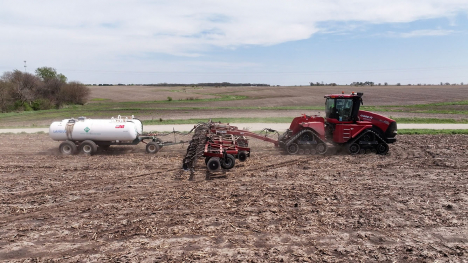
American farmers face higher production costs than their competitors while selling into the same worldwide commodity market.
We discuss soy exports, inelastic demand and a possibly tight carryover.
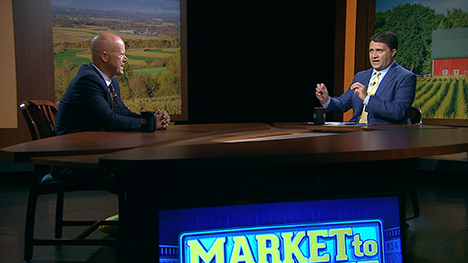
Is the market too comfortable with a trendline corn yield? Ted Seifried discusses the assumptions driving prices and what could change the outlook in this week’s online-only Market Plus.
USMCA and other global trade are vital to rural America as discussed in our Market Plus.
Data centers, inflation, oil and USDA reports dominate our Market Analysis with Chris Robinson and Ernie Goss.