Iowa Senate Democratic Leader Sen. Janice Weiner (D - Iowa City) discusses the 2026 legislative session and the upcoming elections.


On this edition of Iowa Press, Iowa Senate Democratic Leader Sen. Janice Weiner (D - Iowa City) discusses the 2026 legislative session and the upcoming elections.
Joining moderator Kay Henderson at the Iowa Press table will be Erin Murphy, Des Moines bureau chief for The Gazette.
Program support provided by: Associated General Contractors of Iowa, Iowa Bankers Association and Robert and Doreen Sheppard.
Transcript
[KAY HENDERSON] Senate Democrats broke a Republican supermajority heading into the 2026 legislative session. Did it make a difference? We'll sit down with Senate Democratic leader Janice Weiner on this edition of Iowa Press.
[ANNOUNCER] Funding for Iowa Press was provided by Friends, the Iowa PBS Foundation.
[ANNOUNCER] The Associated General Contractors of Iowa, the public's partner in building Iowa's highway, bridge and municipal utility infrastructure.
[MUSIC]
[ANNOUNCER] The Bob and Doreen Sheppard Family, proud supporters of educational programming seen only on Iowa PBS.
[MUSIC]
[ANNOUNCER] Banking in Iowa goes beyond transactions. Banks work to help people and small businesses succeed, and Iowa banks are committed to building confident banking relationships. Iowa banks, your partner through it all.
[MUSIC]
[ANNOUNCER] For decades, Iowa Press has brought you political leaders and newsmakers from across Iowa and beyond. Celebrating more than 50 years on statewide Iowa PBS, this is the Friday, May 29th edition of Iowa Press. Here is Kay Henderson.
[HENDERSON] It's been nearly a month since the 2026 legislative session ended. Governor Reynolds has signed many bills, including a property tax reform plan. She has until Tuesday, June 2nd, to sign all of the legislation that cleared the 2026 legislative session. For the past few weeks, we've been checking in with floor managers on both the House and Senate side and our guest this week is Senator Janice Weiner. She is the Senate minority leader. She's from Iowa City. She worked in the Foreign Service for the U.S. State Department for years. And she then came back to Iowa and served on the Iowa City City Council. In 2022, she won a seat in the Iowa Senate, and this is her second year as the Senate Democratic leader. Welcome back to Iowa Press.
[SENATOR JANICE WEINER] Thank you so much, Kay.
[HENDERSON] Also joining our conversation, Erin Murphy of the Gazette in Cedar Rapids.
[ERIN MURPHY] Senator, as Kay mentioned, we have so much from the session to get into. But real quick, we want to start with something that occurred this week. Iowa Democratic Party leaders were out in Washington, D.C., to talk about the next presidential nominating calendar and Iowa's role in that, specifically, Iowa Democrats, who were formerly first in the nation. And they made the pitch that they should be, again, your colleague across the aisle and the Iowa House Representative Brian Meyer, was quoted in a media piece recently saying that he thinks Iowa should go first again and double dog dares national Democrats to sanction the state party over that. Where are you on whether Iowa Democrats should be making this concerted effort to be first again?
[WEINER] Where I am on this is that I'm I'm glad that our colleagues went to Washington to make the pitch. I am entirely focused on our state Senate races. The one thing I think would be good is if they wait until after this November's election to make their decision so they can see what Iowa looks like after November. But otherwise, my focus is on winning seats.
[MURPHY] Does whether Iowa's first or not impact that? Does it. Is Iowa being first in the nation? Help Iowa State House candidates in any meaningful way.
[WEINER] At this point. that's hard to say. The thing that I think helps us the most is we have a whole series of really competitive races, competitive top of the ticket, gubernatorial race, competitive U.S. Senate race, several competitive U.S. House races. That's what helps us the most.
[MURPHY] And stay tuned, we're going to talk about more of those later, but we want to talk about the session. She didn't get enough of it this year.
[HENDERSON] Exactly. I don't think any of us did. The marquee issue of the session was, of course, property taxes. When the final version cleared the House, I mean, the Senate, rather, it got the support of all Democrats except for one. Why did Democrats vote for that plan? What did you see in it that merited your yes vote?
[WEINER] So, obviously property taxes have been the focus of our Republican colleagues for the past two sessions. The one thing I'd say at the outset that I was sort of disappointed they didn't manage to come into this session with a united plan. But what we were looking for from the very beginning, because we heard from Iowans that this is one of the costs that's just too high for many Iowans. We were looking for a plan that would really help the homeowners, especially homeowners who need, it while not tying the hands of cities and counties so they can still provide the public safety, so they can still provide the services their constituents want. And our judgment at the end was that while this isn't the bill that we would write, this will go a long way toward doing exactly that.
[HENDERSON] So it has a 2% limit on most property tax growth, but it does have allowances for employee benefits and paying off debt. Is that I think in your in your world, sufficient?
[WEINER] It's hard to tell if it's sufficient. It was really important that there not be a hard cap because we're seeing inflation go up again. We know that that cities and counties have to pay pension costs, that the costs of the cost of replacing vehicles is high and that their constituents demand a lot. So it remains to be seen if it will be enough. However, there is a runway until 2028, so there's time to talk to cities, time to talk to counties, time to work in the legislature to fix things.
[HENDERSON] Well, 2027 is around the corner. Will you and your Democratic colleagues in the Senate come up with a new proposal to put on the table in terms of property taxes?
[WEINER] That is not part of the plan right now. Right now, what we're focused on is the same things we if I had to be putting in bills right now for 2027, I'd be focused on the same things that we were at this session. And our focus in this past session was really informed by a series of special elections in 2025, where we literally knocked thousands and thousands of doors all across the state, had the ability and the privilege of listening to and talking to thousands of Iowans. And what we were hearing was the kitchen table issues, health care, too expensive, and too hard to get, child care, housing costs, our public schools, people are still really worried about their public schools and the quality of education, water quality and cancer. Those were the top issues we heard. So those that was what that was what had us craft our bills and the bills that we filed, which of course mostly didn't see the light of day or didn't see the light of day at all. But that's why we had that focus.
[MURPHY] Speaking of one of those topics, just recently, governor signed into law the legislation on funding for cancer research tied to a new tax on a modest tax on vape and nicotine alternative products. Some of the pushback on that from advocates and some state House Democrats, was that the new tax on vapes was too low to meaningfully impact behaviors, basically too low to keep people from, to get people to stop using those products. To borrow a phrase you just used, if you had been writing the bill, what would that tax level have looked like?
[WEINER] I'm not sure what the tax level would have looked like if I had written the bill. It certainly would have been -- it certainly would have been higher, but I'm not in charge. And so we're dealing with the legislation that came forward, brought by our colleagues and even the bill manager, Senator Warme, noted, both on the floor and at the signing ceremony that I attended this Tuesday at Stead Family Children's Hospital in Iowa City, that it's really that it may be too low to change behavior at all, but it's a start. And when I look at the the cancer crisis overall, because we really do have a cancer crisis in the state, we can either say, oh, it's, it's too big to deal with, or we can look at it and figure out which pieces we can deal with. It was really important. And I give the parents, the families and some of the survivors full credit for lobbying and being really determined and stubborn in their efforts to get something across the finish line. You know, kids are not just little adults. They've been dealing -- that's really all we have to use with kids, for the most part, in treating cancer. And so it was actually really an honor to be there for the signing ceremony and to imagine the difference that this really can make. It is one important piece.
[MURPHY] Yeah. Would you have the House bill House proposal would have just had that funding for pediatric cancer research separately. And you had some people will argued that that was the better way because you've sort of with this bill created this competing interests, right, of funding cancer research with a tax on a product that is bad for your health. Would you have preferred those two things to be separated?
[WEINER] I actually would, I actually think that it's probably the better that we came to a better result. Although, as I said, I'd like to see I'd like to see a bigger deterrent. And one of the reasons for that is the budget situation we're in. I don't understand, I don't see how we can continue to take more money, create new funds and fund fund new projects when we are running an annual $1 billion plus budget deficit.
[HENDERSON] The thing that happened last year in regards to cancer research was that the legislature proposed and the governor signed $1 million to finance research at the University of Iowa, and they covered a few types of cancer to try to determine what the causes were. This year's allotment of far more money, $3 million is just focused on pediatric cancer. What happens to that set of research that was started last year?
[WEINER] I mean, my understanding, because we I actually helped organize a briefing with together with Senator Warme, with the researchers who came from from UIHC to speak to anybody at the legislature on the Senate side who was interested is that they convened a blue ribbon panel. They're looking and they're continuing to use those funds to drill down into some of those, into the cancers that have turned out to be the most prevalent. And the ones that are really making us really driving our high cancer rates. And they're going to continue to do that work.
[HENDERSON] So, they still have enough funding to do that.
[WEINER] They still have the funding to to work on that aand continue to figure out what is driving that. And that to me is also really important. When I say look at the big picture, let's fix one thing, let's work on some of the other pieces as we can.
[HENDERSON] So you've been mentioning Senator Kara Warme, who is from Ames. She's a Republican. Are you suggesting perhaps to our viewers that there's a bipartisan focus on this issue?
[WEINER] I would certainly hope so. I don't think there's anybody, if you just look at the Senate, look at the Senate, and how many of our members have been, have cancer, have died of cancer, have been touched by cancer as families, this is a plague in our state. And if something like that can't bring us to do something in a bipartisan manner, I don't know what can.
[HENDERSON] Let's shift to something else. In Iowa City, the center for Intellectual Freedom that was created by legislation last year. There is a part of a budget bill that the governor is reviewing that would impact students at the University of Iowa and how they fulfill certain required courses. Are you comfortable with that proposal?
[WEINER] I am not, and in fact, I would support the proposal put forward by my colleague, Senator Petersen, that the governor line item veto that piece of the standing bill, the very last train out of town, the last budget bill, essentially our Republican colleagues put in a piece of policy into that bill, which is supposed to be a straight budget bill, and it's a piece of policy that first would force 5500 freshmen every year to to get, at some point to get six hours of classes at the so-called center for Intellectual Freedom, which couldn't even manage to find enough students to hold its initial classes. These are additional mandates that haven't, that the Board of Regents has not looked at, that we have not had a chance to look at in terms of policy. It would cost students and parents potentially thousands of dollars. And it's also an unfunded mandate for the university itself, which was essentially had a flat line budget. So I'm not sure how they would find the staff or pay the staff to teach those classes.
[MURPHY] I wanted to ask you about the the change in leadership in IPERS, the state's public employment retirement system. There's been accusations of misconduct. We heard from a candidate for treasurer, John Norwood, a Democrat, who said that perhaps the legislature should play a little more of an active role in the leadership post in IPERS, and perhaps that some, including that those should be nominated by the Senate, which many other state agency posts are given. What we've seen out of that, do you agree? Do you, as Senate Minority leader, would you like to see those roles pass through the Senate?
[WEINER] I mean, the Senate already should have a robust confirmation role. My understanding of what's happened is that this a personnel issue, a human resources issue, that it doesn't have anything to do with the viability of the fund. And so I would actually view this right now as an opportunity for whoever the next governor is to do a very thorough search to make sure that we get the best leadership possible at the head of IPERS, and then for the Senate to do a very thorough and robust job of confirmation.
[HENDERSON] The legislature in Maine recently passed a moratorium on construction of new data centers. Maine's governor vetoed that, saying she did so not because she opposed the policy, but because there was already a data center being constructed, and this would have halted that construction. What is the view of Senate Democrats about the construction of these data centers in Iowa, their use of Iowa land and their use of Iowa resources, electricity and water?
[WEINER] Well, I mean, data centers have certainly become a hot button issue in many ways. And it wouldn't surprise me if we see something on it next year. We had actually proposed legislation that would say data centers, yes, but let's make sure that they make appropriate use of our water resources and let's also make sure that any additional power required is not paid for by the consumer. And so I would start there.
[HENDERSON] The legislature also approved a sales tax break that would impact the Duane Arnold nuclear power plant, which is near you. It's near Palo that's being recommissioned. And it would also impact any small scale nuclear power plants that might be built in the future. Is a sales tax break the right move for a corporation?
[WEINER] I mean, we obviously need more energy generation and the smaller new nuclear power plants are one piece in that mix. And they provide a lot of really good jobs. So I can't tell you if it was exactly the correct route to go. It was the one that was proposed to us. And I think we have to be in that power mix game right now.
[MURPHY] You mentioned the state budget deficit earlier. I wanted to ask you about that, similar to a question we asked Leader Meyer when he was on the show. Democrats in Iowa are hopeful, if not confident, that they'll have a Democratic governor next year in Rob Sand, who is going to be the candidate in this fall's election. If that were to be the case, and if him or his staff came to you and said, I'm crafting my first budget proposal as governor here, what are your suggestions for how we should handle this? Should we keep using this relief fund? Should we reduce spending? What would your advice to a Democratic governor be about how to manage that current budget shortfall created by the income tax reductions?
[WEINER] I mean, first we have to sort of sit back and look at how we got here, because it's really almost ten years of Republican mismanagement of our budget that has gotten us into this position where we've had back to back years of billion dollar plus deficits, where we're using one time funds for ongoing expenses. And we know that from the governor's projections that that's supposed to continue until at least 2030. So with that as the backdrop, what's been created over a number of years isn't going to be fixed overnight. But Iowans really should not have to pay the price. There are some things that we ought to look at, such as hundreds of millions of dollars that are going every year for unaccountable school vouchers. But I think the real way to approach this is to say, how do we make Iowa a really welcoming state again? How do we roll back the culture wars and the policies that have been passed, that are pushing our young people out of the state, that are making it really hard for companies to attract and retain talent? How do we turn ourselves back into a welcoming state where people want to come and companies want to invest so that we can grow our tax base? That seems to be the way forward. We should aim to be number one in education again, that's always been our calling card. We have to be, both for people and business, a welcoming state again.
[MURPHY] And speaking of the next governor, regardless of who it is, they could have some new constraints, some new limits on their authorities if the Governor Reynolds signs into law a bill that did pass the legislature. There were some wider proposals, though, that ultimately didn't pass, one that would have codified the state's Medicaid management, another one that would have created a continued budget spending if the governor and budget, and governor and legislature, pardon me, don't agree on a budget. Those ones did not pass. Were you ultimately okay with the ones that the limits that did? There were some limits on declarations in a public health emergency. I assume you were relieved by what didn't pass. Were you fine with the ones that did, or do you still have concerns?
[WEINER] I'm not happy with the ones that did pass. I mean, I’m yes, relieved that some of the others didn't did not pass because we're Iowa, we're not D.C. We have we have always passed a budget. We will always pass a budget. And it seemed to me that some of the other options that were pushed on the Senate side were an effort to say, we might have a Democratic governor, and we don't necessarily want to have to negotiate or work with a Democratic governor. And that's just basically taking their ball and going home. It was a power play, and that's not acceptable. For the other part, it just seems to me that we're also constraining a future governor in the event of another public health emergency or some emergency that we can't even imagine right now.
[HENDERSON] Your colleague, House Minority Leader Brian Meyer, was on this program a couple of weeks ago, and he expressed concern about the prospect of the legislature next year engaging in redistricting in the way that has happened in some states in advance of this year's election. Do you have similar concerns?
[WEINER] Iowa's redistricting process is the gold standard. I see no reason for us to change it. I see no reason for us to push those boundaries. In fact, I think that we would be well served if we started telling other states across the nation that they should adopt the same gold standard that we have here.
[MURPHY] There is an -- this is an issue that sort of straddles the official office and political side of this. There's an ethics complaint that's been filed in the Iowa Senate over Senator Wahls accusing him of, a Democrat from Coralville accusing him of working with a PAC that a political organization, which is forbidden by Senate ethics rules. That was this essentially dismissed but left open for possibility of more evidence being filed. But what I'm more curious to hear from you is we know that this complaint was filed by a known supporter of Josh Turek, state House member who's running against Senator Wahls in this Democratic primary for Iowa's U.S. Senate race. Do you have concern -- that's expected to be a very competitive general election with Ashley Hinson, the presumed Republican candidate, democrats presumably are going to need every vote they can get to win that election this fall -- does something like this poison the waters in any way that concerns you that will hamper whoever the Democratic candidate is against Ashley Hanson?
[WEINER] So, first off, the Ethics Committee did their job in in accordance with the Senate rules. Second, you know, primaries are often competitive and combative. And then our job for either party after the primary is to say, we're done. We're past the primary, we're all working together and moving forward. And that is that is our goal.
[MURPHY] And I guess that's the question. Do you have any concern that if, let's say, if the nominee is Josh Turek, that there will be some Zach Wahls supporters who will be disillusioned by this and will sit out the fall?
[WEINER] I do not.
[HENDERSON] There will be a lot of national attention on Iowa's election in November, because we have an open governor's race and we have an open U.S. Senate race. In that environment, how does Janice Weiner go out and convince donors and voters to pay attention to state Senate races?
[WEINER] Number one, I call attention to what we accomplished in 2025. We have a track record. We know how to do it. And we made some important progress this year, without which a potential governor Sand can't govern because we need, we must stay out of the super minority. We need to continue to gain seats so that we can be a good governing partner for a potential governor Sand and those plus what we know to be true, which is that while it's important, it's really important who's at the top of the ticket and that impacts races down ballot, the legislative races also are really consequential for the for the top of the ticket because we have candidates who know their neighbors and friends, who are going to bring them out to vote, who are going to be talking to them every day as they knock doors and listening to them. And as part of the the coordinated campaign and various other conversations, all that will come into the mix. So, the top of the ticket needs the bottom of the ticket and vice versa. And so far I've found those to be very persuasive arguments.
[HENDERSON] You have two of the three special elections you won in districts that were easily won by Donald Trump. How do you counter that in a general election?
[WEINER] We counter that with the record of those two state senators, currently, Senator Zimmer over in Senate District 35 in Clinton and DeWitt and Senator Drey over in Sioux City and Senate District one, because they, like the rest of our candidates, are out working hard, raising their own money, knocking doors, listening to constituents and that I think basically having normal people who are well known in their communities, who are active in their communities and who are out listening and have been out listening since day one, if there's a secret sauce, that's it.
[HENDERSON] As is normal, I have to cut off our conversation when we are bumping up against our time. Thank you for joining us again today at Iowa Press.
[WEINER] Thank you so much for having me.
[HENDERSON] You may watch other episodes of Iowa Press at iowapbs.org. For everyone here at Iowa PBS, thanks for watching today.
[MUSIC]
[ANNOUNCER] Funding for Iowa Press was provided by Friends, the Iowa PBS Foundation.
[ANNOUNCER] The Associated General Contractors of Iowa, the public's partner in building Iowa's highway, bridge and municipal utility infrastructure.
[MUSIC]
[ANNOUNCER] The Bob and Doreen Sheppard Family, proud supporters of educational programming seen only on Iowa PBS.
[MUSIC]
[ANNOUNCER] Banking in Iowa goes beyond transactions. Banks work to help people and small businesses succeed, and Iowa banks are committed to building confident banking relationships. Iowa banks, your partner through it all.
Watch More
Zach Lahn (R-Belle Plaine) and Rob Sand (D-Des Moines) will answer questions from Iowa reporters and discuss their priorities and vision for the state during a 90-minute debate.
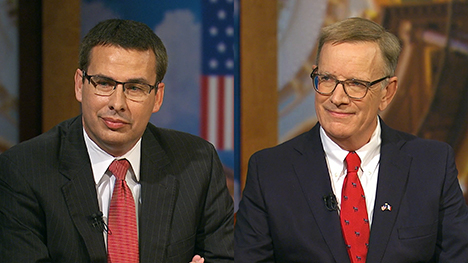
Iowa State Treasurer candidates John Norwood (D-West Des Moines) and Roby Smith (R-Davenport) discuss key issues and policy positions.

Candidates Dave Dawson (D-Lawton) and Chris McGowan (R-Sioux City) will answer questions from reporters and discuss their platforms, concerns and future plans.
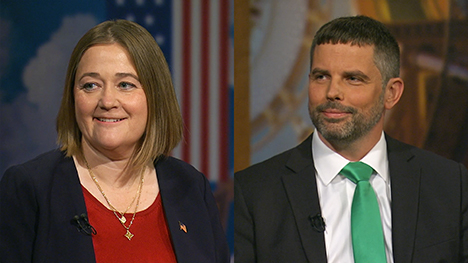
Iowa Attorney General candidates Brenna Bird (R-Dexter) and Nate Willems (D-Mount Vernon) discuss key issues and policy positions.
Lindsay James (D-Dubuque) and Joe Mitchell (R-Clear Lake) answer questions from Iowa reporters and discuss their platforms, concerns and future plans.
Candidates Ashley Hinson (R - Marion) and Josh Turek (D - Council Bluffs) answer questions from reporters and discuss their platforms, concerns and future plans.