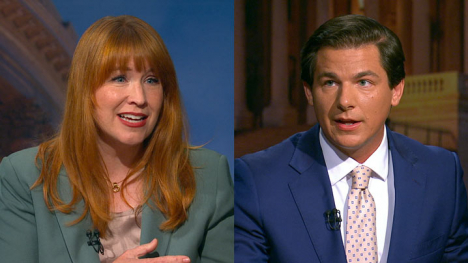
State Auditor candidates Chris Cournoyer (R-LeClaire) and Taylor Wettach (D-Muscatine) discuss key issues and policy positions.
State Auditor Candidates Chris Cournoyer & Taylor Wettach
Share


On this edition of Iowa Press, State Auditor candidates Chris Cournoyer (R-LeClaire) and Taylor Wettach (D-Muscatine) discuss key issues and policy positions.
Joining moderator Kay Henderson at the Iowa Press table is Stephen Gruber-Miller, Capitol bureau chief for The Des Moines Register.
Program support provided by: Iowa Bankers Association, and Robert and Doreen Sheppard.
Recorded: October 23, 2026
Transcript
♪♪
[KAY HENDERSON] The state auditor helps make sure government officials use your tax dollars the way they're supposed to. We'll talk with the two candidates running to be Iowa's next state auditor on this edition of Iowa Press.
[ANNOUNCER] Funding for Iowa Press was provided by Friends, the Iowa PBS Foundation.
♪♪
[ANNOUNCER] The Bob and Doreen Sheppard Family, proud supporters of educational programming seen only on Iowa PBS.
♪♪
[ANNOUNCER] Banking in Iowa goes beyond transactions. Banks work to help people and small businesses succeed, and Iowa banks are committed to building confident banking relationships. Iowa banks, your partner through it all.
♪♪
[ANNOUNCER] For decades, Iowa Press has brought you political leaders and newsmakers from across Iowa and beyond. Celebrating more than 50 years on statewide Iowa PBS, this is the Friday, October 30th edition of Iowa Press. Here is Kay Henderson.
[HENDERSON] The state auditor is often called the Iowa watchdog. The office audits every state agency and provides services to local governments, as well as guidelines to private CPA firms in Iowa involved in auditing. Our guest today are running to be elected state auditor for the next four years. Let me introduce them. Chris Cournoyer is from LeClaire. She's the Republican nominee. She's the current lieutenant governor. She previously served in the Iowa Senate and has worked in the technology industry. Welcome to Iowa Press.
[CHRIS COURNOYER] Thank you, Kay. It's good to be here.
[HENDERSON] Also here is Taylor Wettach. He is from Muscatine. He's the Democratic Party's nominee. He's a lawyer who has worked primarily on trade and national security issues with companies and with the federal government. Welcome to you as well.
[TAYLOR WETTACH] Thanks for the opportunity to be here.
[HENDERSON] Joining our conversation is Stephen Gruber-Miller. He is the Capitol bureau chief for the Des Moines Register.
[STEPHEN GRUBER-MILLER] So in 2018, Republicans were critical of the current state auditor, Rob Sand, because he's not a CPA. Neither of you are CPAs. So, I'd like to start by giving you both the opportunity to say, what about your background best qualifies you to be the next state auditor? Chris Cournoyer, we'll start with you.
[COURNOYER] Yeah. Well, first of all, I'm a mother of four children and proud to be part of public service in the state. And I have I've served on the local school board. I've served in the Iowa Senate. And now as lieutenant governor. And I have 30 years in the technology sector, over 20 years as a small business owner. So, what I bring to the office is that kind of leadership to provide the resources and tools to the CPAs and the staff in the office to be able to modernize and optimize how we conduct those audits and investigations in a much more timely manner. So, I think that leadership and my experience in the private sector will certainly help modernize the office, get those audits done in a more timely manner, and then also be able to look for ways where we can make recommendations to government at all levels to be more efficient and effective in how we deliver services to Iowans. And then which would lead to being able to continue to lower the tax burden on Iowans.
[GRUBER-MILLER] Taylor Wettach, what qualifies you to be state auditor?
[WETTACH] Yeah. Well, thanks again for the chance to join you all today. I'm a seventh generation Iowan, born and raised in Muscatine, where I learned my values from my faith. And as an Eagle Scout, I think at the end of the day, the position of state auditor needs to be somebody that will maintain the independence and integrity of this office. I spent my career as an attorney reviewing multi-billion dollar financial issues and legal matters, and standing up to folks who are trying to rig the system. And so, I think having that experience actually reviewing complex financials, actually pursuing legal actions against bad actors who might be trying to rig the system, and ultimately having the integrity to maintain this independence and call a spade a spade and do things the right way, is the foundation of our ability to do best in this office. There was a law that was passed in 2023 which Chris had supported that made it more difficult for this office to actually be able to protect taxpayers money, to be able to do its job. And I think the end of the day, that was not a good thing. We need somebody that's going to push back against political partisanship, and that's the sort of integrity I would bring to this office.
[HENDERSON] We'll get to that law in more detail in a few minutes. But first, I want to bring up the fact that as a reporter who's covered government at all levels for several years, the state auditor's office has been releasing audits of particularly small towns where a city clerk has stolen essentially the tax dollars from their fellow citizens. The current state auditor has suggested that there should be at least some prison time for someone who is convicted of stealing $10,000 or more from a local government. Taylor Wettach, would that be something that you would push legislators to do?
[WETTACH] Yeah, I believe that if you're stealing money from the taxpayer, you can't get off with a slap on the wrist. We need to make sure we have the strongest deterrents possible so people know that if they do something like that, they will be punished. So, I'm very much in support of that. But I think beyond that, there's more that we can do. And to that degree, I think we really should be supporting investing in our local communities more, making sure the state auditor provides more assistance on the front end. I always say it's like, you know, you find yourself in a difficult situation if you are really sick and you're down the road, you have to get expensive, painful treatment at that point. Well, if we provide more support on the front end by helping out local communities, it's like getting good primary care up front. It's less expensive, less painful. And so, I think we need to have good deterrents on the back end, but also provide more support, especially for our rural communities and small towns that might not have the same resources or staffing that our bigger cities might have.
[HENDERSON] Chris Cournoyer, what are your thoughts about a state law that would require prison time for a local employee or a local government official who steals $10,000 or more in tax dollars?
[COURNOYER] Yeah. Well, I think anybody that steals from the taxpayer should be held accountable for that. And there's got to be teeth in it for the deterrents to work. So, I think in addition to some kind of prison time, there needs to be a plan for them to repay the money that they stole to the taxpayer to make the taxpayer whole again. So again, I think, you know, the auditor's office is a place that can lead and be a resource to our local governments, who sometimes only do have a part time clerk working there to make sure that there's controls and there's checks and balances, and there's transparency and accountability with technology that we can help them implement with dashboards so taxpayers can see exactly what's coming in and going out at all times, so that we don't have to wait until next year's audit to find fraud, waste or abuse going on. So, I think there's a lot of opportunities there to lead and really help our locally elected officials look for those signs and those red flags and ask the right questions and look for the right things so that those things don't happen.
[GRUBER-MILLER] So, we got started talking about the 2023 law that, as your opponent mentioned, you voted for. One of the things that that law does is it prevents the auditor's office from suing an executive branch agency or commission to force them to turn over documents. So, what will you do, Chris Cournoyer, if you're elected and a state agency doesn't give you documents that you need for an audit?
[COURNOYER] Right. Well, what we did in that law, and I did vote for it because I would think it was important that we put some guardrails on how the audit conducts, auditor conducts that type of business. If there's a disagreement or an issue with a state agency, I don't think we want to get in the habit of taking a state agency to court and going through an expensive legal battle that the taxpayer has to pay for to be able to resolve differences. So, the solution and that bill was to create an arbitration panel, like other state agencies use, and do it in the most minimal way possible to lay all the facts out on the table, have the arbitration panel take a look at it and not drag the taxpayers through an expensive legal battle. And I think that was appropriate. And, you know, the state auditor can say that that gutted their ability to do audits, but they've literally done hundreds of audits since then. And it hasn't been a problem. So, I think that was appropriate.
[GRUBER-MILLER] Yeah. Taylor Wettach, one of the other things that that law did was restrict the auditor's office access to people's medical records, education records, other personal information. Are those things that the state auditor's office needs to be able to look at?
[WETTACH] Well, look, the auditor's office was prevented from looking at all kinds of things, including criminal records. What actually happened here was there was an effort that made it more difficult for this office to get the information that, by the way, Democrat and Republican state lawyers alike had previously had access to. And you don't have to just take my word for it. The National Association of CPAs, the folks that literally write the rules of auditing, said this is going to cause a lot of damage. It's going to make it very hard for this office to be able to fully do its thoughts and protect the taxpayers. State auditors across the country also chimed in and said, hey, this is going to be a real problem. So, there were guardrails in place. The guardrail was that if the request was pushed back on from a state agency, judicial review would determine whether or not the information should be provided. Instead, now you get a panel that's made up of the agencies that are getting reviewed in the first place. It's kind of like letting an accused in a courtroom determine whether the information that's being provided should be provided for the evidence, or determine who the judge or the jury is going to be.
[HENDERSON] Chris Cournoyer you were shaking your head.
[COURNOYER] Well, I don't think the state auditor, you know, at the time, Rob Sand said he was entitled to medical records and school records of citizens of Iowa. When I was the chair of the technology committee in the Iowa Senate, I ran the consumer data privacy bill. So, the protection of privacy and the data that's collected on our citizens is very important to me. And the auditor is not entitled to your medical records or your health care records or your vaccination records or school records. If it has something to do directly with the audit at hand, then make a case for it. Otherwise, I do not want the state auditor looking at me or my children's medical records without my consent. I mean, it's a privacy issue that we had to take into consideration for Iowans, and I think that appropriate steps were taken to protect privacy.
[WETTACH] The auditor used to be able to make a case for it. What they did was they made it so the auditor can no longer make a case for it. It used to be that the auditor needed that information. It's not like the information was automatically provided. What would happen is they would bring it to a panel determined by a judge to review whether that information was necessary. Now the auditor is no longer able to actually make that case. So, they're just up a creek when they need information to complete their audits. And I think that's wrong. I think we need a state auditor that will defend the integrity of this office to protect the taxpayer, no matter what.
[HENDERSON] Under current Iowa law, on a different kind of auditing, the state auditor's office may initiate audits or reviews of local school districts under three conditions. The state education director directs it or asks for it, either an employee or a member of the local school board in that district asked for it, or a petition is signed by 100 people, at least in who live in the school district asking for the auditor to initiate it. Taylor Wettach, what should lawmakers do on this issue? This has come up in the gubernatorial race because Rob Sand is being criticized for not auditing the Iowa City Community School District, which has had some financial irregularities over the past few years.
[WETTACH] Yeah, well, you know, I think the reality is that the auditor's office has been hemmed in. The auditor's office has historically been under-resourced compared to where it used to be, even compared to 20 years ago. The state auditor's office has had diminished powers due to various efforts to make it more difficult for this office to do its job. I can't speak to any particular case. I'm not currently in that office. But what I can say is that we should make sure we have a state auditor that actually has the teeth to go after these sorts of issues, and isn't chasing after the problems down the road because they haven't been able to get the information in the first place to complete their audits. I think it's really important that we defend the ability of the office to do its job, no matter what, without any political gamesmanship that makes it harder.
[HENDERSON] Chris Cournoyer should state law be changed that would make school districts use the state auditor's office to be audited? They currently have the option of choosing the auditor's office, or a private auditing firm.
[COURNOYER] You know, I don't think that should be mandated, mandatory because, you know, we have limited resources in the state auditor's office. So, I think it is important that we have those third parties that understand the governmental generally accepted accounting principles and the standards that they need to abide by when conducting those audits as school boards. And, you know, as a former school board member, this hits very close to home for me. And it's just it's outrageous to me that the Iowa City School Board was able to get away with or the district was able to get away with an audit that was 18 months past the state deadline, and that should have been a red flag in the auditor's office, that something was going on, and it should have been alerted much sooner than it was. So, when an audit comes in that late, you know, we can have a dashboard that keeps track of when audits are initiated, when they're due and if they're late, let's find out why they're late. And if we need to provide additional resources from the auditor's office, we can certainly do that. But it's outrageous the amount of millions of dollars in the Iowa City School District that were misappropriated, and there don't seem to, you know, the school board should have been involved. The administrators that should have should be held accountable for that. And, you know, really, that's millions of dollars that should have been going in the classroom into teacher salaries and to student programing. So, you know, I think that there's definitely things that we need to look at to make sure that those late audits and those financials are looked at from the auditor's office and those deadlines are met.
[GRUBER-MILLER] Speaking of schools, Taylor Wettach, Rob Sand has said the state auditor's office should be able to audit the Education Savings Account program for private school funding. Do you agree with that position? And if so, how would you work with Republican lawmakers who passed this program to agree to those changes?
[WETTACH] Yeah, I agree with Rob on that one. My view is it doesn't matter what the government program is, you should be able to have full transparency of where tax dollars are going. Currently right now there is almost zero transparency, certainly nothing along the lines of the sort of transparency that we demand from public schools. And effectively the schools are able to do what they want with that money without much oversight, especially at a time like right now where, you know, the cost of this program have ballooned from $130 million in the first year to $330 million this past year. And we're looking at having a terrible deficit for our state. Folks deserve to know where their money is going. And so again I think my view ultimately is it's not anything specific to this program. Folks should be able to send their kids where they want to send their kids. This program is in law, it's done and dusted, and we should make sure it's being done the right way. And I think a lot of folks can understand that. So, we're hopeful that when we get in there, we'll be able to work with Republicans, with Democrats, with all folks who believe that every government program, no matter what the program is, deserves to have the oversight that it is due and make sure that we're approaching things in the same way for this program as we do for everything else.
[GRUBER-MILLER] Chris Cournoyer, Republican governor candidate Zach Lahn said during a debate that he thinks there should be third party audits done of the Education Savings Account program. Do you think that the program should be subject to audits? And if so, should they be done by the state auditor or a third party?
[COURNOYER] Well, it is a program that involves taxpayer dollars. So absolutely, it should have auditor eyes on it. So, whether or not that's done by the auditor's office or a third party, it should absolutely be done. I mean it's taxpayer dollars. And we need to make sure we have eyes on it. So, you know, the issues that I've had with that is when the auditor's office gets political. And so, our current auditor has been very vocally criticizing various programs in state government. And then they want to conduct an audit on it. And you cannot expect the Iowa citizens to believe that it's going to be a fair, unbiased audit when the state auditor is in putting his negative views on a program. So again, we need to have an independent auditor that looks at the facts and the data involved in every audit and their political opinion of whatever program is being audited should not be known. So that's something that I would definitely do. But absolutely, we should have eyes on every program that involves taxpayer dollars.
[GRUBER-MILLER] Chris Cournoyer, Dave Vaudt, a Republican, served as auditor earlier in the century and after the democratically led legislature adjourned and the Democrat governor at the time signed the bill, the budget bills into law, he would have a news conference and evaluate the budget that they produced, whether he thought it was good or bad. Is that something you would reinstitute publicly evaluating the budget that's produced by lawmakers?
[COURNOYER] Yeah. Well, I mean, when I was in the Senate, I oversaw the education budget, $1 billion budget. And we have the Revenue Estimating Committee that looks at the revenues coming in. And I think the auditor should have a full grasp of the budget as it's presented, so that we can make sure that we make a plan for oversight at all levels of government. So that is definitely a, it's a good idea. And if it's a good idea, I don't care who came up with it Republican, Democrat or independent, it's definitely something I would look at to institute. And it really, it is at the end of the day to bring transparency and accountability to government so that the Iowa taxpayer can know that the money that they work hard for is being used appropriately and responsibly.
[HENDERSON] Taylor Wettach, what would be your view? Would you reinstitute that practice?
[WETTACH] Yeah, my view is that you should be doing everything you can to look out for the Iowa taxpayer, and that means giving full transparency to our programs. What's the point of having an auditor if we're not going to let the auditor do its job fully? What's the point of having an auditor if the auditor is not going to actively push back on anything that's not getting full oversight? My view is it doesn't matter who is in power in terms of the governor's seat, if it's Rob Sand or Zach Lahn, it's the same thing. You need to have a state auditor that's going to call a spade a spade, that's going to bring attention to that and actually push back. We cannot have the sort of political gamesmanship that we've seen that has actually made it harder for this office to do its job. And my view is whenever that happens from a governor or from the legislature or anywhere else, you push back and you fight for the taxpayer.
[GRUBER-MILLER] Both of you live in eastern Iowa, along the Mississippi River. Taylor Wettach if you're elected, will you continue living where you do now, or will you move to Des Moines? Will you commute? Split your time? How will that work?
[WETTACH] We haven't determined all that yet. I got to talk to my wife on how that's probably going to work out. Commuting every day 2.5 hours might be a little bit difficult, but likely we'll be doing some time splitting and all of that. Love my community in Muscatine. I do think another thing, too, is that the auditor ends up not just being, of course, in the office of in Des Moines, but actually is out on the road going all throughout the state, making sure things are being done the right way. So, it's not really clear where I'll be on every which day that's within all that. I think one thing that's really important, too, is that we have an auditor that will go all throughout the state who will actually get on the ground meeting people. I think one thing Rob Sand has done wonderful in this office is by doing a 99 county meeting series every year, getting out to every part of the state to make sure that it doesn't matter where you are. If you're in Polk County, if you're in Muscatine County, if you're in Scott County or Clinton County, wherever you are, you can actually get your voice heard. And I think it's really important that we have a state auditor that will go out there, earn every vote, and make sure that everybody has their voice heard.
[GRUBER-MILLER] Chris Cournoyer, you've criticized Rob Sand for not spending enough time in the auditor's office at the Capitol. How much time is enough to spend in the Capitol versus elsewhere?
[COURNOYER] Yeah, well, his office is right next to mine, and more often than not, the door is locked and the lights are off. So not only is he not there, he doesn't have staff there. So, you know, I'd like to get in there and really understand, you know, talk to the CPAs, talk to the staff and understand what their challenges and are and what the opportunities are in the office. But we absolutely need to be out and about in the state as lieutenant governor, I have been to all 99 counties. I've traveled around the state. So, I already have that experience, and I've developed relationships around the state. And, you know, I've learned a lot by talking to locally elected officials and locals, around community leaders around the state. There's a lot of really great ideas out there on how we can run a more efficient, effective government to deliver better services to our citizens. And I think we need an auditor that will listen to those good ideas and help implement those ideas. And that's where, again, my technology background, my business background, and my experience at the local level of government, the State Senate, and now as lieutenant governor comes into play, I have the relationships, I have the experience, and I will go out there and I will listen. We will make sure that we go out and do the audits and investigations in person. Too often now there are desk audits where the information has to come to Des Moines, and I think it's absolutely critical that we have our auditors out and about and the state auditor leading and listening to all of the ideas around the state on how we can optimize state government.
[HENDERSON] We have just a few minutes left. Chris Cournoyer, one of your Senate colleagues suggested that state agencies should be allowed to hire private auditing firms. Is that something you support?
[COURNOYER] You know, again, we are limited in the auditor's office in terms of the capacity that we have. So sometimes it is necessary to have third parties come in, and we need to make sure that as the in the auditor's office, those third parties are qualified. They understand the uniqueness of auditing governmental entities. So, communicating and training, I think, is extremely important. So, we would need to make sure that those guidelines are in place. And then of course, those audits would come into the auditor's office and we would have eyes on them to ensure that everything was done properly and thoroughly.
[HENDERSON] What's your view, Taylor Wettach?
[WETTACH] What is the point of having an auditor if you're not going to let the auditor do its job? I mean, effectively, this office has been strangled by efforts to diminish the power of the office and by efforts to diminish the resourcing that this office has. I mean, we need to make sure the auditor can do its job. And if we're going to give those jobs away to folks that are under political management and oversight instead of under the independent oversight of the folks that work in this office, the nonpartisan public servants, then that's not really an audit. We need an auditor that's going to fight for the independence of this office and make sure that the nonpartisan public servants can do their job, which is why I think it's so important that we maintain the office's strength and independence and push back against anyone who's trying to put those restrictions in, like my opponent has.
[GRUBER-MILLER] I want to talk about the office's budget a little bit, since that's come up. According to the Legislative Services Agency, the budget has not been increased for the past eight years. Chris Cournoyer, what would you recommend for the state auditor's office budget?
[COURNOYER] Right. So, you know, that's where my relationship as a former state senator, I have that relationship with the legislature in the House and the Senate. And as a former education budget chair in understanding the state budget and the appropriations process going into the office, understanding what the needs are, how we need to modernize and optimize the office and come up with a plan on the budget that we need. And if there is an increase in the appropriation, working with the right individuals in the legislature, I have those existing relationships to help them understand the case for increasing the budget, if that's necessary.
[GRUBER-MILLER] Taylor Wettach, there's state appropriations. There's also the fees the auditor's office charges to agencies that IT audits. Do those need to be looked at as well?
[WETTACH] Well, look, the state Auditor's office has been repeatedly sounding the alarm on the fact that it has been underfunded for years at this point. And unfortunately, the current legislature has not listened to that. I would hope that we would be able to push that further and hopefully get folks on board with it. But it's not like a new thing, right? It's a situation where Chris’ colleagues have been routinely working hard to make it more difficult for this office to get all the funding that it has requested. So, my view is, again, we need to have somebody that will defend this office, make sure it has all the support it needs, because right now it has been strangled and prevented from actually having the resources to fight for folks. But with that being said, you know, I think it's really important then to have somebody that will be independent, who hasn't engaged in political gamesmanship, who will work across party lines to talk with all folks in the government to work for that. I'm looking forward to doing that with governor, if they're Democrat or Republican and with the state legislature, no matter who's in control.
[HENDERSON] We have about half a minute left. Zach Lahn has been talking about putting every government transaction on line so that every Iowa taxpayer can watch it in real time. Chris Cournoyer, how quickly could you get that up and running?
[COURNOYER] Well, it would be a challenge, but I love a good challenge. I've got that background in technology and business, and I think that we could get that up to up to date rather quickly with the getting our IT under one umbrella. We've got the infrastructure, we've got the technology and expertise. I think we could get a dashboard up. And I think it would be wonderful for the taxpayer to be able to see where the money is coming in, where it's going, and, and make sure that we have oversight on it.
[HENDERSON] Taylor Wettach.
[WETTACH] Yeah, my view is that more transparency is always good. The most important thing is that we know that we can trust with that information is coming from that. We know that we have a state auditor that will actually make that information clear to folks, and who will always do that without political favor. So, I'm in support of doing that and support of making sure we maintain the ability of this office to actually look out for the Iowa taxpayer.
[HENDERSON] I have to look out for the clock, and sadly, we're out of time for this conversation. Thanks to both of you for being here and sharing your views with viewers.
[COURNOYER] Thank you, Kay.
[WETTACH] Thank you very much. Appreciate it.
[HENDERSON] This is part of a series of conversations with candidates for executive offices in Iowa. If you missed any of them and want to see them, they're at iowapbs.org. We've also hosted live candidate events for the U.S. Senate for Iowa's second and fourth congressional districts. You can see those online at iowapbs.org. For everyone here at Iowa PBS, thanks for watching today.
♪♪
[ANNOUNCER] Funding for Iowa Press was provided by Friends, the Iowa PBS Foundation.
♪♪
[ANNOUNCER] The Bob and Doreen Sheppard Family, proud supporters of educational programming seen only on Iowa PBS.
♪♪
[ANNOUNCER] Banking in Iowa goes beyond transactions. Banks work to help people and small businesses succeed, and Iowa banks are committed to building confident banking relationships. Iowa banks, your partner through it all.
Watch More
Iowa Secretary of State candidates Paul Pate (R-Cedar Rapids) and Ryan Peterman (D-Davenport) discuss key issues and policy positions.
Iowa State Treasurer candidates John Norwood (D-West Des Moines) and Roby Smith (R-Davenport) discuss key issues and policy positions.
Candidates Dave Dawson (D-Lawton) and Chris McGowan (R-Sioux City) answer questions from reporters and discuss their platforms, concerns and future plans.
Iowa Attorney General candidates Brenna Bird (R-Dexter) and Nate Willems (D-Mount Vernon) discuss key issues and policy positions.
Lindsay James (D-Dubuque) and Joe Mitchell (R-Clear Lake) answer questions from Iowa reporters and discuss their platforms, concerns and future plans.
Candidates Ashley Hinson (R - Marion) and Josh Turek (D - Council Bluffs) answer questions from reporters and discuss their platforms, concerns and future plans.