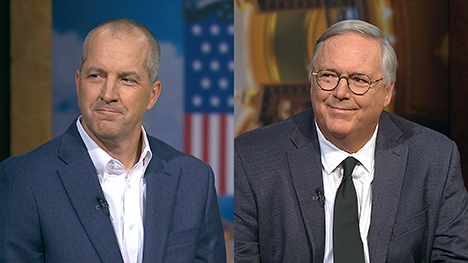
Iowa State Treasurer candidates John Norwood (D-West Des Moines) and Roby Smith (R-Davenport) discuss key issues and policy positions.
Iowa State Treasurer Candidates John Norwood & Roby Smith
Share


On this edition of Iowa Press, Iowa State Treasurer candidates John Norwood (D-West Des Moines) and Roby Smith (R-Davenport) discuss key issues and policy positions.
Joining moderator Kay Henderson at the Iowa Press table is Erin Murphy, Des Moines bureau chief for The Gazette.
Program support provided by: Iowa Bankers Association, and Robert and Doreen Sheppard.
Recorded: October 9, 2026
Transcript
[KAY HENDERSON] The state treasurer is rarely in the spotlight, but managing the state's finances is a big responsibility. We'll talk to the two candidates who want the job on this edition of Iowa Press.
[ANNOUNCER] Funding for Iowa Press was provided by Friends, the Iowa PBS Foundation.
[ANNOUNCER] The Bob and Doreen Sheppard Family, proud supporters of educational programming seen only on Iowa PBS.
♪♪
[ANNOUNCER] Banking in Iowa goes beyond transactions. Banks work to help people and small businesses succeed, and Iowa banks are committed to building confident banking relationships. Iowa banks, your partner through it all.
♪♪
[ANNOUNCER] For decades, Iowa Press has brought you political leaders and newsmakers from across Iowa and beyond. Celebrating more than 50 years on statewide Iowa PBS, this is the Friday, October 16th edition of Iowa Press. Here is Kay Henderson.
[HENDERSON] The state treasurer is basically the state's banker, or you might say, the chief financial officer. They deposit funds. They manage investments. And they help keep the state's finances in order. Our guests today are two candidates running to be state treasurer for the next four years. Let me introduce the candidates. Roby Smith is a Republican and the current treasurer. He is running for a second term. Previously, he served three terms in the Iowa Senate. He's also worked in banking. John Norwood is the democratic nominee. He is the founder and president of a business consulting company and has also coached and advised several small businesses in Iowa. Gentlemen, thanks for being here.
[ROBY SMITH] Thank you.
[JOHN NORWOOD] Thank you.
[HENDERSON] And just a note for our viewers. We are taping this program on Friday, the Friday before it will air. Now joining the conversation, Erin Murphy, Des Moines bureau chief for the Gazette in Cedar Rapids.
[MURPHY] So, gentlemen, the state Treasurer's office is one that maybe flies under some Iowans radar. Let me ask you each about your top priorities for the next four years. Roby Smith, you've held the office for four years now. What would you seek to accomplish in a second term?
[SMITH] Well, we're going to first of all, thank you for having us here. We're going to expand on the record setting performance that we have. I want Iowans to know that I visited all 99 counties. I have 3.2 million bosses. And you know what? I run the state treasurer's office, not as a Republican, not as a Democrat, but as a banker, because I am one. I was a banker for ten years, and a state senator for 12, and I've been the state banker for the last four years. And in the in the Treasurer's office, it's a scoreboard business. And we put up record numbers. And in there I managed $10 billion in state idle money fund. And we have brought in over $1 million a day in interest, an all-time record. To put that in perspective, the previous state treasurer, his last four years brought in $100,000 a day. So, it's an all-time record. Also, I do manage the Iowa, ISave529. And so that is $7.25 billion. That's a record assets under management. And then we also have more Iowans than any time before have accounts there. So, we're going to continue to expand on those successes in the Treasurer's office. We've also modernized the office, and we're going to continue to do that.
[MURPHY] John Norwood what would be your top priority?
[NORWOOD] Thank you for having me today. You know, and I would echo what Robby said in terms of this really is not a red office or a blue office. It's a green office. We really ought to think about what's important from a dollars and cents point of view. I'm essentially a financial educator. And, you know, one of the things I think we need to do and see in the treasurer is we need to have an engaged and visible treasurer. We don't have that today. We have a treasurer who's largely unknown by Iowans. And I know that from traveling the state. I think we need to have a treasurer who's engaged on the important issues of the day. We could talk about the billion two structural budget deficit. I think there's also a capital allocation rule to this office. The treasurer doesn't get to decide these things on themselves by themselves. But the idea of keeping more of our Iowa taxpayer money in Iowa, working through our Iowa banks and credit unions is an incredibly important part of this job. We don't get to spend the money, but we can help see that the money works harder for Iowans.
[HENDERSON] Roby Smith, the legislature and the governor have recently approved a nearly $1.4 billion set of incentives for proposed steel mill in southeast Iowa. Is that a good deal for taxpayers? And as state treasurer, what would be the state Treasurer's role in overseeing that?
[SMITH] Well, obviously, the legislature and the governor decided on that. It brings in a great amount of jobs. You're talking about 1500 jobs. We want to make sure that those tax credits and how the bill was written is that they have to show that they're actually producing and building, and the jobs are coming before the money comes. So, I think it's a matter of fact when you're talking about state treasurers making sure that the law is being followed, and as long as it's being filed, those jobs are coming, it's going to help Iowa.
[HENDERSON] John Norwood what is your view?
[NORWOOD] Yeah, you know, I think a couple of different lenses. One, you know, from a big picture standpoint, if the state is able to attract a large project in this case, $15 billion of investment, that could have a huge benefit for the state in terms of job creation and tax collection and so forth. And particularly for a region that's been suffering Lee County historically a big manufacturing area. But we also have to be realistic in terms of, I think the proponents of this deal have a somewhat questionable past. There needs to be very careful scrutiny of the parent company, the subsidiary, the past track record of this company and then some of the logistical concerns. How do we get this, the pellets down from Minnesota, either by rail or by barge? That's a big consideration. There's also things having to do with energy grid. But, you know, I think we also have to think from a capital allocation standpoint is what are the what are the different opportunities. So, if we spend $1 billion in taxpayer funds for a $15 billion project over a period of time, there are other ways we can help stimulate the economy. One is by keeping more of the taxpayer money. We have about $2.5 billion. We pay out to our schools and municipal governments. That money gets pooled, and a good chunk of that money leaves the state. Why does that matter? Because if the money isn't deposited here, banks and credit unions make money loans based on deposits. Deposits help grow the economy. If that money leaves the state, it's a lost opportunity to grow our Iowa economy, which happens to be in the tank. The other part of this, I think, is the fact that when we look at small businesses, I've worked with scores of small businesses through, for example, the Goldman Sachs 10,000 small business program, over 430 businesses here in Iowa, all across Iowa have gone through this program collectively, over a half billion dollars. What's the job creation associated with those businesses? Over 5000 people work for those 430. I've worked for 80 of those companies helping grow them. And so, for that billion dollars, you know what, for $1 billion of keeping $1 billion here in Iowa instead of having it, you know, leave the state, we can essentially do that, I think, on pennies on the dollar for what it would cost for us to invest for a $15 billion steel plant. So, I think these are some of the decisions we need to think about.
[HENDERSON] Which would you prefer?
[NORWOOD] Well, I think things we can do today, I think we need to support the small businesses here in this state today. Very important to do. And we can do that for a fraction of the cost.
[MURPHY] So, this was on my list to get to later. But since we talked about it now Roby Smith, let me just get your perspective on that. Is there something to what John Norwood is suggesting here about keeping investing that money, keeping it more in Iowa banks?
[SMITH] Yeah. So, what we have done in the Treasurer's office, when I took over, there was about $150 million that was being invested in Iowa banks. I've increased that to over a half $1 billion. That's a 200% increase. We have LIFT loans, which helps small businesses. We've increased that 400% in my time as state treasurer, we've put up all-time records. Let's talk about the Great Iowa Treasure Hunt, $38 million was given back last year, an all-time record, $53,000, or 53,000 applications, all-time record. In my time, my administration, we've given back over $100 million to Iowans, which is an all-time record, and it's a scoreboard business, and we're putting the numbers up. We I have traveled to all 99 counties as state treasurer. I've sat down with over 50 county treasurers in their office in their county, and I've asked them, hey, will you help me get this out? So, when people come in to pay their taxes, will you talk about the Great Iowa Treasure Hunt? That's how you put up these record numbers. They just don't happen. We put up a number of records because we're out there and we're making things happen in the Treasurer's office.
[MURPHY] I want to talk a little bit about the leadership of IPERS, the state's retirement program for public workers. In the past year one IPERS leader resigned and another was dismissed. At the time, Governor Reynolds said neither cases had to do with programs financial performance. But as far as how these leaders are appointed right now, IPERS leaders are appointed by the governor. Roby Smith should that process be reconsidered in any way? Should either the other. The board that the treasurer sits on or the legislature be more involved?
[SMITH] So, first of all, this governance structure has been around for over 20 years. It's been through Republican and Democrat legislatures on this. It is something that has worked. When I came here in 2011 as state senator, IPERS was funded at about 80%. Today it's funded at 94.5%. And to put that in perspective, the average pension in the United States is about the 80% range. We're a top ten pension. But what's most important is we need to keep the promise for current and future retirees, promises made, promises kept. When it comes to IPERS.
[HENDERSON] For people who aren't familiar, you mentioned the governance structure. What is it?
[SMITH] Yeah, the governance structure where the governor appoints the CEO and then the governor could hire, hire or fire. And then obviously we have the state Senate that would approve. And then we have the board. I'm one of seven members on that. We oversee the investments to make sure the investment policy, the strategies, what we're doing, and the governance structure, like I said, has been around for 20 years. There's not a single legislator in the executive branch or in the legislative branch that's recommending to make changes to IPERS, the only person that wants to make changes to IPERS is my opponent.
[MURPHY] So, I take it you do not either. John, why?
[NORWOOD] I think we have actually a lot of work to be done protecting IPERS and strengthening IPERS. We've got a CEO that was hired by the governor in 2020 that resigned under investigation. The number two person he brought in, the benefits officer who was fired from Kentucky pension system, was just fired at the same time from IPERS. We also have a whistleblower lawsuit that winding its way through Polk County. They fired the previous risk officer for the $46, $47 billion fund. And we don't have a risk officer. The risk officer was reporting to the person he was supposed to be overseeing. I mean, that's out of step. The risk officer should be reporting to the board of directors. As Roby mentioned, we have a CEO that isn't hired and fired by the board. That's not that's not in step. So, you know, this isn't just me saying this. This is the Financial Times has written on this subject. The governance issues are a reflection or the mismanagement issues are reflection, reflection of the governance, the governance, structural issues. And so, I think we need to have more scrutiny. Right now, though we don't have an independent investigation. We don't really know I think the depth of the issues, because that has been all swept under the rug. And it's and it's been investigation is internal to the executive branch. One of the problems, I think, of having that CEO hired and fired by the governor is you don't have the same set of interests in alignment in trying to find out what's going on. So, we're going to learn some more through the Polk County, I think, through the whistleblower lawsuit. Some of this has to do with performance bonuses. And the whistleblower alleges cooking of the books. So, I think we need to have a board that's much more engaged. As the treasurer, I'm going to stand up and protect IPERS. We do see evidence of privatization. We're seeing that right now in the positions that are currently under IPERS that are being moved out of IPERS. The 200 IT positions that were IPERS positions moved into the private sector, the $330 million that we're spending on private school vouchers, that's not going for public school teachers. That's weakening the public school system. So IPERS is intimately connected with as a benefit with the 420,000 members. And we need to strengthen it, the DOGE report is another example of beginning to give people other options.
[MURPHY] Sorry, but we got to keep moving on. We've got little time and a lot of topics. The treasurer is a member -- in this same kind of ballpark here -- the treasurer is a member of the state's executive council that approves settlement payments for, among other things, lawsuit settlements. Rob Sand the Democratic candidate for governor, is saying during his campaign this year that he believes that state taxpayers should not have to pay when the state settles with harassment victims and that the state should instead pursue financial compensation from those perpetrators. Roby Smith do you agree with that?
[SMITH] Yeah. So, I actually went over to the Attorney General's office when a lot of this was happening about six, eight years ago, and I had a meeting with them and I asked them, is there something we can do to get this money back for the taxpayers? And he said, yeah, we might be able to we could bring a lawsuit forward. I think that should happen. If someone's egregious and there's sexual harassment going on, then yeah, I think what needs to happen is that the attorney general's office needs to go and bring up a lawsuit and have them pay for it, the state worker. So, I totally agree with that.
[MURPHY] John Norwood, do you agree with that?
[NORWOOD] Yeah, I think there's a deterrence effect that if we have bad actors, that they need to be held accountable, even if it costs money, I do want to also respond, though, in terms of the scoreboard comments that Robby made about, you know, the record numbers, a lot of the record numbers have to do with two factors. One, they have to do with the fact that we had a lot of Covid era money, federal money that was deposited for the state of Iowa. So, we have a lot more money that's being potentially invested. And then the second thing is, you know, the rise in interest rates that's going up. A lot of this has to do -- we just saw it in the Wall Street Journal today, you know, record U.S. Treasuries over 5.25%, mortgages now 7.4%. This is all a reflection of affordability, things getting more expensive. So yeah, we're going to make some more money. But you know, there's no incredible wizardry with the scoreboard numbers. It's really has to do more with allocation.
[MURPHY] Roby Smith, let you respond to that and then we need to move on.
[SMITH] No, I'm going to respond to that. So first of all, interest rates are lower today than when I took office on January 1st, 2023. So, it's not just about interest rates. What I've done as state treasurer, I want you to know that I sat down and this money was not being met. It was passively managed. We are actively managing this money. And what I did is I went to every single department director that's in charge of a lot of money, and I sat down with them one on one. I said, when are you going to spend your budget? Because then I did a ladder approach with the bonds, and I made sure when they were going to spend a lot of money, I could buy a bond that would expire the day before and make maximum return on that. With the previous treasurer was doing was leaving it all in a money market account. What we're doing is actually buying callable bonds and corporate paper all safe. I haven't had a single investment lose any money. That is where the returns are coming from. Not the interest rates. They're actually lower today than when I took office. It's because we're actively managing the money. That's the score. I brought in over $1.5 billion in three and a half years, and all-time record, and I bring in over $1 million a day in interest, including Saturdays and Sundays. I make people's money work. They work hard for the money. I am working hard for that money.
[HENDERSON] Roby Smith you mentioned earlier something called the LIFT program. People may not be familiar with it. What is it and who is it for?
[SMITH] So basically it's for small business owners. And what I did is I actually expanded it. I worked with Senator Reichman to put a bill through my first year. He got it passed to where we included veterans to that program. So, they get preferential treatment when it comes to a certain amount of the money and the LIFT program. So basically, what it is, is we invest money with a bank. We do get a lower interest rate, but that lower interest rate is passed on to the small business to help them out. And that's mandated in code that we do that. And when I took over, it was about $150 million. We're now $500 million as far as bank investments when it comes to LIFT loan. I've increased that by 400%. And that's not because of interest rates. That's because of the hard work of my staff and myself as state treasurer.
[HENDERSON] John?
[NORWOOD] The LIFT program was started by Mike Fitzgerald working with legislators back in the 80s to diversify. So, it's a good program, and we do need to modernize it and I think right size it. It's thematically though, I think, you know, we need to think beyond just what's the what's the highest return we can earn on the Iowa's Iowans taxpayer money. We have to think about where that money gets invested. And thematically, I think it's going to really help this Iowa economy. Iowa small businesses, Iowa family businesses to work with these Iowa banks and credit unions to make sure that more of this money stays in this state, not chasing returns out of state to grow someone else's economy. Staying here in Iowa to grow our Iowa economy, that's incredibly important.
[HENDERSON] Erin?
[HENDERSON] the Treasurer's office also oversees, I believe you mentioned this earlier, Roby Smith this 529 program that allows Iowans to save for college and talk to you both about this. John Norwood, do you propose any changes to or expansion of this?
[NORWOOD] You know, what I've heard with the 529 that's a successful program as well, you know, begun under Mike Fitzgerald's watch. And I think the 529 plan is -- what we need to keep in mind is a third to a half of our Iowa high school students now, don't go on to college. So, 529 plans, you know, I think have often been thought of as helping kids families save for college. That's important, continue to be important, but we also need to make sure that 529 plans are marketed to people, the children who are going on to the trades, or maybe buy or build a business. When you run around the state of Iowa and you ask people, how many people know about 529 plans, you'd be lucky to get half of the people in a room. So, I think that would raise their hand. So, I think, you know, part of this is making sure that we're marketing the 529 programs appropriately. And then also, I think, you know, having a, the idea of a 529 plan being the administration of the 529 plans, I've heard some commentary that they're slow in response. I had one woman tell me about a three week situation. She was locked out of her account. So, I think we need to make sure that we're keeping a better watch. Also, this was brought up in 22.
[MURPHY] So sorry. Yeah, the clock is starting to --
[SMITH] So thank you. So first of all, we rebranded the ISave529 program it was college savings. And so, I came in, I rebranded it so we could go after those blue collar workers that are in the trades, the HVAC, the electrical, the CDL, the trucking, the commercial. We've done that. I have turned around the, ISave529. We have record low fees. I've reduced them by almost 20%. I put a bill in and it got passed. It was $3,800 per beneficiary. I got it raised to $6,100, but that's a 60% increase under the previous state treasurer. It would just go over inflation, 2 or 3%. I raised it 60%. Because of that we have all-time record high $7.25 billion under management. And today, I don't know who he's talking to around the state, this is the number one time in the 50 year, I'm sorry, 30 year history of this program more Iowans are in the ISave529 than ever before. Once again, we're putting up record numbers in the Treasurer's office.
[HENDERSON] Roby Smith you are a member of the State Executive Council. And as we read through the minutes, it strikes us that oftentimes you're approving help for Iowans who are hit by natural disasters. Is there a need for some additional federal, I mean, state program that would support people who are going to be hit by flooding and hail and tornadoes in the coming years, especially since the federal government is talking about sort of scaling back FEMA?
[SMITH] Yeah, so we do have some variance on that when we're talking about helping communities in need. And yes, we do approve that on the Executive Council. I'm open to having that discussion on that. I think that's a need that's out there.
[HENDERSON] John Norwood
[NORWOOD] Yeah, I think that's important to do to help communities in need. I think we also need to think about structurally the important things we need to do as states. So, for example, if we have water quality as a problem and a challenge, how does the Treasurer's office then play a role? Well, the treasurer is the state's banker. What agriculture, what farmer doesn't have to work without a farmer. So, we need to be thinking about how to how can we help finance and build the missing infrastructure that will allow us to diversify the crops that are missing to improve soil health, which has to do with water quality. So, we need a creative, big picture, forward thinking treasure, which we really don't have today.
[MURPHY] We're down to our last few minutes here. John Norwood you mentioned earlier the state's budget. Roby Smith, let me start with you on this. Four years ago on this show, you criticized your predecessor, Mike Fitzgerald, for not being more active, registering on bills, and getting involved in the legislative process, putting the Treasurer's office declaration on those bills. Do you intend to, as treasurer, do you feel that your office should weigh in on the state's overall finances, the budget picture and the way legislatures approach state spending?
[SMITH] Yeah. So first of all, I manage $10 billion. So, I brought in $1.5 billion in my time that helps with public safety, roads and education. So, I am helping with that process on that. I know they looked at giving money back to the taxpayers why that situation is happening. We have almost $5 billion in reserves. But I want the people to know this. This job is a serious job. I have ten years of banking experience. I have been the state's banker for four years. And I've been a state senator for 12 years. And when you manage $10 billion, that's serious money. And I manage $7.25 billion for the ISave529 program. That's serious money, and I'm giving money back. I created the Money Match Program, which allows people that actively. We can send the money proactively to their house from the Great Iowa Treasure Hunt. I created that program and it's being sent. The average amount is $715 last year. So, people can go to their go to their mailbox, open it up, and they could receive an average of $715, which will help them in these times. That's meaningful money. That's what I've done as state treasurer. I have taken this job serious. I have the banking background. I'm the only one that has the banking background and the current state banking background here.
[MURPHY] And John Norwood, we're just under a minute, so I'm going to give you a chance to address that.
[NORWOOD] I have an extensive background in finance and business and working, I mentioned the Goldman Sachs 10,000 small business program sponsored by the Goldman Sachs Foundation. So, I do know something quite a bit about banking. I'm going to be fully engaged as a treasurer. I'm based here in Des Moines. I'm going to be in Des Moines. And I don't think my opponent, who has tried to do this job from a remote office in Davenport, two hours away, is an effective way to lead. As the state's banker, I think you need to be here. You need to be present. You need to be building the relationships in the legislature. And from all the people I've spoken to, the legislators, the lobbyists and so forth, my opponent, he's a no show. He's a no show in Des Moines.
[SMITH] You don't get these results if what he's saying is true. I have never missed a vote on any committee. I have never missed a single committee meeting. When I was state senator, I never missed a vote in 12 years. And I have put 150,000 miles on my car in the last four years going to all 99 counties, going to all four corners of this state, getting word out on this program and going back and forth to the Capitol. The majority of the legislative branch lives outside of Des Moines. The majority of the judicial branch lives outside of Des Moines. And the executive branch lives outside of Des Moines. This is common. I have lived in Davenport for 26 years. I work my tail off and I have put over 150,000 miles on my car, which was brand new four years ago, and now I have 151,596 miles on my car because I care about this state, and we're putting up record numbers in the Treasurer's office.
[HENDERSON] We are out of time for this edition of Iowa Press. Thanks for joining us today.
[NORWOOD] Thank you.
[SMITH] Thank you.
[HENDERSON] This episode is part of a series of conversations with candidates for statewide executive office. You can watch all of them at iowapbs.org. And there are more to come. And we want to remind you about our final Iowa Press debate. Wednesday, October 21st we'll question the two candidates for governor, Zach Lahn and Rob Sand. That's at 7 p.m. on statewide Iowa PBS, and it will be streaming online as well. If you missed any of our other Iowa Press Debates, you'll find those at iowapbs.org too. For everyone here at Iowa PBS, thanks for joining us today.
♪♪
[ANNOUNCER] Funding for Iowa Press was provided by Friends, the Iowa PBS Foundation.
[ANNOUNCER] The Bob and Doreen Sheppard Family, proud supporters of educational programming seen only on Iowa PBS.
♪♪
[ANNOUNCER] Banking in Iowa goes beyond transactions. Banks work to help people and small businesses succeed, and Iowa banks are committed to building confident banking relationships. Iowa banks, your partner through it all.
♪♪
Watch More
Zach Lahn (R-Belle Plaine) and Rob Sand (D-Des Moines) will answer questions from Iowa reporters and discuss their priorities and vision for the state during a 90-minute debate.

Candidates Dave Dawson (D-Lawton) and Chris McGowan (R-Sioux City) will answer questions from reporters and discuss their platforms, concerns and future plans.
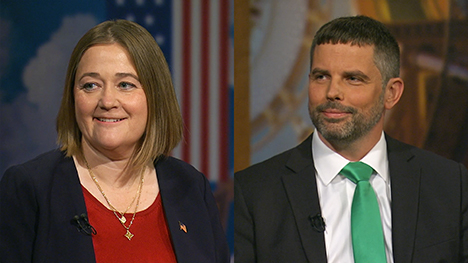
Iowa Attorney General candidates Brenna Bird (R-Dexter) and Nate Willems (D-Mount Vernon) discuss key issues and policy positions.
Lindsay James (D-Dubuque) and Joe Mitchell (R-Clear Lake) answer questions from Iowa reporters and discuss their platforms, concerns and future plans.
Candidates Ashley Hinson (R - Marion) and Josh Turek (D - Council Bluffs) answer questions from reporters and discuss their platforms, concerns and future plans.
Iowa Secretary of Agriculture candidates Chris Jones (D-Iowa City) and Mike Naig (R-Des Moines) discuss key issues and policy positions.