We convene a group of Iowa political reporters for a roundtable discussion about the 2026 election and what's ahead.


On this edition of Iowa Press, we convene a group of Iowa political reporters for a roundtable discussion about the 2026 election and what's ahead.
Joining moderator Kay Henderson at the Iowa Press table are Brianne Pfannenstiel, chief politics reporter for The Des Moines Register, Erin Murphy, Des Moines bureau chief for The Gazette in Cedar Rapids, and Stephen Gruber-Miller, Capitol bureau chief for The Des Moines Register.
Transcript
[KAY HENDERSON] We're all enjoying a respite from political ads, but there's still politics to talk about. We've gathered some familiar reporters to discuss the election and what's ahead on this edition of Iowa Press.
♪♪
[ANNOUNCER] Funding for Iowa Press was provided by Friends, the Iowa PBS Foundation.
♪♪
[ANNOUNCER] The Bob and Doreen Sheppard Family, proud supporters of educational programming seen only on Iowa PBS.
♪♪
[ANNOUNCER] Banking in Iowa goes beyond transactions. Banks work to help people and small businesses succeed, and Iowa banks are committed to building confident banking relationships. Iowa banks, your partner through it all.
♪♪
[ANNOUNCER] For decades, Iowa Press has brought you political leaders and newsmakers from across Iowa and beyond. Celebrating more than 50 years on statewide Iowa PBS, this is the Friday, November 6th edition of Iowa Press. Here is Kay Henderson.
[HENDERSON] It's been a few days since the 2026 election, and results have been canvased in counties all across the state. They'll be certified in a couple of weeks, but we have reporters here at the Iowa Press table to talk about the results and what those results mean for the days, months and years ahead. Let me introduce them. Stephen Gruber-Miller is the Capitol bureau chief for the Des Moines Register. Brianne Pfannenstiel is the chief politics reporter for the Des Moines Register. And joining us also, Erin Murphy, the Des Moines bureau chief for the Gazette in Cedar Rapids. Folks, let's start with just some general observations about what happened on November 3rd. Brianne, what are your thoughts?
[BRIANNE PFANNENSTIEL] Well, I mean, the midterms are almost always, you know, a pushback on the party in power. But what we saw this last week was a lot more than that. It was it was a full scale repudiation, I think, of the party in power, both at the federal level and really in many of the state races that we saw, including the governor in down ballot, to several of those races as well. And we went into this contest really talking a lot about candidate quality and about issues and how those dynamics played out. We were talking about whether Ashley Hinson was one of the strongest Senate candidates on the Republican side in the country. We were talking about whether Zach Nunn was putting together a great campaign against Sarah Trone Garriott in the third district. And really, on election night, the wave was so big that it almost seemed like those things didn't even matter, kind of in the face of voter frustration with what's happening in Congress right now.
[HENDERSON] Erin, what are your thoughts?
[ERIN MURPHY] Yeah, Brianne’s exactly right. The scope of it was the one of the main things that jumped off the page for me. The other thing, well, one of the many other things that I found interesting was look at how much the pendulum swung back in the other direction. Here in Iowa, we've been talking on this show and in our circles for a number of years now as Iowa turned red. And now the question will be is, is it shifting back to becoming a more purple state? We'll need more cycles to make a clear determination on that. But one of the places where we saw some of that change, some of that swinging back, is those Mississippi River counties, the Obama, Trump come country, as they became known. Rob Sand won six counties right on the Mississippi River. Josh Turek won four of them. So, some of those voters in those areas shifting back. And it'll be interesting to see, you know, in ‘28 and moving forward, whether that pendulum stays swinging in that direction or if Republicans can get those back.
[HENDERSON] Stephen?
[STEPHEN GRUBER-MILLER] In the state legislature, one of the things that stood out to me, of course, we have the Democratic wave all across the ballot and we saw Democrats at the state legislature pull back some seats in some smaller communities around the state that had been drifting away from them. But I think the takeaway for me is the prediction that we all could have made before the legislature or before the election, and that Rob Sand was making, which is that he will be working with a Republican Legislature. Their margins were so large that they still have comfortable majorities in the House and Senate, and even on the best night for Democrats in 20 years, they didn't come particularly close to gaining a majority back. So, it's a tough map for them.
[HENDERSON] Let's talk about the U.S. Senate race, which was at the top of the ballot. Stephen, you covered the U.S. Senate race that featured Hinson, the previously mentioned Hinson Josh Turek, as well as Thomas Laehn, the Libertarian candidate.
[GRUBER-MILLER] Yeah. Josh Turek, a two time state representative, Paralympian. He won this race. He was the first Democrat to win a Senate race since Tom Harkin in 2008. And he really ran hard on a few things. One, his personal story, right? Overcoming his disability. Undergoing multiple surgeries. Getting to the Paralympics, winning gold medals and then putting in that work on the campaign trail as well. I think that resonated with people. And then he ran on some basic things that I think we heard from a lot, end the Iran war, bring down costs, fight corruption, right. And he didn't try to overcomplicate it beyond that, right. And so now we'll see with President Trump still in the White House, can he and a Democratic Senate majority deliver on some of those things when they take office? He met with Senator Joni Ernst this week, who he'll be taking over from in the Senate. And they said they're going to work together on a smooth transition. So, he's getting his feet under him and he's going to figure out how to start doing this job that he's won election to.
[HENDERSON] Erin?
[MURPHY] Yeah, that's going to be the interesting challenge for democrats over the next two years is I don't know if we know yet whether this was a blue wave or a change wave. And if it was the latter, voters sent Democrats there because they were displeased with the current administration. And they're going to expect to see results. Otherwise, we could see another change wave in two years if Republicans would be able to come back and say, hey, Democrats have done nothing to lower your costs.
[HENDERSON] Brianne, at this table during a debate between Hinson and Turek, Turek said he wasn't really interested in pursuing impeachment of Donald Trump. Obviously, there are other members of the U.S. Senate who might be. What does that tell us about how Josh Turek will approach this job?
[PFANNENSTIEL] It's interesting kind of his approach to all of this, and he's going to be a really fascinating figure, kind of in the wider context. I was reading some national coverage just this morning and they said, you know, they were talking about Pete Buttigieg and they said he was the only person who was able to campaign with Josh Turek and with Abdul El-Sayed in Michigan. And so, if we're looking at the spectrum of the types of Democrats that have just been elected to the U.S. Senate, I think people see Josh Turek as kind of that more moderate, more centrist red state Democrat. And so, he's going to have to go out and, you know, kind of deliver on the things that he said he was campaigning on, that he's not interested in impeachment, that he's not interested in kind of going down some of these, you know, kind of aggressive oversight areas. And he's more focused on delivering on costs. But as Erin alluded to, it's very hard to bring down the price of goods. This is an issue that has been plaguing the country for a long time now. And so being able to deliver on that is going to be really fascinating.
[HENDERSON] Let's shift to Iowa's first congressional district. Erin that is very close to your coverage area. The candidate who won margin of 10%. What does that tell us?
[MURPHY] It tells us it was a lot more comfortable than the last time out, when the margin was fewer than 800 votes and less than 1%. So, this was the rematch of the rematch, the third straight cycle that it was Republican Mariannette Miller-Meeks against Democrat Christina Bohannan. As alluded to, a very close race two years ago. And I'd love to have some really super insightful explanation here. I think it's the blue wave just carried this district with it that we've been talking about.This is always a competitive district. And when you get an atmosphere like we had in this cycle, that district is going to go whichever direction the wave is going.
[HENDERSON] The Gazette serves the second Congressional District, which is Northeast Iowa, and the margin there for an open seat, obviously, Ashley Hinson was running for the U.S. Senate open seat. The Democrat won by 4% there.
[MURPHY] Yeah, and this one was less, you know, when we knew what was possible, we knew the first and the third district, which we're going to talk about here, werein trouble. We weren't sure about the second district because that had started to lean a little more Republican. Ashley Hinson had won reelection by some fairly comfortable margins. So, the fact that this district went to the Democrat, Lindsay James as well, I think, spoke to, again, the scope of what we saw.
[HENDERSON] The other thing about this district is, you know, that area, north east Iowa, was represented by Jim Nussle Republican. And then when he ran for governor, Bruce Braley won the district. And then when he ran for the U.S. Senate, Republican won the district in Rod Blum. And then you had Abby Finkenauer, a Democrat, and then you had Ashley Hinson. So, this thing has flipped around. Why wasn't it on the national radar, given that flippy background?
[MURPHY] Yeah, I think because of the Ashley Hinson having done fairly well in this. And now, like you said, that it was an open seat, maybe it should have been on the radar and maybe Republicans might have poured more into a defense there. They certainly did in the first and third and that turned out to be wildly unhelpful. But maybe that was the mistake made that assuming that would go similarly without an incumbent there.
[HENDERSON] Let's turn to the third district, where we had an incumbent who had knocked off an incumbent a couple of cycles ago.
[PFANNENSTIEL] Right. And I mean, this kind of continues the trend to Erin's point of is Iowa a purple state? I mean, these are districts that have consistently flipped. The third district was represented just in my time here, a Republican for two cycles, a Democrat for two cycles, now a Republican for two cycles, and now it's flipped to a Democrat again. So, I don't think it should surprise people that these districts are competitive pretty consistently. Iowa is one of the few states that has not fallen into the national gerrymander craze. And so, they'll continue to be competitive and kind of, you know, writing the different waves of voter sentiment. But the third district was really fascinating as well. This is one of the most highly targeted, not just in Iowa, but in the country because of that swingy nature, people saw Zach Nunn as a very strong Republican incumbent. Sarah TroneGarriott again came in and ran a strong campaign as well. And so, I think people were, again, maybe surprised by the margin of victory there. That was a seven point victory for the Democrat. And that was really carried in large part by what we saw happen in Polk County. And this kind of helped Democrats across the state. I was talking to some consultants ahead of the election about what they were watching for, and they said, in Polk County, if Democrats have a margin of 55,000 or better, they're going to have a great night. We saw them win Polk County with 75,000 votes. And so that certainly was a problem for Zach Nunn and it was a problem for Republicans across the state.
[HENDERSON] In the fourth Congressional District, there are far more registered Republicans than Democrats, and it was never on anybody's bingo card as a flip seat nationally. But the Republican there, Chris McGowan, won by 18% over Dave Dawson, which is a little bit surprising because when Randy Feenstra won reelection in that district a couple of years ago, he won by a margin that was almost twice as large. So, I think the fourth district was something that Republicans were saying this is the district that we need to focus on to carry our U.S. Senate candidate and our governor candidate to victory. And it didn't happen. And Brianne, that's why Donald Trump went there toward the end of October and had a rally in Sioux City.
[PFANNENSTIEL] That's right. And we were there. There were two rallies in the just the very final weeks before the election. And the whole point of these rallies was to make sure that the Maga base that Republicans in these strongholds would turn out and support Republicans up and down the ticket. And I think if you're looking now after the fact that whether those were effective, we can pretty clearly say that they were not. He went to Sioux City, Sioux County, did not have a strong enough margin that we normally see in these statewide races. He went to Dubuque. We saw democrats win very consistently in that county from Rob Sand and Josh Turek into the congressional race and down the ballot some more. So, you know, Donald Trump, I think we're looking at a pivot point of how people look at whether he is the right messenger for the Republican Party. I think there's a question about whether Republicans are going to continue to stand by him and say, okay, if we just deliver better, Donald Trump isn't the problem, or are they going to start to break? And we've gotten interesting, you know, 2028 right around the corner, both at the presidential level and for, again, these elections start again. We've got a Senate contest. We're going to have these congressional races up again. And I think it's going to be a really interesting moment to see how Republicans adjust.
[HENDERSON] Erin before we move to the governor's race, what happened between June and the election in November? Because in June, you had this group of Republicans running for governor, you had Randy Feenstra very much coveting Donald Trump's endorsement, who he got just a couple of days before the election. You had Zach Lahn, who was praising President Trump and allied with him, and especially one of Trump's cabinet secretaries, Robert F Kennedy Jr.. What happened between then and Election Day?
[MURPHY] The issues that we've been talking about didn't improve, if not got worse when we're talking about the Iran war still being a thing going on many months later and a very unpopular war, cost of living, affordability issues, gas prices certainly didn't get any better, diesel prices for farmers. So just that continual drip, drip of that. And Democrats, to their credit and Stephen talked about this when he was describing Josh Turek’s campaign were very message focused, very message disciplined throughout this election on hammering on those issues and reminding voters nonstop. And I, when those didn't improve the numbers for Republicans didn't either in the polling and then in the final poll on Election Day.
[HENDERSON] Brianne, on this program last week, viewers got a chance to hear from Rob Sand, the victor in the governor's race. Did we learn anything in the past ten days or so about that particular race? And if you could also sort of look ahead to what his governorship may or may not be?
[PFANNENSTIEL] Yeah, it was interesting. He said that he believes voters delivered him a mandate to execute the campaign trail agenda that he's been running on. He won by 11 points in a statewide contest and granted the 2022 governor's race was not a particularly strong showing from Democrats, but he improved on that showing by 30 points. Every state, every county in the state moved to the left compared to where 2022 happened. And so, he's looking at that and saying, I have a mandate, the voters have given me a mandate to enact what I've been talking about on the campaign trail. And so, looking forward now, even just in the last week and a half, two weeks since the election, he's kind of hit the ground running, building out his transition team. You know, to transition from a Kim Reynolds administration to a Rob Sand administration takes a lot of work in building out who's going to lead his agencies, who's going to be kind of the infrastructure behind the scenes to see this happen. And so, we've seen him name to that committee, two Democrats, a Republican and an independent. He's calling it a tripartisan effort. And that is something that he campaigned on. And so, it's interesting now to see some of the reaction to that, people from both the right and the left deciding whether or not those people are too conservative, whether they're not liberal enough. And it's, I think, an interesting look at what might be coming when he starts to enact some of these agenda points. Are Democrats going to stay with him if he needs to work with Republicans and he does to get these things through into the finish line, is he going to alienate some of his base? And so, it'll be very fascinating to see how he starts to implement this, who he asks to stay on. He told us he'll only be seeking resignations from two agency heads to start Department of Education and Department of Management, which oversees the budget. And so, from there, you know, we've seen questions about who he's going to ask to lead the Department of Natural Resources in a water quality push. Chris Jones, the Democrat who ran for Secretary of Agriculture, lost to the Republican, has already questioned if he keeps the current head in there, vis he serious about water quality? So, there's going to be a lot playing out very quickly.
[HENDERSON] Erin and Stephen, a week ago, we were at a news conference on the floor of the Iowa House where Iowa House Republican, Stephen, kept the same leadership team that they've had for the past couple of years in the Senate. They kept the same leadership team. What does that tell us about what's going to happen?
[GRUBER-MILLER] Yeah, this is one of the things I was most interested in seeing what the reaction would be post-election. What would Pat Grassley, the speaker of the House say? What would Mike Klimesh, the Senate majority leader, say about whether they can work with Rob Sand? And one of the things that I think we saw them do right off the bat was rule out something we'd heard some rumors of that they might hold a special session to limit the new governor's powers, to claw some powers back, which we've seen happen in other states when the governorship changes parties. They didn't do that. They put out a statement that said essentially, where we have agreement, we can work together. If Rob Sand governs as a moderate, as he said he will, we can work together. If he's going to push a liberal agenda, will we as Republicans will push back. And I think what's interesting about this is the statement but then also the reaction to the statement where, you know, I talked to some Democrats about this and they don't totally, you know, they don't totally buy it. They're a little suspicious. I think we're in a new phase where we're having to get used to what Republicans compromising with Democrats looks like. What does it mean when they say those things, right? And so that relationship between those Republican leaders who now have to navigate a majority that has been used to delivering very conservative policy victories, those people are going to have to get used to working with the Democratic Governor, who can say no to them.
[MURPHY] Well, we've been spending two years listening to Republicans say that they're not sure that they believe what Rob Sand says about the way he's going to govern, either. So, the nice thing about all this –
[GRUBER-MILLER] That’s the flip side.
[MURPHY] Yeah, exactly -- is now they have to go to work and we're going to find out in both cases. The session starts in January. And Republicans are going to pass bills. And it's up to the Democratic governor whether to sign them. And we're going to find out whether both of these sides meant what they’ve been saying.
[HENDERSON] One of the things Brianne and I learned at this table from Rob Sand last year is that he plans half a billion worth of cuts in the state budget to address this use of the reserves to sort of fill a budget gap that Republicans have planned for as they sort of glide into reduced income tax collections. That seems very steep.
[MURPHY] Yeah. And to bring that back to my point, that's going to be fascinating and we're going to find out right away. One of the first things Governor Rob Sand will do is propose a budget. And how are they going to reach an agreement on this? How are they going to manage the state's finances when it's not just all Republican control, now? How are the, what are what are the Republicans going to propose, and what will Rob Sand sign off on?
[GRUBER-MILLER] And I don't, excuse me, I don't think he's going to be proposing just cuts. He has ideas for how to raise state revenue. And that includes putting income caps on the education savings account program, legalizing and taxing Marijuana, Making data centers pay a larger share of taxes. And he's talked about Funding the state's water Quality and Natural Resources Trust Fund, which could involve raising the sales tax. So, all of those things, I assume, will be part of the discussion as to how the state can get To a sustainable budget.
[HENDERSON] And we already have reaction to that from the Senate Majority Leader.
[GRUBER-MILLER] That's right. I interviewed Leader Klimesh, and he told me that any sales tax increase to fund the natural Resources and Outdoor Recreation Trust Fund would have to result in a net tax decrease for Iowans. So, what that looks like you can do it different ways. In 2020, Governor Reynolds proposed raising the sales tax by $0.01, but using some of that to put income tax cuts in place. So essentially, what the Republicans are saying is they'd like to see an offset. If you're going to raise the sales tax, how can you not just fund water quality, but use some of that money to lower taxes for Iowans?
[HENDERSON] And there was a proposal from Senator Dan Dawson, who is the Republican chair of the Senate Ways and Means Committee, on this subject never went anywhere. Does that sort of indicate to you that Republicans aren't really interested in this, based on the fact that they've previously rejected this in the past few years?
[GRUBER-MILLER] It's interesting, because I think there are some Republicans who are interested in this, and they're interested in putting money towards water quality. But obviously putting additional money into something is difficult to do when you want to cut taxes. And they do. They want to cut taxes. So, you know, finding ways to essentially move money around. So, if they see this as a priority, they can focus on that rather than something else is the trick.
[PFANNENSTIEL] And I'll be really interested just in the caucus dynamics of what divided government looks like. We've gotten really used to seeing Republicans move as a collective, deciding together how they want to approach most issues. But there are individual Republicans who would like to see the sales tax raise to fund water quality. Are they going to negotiate as a unit or are they going to see defections? Is Rob Sand going to be able to pick off people here and there enough to get things moving, or at least make things interesting?
[MURPHY] And the only thing I'll add to that really quick is, no, they haven't been willing to do it in the past, but we just came off a campaign where that was as central an issue as –
[HENDERSON] Water quality was the mandate?
[MURPHY] I think so. You had both gubernatorial candidates talking about it. Mike Naig, it was a centerpiece of that campaign, and he won reelection, the Republican ag secretary, but by a little bit closer than he's used to. Chris Jones mounted a very serious threat. So, I think the issue definitely has the, voters spoke, I think, pretty clearly on that issue.
[HENDERSON] Brianne, we have a couple minutes left. Iowa Republicans will have a voice in the next presidential campaign. Iowa Democrats are sort of talking about maybe we could have some sort of competition here for the Democratic side. What are your thoughts about where the caucuses stand today and how that will play out in the next few minutes?
[LAUGHTER]
[HENDERSON] They're going to be here.
[PFANNENSTIEL] Things are already happening. People are already having conversations. And what's been interesting to me is not only are the conversations happening on the Republican side, but there are national political figures reaching out to their Iowa contacts and saying, what would it look like if I had an Iowa based operation here in the state? So, I think this election was interesting all on its own. But what it did as well was kind of open up the playing field on both sides when it comes to the 2028 caucuses. Republicans kind of went into this thinking that JD Vance would be the heir apparent to the Maga movement. But if Maga is no longer as enticing as it used to be, JD Vance suddenly has a problem on his hands. He also sent several staffers to work on Zach Lahn’s governor campaign. That obviously didn't end the way that they hoped it would. And so do they have kind of the foothold that maybe they would have if that race had been closer, if they had won. So, JD Vance, I think, comes into this race, several activists have told me at this this point in kind of a tarnished capacity. And that opens up the field for anybody else who's interested in doing it. On the Republican or, excuse me, on the Democratic side now, too, we've got Josh, Turek and Rob Sand both elected, who said we're going to go first if we're in charge. And they are. So, we'll see what that looks like. We'll see whether people like Pete Buttigieg, Mark Kelly, Ro Khanna come back to Iowa and make a play of it.
[HENDERSON] Well, I have to cut off our conversation, but we will certainly talk about the caucuses and the policies that Republicans will pursue at the Capitol at this table again soon. Thanks for watching this edition of Iowa Press. You may watch other editions of this show at iowapbs.org. For everyone here at Iowa PBS, thanks for watching today.
♪♪
[ANNOUNCER] Funding for Iowa Press was provided by Friends, the Iowa PBS Foundation.
♪♪
[ANNOUNCER] The Bob and Doreen Sheppard Family, proud supporters of educational programming seen only on Iowa PBS.
♪♪
[ANNOUNCER] Banking in Iowa goes beyond transactions. Banks work to help people and small businesses succeed, and Iowa banks are committed to building confident banking relationships. Iowa banks, your partner through it all.
Watch More
Iowa Governor-elect Rob Sand discusses his election victory this week, the upcoming transition, and his priorities for when he takes the oath of office in January.
State Auditor candidates Chris Cournoyer (R-LeClaire) and Taylor Wettach (D-Muscatine) discuss key issues and policy positions.
Iowa Secretary of State candidates Paul Pate (R-Cedar Rapids) and Ryan Peterman (D-Davenport) discuss key issues and policy positions.
Iowa State Treasurer candidates John Norwood (D-West Des Moines) and Roby Smith (R-Davenport) discuss key issues and policy positions.
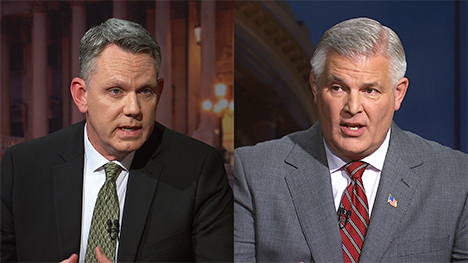
Candidates Dave Dawson (D-Lawton) and Chris McGowan (R-Sioux City) answer questions from reporters and discuss their platforms, concerns and future plans.
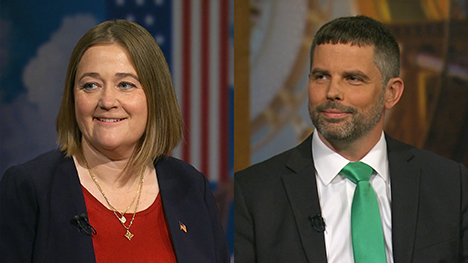
Iowa Attorney General candidates Brenna Bird (R-Dexter) and Nate Willems (D-Mount Vernon) discuss key issues and policy positions.