Jeff French and Ross Baldwin discuss the economic and commodity markets as we talk about hogs, selling into rallies, slaughtering heavyweights, weak basis and “cash is king”
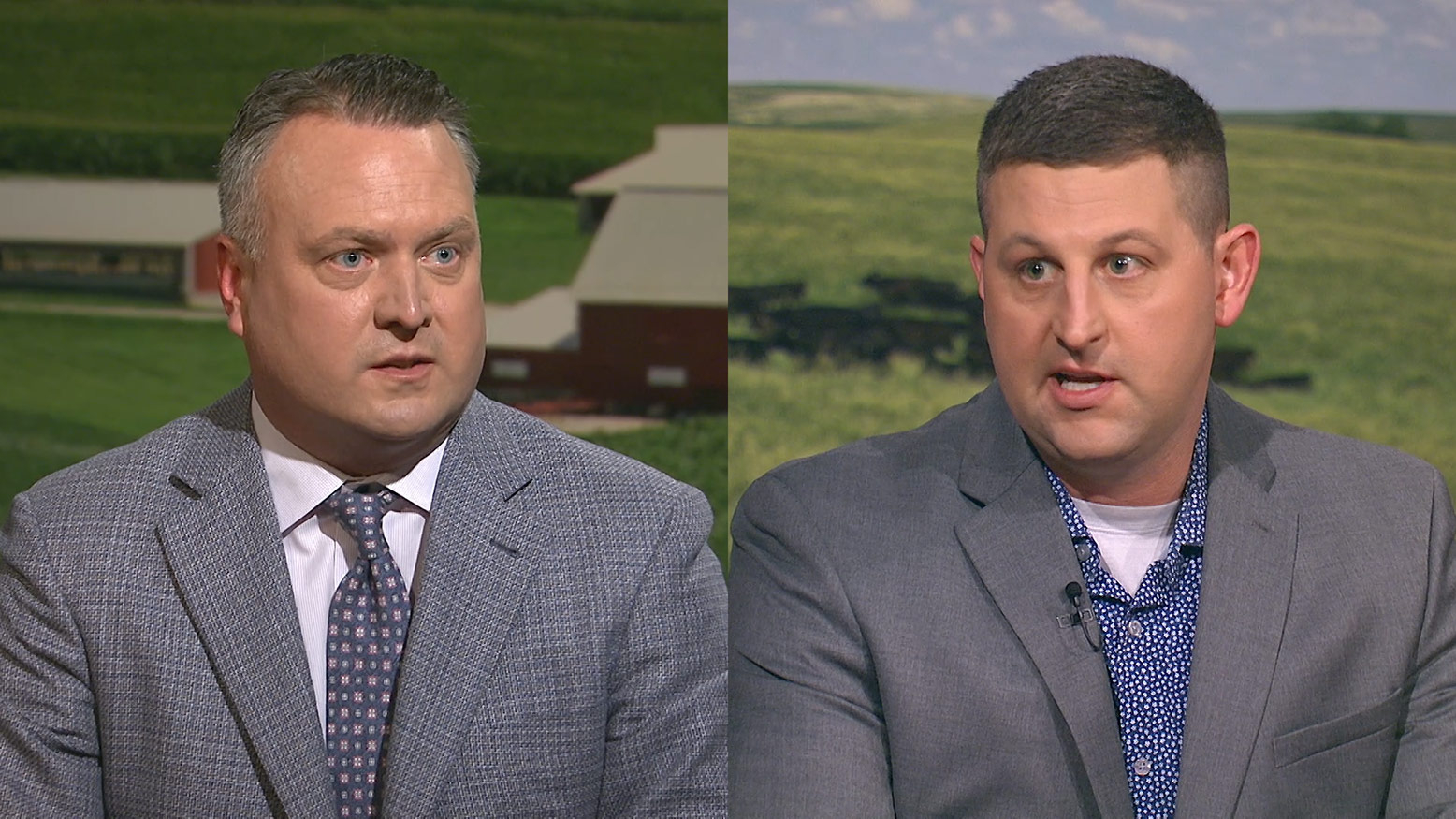
Market Analysis with Jeff French and Ross Baldwin
Share


Looking at conditions and the long term forecast, Ross Baldwin thinks it’s hard to grow the cattle herd as long as the drought continues. The broader impact of drought is a major topic with Jeff French as well in our discussion of the economic and commodity markets.
Transcript
[Announcer] Next, the Market to Market report..
[Paul Yeager] Following USDA's report of more wheat carryout and no changes to the soybean and corn carry, the market turned back to war and weather as the primary movers for the week ending April 10th. TFor the week ending April 10…
The nearby wheat contract lost 27 cents and the May corn contract fell 11 cents.
Great crush demand remained to lead over the weaker export story in the soy complex. The May soybean contract added 12 cents, while May meal improved by $16.60 per ton. May cotton expanded by $2.30 per hundredweight. May Class Three milk futures declined $1.17. The livestock market was mixed. June cattle improved $2.87. May feeders took off $3.90 and the June lean hog contract weakened by 75 cents. In the currency markets, the U.S. dollar index fell by 132 ticks. May crude oil fell by more than 12 percent or $13.74 per barrel. COMEX gold improved $97 per ounce, and the Goldman Sachs Commodity Index was off by more than 21 points to settle at 717 - 20. Here now to lend us their insight on these and other trends, a regular market analyst, Jeff French and Ross Baldwin. Good to see you both.
[Ross Baldwin] Hey, Paul, good to see you.
[Jeff French] Thanks for having me.
[Paul Yeager] All right, Jeff, this wheat story was not going was really going to be something I thought we'd be talking about. Then this USDA report yesterday. Why did it move the market so much?
[Jeff French] Well, I think it just reinforces the fact that not only here domestically but globally, we have plentiful supplies, 930 million bushels in the carryout. That's 80 million bushels more than this report last year. But then you also had a big change in the forecast. And you have some major good rain coming to a good part of wheat country. And we're in the business season of wheat right now. April and May. This is where they get, you know, to add their bushels right now. So you also had the wheat run up to, you know, two, three year highs with the war premium. The funds were long for the first time in four years. But then you just, you get to an area where farmers were hedging. There was a lot of old crop moved on the rally. And we've seen the forecast change. That's what I think was happening here this week.
[Paul Yeager] And the supply story has been the one. That's why it seems so out of place to see that rally that we had recently to come back into this market. So can this market sustain a continued volatility? I mean, there's nothing it can do about volatility in the market. But the weather can it handle this weather volatility. And how does anyone make sense of it right now.
[Jeff French] Well I mean we had you know we're coming down here in the last couple of weeks. We're 60 $0.70 off the highs. You know I'm not looking to sell this market. I like to sell strength. And we were very active in the first week of the conflict. But now we're into, you know, five weeks ago. I mean, that's kind of old news if you get it, you know. So I think the volatility might continue. But if you look at the VIX the volatility index it's actually below where it was trading at prior to the conflict. It's below 20 right now. So it can be put back in really quick. But it's it feels like we're into a quieter time right now.
[Paul Yeager] Let's talk about weather for a minute though. You mentioned we just had the story about the rain potential that's coming to certain areas, certain areas, not all the areas going to get to you in a minute, Ross, because this is this is tied into cattle in a question. What does it mean in Colorado, western Nebraska, all the way to the west, up to the Pacific Northwest on a crop story with this drought?
[Jeff French] Well, they're hurting, there's no question. And if you can't irrigate, they might have to be making some crop choices. But yeah, it's it's been affected and it doesn't look like it's going away. But the places that get rain is going to benefit greatly.
[Paul Yeager] All right Ross so what does the drought story mean in the livestock market as a whole?
[Ross Baldwin] If the drought were to continue and it continues to expand, but if you just take it at face value where it is today, what it means for the livestock industry is not much for herd expansion. And it's the craziest thing to talk about at this point in the ball game, where we're at in these cattle markets, where actually making new all time highs today as we speak, both cash and futures. And to sit here and say that we're now looking down the barrel of not seeing herd expansion at this point in the bull market. It's it's honestly how I've actually summed it up to some people. It's kind of like a double edged sword that the industry has never seen before, because obviously we've never been to these kinds of record high prices. The herds at a 75 year low. You think expansion. We keep thinking that it's going to come, but all we've done is kick the can down the road. And that's what it looks like right now with where the drought sits.
[Paul Yeager] We've moved animals from places to place with drought, whether it was in Texas, Oklahoma, it goes to Nebraska or it goes to Montana. Can we continue to shuffle around to get around this story for the summer?
[Ross Baldwin] Not really. I don't think you can. And one thing that has continued to string this along has been lately, the increase of days on feed, which has pushed carcass weights to where they have. You've got steer carcass weights running 40 pounds above a year ago. As an industry, we've been running 25 to 30 pounds heavier than a year ago, but we've. And with packers slaughtering less cattle on a weekly basis, slaughter is consistently running 10% lower year to date right now. So we've. We've continued to kind of keep production steady right now, but weights are hitting a plateau right now. And so with less supplies, getting ready to hit the market and weights starting to plateau, the rubber is going to, there's still a point where the rubber is going to meet the road. And we are going to continue to experience tighter beef production as we head through 2026.
[Paul Yeager] It's not that I don't pay attention to what you say, but you and I have talked about this. It's seeming the same talking points for the last year. And every time you think it's going to end, it doesn't. Is this ever going to end?
[Ross Baldwin] At some point it will. Right? All good things come to an end. There's no cure for high prices like high prices. But yeah, you and I, we've talked about it and I feel like a broken record as I've been coming on here for a couple years now. And I swear, every time I come on here, there's one big move up or down. It seems like on these Fridays when we record. But there will come a point. And so far we haven't got there, but there will come a point where you incentivize herd expansion. Now, whether that's because the weather cooperates or from a price perspective that's encouraged, or there will come a point where via demand because of high prices. But so far the consumer has been more resilient than anyone could have ever imagined in the US. And demand demand is not a problem. And it hasn't been a problem. Demand actually continues to remain more robust than we could imagine.
[Jeff French] Mother's day right around the corner. Best demand time of the year.
[Paul Yeager] And then it picks up and it starts to we start to grill a lot more. We're going to get back to more of this livestock discussion because you mentioned the cash and the futures I want to get into, but the demand is still a huge story in the corn market. Yeah. Is that the only thing propping us up right now?
[Jeff French] Well, you had the funds get long 240,000 contracts in front of the war. I mean, that was a major reason for the rally. But yeah, demand is great. We got 3.3 billion bushels in exports. You know, on the report they got 6.6 billion bushels on feed and residual. You know, that seems like a big number with the cattle numbers where they're at. But all in all, you know, market's holding in there. But 2.1 billion bushels carry out. That's 600 million more than this time last year. So it is going to probably cap rallies. I mean we we got aggressive there the first week of the conflict and moved a lot of old crop and new crop.
[Paul Yeager] You mentioned the volatility index. What's it look like then for the corn market compared to like the wheat market?
[Jeff French] Well I mean we should firm going into planting season in my opinion. And then it's up to Mother Nature as always. I mean we do have plentiful supplies but that can change. Hurry change quickly depending on what the weather brings.
[Paul Yeager] Well, okay, not weather, but I had somebody ask me this. Want to make sure I asked you. This is $120. Crude oil lead to $5 corn right now because you mentioned the weather story. But let's talk about the oil story.
[Jeff French] It led to 4.98, which is pretty darn close to $5. And you know, we traded up there for two weeks. I mean, we traded 4.95, 4.97 multiple times. And we just could not take that out. I mean, it's like a glass ceiling up there. There was a lot of producers trying to sell for $5, you know, on the button.
[Paul Yeager] What were you telling people at that point?
[Ross Baldwin] We were advising sales as well. I mean, when you look at you, you can't ignore the fact over the last couple of weeks, corn has started to divorce itself from the crude oil story. And it goes back to we've got a 2.1 billion bushel corn carryout. Jeff brought up the FSR number. It's likely on the high side of things, but $5 corn. I mean, that 4.98 level was likely close enough given the 2.1 billion bushel old crop carryout. There's not a shortage of new crop corn acres coming at us. So if Mother Nature cooperates and we have a trendline yield, we're looking at a big production again next year.
[Jeff French] When Wall Street wants your product, sell them some. And that's exactly what we. [Paul Yeager]Reward the rally?
[Jeff French] Reward the rally.
[Paul Yeager] I've heard that a time or two. I think that's a good. But how do you. In spite of every. The. I'll go back to the word, I guess the word of the show this week is volatility. How do you know that? That is the market talking to me right now and not just a half of a pause before we run up higher.
[Jeff French] Well, we'll have to see. But the corn market definitely divorced itself from the crude. I mean prior to the cease fire, the previous two weeks crude was up $20 and corn was down $0.25 from the highs. So can it turn on a dime? Sure. But I think we got to see what happens Saturday in Pakistan with the meeting. So Sunday night could be volatile.
[Paul Yeager] On the livestock side of. It's always easy to say with feeders, but I mean from. You have to kind of work both sides of the the street there with your clients that you're trying to help that way. But how about those that maybe didn't lock in anything to feed? And they're looking at this, this high run up. Are they just having to wait it out or are they looking for alternatives yet when it gets to $5 on corn.
[Ross Baldwin] The, the saving grace for, for cattle on feed right now, if if, if feed wasn't locked in has been that the old crop contracts given the carry that the market is in right now. Yes. You had December corn get up to 4.98. But the nearby I mean we're in a we're in a big carry. So the old crop of where guys are more focused on buying feed needs right now has not really got that crazy priced. When you factor in what corn basis has been. So corn basis has been pretty weak across the country. So from a from a cost of gain standpoint, it's still very manageable. So you've still been looking at 450 or less cash corn up here in the northern feeding regions. And with a 240 now 250 type cash market, your cost of gain has really been pretty much irrelevant. But that said, the cheaper cost of gain that we're still seeing across the industry, coupled with $2.50 fat cattle. It's all, it's all factored into what these feeder cattle costs that are getting placed and going on to feed right now. So yes, there's a cheap cost gain. We've got big cash. But the margins, I mean margins have they're very, very tight right now across the cattle feeding sector. So and that's all because of the optimism there is. And that's all figured into what feeder cattle are bringing right now.
[Paul Yeager] And again those tight margins have been there for quite a while now.
[Ross Baldwin] They have been for sure. But we're really starting to see over the last 6 to 8 months, those margins across the fat cattle finishing sector, they've really been squeezed down on just because of what feeder cattle have done there for quite a while. Feeders outpaced fat cattle by so much that with what the. The breakevens got so high. I mean, you got to think, I mean, most of the industry right now, it's well over a $2.40 break even of cattle that are on feed in feedlots. So breakevens are high right now. So I mean, we definitely need to see this upper. 240, 250 type cash.
[Jeff French] Packer margins in the red. I mean, I we won't see that long. I mean, they, they do not like that.
[Ross Baldwin] But it's been a yo yo. I mean the Packer margins for the better part of the last three years have been negative. They just recently got positive again. They had about three weeks where they were in some positive territory. But now over the last week, they've quickly sunk right back into the red, likely over $100 a head negative. It's just a tricky situation for the Packers right now because of the supply side of it. But 26 I mean it's still a pretty bleak outlook for the packing industry. It's going to be difficult for them to not run in the red right now. But no question, the longer they run in the red, coming off the amount of years that they have been, it's the more likelihood you you start to hear chatter of maybe another announcement around a plan or something going on. Because like Jeff said, they don't like it and they're not going to do it forever. They've done it longer than we've seen. So something to keep your eye on as a cattle producer.
[Paul Yeager] Let's move over to beans for a minute with this demand story, because we talk about crush, we don't have the exports. There's meetings on weekends, there's meetings in six weeks, there's four weeks. There's acres discussion. What's the headline for you right now? In beans.
[Jeff French] Beans have just been absolutely sideways since the limit down day on March 16th. I mean, we've just been three weeks of just moving. I think every day we've traded in May 1160. I mean, we just have not moved. And you're right, the market is waiting for that meeting on May 15th with Trump traveling to China. But you know, we'll have to see what develops here over the weekend. I just don't anticipate a meeting happening. If we're in a conflict still. But you know, funds are long. They want to see higher prices on acres. I think 84 million is the low print of the year. I think beans will gain some acres.
[Paul Yeager] Even over what was released here a couple of weeks ago.
[Jeff French] Yeah, I think that will be the low print in my opinion. I think beans will gain some acres. I mean, 1150 beans. It works especially well for fertilizer prices for corn are.
[Paul Yeager] Well, okay. It's also the only the 10th of April. And we talk about rain. You can always get the crop in. At what point does the weather, what's the biggest weather premium opportunity for soybeans?
[Jeff French] Well, I you know, they want to plant the soybeans early. So if this thing does continue, I mean, it can change quickly. But I think the rains right now are probably more beneficial. I mean, but I think you get into the third week of April and we're still slow. I think you could see some things change quick.
[Paul Yeager] More beneficial over problematic.
[Jeff French] Right now. Yes.
[Paul Yeager] Okay. Let's talk. I didn't I kind of skipped over the ethanol side of this, but what's the soybean oil story in all of this? Because it had been part of it. Now it's not a part of it, but with crude oil is there you mentioned there's some divorces going on. Is there one right here?
[Jeff French] Well, what what the trade was doing. They they were buying the oil, the soybean oil and selling the meal. And they did that trade for months. And here in the last week they've they've unwound that trade. And that's why you saw meal really. I mean meal was up 16, $18 here today trading at about a one month high. So it looks like they're unwinding that. But again it's going to be well supported with $100 crude. I mean it's just it's going to be supported.
[Ross Baldwin] And you had the manage my record long soybean oil recently. So I mean these are some big positions that they've got on.
[Paul Yeager] What about the headline this week of China and their hog industry. Not necessarily interested in US meal anymore. What's that doing.
[Ross Baldwin] China's hog industry. I mean I believe the prices are at the lowest levels they've been at in the last 15 years. They've got an overabundance of hogs right now and hog production. So it's, a, that's the, I'd say that's one of the bigger red flags for the hog industry, the hog industry domestically. Right now, we're actually in pretty good shape in the US margin. I mean, the profitability is pretty good across the industry. We're seeing strong demand out of Mexico. We've seen an increase in exports to Japan as Japan's had a ban on Spain due to the ASF over there. So there is some positives right now across the hog industry from a domestic standpoint. But you can't ignore the Chinese stories that are floating around out there with their hog markets.
[Paul Yeager] I'm going to pull from the depths here of something you said, and I have to reach into my pocket for this question for Ross, I wrote Futures and Cash. You kind of talked about it earlier, specifically in the cattle market. Cash is always king. But you've also mentioned futures. We've been having some issues with the two, which is king right now.
[Ross Baldwin] Cash is absolutely king across both fats and feeders right now. But what is extremely interesting is you go back to last week, you had the previous week, cash had we'd been stagnant around 235. We came into the week. I mean, there was some optimism that cash was going to be a little bit higher. And then futures rocketed higher before cash even started trading a week ago. And heading into last Thursday, right before Good Friday, you had futures sitting around April, futures around 245, which was ahead of First Notice Day, which was this past Monday. And that was against a previous week's cash of 235. So we were staring at a -$10 basis essentially, and cash screamed higher, traded 10 to $11 higher. That was last week, one of the largest week over week increases that we've seen across the industry. So last week we end the week at 245 to 246. Today as we're recording this, cash is very quiet to end the week, but there has been some 250 cash that has traded to a regional in the north. And there is a lot of Packer interest still today. So if you factor in what cash did this 250 today, which is not the average for the industry for the week because we don't know where it's at. But the 250 today and what cash did last week, we've seen a $15 increase in the cash markets really in a one week's time, because it hasn't even been two weeks because it was last Thursday when cash jumped $10. So in about one week time frame, we've seen a $15 jump, which is why futures have done what they did to end the week today. And we're making new contract highs across fat cattle.
[Paul Yeager] And that's it. We out, we're out. We're done. That was a lot. I have to take a breath. We have to take a breath. Thank you very much. Ross Baldwin. Jeff French. We'll let you get your answer here in a minute. All right. All right. Thank you both. And you have been watching the analysis portion of the program. In a moment we will continue that discussion in what we call Market Plus. So here's how you find their discussion. Search Market Plus with Jeff French and Ross Baldwin. Wherever you get your podcasts. You can also go to our website of markettomarket.org to listen. Now, those of you who subscribe to our YouTube channel have long known that's a place to find our program. Market Plus and other offerings. If you turn on notifications from us, you get the content first. Subscribe now at YouTube.com Market to Market. Next week, the dairy industry finds balance as new tastes churn. Fresh optimism. Thank you so much for watching. Have a great week.
[Announcer] Market to Market is a production of Iowa PBS, which is solely responsible for its content.
[Announcer](Pioneer) I wouldn't be here without my customers. Yeah, I'd like to thank the customers. They're, they're very dear to our hearts. It's about the people that you're working with and the relationships that you have. Thank you, thank you, thank you. Thank you from the bottom of my heart.
[Announcer] Tomorrow, for over 100 years, we've worked to help our customers be ready for tomorrow. Trust in tomorrow. Information is available from a Grinnell Mutual agent today.
Trading in futures and options involves substantial risk. No warranty is given or implied by Iowa PBS or the analysts who appear on Market to Market. Past performance is not necessarily indicative of future results.