Market Analysis with Jeff French and Chad Hart
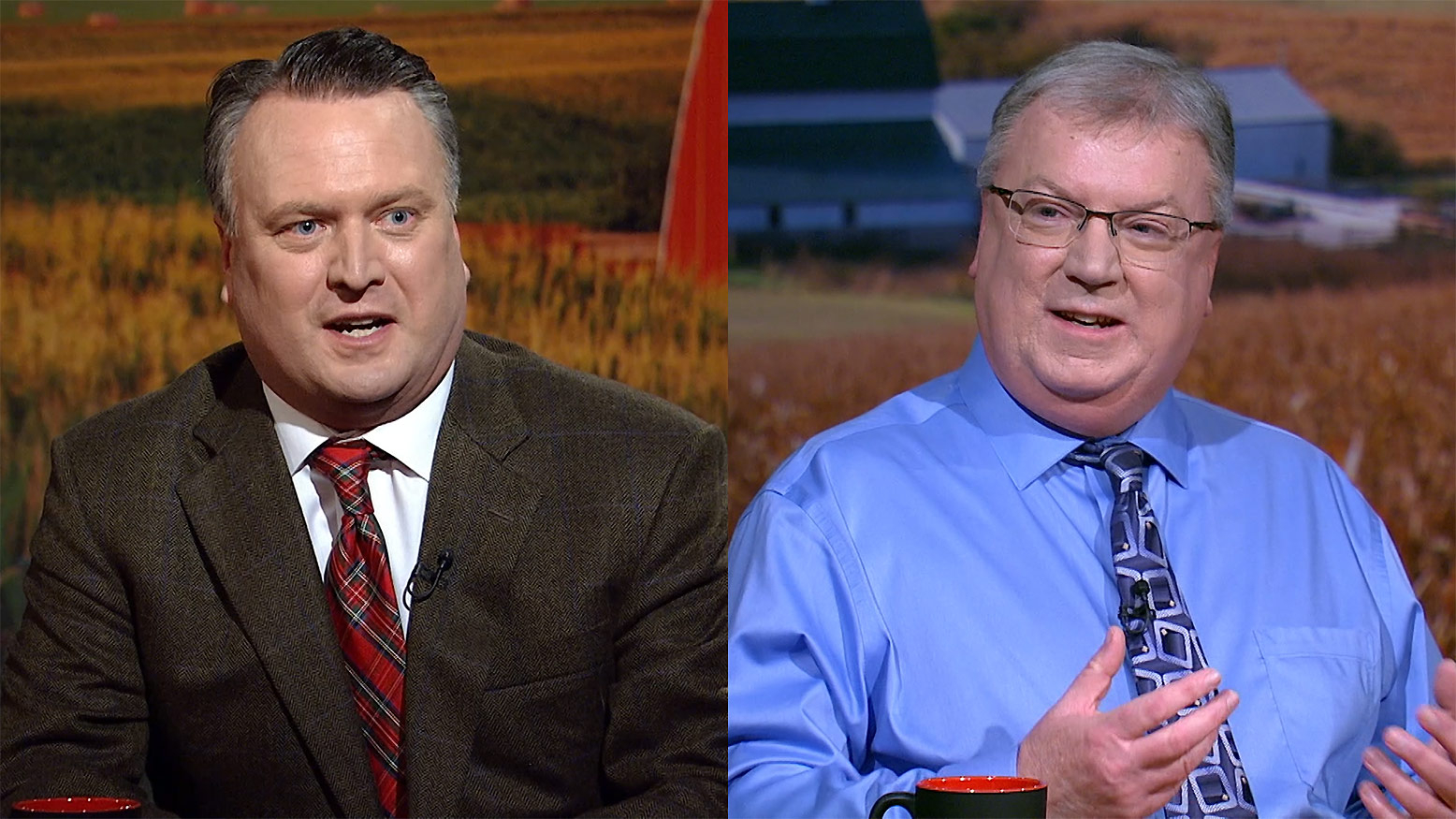


Jeff French and Chad Hart discussed corn, beans, wheat, cattle, hogs, tariffs, China and Brazil.
[ Recorded: December 23, 2025 ]
Transcript
Paul Yeager: Coming up on market to market as the year draws to a close, we look back at a year of economic ups and downs, economic and commodity market analysis with Jeff French and Chad Hart. Next.
Announcer: I wouldn't be here without my customers. Yeah, I'd like to thank the customers. They're, they're very dear to our hearts. It's about the people that you're working with and the relationships that you have. Thank you, thank you, thank you. Thank you from the bottom of my heart.
Announcer: Tomorrow, for over 100 years, we've worked to help our customers be ready for tomorrow. Trust in tomorrow. Information is available from a Grinnell Mutual agent today.
Announcer: This is the Friday, December 26th edition of Market to Market, the Weekly Journal of Rural America.
Hello, I'm Paul Yeager. The year 2025 could be summed up in just a few words trade. China, cattle and inflation. But there's always more to the story and a need to expand on those topics on why they matter now and in the new year, both on Main Street and the farm. We are recording this ahead of Christmas to allow our production crew and guests time to celebrate with family and friends. Chad Hart is a professor of Agricultural and financial economics at Iowa State University. Jeff French. Well, he's the founder of Ag-Hedger.com. First, though, we do have a shortened trading week. We'll get to the two of you in just a moment. Let's take a look at the numbers. As of Tuesday's close. The nearby wheat contract added $0.07 and the March corn contract gained $0.04. More flash sales to China were announced. The January soybean contract put on $0.02, while January meal increased 3.50 per ton. March cotton expanded by $0.26 per hundredweight over in the dairy parlor. January class three milk futures declined by $0.22. The livestock market was mixed. February cattle lost $0.80. January feeders cut $0.97, and the February lean hog contract improved by $1.48. In the currency markets, the U.S. dollar index was lower by 65 ticks. February crude oil strengthened $1.85 per barrel. Comex gold found one 3860 per ounce, and the Goldman Sachs Commodity Index was up by 13.5 points to settle at five 5370. Let's bring back our guests now. Chad Hart and Jeff French. Jeff, we'll get to you in a moment. I want to start with Chad. Chad, I said four words to start trade China cattle inflation. Which one of those is the most impactful and important in rural America today?
Chad Hart: In rural America? I would still argue inflation when we're looking at how costs have increased across the board over the last several years. You're looking at that impacting not only the farmers as they're looking at buying their inputs. But let's face it, anybody living out in the countryside, it just costs more to be out there now than it used to. And so with inflation still sort of rearing its ugly head out there, as it's not quite where we'd like it to be at that 2% range. Still clinging, if you will, trying to hang on at three. That is still a big issue to rule America.
Yeager: Is there a fifth word that we should be talking about.?
Chad Hart: I would maybe add a couple more words. Actually, when I think of interest rates, we're going to see that challenge as well. As the fed wrestles with its dual mandate, does it help the labor market and bring those interest rates down, or does it help knock inflation further down and keep those interest rates where they're at?
Yeager: Well, Jeff, when I ask you those words, trade China cattle inflation or either of you can use the professor's terms if you want. What have been the biggest impact on commodities?
Jeff French: Well, from my standpoint with my clients, it would be cattle and trade. I mean, those dominated the headlines pretty much all year. But that rolls into inflation because we have this administration that is really focused on affordability. And they've been pressing that word here for a time. So that affected everything as well. But yeah, good time for cattle producers this year. But it definitely came well off the highs.
Yeager: I knew we'd talk about cattle, but let's just start if we could for a moment on the week. This is something that I know, Jeff, you and I have talked about several times on how when's that high in and, and it seems the last couple of times it looks like we're getting closer to live cattle top. Is it here?
French: You know, I don't think it's quite here. Now, we technically we close the gap from October this week. That was a big thing for the market to do. But you got to realize we've come 25, $30 off the lows in the fat cattle and $50 off the lows in the feeder cattle. So we've had a good move here the last six weeks. But we're coming into the end of the year seasonally. Cattle typically do rally. We have some nice weather now, but the next couple of months could be dominated by weather. Winter can obviously be a big impact on feeding. But right now, you know, demand remains robust. And the numbers are the numbers. The numbers are going to remain tight into the first quarter of ‘26.
Yeager: So, Chad, when you are the consumer going to shop on the other side of the farmer right here, what am I supposed to do in situations like that?
Hart: Well, as Jeff mentioned, consumers have been bucking up and continuing to buy. Demand has remained incredibly robust despite the higher prices, and I expect that to continue as we look forward here. I mean, one of the challenges I think we're dealing with in trying to figure out this economy is we are seeing that K shape really continue to extend itself into the new year. And so as we're looking at, you know, the beef dynamics, it is that high income consumer that is holding this market up and continues to push it forward. And I don't see that necessarily slowing down in 2026.
Yeager: Ernie Goss used the K letter too at Thanksgiving when he talked. Tell me a little bit more about that and what that means.
Hart: Basically, the idea is that you can think of the economy as sort of split into now, and that if you are a high income consumer, you're still going on as you know, life has not really changed. Yeah, you complain about inflation, but we continue to buy as we normally have been. Meanwhile, on the other hand, if you're a low income consumer, you have seen those higher prices that has forced you to gear down in terms of your consumption. And that is sort of leaving you behind right now, even though it looks like, you know, when you look at the big numbers, the general economy continues to churn on.
Yeager: Well, Jeff, Sunday in The New York Times was a story about the consumer that Chad's referring to and the fact that the high end is still high and doing fine. But the steakhouse on the side of the Interstate one raised its prices. The other one, not so much the one, not so much is still super busy, so people still are willing to pay on some increases. So what does that do from a standpoint of analyzing these markets and understanding patterns and trends that might be ahead for this cattle market?
French: Well, I mean, when I look at the cattle market, I still look at it as a hamburger market. I mean, that's what drives the prices. And right now, I think nationally we're right around $7 a pound. I think consumers are willing to pay up for that. I mean, we have not seen a decline in hamburger demand. Now, if you see some analysts out there projecting $10 a pound hamburger next year during 2026, you know, I think maybe that's a price point that, you know, you start to cut into demand. But we're just not seeing it yet.
Yeager: And I mean, do you agree with that sentiment, that number, if there's a certain number that scares somebody, it might be a ten for ground beef.
Hart:: I'm going to argue we probably get scared before ten, but definitely if we were to get to a ten, yeah, that's going to change some people's minds out there that I would say we've already seen some folks change, but it's again, this case of is that worked its way far enough up the income ladder to truly change the needle here.
Yeager: Well, let's finish with feeders, if we could for a moment. Is the retention happening now? Are you starting to see a pullback a hold back?
French: If you look at the on feed numbers it's not happening at a rate that we're going to notice very quickly. You know we've had a nice bounce off the lows here. You know again we'll look at the weather the next couple of months. But I think, you know there was a big run up in the cash market during December this month. There was a lot of people that wanted to spend some money before the year. The end of the year. And I think we've kind of plateaued up here, but we'll just have to see what weather brings here in the next couple of months.
Yeager: Well, Chad, let's discuss then, some of the area that you cover in the state of Iowa. What are you hearing from producers? Are you hearing anything about retention, expansion? Consolidation? I mean, what's the buzz in the land?
Hart: I would say it's mixed. The idea is that, you know, there are a few folks out there definitely looking to expand others. Nope. Not in that mindset yet. And so that is the challenge right now, is it's going to take us a while to truly see an expansion coming on. And even then, once we get there, the question is, how large an expansion will it be? We have fewer folks that are willing to participate in the cattle industry these days, and so it's going to be a challenge to see how quickly we might build up. Or to put it another way, how slowly we might build back up.
Yeager: And I know Iowa's your focus, but you've got roots in other areas. You've got friends in other areas. Is this the same in other states in the country right now?
Hart: Are it sort of is. And I would argue it's similar because, yeah, the worries about the weather. But also, let's face it, there's a lot of risk when you're talking about, you know, calves at five bucks a pound on the hoof. That is a lot of capital to be putting in right now. Not sure that you're going to hang on to these prices throughout the lifetime of that calf.
Yeager: Let's stick in the grocery store. You mentioned inflation and the prices that people are paying. We're still shopping, government shutdown, whatever you want to use as an excuse why we didn't shop or did shop and we just continue on. What's the mindset? Is the mindset different in 26? Is it going to be different in 26 than it was in 25? That's where I'm trying to land.
Hart:: I'm going to argue, no, not really, because in this case, you know, what we saw was, again, the split within the economy. I'm going to argue that the split is going to continue into 2026. And in fact, if anything, it's likely going to let's call it, harden as we move forward here that those that haven't felt the pinch know they're still going to be just fine. But those that have been trading down, it's going to get even tougher now, especially if inflation is going to remain up here in that near 3% range.
Yeager: You're about to hit the well, you're always on the speaking circuit, but you're about to get really busy in January, February, March. What's the title of this year's presentation?
Hart: Let's face it, I get to play up my Dr. Doom persona. So I'm here as we're looking here, that 2026 from a marketing perspective, I'm going to argue another very challenging year. And while it's I wasn't going to argue, not as dire as it could be, it's also not improving very much. 2025 I argue we got to trend, you know, sort of tread water for a little bit here. Our prices didn't move all that much on the crop side, but neither did our costs. And so that's going to keep us at a breakeven at best and probably well below breakeven situation for most crop farmers.
Yeager: So he's coal, what are you?
French: Well, I mean, it's you look at the inputs and you look at the prices. I mean, for 65 new crop corn and 1075 new crop beans. It's, you know, he's not going out on a limb there. I mean, that's just it's hard to get a margin at those prices. And we are, you know, everybody's looking at Brazil. And if there's going to be a weather problem. But, you know, we'll get through the month of January and, you know, into the month of February, it's hard to really ruin that crop down there. So yeah, it could be another difficult one. There's no question.
Yeager: Let's talk beans for a moment. From the perspective of what you just said. Bigger story for the soybean. The U.S. soybean farmer next year. Is it China or is it South America?
French: Well I think it's both. I mean, you can't talk about one without the other. I mean, you got to have the Chinese demand, number one, you know, they are you know, it looks like they're going to fulfill the 12 million metric tons. You know, it's estimated that they're close to 9 million metric tons right now. But, you know, Brazil is planting 120, 122 million acres of beans. And, you know, they don't look like they're going away anytime soon. So it's it's going to be an uphill battle, especially if they have good weather.
Yeager: How much longer can we wait till we hear the word delivery on those purchases from China?
French: Well, I mean, I think it's happening right now. I mean, it's, you know, they're taking delivery. They're having the auction reserves right now. They've had three state auction reserves, but the purchases, you know, every time they announce a purchase, the futures actually goes lower. You know, we're actually moving higher on the anticipation of purchases. So, you know, maybe if they stop buying, you know, maybe it will actually give the prices some support.
Yeager: Don't say that out loud. You'll get in trouble, Jeff. What do you think South America or China is a bigger deal?
Hart: Next year I'm going to lean more towards South America. But I would agree that you can't separate the two. And when we're looking here, you know, trade looms large across the board when it comes to soybeans. China will dominate where that plays out for us. And yeah they have been purchasing I know you know we're catching up on the weekly export sales data. And they just had another release this morning. And you know, that brought China up officially in that data up to about 5.3 million metric tons, which is again, it's still a couple of weeks behind where we are right now, but it shows we're on that path in terms of sales. But when you look at accumulated exports thus far, only 273,000 thus far. So what that tells you is there's a lot that has to move here within the next month, month and a half to fulfill that agreement that we've struck with China.
Yeager: If I'm a producer watching this and gathering with family and friends this weekend, when I'm looking at beans, am I? I'm not happy with certain things. But what can I do to put myself in a position to maybe sleep a little bit better in the new year?
French: Well, I mean, you know, beans, a month ago, we're at an 18 month high. You know, we moved a lot of beans up there. You know, it wasn't the best we've ever done, but it's been the best that we've had in the last 18 months. So I'm looking at 1050 or 1060 in this March. It's a 200 day moving average. We just broke $1.20. You know, personally I think, you know, we firm up down here. You know I just feel that if you made some higher purchases or excuse me, some higher sales, you use this break to, to maybe re-own them back on paper.
Yeager: And you mentioned the 200 day average that has become extremely important for this one. And the corn market, they're more at the 100 day moving average. But tell me why that's so important?
French: Because the funds trade heavily in this market and they trade heavily on technicals. And the funds ran this market up to 18 month highs. And now they've kind of shed some of that long positions. They were long over 250,000 contracts. Now we didn't know because the government was shut down. But they've started to decrease some of those long positions and 200 day moving average from a technical standpoint is very good price support.
Yeager: Let's talk about corn then. It's near that 100 day moving average. That one has had a little more strength as of late. How do you like it moving forward?
French: You know corn is just it hasn't done much in the last six weeks. I mean, it just has stayed in this 20 cent range, you know, from a hedge standpoint, I'm looking at 435 on March to the downside. If it gets below there, we'll probably move some more. And then 452 on the upside, if we close above 452, we're going to start owning some of those sales that we have on the books. But you know, this market right now, you know, we're the week before Christmas going into New Year's. It's just going to be very choppy here.
Yeager: And what do you think of the new crop situation?
French: Well, I still think, you know, we've seen some estimates 93.5 to 95 million acres of corn. I still think that's a lot of acres. But when you look at the prices for next year, it's not hard to see why there are going to be more corn acres.
Yeager: Chad, when we look at acres in the discussion, where do you not necessarily sit with acre numbers, but the impact, if it goes one way or another?
Hart: Well, that's the I think as we're looking here, everybody is figuring it's going to be a hard time in 2026. I describe it as where do you go hide. And typically where do we go hide? It's corn. That's what we did this past year in 2025. And that's probably what we're going to do again here in 2026. Because if you think about it, I mean, what has been amazing about the corn market this past year is here we have we planted 98 million acres. We're producing well over 16 billion bushels, the biggest crop we've ever seen. And yet prices sort of held together. We didn't see a massive crop crush the market. It was already down there, but it didn't really move. So that gives us at least a firm base of support at where we're at right now.
Yeager: Firm base of support or false optimism?
Hart: I don't think it's false optimism, but it's also the case of when we're looking here, if you want me to try to give a, let's call it that ray of sunshine out there, when you're looking at the corn trade right now, we are seeing that we are well priced. We're moving a lot of crop internationally here, and a lot of that movement is because when we're looking at this, you know, we were talking about beef earlier, global demand for protein remains very strong. And that's helping promote usage of feed grains. That's really helping the corn market right now.
Yeager: Stabilize. Can renewables be a major factor in this discussion too?
Hart: They could be. But I'm going to argue for 2026. No, probably not here. In this case, we can set up for growth in 2027, 2028. But as far as 2026, what we've got is what we have, because the really change on a bio renewable side, I need to see growth in sort of capacity. How can we produce more fuel?
Yeager: Where do you see a growth in demand for corn?
French: Well, I think it's two places that I see it. I mean, the exports I mean, we've gone to a price and that's what, you know, when you're in a surplus like we are, I mean, the market has to go to a price where it attracts demand. And the exports have been phenomenal. I mean, we're running 70% higher than last year. I mean, we're on pace for 3.6 billion bushels of exports of corn. I mean, that is phenomenal. But then you look at, you know, do we increase the cattle, that number that big to on feed. Not in one year. So I think it's definitely you know, it's got to be come from the renewable. But you know that's going to probably take years in the future.
Yeager: And then are you more bullish ethanol or the renewable diesel side or from the soybean and the crush?
French: You know I think near term I think it would be ethanol. I think we could increase our capacity there. E-15 would be a quick fix to that, in my opinion. You know, the EPA needs a rule on this RVO. They've been kicking the can down the road for long enough. But yeah, that's one place that we could definitely increase.
Yeager: Let's talk wheat for a minute. That's a commodity that there's a lot of. Do you see that changing anytime soon?
French: No. I mean people want to talk about you know, we're going to be setting some record temperatures this week. You know, maybe if some come out of dormancy and we see some winter kill next, you know, I like selling winter kill rallies. I mean, wheat has nine lives. We've seen that many, many years. But we just got too cheap. I mean, anytime wheat approaches $5, I mean, you just run out of sellers. I mean, I've been doing this business for a long time. I mean, it's been under $5, maybe 3 or 4 times in the last 15 years. I mean, it just doesn't happen very often. So I think you got down to these price levels that, you know, people just said, I'll take my profits, buy back my short positions. And they ran out of sellers.
Yeager: Is there a global story to wheat for you, Chad?
Hart: There is a global story there. But right now it's been the case of, yeah, we got ourselves priced well enough that we were able to move. What was our excess product? If you think about it, what we saw was a lot of growth and export sales for hard Red Winter over the past six months. That's been helping provide some support here. But we also know that that market will change. It's very fickle when it comes to global wheat trade.
Yeager: Fickle. That could be not necessarily my middle name, but somebody let's close with hogs here before we get to a larger picture. A report came out just before we rolled here on Tuesday.
French: Yeah. Just briefly able to summarize the numbers. This stops six quarters in a row of lower hog numbers. We got 1% above last quarter for all hogs and pigs. The numbers are still pretty tight. This market is in good hands, especially with record high beef prices. I think the pork is going to find good demand. You know, look for February in that 88 to 90 cent range. That's where you know I'd probably be looking to play some hedges.
Yeager: All right Chad let's let's look at it this way. If you had to summarize 2025, we talked about, you know, words and phrases. Are we going to look back at this year as good for rural America?
Hart: Let's go backseat. I would argue the word is k-shaped. It's true. The general economy. It's true of the ag economy, as we've just been talking about here, the livestock side, things are looking decent. You know, we've got really strong prices, decent demand. But yeah, we got some high costs there. Crop side. No, we're struggling and continuing to struggle. It looks like it's going to hold that way for a while. And let's face it AG tends to shape or the rural economy goes.
Yeager: And the or the equity market itself, you know, as we keep rocketing a lot of those places at this point, are you seeing any change in that direction that will impact us here?
Hart: I'm not sure we know exactly where we're going to end up next year. I think there is, you know, like we saw within the Fed over the past six months, they're searching for which way do we move from here? Forward. They've moved down a little bit to help us deal, you know, to keep the labor market moving. But at the same time, to know inflation has been rearing its ugly head, but it's showing up in weird spots. I'm thinking about that on my drive down here today. You know, driving down. And first time I got to see gas prices under $2 a gallon in quite some time. So we are seeing some price relief in some areas while still staring at record high prices and others. And so it really just depends upon you as a consumer. Which market are you in right now?
Yeager: How optimistic are you? About 26?
French: Well, I mean, being in this business, I mean, you have to be optimistic. I mean, to put a seed in the ground in the spring and hopefully make money off of it in the fall. I mean, you're, you're, you're optimistic. So I'm always optimistic. And, you know, it's a great living to be in.
Yeager: Is there a commodity that you're most optimistic about?
French: You know, I, I wouldn't say most optimistic, but I think the has some of the most bullish is the cattle. I just think cattle are high. Prices are here to stay. I just think, you know, with the stock market the way it is with the consumer, with the numbers. I just think beef prices could continue to move higher.
Yeager: So you're saying I'm going to say cattle a lot again in 26?
French: Yes you are.
Yeager: Do we see that changing in 27. Do you want to stick, you want to go out that far?
French: Are potentially. But there's a lot of things that can happen. And what will dictate, you know, cattle breaking is something that like what we just experienced, you know, it won't be fundamentals. It will be either, you know, something in the stock market or the administration, but the supply and demand right now remain very friendly.
Yeager: Crude oil below $60 again this week, Chad mentioned the gas prices. What's that do for? I mean that's one of those inputs that's changed a little bit for somebody. Maybe not all the farmers, but everybody at home walk me through that drop and the impact, the importance of being below that number.
French: Well it just trickles down to everything. I mean, it just gives the consumer more discretionary income and, you know, where they go spend that. I don't know for sure. But it would be one of my first top picks would be food. So yeah, it it definitely helps out the consumer. No question about it.
Yeager: I'm going to make you say one word to what we should give me. Give me one thing or two things to look at in 26 real quick?
Hart: I'm going to continue to say exports. Okay. We need to watch how the international market's going to pull on us as we move forward. One of the big challenges as we look at how we got in this mess in 2025, is we've been able to supply the demand that we've had, so we've got to move it.
Yeager: All right. We got to move out of here. Chad Hart good to see you again. Jeff French. Great to see you as well. Merry Christmas to you both. Merry Christmas. Thank you so much for what has now become a little bit of a tradition. And thank you. You've been watching the analysis segment and in a moment we will continue this discussion in our Market Plus search Market Plus with Chad Hart and Jeff French. Wherever you get your podcasts. To hear that conversation or go to our website of Markettomarket.org. Our gift to you comes three times each week in the form of podcasts of Market Analysis, Market Plus and the MtoM. Subscribe wherever that you get your podcasts. Next week we look at the biggest news stories of 2025. Thank you so much for watching. Have a great week!
[MUSIC]
Announcer: Market to Market is a production of Iowa PBS, which is solely responsible for its content.
Announcer: (Pioneer) I wouldn't be here without my customers. Yeah, I'd like to thank the customers. They're, they're very dear to our hearts. It's about the people that you're working with and the relationships that you have. Thank you, thank you, thank you. Thank you from the bottom of my heart.
Announcer: Tomorrow, for over 100 years, we've worked to help our customers be ready for tomorrow. Trust in tomorrow. Information is available from a Grinnell Mutual agent today.
Trading in futures and options involves substantial risk. No warranty is given or implied by Iowa PBS or the analysts who appear on Market to Market. Past performance is not necessarily indicative of future results.