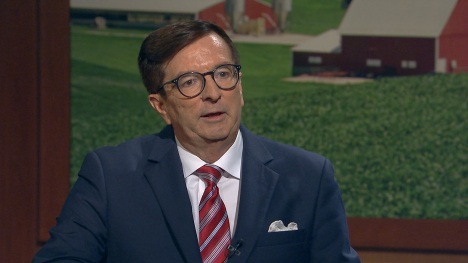
John Roach discusses the economic and commodity markets in this web-only feature on corn, soybeans and livestock.


John Roach discusses the economic and commodity markets in this web-only feature.
Transcript
[Paul Yeager] Welcome back to the table for the Friday, January 9th, 2026 installment. Market Plus Senior Market Analyst John Roach. Still with us here, John. Thanks for coming back in December. Sorry I missed you.
[John Roach] Hey, listen, it was cold, but it's nice today.
[Yeager] Well, let's talk weather a little bit. Rain in Iowa, Minnesota, Wisconsin, South Dakota, Missouri. But we're not getting the rain in Oklahoma and Texas and other areas right now. What? What does a weather story look like to you in the in the United States in winter?
[Roach] Well, you have to see some ratings drop when you're looking at the winter wheat crop. You need to see ratings that start to worry you, and where it shows that it's drier than prior years and the ratings are not worrying anybody right now. And so what needs to happen is that it needs to we need somebody reporting a a neutral third party observer reporting that is causing us a problem. And that's not the case.
[Yeager] Well, in the wheat side of things, we talked about it during the show about some declining ratings on the crop. At what point does that translate into I mean, it's been so good in some of those areas for getting their pastures back. What part of that equation comes back into this cattle discussion and feeder discussion with the weather? Is it something that ever appears in January and February?
[Roach] That's a really good question. The the weather situation normally starts to impact us calendar wise in February. And so that would be maybe my first response is don't look for it in January because it's too early unless it's really a problem situation. And this year doesn't appear to be.
[Yeager] Like you get snowed in at the airport and you can't go anywhere. All right. But February, February watch February weather because we start to pay attention as wheat comes out of dormancy or is about to come out of dormancy. That's when we really pay attention.
[Roach] Or we have that freeze thaw, freeze thaw business that causes problems.
[Yeager] But again, same time of year type of thing. Okay, let's get to the big story, which is Monday. And we've heard this referred to John in the past. All the major sporting events or world events come together at one on Monday. But this one is big. So let's do Gary in Wisconsin, if we could please to lead us off, how big is for 50 corn going to be Monday, both as a resistance level and the mentality for farmer selling?
[Roach] Well, the mentality for farmer selling is farmers don't like that price. And so I don't think that will change regardless of what the government says. But but the market is stuck here. We're we're right at the 20 day moving average. And so we've got to get something to boost us up through that. And, and we'll have to wait for the government to do that if, if that's where it's going to come from.
[Yeager] You talk about the 20 day moving average. But really if you go back, the 200 day moving average hasn't really moved much either.
[Roach] No it hasn't. No, actually it's the same situation we've been in about the same price range really going all the way back to August.
[Yeager] So why?
[Roach] Because that's the balance between the supply and demand. We're able to source the inventory that we need to source. We've been able to handle the the fund, the spec fund. I put them together.
[Yeager] I do it all the time. You're okay.
[Roach] The spec fund buying and selling. We've been able to handle all of that in this price range. When the price gets down to the lower side, the users come in and start to accumulate. When they get to the upper side of the range. Farmers step up and start making sales. And so that's confined us to this range of trade. And it's probably going to continue for a while because the supplies are plentiful.
[Yeager] But let's throw in the big but on Monday. What if it can't speculate? No one can outguess this report. I mean, you're kind of guessing. You've kind of given us some guidance on some things. Is this the type of day that can be a black swan day? Or maybe is that too extreme of a term to use on news that could come out on Monday with numbers?
[Roach] I'm not sure if I call it extreme, but it's sure an optimistic thing. Farmers are hoping for some sort of a black swan that causes the market to stage a big, major rally. In my opinion, that's you shouldn't look for that. It may come, but. But that's not what you should look for. What you should look for is take a look at what your prices were at the peak in November, early December, and take a look at what the prices were at the very bottom of the market back here just a couple of weeks ago, and expect the price to stay within that range for a while, and the government won't tell us anything that takes us out of that range. If it does, I'll be surprised.
[Yeager] And as you have said time and again, dribbling a little here, dribbling a little there at certain times benefits us in the long run. Right?
[Roach] Well, what I like to do is to sell the peaks. I like to sell the the cycles. The market has you cycle from a low to a peak to a low to a peak. I like to sell the peaks, and I like to avoid selling anything at the lows. And so that means you have to look out and see how many bushels do I need to sell to pay my bills. And on the next peak, I want to get that number. Bushel sold.
[Yeager] All right. Let's talk about Brazil. If we could for a minute. Phil, in Ontario has the next question. USDA is saying that the Brazil soybean crop is 175 million metric tons, but some estimates put it closer to 180. How is this possible? Future reality weighing on soybean prices now? And is there still time for a weather related calamity?
[Roach] Well, there's certainly time for weather related calamity because we have beans that are being harvested right now, and you can have problems during the harvest with with too much moisture. And we also have beans that are just being planted in Matto Grasso. I think there are only 93% planted right now, and we certainly could have a problem in that area of raising the crop. So that's certainly a possibility. But the probability is diminishing because we're actually harvesting and the crops the harvest is pretty good. The yields are pretty good. So as you take it off of the field and put it into the bin, the risk goes down. And the closer you get to doing that, the risk goes deteriorates away. The biggest concern that we should be looking at right now is what their Supreme Court says about the. Tearing up parts of the of the forest in order to plant new acres. In 2006, there was an agreement where they gave some tax benefits to the buyer. If they did not buy crops from farmers, farmers that had that had torn up the forest and and that the farmers in Brazil are appealing that. And the Supreme Court is due to come out with a judgment. The talk this week was that they're delaying it maybe for 120 days, but it still appears to me like that. Unless something changes, they're going to open up additional acreage for farmers to plant. And for the 26 crop. And and so that's the biggest worry that I have out of South America. And it's not a positive worry. Obviously, it's a negative. We more acres there is more competition for for farmers and the rest of the world.
[Yeager] More acres, more bushels. And for the American farmer, possibly more problems.
[Roach] I think. So I mean, that's my that's my concern. Now, obviously that that can change. But at the moment the pressure is to, to try to. And if you look at it from a standpoint of a farmer, you'd like to be able to to farm your farm the way you'd like to. And, and so, so that's that's right. Now what the farmers in Brazil are asking for.
[Yeager] All right. I want to thank Ethan Holtz view Boyce, Phil, Jim and Brad for all your questions, but I've got time for one more Keith in North Dakota, if we could, please. Keith is wanting to know what's your opinion on whether China front ran the soybean purchase agreement by buying the board ahead of the announcement? We kind of talked a little bit about this earlier.
[Roach] I think what China really did was they they they allowed the funds, they couldn't prevent it. The funds bought the soybean market back in August, September and October and ran it up in November and made a peak there in November, maybe just before the latter part of November. And, and at that point, the Chinese said, we're never going to buy them. We are not going to buy the beans. And the administration said, oh, yeah, they will. They eventually will. And they played their hand very well, and they let the market slide all the way back down. And then accumulated on the downside slide and, and, and have purchased something in the neighborhood of something in excess of 8 million tons, maybe up to as much as 10 million tons of the 12 million tons they promised they were going to buy. And had we talked about this in the 1st of December, the question was, well, how could they possibly do it? But but they've actually done it. And they waited for the market to slide lower thanks to the fund liquidation, which pressured the price down in order to get the job done.
[Yeager] You mentioned the optimism of a farmer. There's still the pessimism of well, well, we'll see when China takes shipment and we offload that grain, they could still see a cancellation. That's their concern too, in this market. Is that yours?
[Roach] Well, I think that that that that's certainly a reason for to be a little bit concerned. But I think that the Chinese seem to be willing to do what the U.S. administration wants in order to be able to continue to have trade with the U.S. and not have and not have tariffs be raised. Remember, this is a this is a piece of a bigger deal. And so far it appears like the Chinese really don't want to get crosswise with the Trump administration.
[Yeager] And we could go back and forth on that for another reason. But I want one last thing on the economy before we close, because we also talked about that in the main program jobs report was a little better, but not as good. Could give credit to lowering interest rates as you look into your crystal ball for 26 in the economy, what do you see?
[Roach] I think the economy looks very positive here. I think what we've done all year long is we've worried and worried and worried about the economy and the economy is has outperformed everybody's forecast. And so as we look forward, it's how much of this is A.I., how much of this is the reduction of of. Regulations and rules and so forth from the government? How much of this is happening because of tariffs? How much of this is by the trillions of dollars that are supposed to come in in this country for investment? I mean, I don't know the answer to all that, but the economy is much, much better. As we begin 26 than anybody anticipated that it would be. And so I think that we just look at it at its face value and say, whatever these things are that are coming together, they're pretty positive right now.
[Yeager] And we'll look at it the next time when you come back. How about that?
[Roach] Thanks. That sounds good, Paul
[Yeager] John Roach everybody, appreciate your time. Thank you. And next week we're going to break down that USDA report. Naomi Blohm Ted Seifried will be here. Thanks for joining us here in Market Plus. Be sure to sign up for the Market Insider newsletter and all of our social media channels. We'll see you next time. Have a great week.
Trading in futures and options involves substantial risk. No warranty is given or implied by Iowa PBS or the analysts who appear on Market to Market. Past performance is not necessarily indicative of future results.
Watch More
An E15 waiver at the pump may give benefits to row crop farmers. Encouraging more women to step into leadership roles on the farm. And, commodity market analysis with Don Roose.
This week, the White House worked to reduce high prices at the gas pump and seek some relief from the political backlash over high energy prices brought on by the war with Iran.
Don Roose discusses the economic and commodity markets in this web-only feature.
Don Roose discusses the economic and commodity markets.
Small business lender Ben Johnston of Kapitus breaks down who is really paying America's tariffs, how entrepreneurs are surviving the chaos, and what the ghost of Smoot-Hawley means for the future of American manufacturing.
The Jones Act is pulled out to help stabilize prices. Nebraska spends another week battling wildfires. A drug’s expansion in the marketplace helps spur demand for animal protein. Commodity market analysis with Mark Gold.