Sue Martin discusses the economic and commodity markets in this web-only feature.


Sue Martin discusses the economic and commodity markets in this web-only feature.
Transcript
[Paul Yeager] Welcome back to the table for the Friday, February 27th, 2026 installment of Market Plus. Joining us now, Sue Martin. It's Friday Sue it's a fish Friday. What's your favorite fish fry Friday delicacy? Smelt?
[Sue Martin] No, no.
[Yeager] That's what I grew up with.
[Martin] I tend to like lobster and shrimp.
[Yeager] Yeah that's a very good fish to have on Friday.
[Martin] And sea bass.
[Yeager] Sea bass is good. Yeah, it is one of the proteins. Protein was a big part of the discussion last week with Sean. I want to pick up with hogs because they've had in 2026 some pretty good chart action.
[Martin] Yes they have.
[Yeager] They were the only one up this week. Why?
[Martin] Well, it's first off as the cattle break you're getting unwinding of spreads between hogs and cattle. That's part of it. The other thing is, is when you look at this hog market, isolines are very high priced. And I look at the demand for pork, and I think it's doing pretty well. And so, I continue to be very price positive towards summer markets like June, July. I think we're going to have some good hog prices.
[Yeager] Can you say the same thing about feeder cattle?
[Martin] Oh, those feeders that market. I think the market is probably going to still see a little more decline as we get into March. And then I wonder if we won't try to catch, but we could drop another ten, $15. And when you're going seven, $8 a day, it doesn't take long. But we could drop and then maybe around the 20th of March, somewhere in there, we'll try to catch and maybe rally back into April. Usually, cattle prices are good in April. And then we see how we're faring as we move into June. It's usually not as good.
[Yeager] I want to let Robby know. In Kansas, we did kind of hit your question in the main program, but let's pick up with cattle for just a moment. Sue, we were talking right at the end of the TV show about this strike in Greeley, Colorado. That could have changed from the time we started to record. They have the strike vote to. They've authorized to strike. They've taken a couple of other steps forward that could possibly allow the strike. It's 5% of the beef production capacity, right? Processing capacity, I.
[Martin] Think very much so.
[Yeager] What would that do? And is that any part of this at all? Because, I mean, there's that story of there's been buying ahead of the strike to prepare in case there is.
[Martin] Yes. In fact, that was thought the reason for the good jump in cut out this week for choice and even select. And then we ended up I think on Thursday. Anyway, I haven't seen the cut out this afternoon, but we had select up nicely. But choice was down. I think we have to keep in mind the Packers losing about $300 a head, and he's not going to keep doing that forever. And then you look at not only that, but the situation where like with as we talked about Argentina and per capita consumption, there is down to a 20-year low. Numbers are a little tighter. We may not be getting as much beef in from Argentina as we would think. Then it takes you to Brazil. In the meantime, I think that, you know, part of what also helped break the cattle market might have been the concern about the relationship between President Trump and President XI. Will we not see some exports into China for beef? You know, pork exports were fabulous. A four-week high. And I just have a feeling, in my opinion, the rhetoric we've heard this week, this past week about between President XI and President Trump, I think is overrated. I think it's some of it might have a hair of fake news. Some of it might have a little bit of trying to drive the prices backwards to make it easier for China. But President Trump early on said he would not raise tariffs to China by 10% like he has other countries.
[Yeager] And it goes to your beef or your beans. Comments from the program about you're saying that Brazil's not too interested in selling right now, which that's a lever China usually has to pull. So, they maybe are pulling the yeah, we're not interested. Which then usually sends the market lower. Is that what I'm hearing? You maybe say.
[Martin] Yes. But another thing that we have going on in the U.S. is of course, the EPA decisions sent to the white House Office of Management and Budget and talk and the talk of maybe 50% of rvos going to larger entities. And I think that when we look at this, that first off, soybean oil has been making even on Friday, it made new highs for two and a half years. And that too is helping support the bean market here. And then you have Soymeal and the world production deficit. I should say it this way. The foreign production deficit taking the U.S. out of the picture and leaving Argentina, Brazil, China, all the rest of the world in how bad does the world need soymeal it's record need. And therefore, we are seeing our exports picking up in soymeal. And I think Soymeal has got a story here. Besides the soybean oil, trying to also carry us forward.
[Yeager] Well, how about a story in corn? Let's ask Aaron in Iowa's question, because this one, I think the chart folks really get excited about this one. The role to make corn on the continuation chart is leaving a huge gap. Is it more likely that it pulls corn back down to fill it before we can spring rally? Or more likely, we'll end up a breakaway gap in the end?
[Martin] I don't think it's a breakaway gap. I do think that you're into a caring large market in corn. Why? Because of all the corn on farm. But in the meantime, I also believe that all that corn on farm then creates a little bit of concern about basis. But yet, you know, Thursday into Friday basis was starting to improve. I think that when I look at the corn market and yes, you've got to get your expiration on the march before you worry about that. So, around the 13th, Friday the 13th, I think we'll see that, you know, spread. And then once it's off the board, then we could see the march or they may excuse me, start to shift down towards where the march expired. They tend to do that. That's a carrying charge market where if you're in an inverted market you get out, you're rolling cheaper and it comes up carrying charge. Markets tend to go down. And I will say though, for on a positive note for the corn market, the weekly indicators that I utilize are setting up beautifully to help send us higher. So, I think the breaks are going to find buying in corn. And I also think that when I talk about the long-term indicators on beans, corn looks very similar. It's just maybe a step or two behind. And in a year of a six, this is a year of a six. And since 1916, the last 11 of them one year made the high for the year on corn. So, it could be any contract made the high for corn one year in May, one year in June that year happened to be in 2016, a year of big carryout. And then we had three years where it made the high in July, two years in August, two years in September and two years in December. Nine out of those 11 years did see traditional break in at harvest time. So, I think I'm more positive in the last half of this year, but it'll be interesting to see how we play into May if we have prices that try to break into May, I think it's going to flip us and then send us higher into summer. Of course, it's going to be very much weather related.
[Yeager] Well, it is, and Stephen, Wisconsin is setting you up to continue that part. And I think you kind of answered a little bit. We were talking about weather before we rolled, and it's coming up on an MtoM you had James Romer quoted in your newsletter who's a friend of the program as well. But Stephen Wisconsin wants to know, other than trying to buy acres and corn and beans, what else can rally price before planting? So, planting. So, let's earlier than later that you were just talking about what kind of price range can we expect with a normal weather outlook?
[Martin] Well, for a normal weather outlook, first off, the downside was be what we're worried about. And the downside would be taking corn back to oh, I would have to say first there's a gap on the chart. That's for a lead contract that's not been filled around 403 to 405. So, I would think the market would look at that and try. And then the next thing would be if you can get through that, it's the 390 to 398 area and there's very good support there. If you are able. I don't think we'll get through that. But if you are able then it's the lows of what was it in 2024, I believe we got down to 362, but 362 would be the next ledge. I don't see us getting that low because I think we've got very good demand. I talk about foreign production deficits. Well, you take you leave Ukraine. It was number four exporter in the world. Brazil and Argentina number two and three. And then South Africa number five. You leave all everybody in the world in the data. And that includes China. And what's interesting is the foreign production deficit taking the U.S. out of the picture. We want to know how bad does the world need us. The foreign production deficit is 101.6 million metric tons, a record. So, there is some possibilities of positivity. Exports are excellent.
[Yeager] They have held up strong.
[Martin] Oh, they are, they've been very good. And to be honest with you, we're already well ahead of what the USDA projected we should be even like if we're going to make this time of the year. You know, we're well ahead of a year ago. And I think they're going to have to keep adding in in future reports. And of course, March is where you get some of your bigger reports again at the end of the quarter or end of the quarter, you get your quarterly stocks report along with prospective plantings.
[Yeager] Okay, I've got two questions. It's a dot dash here. We'll do the long one. First Morse code speak. Sorry Marvin A wants to know he submitted this via Facebook. How come grains are so cheap compared to the Dow, stock market, gold, silver, other metals and cattle? When are the funds going to return and what's your upside targets? Every single market I need them all.
[Martin] Okay. Oh, you're hard to please, but I would say when I look at corn, keep in mind December corn, the high was 493 last year and we got up near the 470 area on Friday for 69, something like that. Right near that. 470. So we need to be very cognizant, but we're dropping acres this year and what's going to be interesting is the cost of inputs isn't going down. It's expensive. And with what beans are doing and the optimism on the rvos and the 45 and ethanol Renewable Fuel Standard, it's going to be interesting because I could see corn if we catch weather here, you could see corn come back up and take out last year's high, which on the July contract, I think it did it in May was around 521. And what's more important is to see it take out the high on the December contract. And again, I talked about the longer-term charts and the corn's just a step or so behind the beans. But you know, if wheat's running it's going to pull corn along. And I think that occurred on Friday.
[Yeager] All right. That's the dash. Here's the dot Jeremy in Michigan $5 cash corn or $6 cash wheat. Which one will we see first?
[Martin] Wheat.
[Yeager] Sue Martin always good. Thank you so much for coming in.
[Martin] Now, if I'm just right.
[Yeager] I love it. All right. Appreciate it. Sue Martin everyone. Next week we're going to build an agriculture program. Talk about them and how they are feeding a changing local community. And Matt Bennett will be here. Thanks for joining us. Have a great week.
Trading in futures and options involves substantial risk. No warranty is given or implied by Iowa PBS or the analysts who appear on Market to Market. Past performance is not necessarily indicative of future results.
Watch More
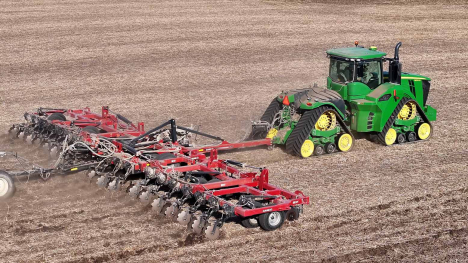
War and High Prices Put Pressure on Farmers with Another Tough Start to Planting Season
Markets react to USDA acreage shifts, crude oil volatility and strength in cattle and cotton.
Chris Robinson says the market was in gift-giving mode this week on the rallies.
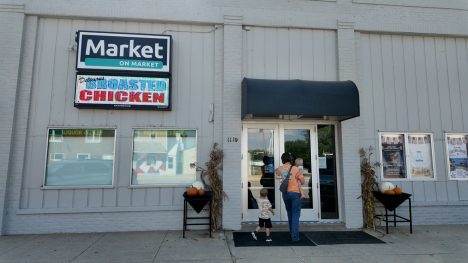
A tiny Iowa town was days from losing its only grocery store, so they just bought it themselves.
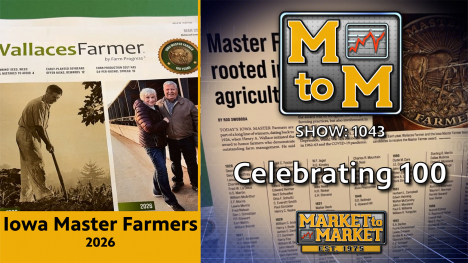
A century of good farming, clear thinking, and right living. That's the Iowa Master Farmer program, and this week we're at its 100th anniversary celebration with the organization's president, a descendant of founder Henry Wallace, and one of this year's award recipients who showed up for the land, your community, and the next generation.
Farmers face more hurdles as they head into the field. A grocery store keeps a community from turning into a food desert. Commodity market analysis with Chris Robinson.