On this edition of Iowa Press we discuss tax policy and proposed property tax reforms.


On this edition of Iowa Press, Sen. Dan Dawson (R - Council Bluffs), chair of the Senate Ways and Means Committee and Rep. Dave Jacoby (D - Coralville), ranking member of the House Ways and Means Committee, discuss tax policy and proposed property tax reforms.
Joining moderator Kay Henderson at the Iowa Press table is Katarina Sostaric, state government reporter for Iowa Public Radio.
Program support provided by: Associated General Contractors of Iowa, Iowa Bankers Association and Robert and Doreen Sheppard.
Transcript
[Kay Henderson] Property tax relief. Will the legislature reach consensus by the end of this session? We'll talk to Republican and Democrat members of the Senate and House Ways and Means committees on this edition of Iowa Press.
[Announcer] Funding for Iowa Press was provided by Friends, the Iowa PBS Foundation.
The Bob and Doreen Sheppard Family. Proud supporters of educational programing seen only on Iowa PBS.
Banking in Iowa goes beyond transactions. Banks work to help people and small businesses succeed. And Iowa banks are committed to building confident banking relationships. Iowa banks, your partner through it all.
[Announcer] For decades, Iowa Press has brought you political leaders and newsmakers from across Iowa and beyond. Celebrating more than 50 years on statewide Iowa PBS, this is the Friday, March 27 edition of Iowa Press. Here is Kay Henderson.
[Kay] We'll start this edition of Iowa Press with just a public service announcement for people who own property in Iowa. Your second part of your property tax payment is due at the end of this month, on March 31. We have a couple of guests here who have a deadline, maybe in April, to come up with a property tax deal. They're involved in all of the negotiations here at the Iowa Statehouse as the April 21 deadline looms for legislators to get their work done. Let me introduce them.
Senator Dan Dawson is a Republican from Council Bluffs. He is chair of the Senate Ways and Means Committee. That means tax writing.
[Dan Dawson] Thank you.
[Kay] Also joining us today, Dave Jacoby. He is a Democrat from Coralville and the ranking member of the House Ways and Means Committee and involved in the debate over in the House. Welcome back, both of you.
[Dave Jacoby] Thank you. Appreciate it.
[Kay] Joining our conversation today is Katarina Sostaric of Iowa Public Radio.
[Katarina] So there are two different property tax bills that have been advancing in the legislature. Both bills, as well as a plan from House Democrats, they all include some sort of limit on city and county revenue growth. That's a central piece of the discussions. Senator Dawson, how will that revenue limit translate to relief for property tax payers, and when will taxpayers see that relief?
[Dan] Well, I guess we have to first settle on how we do the revenue limit and where the percentage is at. But I'd say ultimately in the end, and which gives me a lot of hope for us to find a compromise and a deal this session, is that for my time up there, this is the first time I've ever seen the governor, the House, the Senate and even House Democrats all come in and say we have to limit the revenue coming in. I've always said before, one of the biggest lies in the property tax system for all these years is when a major assessment cycle comes through, and when a local official says, we kept your levy the same or we didn't raise your levy. And the question should never be, did you not raise my levy, but how much did you lower it? Right. And ultimately, that's where we have to get to in the end. Iowa is the 10th highest, depending on what you look at for property tax burden in the country. And when we have major housing assessment cycles like we've been under the last few years, we have to do more than the Band-Aids we've done in the past. And the revenue limitation has to be part of the conversation, because when inflation rises, your taxable rate should come down.
[Katarina] And specifically, the bill that you've been pushing for has included a limit that's sort of tied to inflation to give some more flexibility to local governments. House Republicans and the governor have proposed a 2% cap. They say that maybe the Senate proposal would be too close to the status quo and wouldn't do enough to limit revenue growth. How do you respond to that?
[Dan] Yeah, I guess I wouldn't agree with that assessment. And I'd say we put a lot of thought in how we wanted to go about our limitation. I mean, one, we know it has to be something meaningful, right? Which is where we land at 2%. At the same time, two from a Senate Republican standpoint, we don't want to be micromanaging local government budgets every year. Right? You know, I think we could both agree that when it comes to the education side of the first 30 days every year, that can become pretty political. And that's just 300-some districts out there, right? If we want to, you know, have a limitation that is so stringent, that's not workable, we will be back on multiple years trying to make adjustments. Right. And I don't have much of an intention to renegotiate with 940 some cities and 99 counties and all the other taxing jurisdictions out there is 2% accurate, or should we act more? I think what we put in place is a very responsible and thoughtful approach, where what I would call is a soft cap, where we exclude pensions, where we exclude tort liability, some of these unexpected things that do come into local governments out there. As well as I think it's a pretty reasonable approach that when inflation rises to a certain point, there is an automatic lever in there that provides additional relief. It's not an automatic one for one, but something where I think from a long-term standpoint, building a system that is sustainable, it avoids the legislature having to come back in and micromanage these higher inflation environments.
[Katarina] And Representative Jacoby, House Democrats proposed a 4% revenue growth limit. You know, local governments in general are looking at these proposals, and they're concerned that, you know, with their costs rising all the time, that if their ability to raise revenue is limited, they won't be able to meet the needs and the wants of their, of their local communities. How do you respond to those concerns from local governments? And why is 4% right, do you think?
[Dave] Well, just as a point of clarification, some of the plans being offered by House Republicans and Senate Republicans is limiting the revenues for our local government. The House Democrat plan is actually limiting the liability for homeowners. In other words, that 4% cap means that your total tax liability for the following year cannot go up more than 4%. If you pay $1,000, there will be 1040 at the most. If it goes up at all. We don't limit the revenues. We're limited to each homeowner. And also we like to take a look at the two S's, certainty and simpleness. Is the plan going to be simple and it's going to be certain. Our plan offers that certainty to every homeowner. That's also why in the transition to a new plan, we like the idea that we actually rebate every homeowner $1,000 and every renter $500. Because in the transition to any new plan that comes out of the state legislature, city governments are going to be making transition, as with counties. But also currently, the economy is not very strong in Iowa. And I would argue the Reynolds Trump economy is hurting more middle class families now than they have seen in the past 30 years. We have more Warn notices that have gone out and in the last 14 months than we've seen in 30 years. And a Warn notice is the notice you get every time a company lays off 50 or more people. That's what concerns us is that we see a lot of people feeling the strain of everyday living. Our plan actually puts money in their pocket right now and helps the transition to what the property tax outlook will be over the next five years.
[Kay] Senator Dawson, the plan that Senate Republicans have put together includes a gas tax increase. Briefly explain it, and also I'll follow up by talking about the fact that that's not included in the other plans that are out there.
[Dan] Yeah. When we've gone through tax negotiations in the last few years and we've talked to local government, right, whether it be counties or cities, and our local constituents, one of the top things we always heard was we want to make sure we have good roads and bridges, right? Iowa is very unique, where in our Constitution, every dollar that goes into the road use tax fund, which is where gas tax monies go into, is constitutionally protected. Right? And so, as we try to figure out how can we deliver the most relief for Iowans on property taxes, we're not naive to the fact that there are some services that need to be provided that are very high-ranking on what Iowans want. Quality roads and bridges is one of those, right. Over half the states in the United States actually have some type of indexing on the gas tax. Iowa has not dealt with the gas tax for over ten years now, right. The value of the dollar that was applied back then to rebuild our roads and bridges is diminished from what it is now. So, what we tried to incorporate here is while we try to do a dynamic plan to rebuild local government funding system, how do we make sure that we can have good quality roads and bridges? So, the plan we provided there does multiple things. One, it finds a CPI factor and it says if there is inflation a certain year, then the gas tax can go up to a certain extent. Now the circuit breakers in this are is one, can't go up any more than a penny on any given year. Two, that it can't go up every year consecutively. There are time-outs, there are pauses, where if it goes up more than 2 or 3 years in a row, it takes a pause. And three, the legislature has an ability to come in and suspend that every year. That's what the plan is. And that's how, again, it's not just a property tax cut. It's how do we rebuild local government funding here in the state of Iowa, which is why that's part of our proposal. We could raise a bunch of other give them some other revenues, but we found a lot of times let local governments raise revenues, what are we going to get? A drone show. We're going to get some new environmental coordinator or some random administrator in local government, right? This is something that we can tell Iowans. I can guarantee you, if this goes up, this will go into that. And frankly, just one more example last year, because I'm really disappointed in some of the associations in their rhetoric. And I think it's actually pretty disingenuous from these associations. But the reality is this. Last year, if this bill was in place, the gas tax would have went up 6/10 of a cent. The average Iowan, a family of four, would have seen their taxes go up $8.44. That, to me, is a tremendous deal with the promise in the end to eliminate your property taxes on a homestead. This is what we're talking about when dynamic reform.
[Kay] But in the current environment, people are seeing gas prices go up a lot. Do you think Iowans want to see their gas tax raised?
[Dan] Well, what I would say is this, because I've heard that rhetoric there from some of these associations who, quite frankly, have never come to the table in the first place. Right. You have tax associations out there that say they're fighting for the average Iowan who literally bring nothing to the table every day at the legislature on how to reform the system. But they have their national priorities there. And the reality is, when we talk about 6/10 of a cent, $8.44 a year, the current conflict in Iran went up a dollar in a week. There are far more factors out there that actually impact the day to day than a long term plan to rebuild our roads and bridges.
[Dave] I couldn't see worse timing in terms of talking about a gasoline tax. If we're talking about CPI, maybe we should use that for minimum wage and help raise a bunch of families in the state of Iowa where they at in terms of their household income. Iowans, not from association, but people I've listened to. People when we have a little fire pit at our driveway and they talk, they're worried about gas prices right now. It is hurting them. When we're talking about some of the pieces in the property tax for first time home owners, one of my neighbors said, how will we have any money to invest in a first-time homeowner 529, because we won't have any money left over at the end of the week to invest? So right now, people are worried about how we're going to get they're going to get through to the next two weeks. And when we talk about gas tax, the road use tax fund is solid in Iowa, but it needs some reforming too. We need more, we need more input in terms of what our county and city governments need from the state, because the state has abdicated in its role in roads and bridges for a number of years. And it's always fallen back on our UTF say we have it or we don't. I remember back when the state gave Iowa City and Coralville Highway 965. Instead of the state maintain it, the cities maintain it.
[Katarina] One of the common threads in some of the property tax proposals is specific relief for seniors. And I know, Senator Dawson, your bill proposes eliminating some property taxes for people, seniors who have paid off their mortgage, along with some exemptions for other seniors. I guess, why should people who paid off their mortgage get a tax break from when they're still using local services? And then there's, you know, other families that are having to pay their mortgage and, and property taxes.
[Dan] Well, I think it goes back to the Senate Republican philosophy, right? You know, where we're trying to rebuild a system that you either have property you own for your family, property you own for income. And at what point in time do you actually get a chance to own your property, right? Whether I mean, I have a lot of other things I'd like to do, but to do something responsible. But at the same time too, isn't it right for someone to be able to actually own their property at some point in time? I was talking to someone actually yesterday and essentially never thought of it this way, you pay for your house twice in your life. Once you're actually paying for your house. But if you add up your property tax bills year over year, you're actually paying it for a second time. Now the point is well taken about services, but at the same time too, shouldn't an Iowan be able to own their home at some point in time? And that's the thrust of the Senate Republican proposal. Is that essentially, in the end, at some point in time in your life, you have to be able to stop paying rent on your house to the government. You have to be able to own your house. And that's where the crux of this discussion comes to. How do we rebuild a system? And how do you actually own your own home for the family in the end?
[Kay] Representative Jacoby.
[Dave] Well, the concept of freezing seniors’ property tax rates is something that we're looking strongly at. We want seniors to stay in Iowa, but we also want the cities and counties and schools and community colleges to be able to offer services. So, a freeze for seniors is one concept. The concept where there's no property taxes for people who own their home is just a way to back the rich even more. In other words, if you could pay off your house when you're 30, then you have no tax liability going forward. What that means is it squeezes the people who have a 30 or a 20-year mortgage. It doesn't work. And that's what worries me most about the plans we see in front of us is I don't see them working. I don't see how they're going to be effective. Because quite frankly, when we're sitting around that driveway around the fire, when I mention property taxes and property tax reforms, the most common response I get are, yeah, right. We've heard that since 2013, and no progress has really been made.
[Dan] Well, I would just say, just to follow up on that, the House Democrat plan is exactly what we're trying to avoid, right? When you say your property taxes can go up 4% a year, when you throw in a bunch of credits, people don't believe it in the end. This is why the Senate Republican plan is different, where you actually change the dynamic of the whole discussion, say, at some point in time in your life, your property taxes actually go away. Not a promise for a 2% increase or a 4% increase, or we'll give you this credit there. Actually, where you can own your home. Because I agree with you, representative, if, if we do some of these band aid approaches that we've done right now, we lose credibility with Iowans. But where we don't lose credibility with Iowans is when you actually get to own your own home. I would say, furthermore, on the services we talked about earlier on, governments have many ways to still fund their priorities. And they have many ways to tax these seniors out there. They have a local option sales tax. They have the franchise fee. They have your sewer fees. Government will always find a way to tax people when they want to. The Senate Republicans are saying one thing. On their own house, they actually get to own it at some point in time. And that's the thrust of our proposal.
[Kay] But Senate Republicans are the only ones that are making this proposal. Governor Reynolds and House Republicans are not. Are you on an island?
[Dan] I think we're at the tip of the spear. I mean, this is the discussion that we ran to all these years, right? You know, the House Democrats brought their own proposal forward and everyone's bringing their ideas. But the reality is, if we don't change the dynamic on this discussion, Republicans and Democrats will lose faith with the local voters there. That's why we are pushing this as hard as we can to try to come to some different dynamic, some different type of system out there where people see meaningful relief. And not just the homeowners. We got to talk about, you know, our farmers, we have to talk about our commercial industrial individuals as well, too. A lot of people out there need to see massive relief in their bills.
[Katarina] Representative Jacoby, you mentioned House Democrats are proposing property tax rebates for both homeowners and renters, and you said that the Taxpayer Relief Fund would be used to pay out those rebates. But on the other hand, Democrats are also warning that there's not going to be enough money in the Taxpayer Relief Fund to cover the upcoming budget deficits. Which one is it?
[Dave] Well, actually, that's not a fair comparison. Because there would be enough money in the taxpayer trust fund if we weren't robbing from it to pay off our Medicaid bills. If we use the taxpayer trust fund, what I believe it was truly set up for that would be relief directly to taxpayers in the state of Iowa. And there's no better relief than an immediate check to the homeowners and to the renters. I think you see the taxpayer trust fund being depleted over the last three years. We're sitting at 1.2 billion now, but originally, we were sitting around 7 or 8 billion, then using the Taxpayer Trust Fund as a one-time funding to cover ongoing bills for a number of years. I think where there's a will, there's a way. And I think our idea is better in terms of putting those dollars back in people's pocket.
[Katarina] But if the state wasn't using that money to cover the budget deficit, then there would be budget cuts, right?
[Dave] There doesn't have to be budget cuts. It's always a matter of making good decisions. We found a way to fund 500 plus million a year for vouchers and support for our private schools. Now, not arguing whether that was right or wrong, but I'm saying where there's a will, there's a way. If we truly put taxpayers as number one, we would use the taxpayer trust fund for them. And I think that is a good investment of taxpayer trust fund.
[Kay] There are elements of the state, businesses and ag interests, who are worried that the focus on residential, Senator Dawson, will mean that their taxes will go up. Is that going to happen?
[Dan] I think you said ag and…
[Kay] Ag land and business owners.
[Dan] Yeah. No, I mean, I guess it would probably depend on which proposal you look at, right? The way I would describe it is this, is that we have, you know, different concepts out there, but you have your rates here, right? Some proposals would essentially carve out taxable value underneath that rate, which does cause, I mean, there's a potential there, right? The Senate Republican proposals we're trying to add valuation on top of those rates to plow them down, right. If we do our band aid approach, as we have in the past, where we just keep on hollowing out taxable value and you leave your rates where you're at, someone's going to get stuck paying those bills. The difference between those, some of those ideas, and what we're trying to propose is that we're trying to drive those rates down for everyone. You know, I think just like the bills we had last year, we saw large relief for our ag land. We saw large relief for our commercial and industrial people out there as well. And that's what we're trying to do, is not just address the homestead, but rebuild the entire system to have these rates substantively come down.
[Kay] There are other tax issues, including one that came up this week.
[Katarina] The Senate sent a bill to the governor's desk that would raise the tax on HMO health insurance plans. That's paid by health insurers. Governor Reynolds told us this week that this was kind of her last option to try to fill the Medicaid budget deficit. Senator Dawson, Republicans raising a tax. Why did you decide to move forward with that?
[Dan] Yeah, I mean, as governor indicated, it was the last best option there. Right. But the reality is that between CMS direction that we were given a few, well, within the last six months, as well as the One Big Beautiful Bill, we had two options. Essentially, we had to equalize the rates between our previous MCO tax and the HMO. And if we took it down, we were going to have a wider Medicaid gap. And if we brought it up for a temporary time of nine months, then we can at least be able to draw down some more money for Medicaid to close that gap. I'd also say as well, too, you know, this is a nine-month window. Wellmark has said that they have not decided if they are going to pass those down or not. Our hope and expectation would be that they don't. But the reality, it's like once in a while these are tough, tough budget decisions when you have to make when you get sandwiched between two federal policies that occur in the last year.
[Dave] I'm pretty sure we know who's going to pay for it. And that's the residents in the state of Iowa. If you read the bill, it does say that this is a new health care tax. I mean, that's right across there. There's been some spin, if you will, saying that we're just readjusting the tax. No, it's a brand new health care tax. And in the same bill we are taking 299 million out of the taxpayer trust fund. We are lining up with what some people call the big, beautiful bill and what some people call the big, beautiful boondoggle bill. We're trying to couple with the feds. And at a time where we refuse to couple with the feds over the previous four years when it came to SNAP benefits, when it came to other benefits, it came directly to Iowans, feeding the children. We refused to couple at that point in time, but now we're coupling because the state budget is tanking because of two reasons. One, we've outspent our incoming dollars, but we also spent the Biden dollars that was invested in Iowa from the pandemic. Second of all, the reason the budget is getting worse is because we're seeing less liability from our income tax payers. Those layoffs from people and good jobs, over 1000 people at John Deere, when you lose a job paying $80 an hour and now, you're struggling to get by with your family at $12 an hour, your tax liability is less. So, the tax revenues in the state of Iowa are going down.
[Kay] Senator Dawson, we have about a minute left. There are more Republicans in the Senate and more Republicans in the House than there are Democrats. And there's a Republican governor. So, this deal is going to have to be made among Republicans. How will this end?
[Dan] I think how it ends is we find a common ground on principle of what we're trying to achieve and what we can tell Iowans. I've said this all along, if we can follow, if we can establish a principle which the Senate Republicans principle is property you own for income, property you own for your family, and giving people an opportunity to own their home. If we can come together on a common principle, the details are somewhat easier to work out. But that's where the that's where the deal comes together in the end. What are we trying to achieve? What can we tell Iowans at the end of this?
[Kay] And what are you willing to concede?
[Dan] I, the door is wide open for negotiation. But what I would say is that we have to be able to bring something meaningful to Iowans at the end of this. No more Band-Aids. No more simple approaches. Either we go after the system head on, or we be honest with ourselves and say that we fell short.
[Kay]] We are short of time to continue this conversation. We're actually out of time. Thanks to both of you for being back here today.
[Dan] Thank you
[Dave] Thank you.
[Kay] You can watch every episode of Iowa PBS at Iowa Press at iowapbs.org. For everyone here at Iowa PBS, thanks for watching today.
[Announcer] Funding for Iowa Press was provided by Friends, the Iowa PBS Foundation.
The Bob and Doreen Sheppard Family. Proud supporters of educational programing seen only on Iowa PBS.
Banking in Iowa goes beyond transactions. Banks work to help people and small businesses succeed. And Iowa banks are committed to building confident banking relationships. Iowa banks, your partner through it all.
Watch More
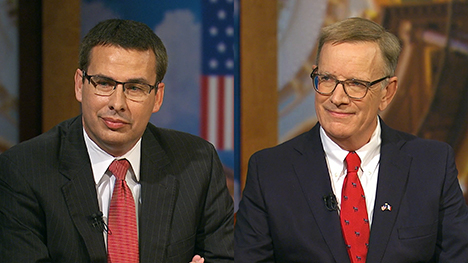
Zach Lahn (R-Belle Plaine) and Rob Sand (D-Des Moines) will answer questions from Iowa reporters and discuss their priorities and vision for the state during a 90-minute debate.
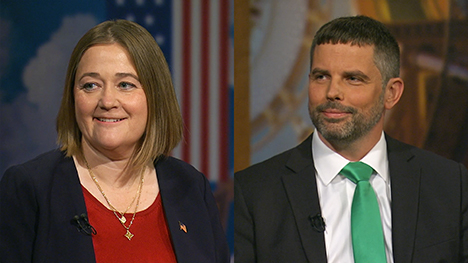
Iowa State Treasurer candidates John Norwood (D-West Des Moines) and Roby Smith (R-Davenport) discuss key issues and policy positions.

Candidates Dave Dawson (D-Lawton) and Chris McGowan (R-Sioux City) will answer questions from reporters and discuss their platforms, concerns and future plans.
Iowa Attorney General candidates Brenna Bird (R-Dexter) and Nate Willems (D-Mount Vernon) discuss key issues and policy positions.
Lindsay James (D-Dubuque) and Joe Mitchell (R-Clear Lake) answer questions from Iowa reporters and discuss their platforms, concerns and future plans.
Candidates Ashley Hinson (R - Marion) and Josh Turek (D - Council Bluffs) answer questions from reporters and discuss their platforms, concerns and future plans.