It's been a busy summer of politics in Iowa. We recap it for you and look ahead with a reporters' roundtable discussion on this edition of Iowa Press.


It's been a busy summer of politics in Iowa. We recap it for you and look ahead with a reporters' roundtable discussion on this edition of Iowa Press.
Joining moderator Kay Henderson at the Iowa Press table are Brianne Pfannenstiel, chief politics reporter for the Des Moines Register, Dave Price, Iowa political director for Gray Media, Stephen Gruber-Miller, Capitol bureau chief for The Des Moines Register, and Erin Murphy, Des Moines bureau chief for The Gazette.
Program support provided by: Friends, The Iowa PBS Foundation, The Bob and Doreen Sheppard Family and Iowa Banks.
Transcript
[KAY HENDERSON] It's been a busy summer of politics in Iowa. We'll recap it for you and look ahead with a reporters’ roundtable discussion on this edition of Iowa Press.
[ANNOUNCER] Funding for Iowa Press was provided by Friends, the Iowa PBS Foundation.
[ANNOUNCER] The Bob and Doreen Sheppard Family, proud supporters of educational programming seen only on Iowa PBS.
[ANNOUNCER] Banking in Iowa goes beyond transactions. Banks work to help people and small businesses succeed, and Iowa banks are committed to building confident banking relationships. Iowa banks, your partner through it all.
[ANNOUNCER] For decades, Iowa Press has brought you political leaders and newsmakers from across Iowa and beyond. Celebrating more than 50 years on statewide Iowa PBS, this is the Friday, August 28th edition of Iowa Press. Here is Kay Henderson.
[HENDERSON] Most Iowa school kids entered the school year this week. This week is also kicking off the next season of Iowa Press. Thanks for joining us. We have assembled a group of political reporters who've been covering that thing that you may have been paying attention to, the campaign of 2026. Let me introduce the folks who are joining me at the Iowa Press table. Brianne Pfannenstiel is chief politics reporter for the Des Moines Register. Dave Price is Iowa political director for ten Gray Media television stations in Iowa. Stephen Gruber-Miller is Capitol bureau chief for the Des Moines Register, and Erin Murphy is the Des Moines bureau chief for the Gazette in Cedar Rapids. Okay, Dave, the primary in June is sort of in the rear view mirror, but that may tell us something about what sort of percolating through the electorate. So, what do you see and sense and smell?
[DAVE PRICE] All the things I think we've smelled. We've seen a lot since that June primary. And I was thinking about where maybe expectations were maybe when the year started in January. So, if you look at that Republican gubernatorial primary, you had a congressman running, Randy Feenstra, expected to win, right? But perhaps he learned the tale, as somebody had warned me about, that it's very difficult to be a member of Congress in a House district and run for a state seat. And that's what Randy Feenstra found out in that race. And Zach Lahn, I'd be curious how many people watching right now could raise their hand if they knew anything about Zach Lahn in January of 2026. And now here he is, the Republican nominee. And then the other, our other big statewide one in the U.S. Senate race for the Democrats. When the year started, you have two legislators, when it came down to two legislators, Zach Wahls and Josh Turek. But I wonder if people really expected that to be such a blow up in that primary.
[ERIN MURPHY] I did not. Yeah, I was surprised -- I was not surprised by the outcome necessarily, but the margin was surprising. Absolutely.
[HENDERSON] And why was that margin such. Was it the endorsement of Tom Harkin? Was it the spending by an outside group on advertising?
[MURPHY] I think you'll find more people that would say the latter of those two things, that the Vote Vets group in particular, poured a lot of money into that race and supporting Josh Turek, and really helped get his name and his story out to a lot of voters.
[HENDERSON] We have two key statewide races in this election, the governor's race and the U.S. Senate race. Brianne, both of those races are drawing a lot of national attention. Why?
[BRIANNE PFANNENSTIEL] Well, I think, you know, Iowa is in this weird space where it's been kind of a swing state for many years, but has trended Republican. And now suddenly people are saying, wait a minute, is Iowa interesting again? And so, we're looking at the governor's race, the U.S. Senate race, national elections forecasters recently just switched the governor's race from they had been calling it a toss-up, which is the most competitive to leans Democrat, which I don't think we've seen since I've been covering politics in this state. And so that, I think, is really having people on high alert. They're watching and they're watching the campaign. He's running and they're wondering if he if he can turn the state back-to-back to blue in that category. You know, they're looking at things like fundraising. He's got $18 million in the bank compared to Zach Lahn's $1 million at the end of July when they last reported those numbers. The polling has pretty consistently shown Sand with a couple of points lead. The rolling average has him 49% to 44% to Zach Lahn. But analysts at Cook who rated this race, they're not calling it a blowout. They're saying, you know, don't expect Rob Sand to run away with it. If he does indeed win that this is still going to be a close race. We're still looking at a state that has, you know, 180,000 more registered Republicans than registered Democrats. So, it's still going to be a very close race. But I think they're looking at that. As, you know, is, is Iowa kind of swinging back to the middle.
[HENDERSON] Going back to 2018 when Kim Reynolds was running against a well-financed candidate in Democrat Fred Hubbell, are there parallels or what are we seeing? The two fellows over here, both nodding their heads.
[MURPHY] The Democrats certainly hope so, because that was the last and only real good election cycle for them in the last decade. And he still lost. But by less than three percentage points, if I remember right. Whereas then Kim Reynolds, four years later won reelection by almost 20 points. But the Democrats also won three House seats in that election. So, they're hoping that the electorate looks similar to 2018. But to your point, Fred Hubbell still lost. And which marries with Brianne's point, which is don't expect this to be a blowout.
[STEPHEN GRUBER-MILLER] One difference, though, too, would be that in the 2018 election, Kim Reynolds was running for a full term, but she was already serving as governor. She had been lieutenant governor. She was governor. So, she was much more of a known quantity than Zach Lahn is now, to Dave's point, earlier.
[PRICE] Yeah, and we had maybe the similarity is that Donald Trump was halfway through a term. You know, he was the new thing back in that cycle. And then there was the midterm correction, which Democrats are hoping they will see that in this state. But they have to -- I'm glad you brought up the 180,000, because it feels like every one of these stories should have that asterisk in there. Right? That's still a lot to overcome, which may explain maybe why Rob Sand doesn't talk about being a Democrat a lot of time when he's campaigning.
[MURPHY] And to bring one more midterm cycle into the discussion, I'm curious to see if this plays out similar to 2014, where we had an open seat U.S. Senate race in that one as well, with the retirement of Tom Harkin, Bruce Braley against Joni Ernst, and for a long time in that campaign, there was a lot of polling that showed Bruce Braley leading in that campaign. And as it got closer to the election, things kind of tightened up. The old, the kind of the Republicans came home at the end of the day and still voted Republican. Is that going to happen in this gubernatorial race as well? And the Senate race?
[HENDERSON] And he was also a sitting congressman who lost a statewide race.
[MURPHY] Exactly.
[HENDERSON] Let's turn to the U.S. Senate race, Stephen, which you're covering. What are the national prognosticators seeing to show such national interest in this race?
[GRUBER-MILLER] Yeah, we've touched on the race a little bit, but Republican Congresswoman, U.S. Rep Ashley Hinson is running against Josh Turek, who we've been talking about, the Cook Political Report recently rated the race a toss-up. So moved it out of the lean Republican column into the toss-up category. They're expecting it to be, you know, I think some folks have been making the case for a while that Iowa could be a very competitive race this year. But I think in the national consciousness, it has fallen fifth, sixth, sometimes seventh in sort of the order, the ranking of states that are going to be key to which party controls the Senate this summer. But with some kind of surprises in some of the other states like Maine and Michigan, even Iowa has sort of elevated a little bit in importance. And it's a cheaper state for national parties to spend in. So, we're seeing a lot of spending by Iowa standards in the race from both the Democrats and the Republicans. But that's still cheaper than spending in, say, Texas. So, the polling has shown many polls show Ashley Hinson up a couple of points over Josh Turek. There is at least one poll where Turek is up over Hinson, but it's within a couple of points either way, typically. So, seems like it's going to be a competitive race.
[HENDERSON] Iowa draws its congressional district lines in a very nonpartisan way, and as such, it seems as if at least one Iowa congressional race is always listed on the top ten, top 12, top 20 most competitive in the country. We may have a couple this cycle that are among the top competitive races in the country. Erin, what are we seeing in particularly those Eastern Iowa races?
[MURPHY] Yeah, for sure The first district where Republican Congresswoman Mariannette Miller-Meeks, she has a tough one every time a couple of her reelections have gone to recounts. And that's going to we expect the same again. She's again facing Democrat Christina Bohannan, a third straight cycle that that's the matchup. Third district is always close. Zach Nunn the Republican incumbent is going to have a tough one there. And then expanding the map a little bit. The one that's kind of interesting is that second district, the second eastern Iowa race that you were talking about, Kay. The open seat one, because Ashley Hinson is running for the U.S. Senate. So, we've got Republican Joe Mitchell and Democrat Lindsay James, a couple of former state legislators. Does that also become a -- I think that race will tell us a lot about where the national mood is, because if that one has tightened up, then we're really close and Mariannette, Miller-Meeks and Zach Nunn are probably really nervous.
[PRICE] When the RNC chair was here, I covered him at an event in Newton with Congresswoman Miller-Meeks, and he included Hinson's current seat in the list and his sales pitch to the room, which was all party insider types, and I forget if you used 16 or 20, so give me a range there. But he's saying, look, when you come down to it, there aren't a lot of House races that are truly competitive. And somewhere between 16 and 20 is like, you all have three of them. That's why we consider this the top state.
[PFANNENSTIEL] Well, and I think you can look at all of the travel from national political figures to kind of emphasize that point. We've had 8 or 9 cabinet secretaries at this point. We've had Attorney General Todd Blanche, HHS Secretary RFK Jr.We've seen Brooke Rollins, the ag secretary who's been here now a couple of times and is coming back. And I think all of that really kind of underscores, you know, the intensity to which the degree to which Republicans see Iowa as a defensive battleground, that they really need to hold these seats. And of course, we asked Todd Blanche at the State Fair, he was there flipping pork burgers with Attorney General Brenna Bird, you know, does that have anything to do with it? And he said, nope, this is just an important state fair. It's America 250, we're here to celebrate.
[PRICE] And he said Grassley invited him. Yet he was not standing there with Grassley. He was standing there with Brenna Bird, who's up for reelection, unlike the senator.
[MURPHY] Just to put one last fine point on Brianne’s -- this is not over a span of multiple months that these visits took place. Ten days around the state fair. Yeah.
[HENDERSON] And, you know, the U.S. Treasury Secretary was here, Scott Bessent, you had a fundraiser on the fairgrounds with the third district Republican candidate. But the other thing about those cabinet secretaries and top-level officials, like the U.S. Trade Representative who was here in the midst of the U.S. Mexico-Canada trade agreement talks, was that oftentimes they weren't standing adjacent to an Iowa Republican candidate. They were just here on behalf of the administration. So, Erin, what was that about? Is that to bring the Trump voters home?
[MURPHY] It's a little bit of that. And it was fairly clearly some messaging, you know, the like the Treasury secretary is talking about how great the economy is. It's sort of setting, you know, the narrative that, hey, things are going great right now and we should keep the status quo, keep the national government in Republican hands.
[HENDERSON] And Dave, you were there when the attorney general was at the we call it the pork tent, but let's call it the pork grill at the State Fair. He was very careful about answering some of the questions that farmers are concerned about, like fertilizer prices, because his agency is involved in some litigation.
[PRICE] Right. Yeah. Fertilizer prices, meat processing. And he talked about the kind of the delicate balance about when the Department of Justice would have to get involved in potentially monopolistic practices, and whether you just let the marketplace work out in that. But clearly, that is something that the ag community is really watching. And you mentioned Brooke Rollins, who will be coming back here on Tuesday to Boone, but she is put in that awkward spot where she came to the fair on that Friday night, right after it gets out that President Trump is going to allow in more foreign, it sounds like ground beef, which obviously ranchers don't want any part of. And it's going to be cheap, cheaper quality, cheaper price, whatever is they're trying to build back their herd. So that was a tough spot that she was put in to try to make the case that, hey, here's what we're doing. It’s the focus on consumers obviously, but for anybody in AG, it's pretty tough to find anybody who supports that kind of move.
[GRUBER-MILLER] And it's been an interesting position for Iowa's candidates running for office to be in, too, because the Republicans have obviously all stuck very close to President Trump throughout the cycle. Right. They're running sort of they want to activate his voters. They want those people to come out this this November. But then when something an announcement like that happens, that that Iowa's ag community is frustrated by, that's where maybe sometimes you'll see a little bit of separation. Like Ashley Hinson was saying, she would advocate to the administration to change course on that deal. Right. Trying to walk that line of being supportive of President Trump to get his voters out, but also creating some distance where they can.
[HENDERSON] And she called it a bad idea, which was sort of interesting. Let's move on to other statewide races. Erin, there may be some competitive statewide races. We won't really see any public polling in these. What are you watching?
[MURPHY] A couple of them, and they're easy to remember because one's ag and one's AG. The Iowa attorney General race is the national groups are investing in that, The national groups that help elect Democrats and Republicans to those state attorneys general. So Republican incumbent Brenna Bird is just finishing her first term. Democrat Nate Willems, an attorney from eastern Iowa, is the challenger, like I said, other outside groups investing. So clearly, the folks in both of those camps see that as being competitive. And as I mentioned, Ag Secretary, I don't know how close it's going to be to that. Typically, in Iowa is not it's been a pretty safe Republican seat, but it's just a fascinating year overall. And the way water quality has picked up steam as a topic. And that is the issue that the Democratic challenger, Chris Jones, is running on against Republican incumbent Mike Naig. I'm fascinated to see how that turns out and how competitive that one is.
[PRICE] And we were there watching at the end of the legislative session where they put that package, that Secretary Naig was part of, and building support behind the scenes with legislators for a water quality overall legislation that they put through right at the end. And you can tell exactly put some money behind it, 50 million.
[HENDERSON] And they gave the Des Moines Water Works a bunch of money to build a second nitrate removal --
[PRICE] basically clean it up on the back end. Right. And clearly, that was an acknowledgment that people are demanding something to happen with water quality. That's the race that I'm fascinated if it will be competitive.
[MURPHY] And that's a they're hearing it from both sides. The Republican events, they're talking about water quality a lot, too.
I think we're seeing that spill over even into races where you might not expect it. I mean, the first ad that Nate Willems ran attacking Brenna Bird in the attorney general's race was about whether she was being tough enough, prosecuting people who have been polluting Iowa water. And kind of the cancer issue is even spilling into that attorney general's race. So, the way that water quality is affecting people's concerns about cancer, I think, is affecting all of these races and could put a really interesting spin on the way people are viewing candidates this year.
[HENDERSON] The other interesting thing is, if you listen to Chris Jones or you just read his comments and just read Zach Lahn, the Republican candidate for governor, and what he says about water quality, they're not that far apart.
[PFANNENSTIEL] I think Zach Lahn has really changed the dynamic of the way people are talking about water quality this year. I think it's the first time we've really seen a Republican lean into these issues and say it's directly connected to agriculture in the state. That's been something that most Republican elected officials have been really reluctant to kind of lean into publicly. And I think it's given permission to other people around the state to talk about it to that degree. The way that he talks about water quality really overlaps with a lot of the ways that that Democrats in some ways are thinking about it. And that's interesting in the governor's race too, right? Does he attract people into his side who might not traditionally have aligned with Republicans?
[HENDERSON] Dave, we've talked a little bit about previous midterm elections, but for people who don't have their record books open, let's remind people what happened in 2018. That would be the first Trump midterm.
[PRICE] And maybe a mixed bag in a little bit in the sense you mentioned that Kim Reynolds won in her first term. I remember sitting there on the set of the TV studio that night when it looked for a while that Fred Hubbell may pull that one off, and then we later saw the numbers come in from northwest Iowa, where Kim Reynolds dominated up there. So, she was the bright spot for Republicans. And we saw what happened in those four House races where it went three D's, one R, and you see that climate from what we were thinking back there in that midterm. And fast forward to six years from now and like, where's the energy in there? That's what I was wondering when all these Trump cabinet folks are coming here, is that an acknowledgment that we've got to get our people fired up and going with Trump, not on the ballot. And they can, you know, they're kind of calling all these official visits. And it's not really about politics. And it's about seeing the state fair. And RFK Jr. told us that it's because Newton was a great place and doing a great thing. That's why he was there. Just so happens, it happens to be a midterm, you know, two and a half months away. But it's like all hands on deck. Although the biggest hand did not show up at the state fair, Donald Trump, which I thought would be a slam dunk if we started this year at an America 250 celebration. That seems to be like a made for TV moment. But he did not come for whatever reason.
[HENDERSON] The other thing I remember about 2018, Brianne and it actually happened right after Kim Reynolds won significantly. But I think in her mind, she said to herself, I could have won more if Steve King hadn't been a drag on me in the fourth Congressional District. So, let's talk about the fourth Congressional District, because it has the largest share of Republican voters compared to independents. And then Democrats are the third most, third biggest set of voters instead of second in that you have a candidate who is sort of running a civil campaign. He and his opponent have posed for a picture together at the Woodbury County fair. How will that sort of change the dynamic statewide?
[PFANNENSTIEL] That's a great question. I mean, I think the fourth district is obviously super important for Republicans When we're talking about turnout. They really need to drive turnout in in places in the fourth district. Those rural communities that Republicans win by, you know, 20, sometimes 30 points. And so, I think they've got a candidate in Chris McGowan in the fourth district this year. He's kind of a chamber of commerce Republican. He's very collegial, working with the Democrat in that race, Dave Dawson. And so, you know, he's not the liability that we would have seen in somebody like Steve King, who is very polarizing and potentially turning people off. But Steve King supporters, obviously were very motivated to turn out and support him as well. And he's now endorsed Zach Lahn and the governor's race.
[GRUBER-MILLER] And I'll just as we're talking about the fourth district, throw a little wrinkle in there of somebody who's not on the ballot this fall, but who was in June, which is Jim Carlin, who was running in the Republican primary against Ashley Hinson. Hinson beat him, you know, by a wide margin. But Carlin got 50,000 votes in that primary and then afterwards said he couldn't tell his supporters to vote for Hinson. So, it may not end up making much of a difference. But if we're talking margins, that could be a bit.
[HENDERSON] Speaking of margins, we don't have. We have just a couple minutes left. Libertarians learned this week that two of their substitute candidates can't be on the ballot. Will that have an impact on the governor's race and the third district race?
[GRUBER-MILLER] That's right. So, the governor's race and the third district race, as we've mentioned, very competitive races. They will not have a third-party candidate on the ballot. The libertarians, the judge ruled this week that they will not be able to replace their candidates. They didn't follow the procedures laid out in Iowa law to spell out how they would replace candidates if they had had to withdraw, and there they were challenged and removed, and they were not able to replace them. So, it will be just Democrats and Republicans on those ballots.
[MURPHY] Which to his previous point, could matter If you're talking about a race that comes down to a few thousand votes, where libertarian can sometimes siphon those votes off from a Republican candidate, they will no longer exist in those two competitive elections.
[HENDERSON] And interestingly, in the Second Congressional District, there is a libertarian and an independent. So that's essentially a four-way race, giving people four options on the ballot if they if they're voting in the second Congressional District. Brianne, a couple of things just to talk about in the remaining two minutes, we have a lot of counties are passing data center moratoriums. Candidates are talking about data centers. Is this a deciding issue, in your view, for voters, or is this just something that's percolating through politics in general?
[PFANNENSTIEL] I don't think we know just yet. I mean, we we've talked a lot on this show and in Iowa about eminent domain and the carbon capture pipeline and the way that that kind of divided parties in unusual ways, because it created kind of just this populist discontent among voters. And I think data centers is doing the same thing in Iowa. And so, we'll see, you know, again, in the governor's race, both candidates are talking about this. They have pretty similar plans. Zach Lane has said he wants a statewide moratorium. Rob Sand has not called for that. So, they differ in some of the specifics, but they're both trying to tap into this discontent and kind of the feeling of voters that the big guy is out to get the little guy and they're feeling, you know, frustrated by that.
[HENDERSON] Erin?
[MURPHY] I was just going to expand on Brianne's point. She brought up the perfect issue. And I feel the same way. It's very similar to eminent domain. And I don't know, you guys someone jump in and correct me if I'm wrong. I don't know if we saw any election where eminent domain looked like a swing the meter voting issue. So as passionate as people got about it, I don't know that it changed any outcomes out there. But absolutely agree, it's a huge talking point right now. And so many communities talking about it. And now so many candidates talking about it.
[HENDERSON] Is the issue here that Republican voters who are inclined to vote during presidential years and maybe may vote in a midterm might be dissuaded from voting if they don't feel their party is passionate enough about this issue.
[PFANNENSTIEL] Yeah, that could be. I mean, I think people, you know, the people who care about this issue, who don't want data centers coming and they want to see their elected officials with a plan that they've thought about it, that they are not on the side of just bringing them in, you know, aggressively. There's been a lot of talk about the degree to which Iowa should be giving tax incentives to these businesses. In Iowa, you know, being led by Republicans for the last, you know, decade or so, has been a very business friendly type of climate where they want to bring in outside companies. And so, I think they're probably no matter who gets elected in the legislature next year will be some kind of discussion over where to draw those lines and how much do you balance bringing in business that can provide jobs that can do some good things for the communities, but which a lot of people have really serious concerns about?
[HENDERSON] Well, I have to balance our time, and we have none of it left. So thanks to the four of you for joining us and sharing your reportage from the campaign trail. You may watch this episode and others online at iowapbs.org. For everyone here at Iowa PBS, thanks for watching today.
[MUSIC]
[ANNOUNCER] Funding for Iowa Press was provided by Friends, the Iowa PBS Foundation.
[ANNOUNCER] The Bob and Doreen Sheppard Family, proud supporters of educational programming seen only on Iowa PBS.
[ANNOUNCER] Banking in Iowa goes beyond transactions. Banks work to help people and small businesses succeed, and Iowa banks are committed to building confident banking relationships. Iowa banks, your partner through it all.
Watch More
Zach Lahn (R-Belle Plaine) and Rob Sand (D-Des Moines) will answer questions from Iowa reporters and discuss their priorities and vision for the state during a 90-minute debate.
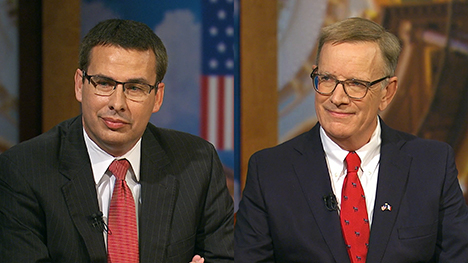
Iowa State Treasurer candidates John Norwood (D-West Des Moines) and Roby Smith (R-Davenport) discuss key issues and policy positions.

Candidates Dave Dawson (D-Lawton) and Chris McGowan (R-Sioux City) will answer questions from reporters and discuss their platforms, concerns and future plans.
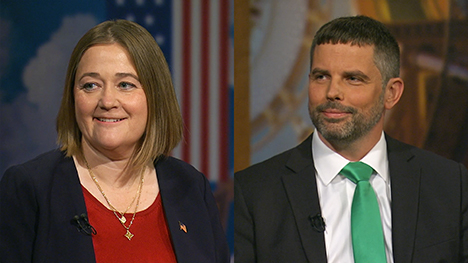
Iowa Attorney General candidates Brenna Bird (R-Dexter) and Nate Willems (D-Mount Vernon) discuss key issues and policy positions.
Lindsay James (D-Dubuque) and Joe Mitchell (R-Clear Lake) answer questions from Iowa reporters and discuss their platforms, concerns and future plans.
Candidates Ashley Hinson (R - Marion) and Josh Turek (D - Council Bluffs) answer questions from reporters and discuss their platforms, concerns and future plans.