On this edition of Iowa Press, we discuss the labor movement and issues affecting Iowa workers.


On this edition of Iowa Press, Jesse Case, secretary-treasurer of Teamsters Local 238, and Jennifer Sherer, deputy director of the Economic Policy Institute’s Economic Analysis and Research Network and director of EPI’s Worker Power Project, discuss the labor movement and issues affecting Iowa workers.
Joining moderator Kay Henderson at the Iowa Press table is Erin Murphy, Des Moines bureau chief for The Gazette.
Program support provided by: Associated General Contractors of Iowa, Iowa Bankers Association and Robert and Doreen Sheppard.
Transcript
[KAY HENDERSON] Labor day is a time to celebrate the achievements of American workers. We'll talk about economic issues and public policy affecting workers on this edition of Iowa Press.
[ANNOUNCER] Funding for Iowa Press was provided by Friends, the Iowa PBS Foundation.
♪♪
[ANNOUNCER] The Bob and Doreen Sheppard Family, proud supporters of educational programming seen only on Iowa PBS.
♪♪
[ANNOUNCER] Banking in Iowa goes beyond transactions. Banks work to help people and small businesses succeed, and Iowa banks are committed to building confident banking relationships. Iowa banks, your partner through it all.
♪♪
[ANNOUNCER] For decades, Iowa Press has brought you political leaders and newsmakers from across Iowa and beyond. Celebrating more than 50 years on statewide Iowa PBS, this is the Friday, September 4th edition of Iowa Press. Here is Kay Henderson.
[HENDERSON] A little bit of history. The first Labor Day parade in the United States was in 1882 in New York City. President Grover Cleveland signed a proclamation that declared Labor Day a national holiday in 1894. So, 132 years later, what does the Iowa labor movement look like? Well, just over 100,000 Iowans are members of a union that represents about 6.8% of Iowa's workforce. And we have two guests here to talk about the labor movement and the status of it on this edition of Iowa Press. Let me introduce them. They are Jesse Case. He is the secretary treasurer of Teamsters Local 238. That's the largest labor union in Iowa. It represents both public and private sector workers in a variety of industries. For example, he is the national director of the Teamsters Food Processing division. Welcome to Iowa Press.
[JESSE CASE] Thank you. Good to be here.
[HENDERSON] And joining us again is Jennifer Sherer. She is with the Economic Policy Institute, a nonpartisan think tank focused on how economic issues impact workers. She's involved in research and policy advocacy. Prior to joining EPI, she served as director of the University of Iowa Labor Center. Welcome back.
[JENNIFER SHERER] Thank you.
[HENDERSON] Joining our discussion is Erin Murphy. He is the Des Moines bureau chief for the Gazette in Cedar Rapids.
[ERIN MURPHY] Jesse, I want to start with you. See how much of an update you could give us. And I know this isn't your specific unit, but UnityPoint nurses have been attempting to unionize and join the Teamsters. There was a vote that was held, and some of those ballots are now being contested. I believe we're waiting on a ruling from the National Labor Relations Board. What's the latest you can tell us on that?
[CASE] Well, we think that the workers won that election without a doubt. And we think the challenges were a stall tactic by the employer, which is not uncommon in the health care industry. They're notorious for union busting and spending millions and millions of dollars on union busting. In fact, this was one of the most expensive union busting campaigns in the history of labor right here in Des Moines. So, we think that the union and the workers are going to prevail with those labor board decisions. And then it's going to, you know, take all hands on deck to get the employer to get to the table and negotiate a fair agreement, because we expect them to stall on that, too. And they really just need to step up to the plate and do the right thing and negotiate in good faith with those workers who have voted to organize under their federal rights.
[MURPHY] And this is one of those things that clearly can take a while. There was a march back in May, if I remember right. And do you have any sense of a timeline of when the National Labor Relations Board might weigh in?
[CASE] The board is moving slow these days for a lot of different reasons. But there is progress made. They are sifting through those ballots. And we expect to have that unit certified soon. And then it's just a matter of negotiating that contract, which can also drag out, which is, you know, there's legislation introduced on the federal level, the Faster Labor Contracts Act, which would compel employers to negotiate within ten days of being certified. And then there would be if there were am impasse reached would go to a mediation process and then an arbitration process. So, we're really, you know, pushing for that law that would compel employers to negotiate and guarantee a contract once workers voted to organize.
[MURPHY] Jennifer, is there research? How common is unionization in the health care industry? And maybe beyond that, is there any data that shows how that impacts the health care workforce?
[SHERER] Yeah, I would say health care is definitely one of the areas where we've seen a significant number of union election filings the last few years. It's an area of growth for the labor movement. And going into Labor Day, I think, you know, one of the headlines nationwide is that unions are extremely popular right now and all kinds of polling coming out reaffirming that. And so, health care is not the only industry where workers are clearly interested in pursuing unions, seeing it as a vehicle for really addressing not only issues they want to confront in their workplace, but trying to rebalance our very unequal economy right now. And, you know, health care workers all over the country also calling for more attention to things like the way that AI is changing their workplaces and using the collective bargaining process to say we as the frontline workers need to have a voice in what the future of our workplace is going to be, how our patients are going to be cared for, what our profession is going to look like. So, I mean, I do absolutely think the UnityPoint example right here in Iowa is a leading example of a trend we're seeing everywhere. It also the UnityPoint case ended up as a pretty important data point in one of our Economic Policy Institute reports this year of tracking how much companies are spending to try to prevent health care workers and other workers from unionizing over $1.7 billion. So, we've got this mismatch right now in our country between huge historic, high levels of popularity for unions, over 70% across the age demographics and party lines of people saying, we support unions, we're with high approval ratings. And on the other hand, a situation where our federal and Iowa, our state labor laws, have gotten so weak that workers don't have a clear path to getting a union contract, even when they go through all the processes and steps. And in some cases, the, you know, fire of having a company throw millions, in the case of UnityPoint, they were the second highest spender on anti-union consultants in 2025 nationwide, second only to Amazon. So, it's an amazing, you know, the battle there. And the workers persistence is, you know, going to carry them through to that union contract. But it shouldn't have to be that hard for workers to get there.
[HENDERSON] Jesse, real quickly, UnityPoint push back has been that it a union contract for health care workers would be too rigid. It would reward seniority instead of performance. What's the pushback?
[CASE] Well, every employer says that when their workers are trying to balance the, you know, level, the playing field, and, you know, it's a partnership, the employer provides the jobs and the employees provide the labor. And, you know, we need successful businesses in every industry in this country because that's what keeps people employed and the economy running. But every business needs workers in order to get product out the door or take care of the patients or whatever the industry is. And if it's a partnership where they have the jobs, supply the jobs, and we supply the labor, that partnership should be negotiated. The terms of that partnership should be negotiated. And workers, whether they're nurses or manufacturing workers or anyone else, have the right to negotiate the cost of their labor. Their labor is a product that they're selling. Nurses have a skill set that is very unique that other people don't have, and they have the right to negotiate the cost of that labor. The federal law says they have the right to negotiate the cost of that labor. And things like seniority mean something. If you've been a nurse for 20 years and maybe you should have input on what shift you're working on as opposed to somebody who's been there for four weeks. So, seniority does mean something. It's those people that bring the experience to the job. And if you've got, you know, a senior, a seasoned and experienced workforce, that's what you want. And when you start attacking seniority and when you don't let people have a voice in their working conditions, that's when turnover increases. People are looking for a different job, and then patient care goes down. So, the more you give people a voice in their conditions, the more consistent the workforce is, the easier it is to recruit and retain employees. And usually the quality of the product has increased, even if it's in the health care field.
[HENDERSON] Jennifer, let's shift to John Deere. The UAW represents about 10,000 workers at John Deere. They have recently said, no, we do not accept John Deere's offer to extend the contract that was negotiated in 2021 after a 34-day strike. Was that the right decision?
[SHERER] Well, that decision was up to the workers. And that's the beauty of a union, is the workers took a vote. They looked at what was put on the table and said, we're not interested in basically what Deere was proposing was skipping the bargaining process this time around. So, there's a long history here. And the most recent piece of that really important Iowa history is that in 2021, as folks might remember, Deere workers went on strike to restore some of the problems that, inequities that had crept in to their contract. And so, they closed gaps, wage gaps that had grown in between longtime and newer employees, improved their retirement, saved their health care. That was a really important turning point. That also nationally had a big impact in laying the foundation for what led to strikes in the big three. You know, workers coming out of the pandemic and saying, we have taken concessions, agreed to, you know, sit back and help keep this business afloat for decades and decades. And in the current economy where they know their corporation is extremely profitable, Deere, this time around was coming to the table saying, let's just keep the status quo essentially where it is. We're not going to go to the bargaining table next time around, maybe with a, you know, a little bit of a bonus on top. And workers said, no, we want to go to the bargaining table because we want to know what the economy is looking like in 2027. And we have the right to once again, go through the bargaining process and see what other improvements we might be able to make. I think that's the message that was coming out of that vote was saying, you know, it's not enough to just accept the status quo right now. We want a bargain and we retain our right to strike. It's also Deere workers saying, we use that right in 2021 to make improvements. And we're letting the company know that we will do that again if we have to.
[MURPHY] So, Jesse, we've seen closures in food processing plants here in Iowa, JBS, Tyson Foods, impacting hundreds of workers each time. Big picture, What does that do to the state of the workforce in Iowa and to those workers that you represent?
[CASE] I think you're seeing these closures, you know, as a product of consolidation of big AG and the monopolies that have been created by Tyson's and Cargill and JBS. There used to be packing plants almost in every community across the state. And then IBP and later Occidental Petroleum, which bought IBP and then Tyson's bought them. And so now it's, you know, just a few employers own the entire industry. There are 11 packing plants in this country that process 50% of the beef, 11 locations nationally. So, in Iowa, where you used to have these small packing plants in every community that have been put out of business by the larger monopolies that now we're all victims of what their business models. So, if they decide that they want to, as they did a couple weeks ago, lay off 2300 people in Illinois across the border and, and bring 1000 people back in Amarillo, they can do that. And there is nowhere else to run that meat. No one else has a say on where Tyson gets to cut beef, or where JBS gets to close workers because the local packing plants are shut down. And it's like that in every industry. If you pick an industry in this country, it's generally run by 4 or 5 companies. And sometimes on a global scale. So, there are monopolies that are controlling business in this country. It's not good for our communities. It's not good for workers. We need to really beef up the antitrust laws in this country and get some U.S. Attorneys who are interested in fixing that, those monopolies, or at least holding them accountable.
[MURPHY] Jennifer, kind of similar question to you? What's do you see in the research and in the data that when as this consolidation continues and these layoffs happen, what impact does it have on workers, the economy, maybe?
[SHERER] Well, we know that the economy for various reasons goes through disruptions that cause layoffs. I think one very Iowa specific concern that workers have these days is that our state legislature has chipped away substantially over the last decade at the unemployment system. And so, it's become weaker and weaker in its ability to respond to those kinds of disruptions. And so, whether it's corporate consolidation or a business cycle or the sort of chaotic tariff policy that the Trump administration has been imposing on certain industries, when workers in Iowa are laid off today as compared to ten, 12 years ago, they are much less able to predict their own household stability on a short term and long-term basis, because unemployment benefits have been shrunk down to shorter periods. And that means our labor market as a whole is not as healthy as it was. There's lots and lots of research about the importance of that unemployment system for ensuring that we don't lose the skills, experience that we as a society and that businesses themselves have invested in, in particular workers. And we are often probably losing that kind of skill and experience as people have to either shift to other lower paying jobs that are not a good fit for their skills and experience, or leave the state to try to find opportunities at better wages and in better conditions.
[MURPHY] And Jesse, and real quick, before I move on, Jennifer earlier talked about AI in health care. I'm curious is, you know, in food processing, and we've already seen automation and the impact it has on that industry and companies needing fewer workers. Does AI pose a similar threat to that industry?
[CASE] Well, I think yes. And there have always been threats to workers in manufacturing and some other sectors. I think you're seeing AI creating a threat to workers in new industries, whether it's white collar or other. But what we're concerned with right now is autonomous vehicles, which is, you part and parcel with AI. We have Silicon Valley companies that are investing in AI. They want to put driverless trucks on our roads, and the technology is not there. It's an issue of public safety. We do not need 60,000-pound vehicles barreling down our highway with no driver in the cab. And then it's an accountability issue If something happens. And there are all kinds of things that can happen. We're not San Francisco, we're not Austin, where they have grids and the technology in place for maybe Waymo's and other things that are also a bad idea. We have farm equipment pulling out in roads aT small, you know, low speeds and the technology isn't there. We have different weather patterns. We have different threats. And so who's accountable if there's an accident and somebody is injured or killed? it's not going to be the Silicon Valley CEO that's held accountable. It's not going to be the lobbyist at the at the Des Moines Capitol that's held accountable. And the victims are going to be the families in those vehicles that are hit by these 60000-pound trucks. It's just the technology is not there. So, it's the same story of as AI advances, you know, can we hold them accountable and slow it down enough to make sure the technology is there to not have negative impacts?
[HENDERSON] What percentage of the trucking industry is unionized?
[CASE] Well, the trucking industry has been, you know, really affected by several different factors. And back in, you know, during the Carter administration, they deregulated trucking, which was really detrimental. And everyone was then misclassified or able to be misclassified as an independent contractor as opposed to an employee of a large freight company. And then you had NAFTA, which really affected, you know, the freight industry. It used to be heavily organized. Now it's just an industry of independent contractors, much like many other industries that are misclassified, including Amazon employees. You have 16,000 trucks sitting outside of the Port of Long Beach, California. All independent contractors, all with their old trucks idling. And no accountability there. So, it's a, you know, it's not a good situation for the freight industry right now. And there needs to be some reform in that industry as well.
[HENDERSON] I want to ask you about something that happened in 2024. The Teamsters president spoke at the Republican National Convention. He said, we're not beholden to either political party. He talked about corporate greed. What has been the outgrowth of that? The Trump administration, Todd Blanche, the attorney general, was just here in Iowa during the state fair talking about the antitrust investigation that the Trump administration is undergoing this past week. They added grocery store chains to that antitrust investigation. What's your view of the impact that had?
[CASE] Well, I think, you know, that's right. Organized labor is not an extension of either political party, nor should we be. We are an independent movement of workers. And, you know, we shouldn't be tied, even though our local union has represented several presidential campaigns, including Biden and including Harris. And we would gladly represent presidential campaign staff of Republican candidates if they organize. But we're not an extension of those candidates or that party. And, you know, it's a mistake for when labor tries to get too close to either party. And the reality is we have to have a relationship with people on both sides of the aisle when we can and when they're reasonable. Sometimes you can't have a relationship with people because they're just nut jobs. But where we can establish relationships, we have to have bipartisan relationships in some states and on the national level. So, but I think, you know, that's what you're seeing, you know, right happening in politics right now is you have a lot of independents who are kind of fed up with both parties and the two-party system. And a lot of people see, you know, in the past have seen the Democrats as incompetent and the Republicans as corrupt and people. That's a horrible choice for people to have, whether it's true or not. That's the perception that a lot of people have. And it's why you see more independents in the state, including in our membership, than Democrats or Republican. Membership of my local union is about a third Republican, a third Democrat, and a third independent. So, we're not beholden to any party. We will work with anyone who is good on our issues and if they want to advocate for worker issues and help us raise standards, we'll work with them regardless of party. But I think you can see the last ten years in Iowa what a one-party system has done in terms of collective bargaining rights being lost by 180,000 public sector employees. We have the highest cancer rates, second highest cancer rates in the country. We have the most polluted water in the country. We've got big money that's come in from New York and DC that has affected policy making in Iowa at the detriment of workers and union and nonunion alike. So, you know, the two-party system is broken, but a one-party system is worse.
[MURPHY] Jesse, as we move into this weekend, that I know means a lot to obviously to you, I was curious to get your reaction to this past week. President Trump on social media posted that he believes that we have too many holidays, federal holidays that require the day off of work. I'm guessing safe to say that you disagree with that, especially when it comes to Labor Day specifically.
[CASE] Well, I mean, when every time we go to the bargaining table, we negotiate holiday pay, we negotiate how many holidays workers get, we negotiate vacation, time off. People need time off. People need to celebrate the history of our country. I don't agree with that assessment of people need to work harder for longer in order to put more money in corporations pockets. So, I think I don't know where that's coming from, but I don't agree with that. People deserve holidays. People deserve vacations. People deserve pensions. People deserve a wage that they can raise their family on. And anyone who lowers those standards needs to come and work alongside our members for a day.
[MURPHY] Jennifer, we're hitting our last few minutes here already. I wanted to ask you, as we record here on Friday, we just got a new jobs report that was a little more encouraging than folks expected, 162,000 jobs were added in August. What is the sort of your view of the state of the workforce right now across the country and the economy?
[SHERER] Well, I think what our economists are saying consistently is that the job market seems relatively stable, but weak in certain important ways. So, for one thing, there are only a couple of sectors, and particularly AI data center investment that are driving growth and almost everywhere else we're seeing either status quo or decline. And that is not a healthy, that's not a healthy economy and it's not a healthy jobs market, with the exception of health care, for example, last year there were job losses in almost every single sector across the board, you know, outside of those two things. So, you know, there's a lot of dispute and discussion about whether some of that AI data center investment will turn out to be a temporary bubble, which is, you know, a fear that people I don't think we know that yet. So, we're not seeing significant job growth, especially this year, that looks anything like what we were seeing coming out of the pandemic. So not a crisis. I don't hear a lot of people yet predicting that we're on the brink of a recession around the corner, but it's not a healthy labor market. And particularly in states like Iowa, where we're seeing pretty weak numbers.
[HENDERSON] Jennifer, last question to you. The reason we have Labor Day, some people say who are historians is because of the Pullman strike happened. Grover Cleveland signed that after the Pullman strike, which involved federal agents and troops and deaths. What do you think is the moment that made the labor movement what it is today historically?
[SHERER] I don't think there is a single moment. I actually think workers are making the labor movement every day. That is really, truly my philosophy. And I think Iowa workers have continued to be a part of that. I'll give a shout out to a fantastic book recommendation for Labor Day in Iowa, Solidarity and Survival by Shel Stromquist that chronicles a lot of a lot of that Iowa labor history, which of course, is tied to many of those national events and sometimes is echoing them and sometimes is initiating some of them. So, I honestly don't think we can ever point to one event. And it's not a history that's been fully written. We're in a period of time that has been difficult for Iowa workers. You know, I look at the data even and think about myself moving here 30 years ago when Iowa's union representation density was always above the national average. And in that time that I've lived here, it has fallen to being just below the national average. And that has to do with all kinds of policy choices and all kinds of attacks, some of which we've talked about today. But that's not the end of this history. Workers are still rewriting it today. And this Labor Day and the next election cycle, and everything that comes after will probably write the next chapter.
[HENDERSON] Well, speaking of the next chapter, I have to end this right now. Thanks to both of you for being here today.
[SHERER] Thank you.
[CASE] Thank you.
[HENDERSON] You may watch other episodes of Iowa Press at iowapbs.org. For everyone here at Iowa PBS, Thanks for watching today.
[MUSIC]
[ANNOUNCER] Funding for Iowa Press was provided by Friends, the Iowa PBS Foundation.
♪♪
[ANNOUNCER] The Bob and Doreen Sheppard Family, proud supporters of educational programming seen only on Iowa PBS.
♪♪
[ANNOUNCER] Banking in Iowa goes beyond transactions. Banks work to help people and small businesses succeed, and Iowa banks are committed to building confident banking relationships. Iowa banks, your partner through it all.
Watch More
Zach Lahn (R-Belle Plaine) and Rob Sand (D-Des Moines) will answer questions from Iowa reporters and discuss their priorities and vision for the state during a 90-minute debate.
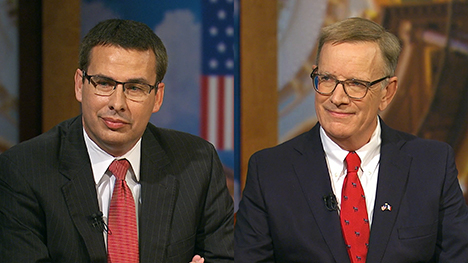
Iowa State Treasurer candidates John Norwood (D-West Des Moines) and Roby Smith (R-Davenport) discuss key issues and policy positions.
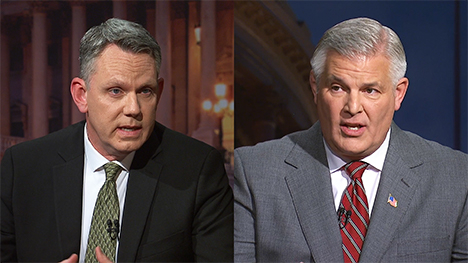
Candidates Dave Dawson (D-Lawton) and Chris McGowan (R-Sioux City) answer questions from reporters and discuss their platforms, concerns and future plans.
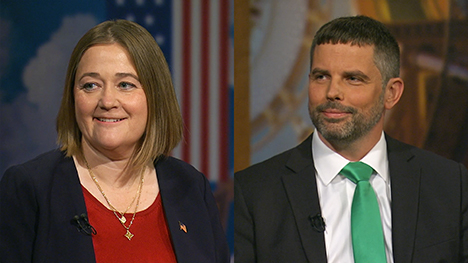
Iowa Attorney General candidates Brenna Bird (R-Dexter) and Nate Willems (D-Mount Vernon) discuss key issues and policy positions.
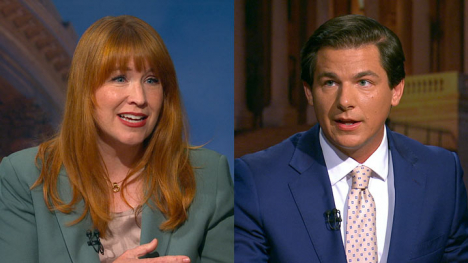
Lindsay James (D-Dubuque) and Joe Mitchell (R-Clear Lake) answer questions from Iowa reporters and discuss their platforms, concerns and future plans.
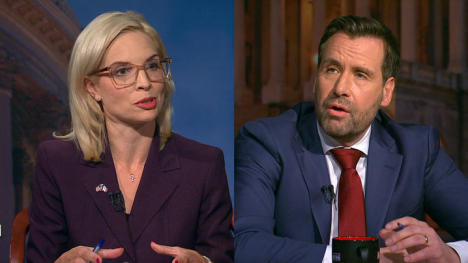
Candidates Ashley Hinson (R - Marion) and Josh Turek (D - Council Bluffs) answer questions from reporters and discuss their platforms, concerns and future plans.