Rita Hart, chair of the Iowa Democratic Party, discusses the 2026 election, key races, and the party's work in the final weeks of the campaign.


On this edition of Iowa Press, Rita Hart, chair of the Iowa Democratic Party, discusses the 2026 election, key races, and the party's work in the final weeks of the campaign.
Joining moderator Kay Henderson at the Iowa Press is Erin Murphy, Des Moines bureau chief for The Gazette.
Program support provided by: Iowa Bankers Association and Robert and Doreen Sheppard.
Transcript
[KAY HENDERSON] Iowa Republicans racked up a lot of electoral wins in recent years. But this election cycle, Democrats believe they have several high profile races in play. We'll talk with Iowa Democratic Party Chair Rita Hart on this edition of Iowa Press.
♪♪
[ANNOUNCER] Funding for Iowa Press was provided by Friends, the Iowa PBS Foundation.
[ANNOUNCER] The Bob and Doreen Sheppard Family, proud supporters of educational programming seen only on Iowa PBS.
♪♪
[ANNOUNCER] Banking in Iowa goes beyond transactions. Banks work to help people and small businesses succeed, and Iowa banks are committed to building confident banking relationships. Iowa banks, your partner through it all.
♪♪
[ANNOUNCER] For decades, Iowa Press has brought you political leaders and newsmakers from across Iowa and beyond. Celebrating more than 50 years on statewide Iowa PBS. This is the Friday, September 18th edition of Iowa Press. Here is Kay Henderson.
[HENDERSON] We are starting a two part series here at Iowa PBS. On this edition of Iowa Press, we'll have the chair of the Iowa Democratic Party. Next week, the chair of the Republican Party of Iowa. Let me introduce Rita Hart, who's been at this table before. She was a teacher for more than two decades. She served six years in the Iowa Senate. She was on the ballot for lieutenant governor in 2018 and for the U.S. House of Representatives in 2020, and in 2023, she became chair of the Iowa Democratic Party. Welcome back to Iowa Press.
[RITA HART] Yeah. Thanks so much. It's great to be here.
[HENDERSON] Joining our conversation is Erin Murphy of the Gazette in Cedar Rapids.
[ERIN MURPHY] Chairwoman Hart, in 2018, you were on the ballot as the lieutenant governor nominee with gubernatorial candidate Fred Hubbell. I'm curious because we hear Democrats say there's hope that this cycle is similar to 2018 when although your race didn't turn out the way you'd hoped, the congressional races for Democrats were very successful that year. What did you see -- What do you recall from that cycle that gives you that hope When you look at the atmosphere right now?
[HART] Well, I think what people are probably saying when they compare it to 2018 is that there was so much democratic enthusiasm, right? And that's what we're seeing and hearing from across the state is a lot of Democrats who are very pleased with our candidates. And that gives them excitement there. They are volunteering. They're showing up. They recognize the importance of this election, and they want to see a Democrat win. I tell you what is a little different, however, is I think that we're seeing more enthusiasm from independents and from some Republicans. And I think that's reflected in Rob Sand’s campaign as he talks about how he's got more Republican donors than his opponent does. That is what we're hearing from folks out at the doors that I was just talking to a doorknocker yesterday, and he was very fired up. And he said, he can't remember -- he's a long Democratic volunteer and he said, I've never had so many Republicans approach me and talk to me about our candidates. And so, I think that in that regard, we're a little bit different, but it's the same kind of energy and enthusiasm and strength of purpose.
[MURPHY] Yeah. And speaking of Rob Sand, the gubernatorial nominee for your party, his lieutenant governor pick, Dave Muhlbauer, is a farmer from western Iowa. When you were, again to draw back on your experience, picked, there was sort of a discussion that Fred Hubbell picked a rural Iowa representative who lived on a farm. Is that is that a conscious choice? And in what way does that benefit the ticket?
[HART] Yeah. Well, I think in both cases it was a good decision to pick a lieutenant governor candidate who has actual farming experience. There's so many, many farmers in Iowa, but most people are one generation, two generations removed from an Iowa farm. And we all recognize how important the ag economy is to the state itself. And so, to have to choose an actual farmer, I think is definitely a good choice. It gives them the opportunity to talk about the challenges, particularly in this race at this time, that our farmers are facing, and that truly are impactive on the Iowa economy itself.
[HENDERSON] As I mentioned a few moments ago, you took over the Iowa Democratic Party in 2023. I want to sort of draw a comparison and contrast. How many staff people did you have when you landed there?
[HART] Yeah. So, when I started, we were really at a low point, right? We had two and a half staffers. We were underwater financially. I did not have the ability to have a comms team or a finance team, a fundraising team. We had to really build quickly and, and in a smart way. And so, I'm very pleased with the progress we've been able to make, because the reality is that we have one of the strongest coordinated campaigns in operation. And we got it together earlier than we have in a long, long time. Perhaps in more than a decade has it been that we've had this kind of ground operation? So really pleased that we've got more than 60 organizers on the ground, that we have more than 30 campaign offices. Some of them open in places that have not had a campaign office or maybe never had a campaign office, because we've got to connect with the voters. We've got to have these one on one conversations so that we can talk about our candidates and make sure that everybody understands what's at stake and that our candidates have the kind of background that people are looking for. So, I'm really pleased with the progress we've made.
[MURPHY] How much -- I'm sure that ground operation is maybe a part of this answer, but you have, the Democratic Party has a voter registration deficit of over 183,000 in this state. How do you overcome that, especially obviously, in those statewide elections at the top of the ticket with Rob Sand for governor and Josh Turek for the Senate?
[HART] We've known this since the day I started, right. That we have this we have to make up when we're upside down in in registrations. And so again, even though that that is concerning, we've always known that that's a little bit deceiving. You know, the registration numbers are just an indicator of the fact that we haven't been winning. Right. It's a lagging indicator that we got to do something different. And that's why, you know, we've been able to make some changes. And that's why you've seen in the last three reports I think we've actually out registered the Republicans. So, things are moving in the other direction. And we also know that many of the races in the last several cycles have been very close. These are not landslide races when it comes to some of our congressional races and some of our state House races that people in Iowa tend to vote for the person they don't. They're not locked in. You know, a lot of them are not locked in on party. They're more locked in on who do they think is authentic, who is going to work hard, who is going to show up, who's going to care about me instead of the candidate himself or herself.
[MURPHY] And those candidates -- another challenge, and this isn't just statewide. This is anywhere on the ticket. Republicans -- and you mentioned the financial issues that you took over with and that's since improved. But Republicans have raised a ton of money and they're putting a lot of ads on TV right now. How much of a challenge is that? And not that Democrats aren't also on the air, but how much of a challenge is that, especially with how many ads the Republicans are able to put on the airwaves?
[HART] Yeah. So that really is a an issue to be concerned about and to be smart about how we push back. I think that, again, all of us, all Iowa voters, all people in the country, probably recognize that money has way too much influence in this process and that that needs to be fixed. So, we see that, you know, in the Turek campaign, for example, that Elon Musk is throwing millions and millions of dollars at it. We probably can't compete with the Republicans in those kinds of efforts, but I don't think money wins the day when you have a strong organization and you have passion and commitment, and when you have candidates that people can believe in, who are authentic, who are hard workers, who have a resume that says, I understand public service, and I take it seriously. And I know that when I do a good job of caring about everyone and listening to their concerns and then doing something about it, that everybody's lives improve.
[MURPHY] And to that, just real quick as an example of how that can impact races, I think back to 2014 in the Senate race here, Bruce Braley and Joni Ernst. And for a long time, the polling in that race showed Bruce Braley with an advantage. And at the very end, when all the ads were flooding the airwaves, Joni Ernst ended up pulling that out by six points. And I assume this is also why candidates say campaign like you're always ten points down while you sprint to the finish, through the finish line, all those things. But how much does a, you know, an example like that weigh on your mind at a time like this as we sit right now?
[HART] Well, sure. You know, I think that politics is a funny business, right? You can't predict it. You don't you know, you know, that you do the very best job that you can under the circumstances. But in the end, the voters get to decide. And I guess I know that more than most folks, right? You know, you're talking to a candidate who the polling was way up on the day before the election. And then we were in a super tight race, the closest race in all of U.S. House history. So, you know, you can't take anything for granted. It's every cycle is different. And the bottom line is, you know, you work hard all the way along. You know, I've said this and I think that's why we won the special elections that we did last year, because we recruited and, and got candidates to step up who are strong candidates for the right reasons, because they have the resume that people can trust, that they are hard workers, that they did show up. They did listen. They ran great campaigns, but we also had to have the organization of the party behind them and the resources, enough of the resources to fight back on the resources that the other side has and, and bring people across the finish line.
[HENDERSON] We want to talk about congressional races in just a moment, but just real quickly, there's a lot of attention on three races here for the U.S. House. Statewide races are getting a lot of attention. Not a lot of people are talking about the legislature. Will Democrats be able to dent the supermajority in the Iowa House and make gains in the Iowa Senate to the extent that they can be positioned to have some sort of influence when redistricting happens in a few cycles ahead of us?
[HART] I'm going to say yes to that.
[HENDERSON] How?
[HART] Well, I think that, again, we've been working hard. We've got the organization. And I would say that the Republicans have helped us a bit in that regard, because people are dissatisfied. They're upset about things that are happening here in Iowa where we can point to so many criterion where we're not going in the right direction. And as a result, we've got terrific candidates who have stepped up in in surprising places. And again, that organization that we have put together is going to drive out the vote all across the state, which is going to make a difference. I think we're going to see some victories on the Democratic side, and we're going to make some gains in both the House and the Senate.
[MURPHY] Well, and speaking of those congressional districts, the crystal ball recently added Iowa to in eastern Iowa to its toss-up status. So, in that forecast, anyways, all three one, two, and three are considered toss ups. What's the your thought on having three apparently noncompetitive congressional races here and how do you then as a party decide how to get the resources to each of those three candidates to give them the best shot they can to win those three races?
[HART] Yeah. So that just takes really good decisions by a lot of different people on a daily basis to make those kinds of decisions. But again, I think that we've got a lot of momentum, we've got a lot of determination, and we've got great candidates and they're running great campaigns. They're getting out there talking to folks. They're listening to folks and they're showing the contrast between what how they are going to represent the folks of these districts and what and the kind of representation that's taking place right now where our Republican representatives have not been having town halls, have not been showing up. They've been having appearances, but they haven't been brave enough to stand in front of a general audience and take questions and really listen to the concerns. And so therefore, they I think there's a lot of people that are dissatisfied with the votes that they've taken, because it's clear they're not listening to the troubles that Iowans are facing.
[HENDERSON] Speaking of appearances, we are taping this program almost at the same time that Vice President Vance is making an appearance in Council Bluffs. That's in the fourth Congressional District, which we haven't mentioned yet, which is a real Republican stronghold. What is your party doing to make a dent in that? Because the fate of your statewide candidates determines actually how things turn out there.
[HART] So again, this is where organization comes into play. And that's why I'm happy that we were able to get this coordinated campaign up early and as strong as it is. In addition to that, what I didn't mention is that, you know, when I started as chair, I don't even know how many counties had Democratic presence and leadership. But today we have 99 counties that that have leadership and are organizing and are getting that vote out. And I think that has got to make a difference. In addition, we have a terrific candidate in that in that fourth district with David Dawson. He's inspiring people. He's having the kinds of conversations that make a difference. And again, I would tell you that there is a lot of dissatisfaction, you know, with the status quo, that people are understanding that things are not going in their favor, and they hearken back and, and are knowing that there was a time when we were more of a purple state, and therefore better decisions were being made. And people had to listen to the other side. We have not seen that in the last ten years here in Iowa under this leadership. And that's how good policy is made when we have when we listen to everybody, regardless of whether there's an R or a D behind their name. So, I think people are hungry for that. And they're showing more interest in David Dawson and in our Democratic candidates throughout the fourth district.
[MURPHY] It feels like, especially in some of these federal elections, that Democrats are making the campaign a referendum on President Trump and his administration. That didn't work in 2024 when President Trump was on the ballot for Democrats, at least in Iowa. Why will it work in 2026?
[HART] Well, I think things have, you know, been different since 24 here. Right? People are struggling. They're recognizing not only that gas prices are higher, but, you know, that this Iran war has not been favorable again to the agriculture economy that we depend on. They know that if we're going to get different results, we’ve got to vote differently. And so, people are struggling. Grocery prices are too high. Rent costs are too much. They're upset. And this is something that we hear a lot at the doors, that people are very upset that that over the last ten years, there has not been progress on cleaning up Iowa's water. And as a result, now to see so many people who are suffering because they or their family members have some kind of cancer and are having to go through that kind of trauma when maybe we should have made some different decisions along the way. Because when you're the state in the country that has the worst rates, maybe you ought to look at what you're doing and do something differently.
[HENDERSON] Your party has a nominee for governor in Rob Sand, who is telling audiences he doesn't like the two party system and just had to choose Democrats in order to participate. Is that helpful to other Democrats to have someone who seems to be a lukewarm Democrat?
[HART] I think Rob probably has gotten some pushback on that. However, again, I think this is the strength of the candidates that we have, and I think that's why Rob is resonating with so many people across Iowa, because he's authentic. He's telling the truth. And the truth is the two party system has not done well for us as a nation lately, because it's too partisan, because we're too connected to the letter behind our name. And not enough work is happening across the aisle. And that's all he's pointing out is that there needs to be changes. Now, I think he's clear that there's a reason why he's running as a Democrat, because he does agree with Democrats on so many issues. He's certainly not a Republican in that regard, but he's telling the truth in that we need to elect people that are going to change the system for the better. And I think that's what resonates with folks all across the state.
[MURPHY] One of the proposed changes to the system he'd like to see is ranked choice voting and things. I can't imagine there's a ton of Democrats who would like to see that. What do you hear from other Democrats, or what are your thoughts on completely changing the way people are elected in this state and in this country?
[HART] Again, I think that there's so much dissatisfaction with the polarization, with the Tribalization that has happened over the last few cycles, that I think people are open to that discussion. They're looking to see, is that working well in other states? How would that change the state and the way we elect officials? And so, again, I think to have a leader that says, I'm at least willing to look at this and let's talk about it and let's see if that would make the system work better for all of us.
[MURPHY] We can't leave the Iowa press table without talking a little bit about the Iowa caucuses. And there's reason to talk about it, too. We recently learned the Democratic National Committee's plans for the next presidential nominating cycle. And once again, Iowa was left out of the early voting states to fight despite a significant effort from the Iowa Democratic Party. My very simple two part question to you is, when will Iowa Democrats caucus and when will they publish the results?
[HART] Well, that's something that I've told folks that we're going to we're going to take a look at. We're going to make those decisions, and we're going to make them together after this election is over. Right now, we are totally focused on winning some races here in Iowa in November, and there'll be plenty of time to talk about that after the election. The fact is that we know that the Republicans are going to have their caucus here, and that is definitely an impact on the Democratic Party, not only here in Iowa, but for the future of the Democratic Party and particularly for 2028. So, it's very important, but it's also important that we win this election and then that we find some consensus on what we do next.
[HENDERSON] How quickly do you have to make that decision? The Republican National Committee has said Iowa will be first. The chair of the Republican Party has said the day after the election is when we start fundraising and making plans. Do you have to make it the week of the election?
[HART] I think that we're going to we're going to have a studied approach, and I think it will -- I think once we have this election, we'll have different people at the table to make these decisions and to talk about what it's going, What that would look like going forward. And so, again, we're focused on this election, and once that's over, then we'll see what happens.
[HENDERSON] Is it a divisive issue in your party? You have some Democrats who say it's time to move on.
[HART] Sure. And I think we found that out when we did our survey that not everybody is in agreement on this. But I do think that there are many things that we agree upon, and I think it's very clear that people want Iowa to be helpful to the process in general. You know, we saw what happened last time when we did not go first, and that gave a definite advantage to the Republicans. And so, nobody wants that. I think we're you know, we don't have to quibble about that. This is more of a thing of what do we do so that we have the best thing that happens for Iowa?
[MURPHY] I know the decision has been made, but I'm curious what your thoughts are. Even if Iowa Democrats do decide to “go rogue”, and go early, despite the National Party calendar, will candidates come here or do you fear that the Democratic National Committee's punishments that they put in place would scare those candidates, even if Iowa is first, that they wouldn't bother coming here anyways?
[HART] Well, again, I think that's what we've got to make sure that whatever we do that it's smart, again, for those candidates and for the country as a whole And what makes the most sense for us here.
[MURPHY] Scott Brennan, who represented the party at those meetings, wanted the National Party to wait until after November's election results. If Iowa does well, if Iowa Democrats do well on November, how much does that embolden that decision making process you'll go through?
[HART] Absolutely. And I fought for that as well. I think it would have been a much better decision to wait until after this election, not only for Iowa and what it's you know, what its situation, its position will be because of the results of the election. But again, this calendar that the DNC has come up with is not written in stone. There's still some hoops that some of those states have to jump through in order to be in that first window. I think it was a big mistake for the DNC to ignore the rural small states in the center of the country and in that first four. And so, it would have been a smarter decision to wait until we have some election results here in Iowa and in other states to see where does it make sense? Where are the Democrats going to have the best jumping off place dependent on how those elections turn out in November?
[HENDERSON] We've got about a minute left. It's often said the only poll that counts is the poll that's taken on Election Day. Right? But people like to follow the score. They like to follow the horse race. What's your advice to people about polling? Because polling has been all over the map recently. Should they watch the polls? How should the polls influence their thinking about these races?
[HART] So again, you know, you're talking to somebody that started out with great polling and ended up in a super, super tight race. So again, polling is a snapshot in time. I think, particularly here in Iowa, people don't often make up their mind until they're in that polling, when they're filling out that ballot, right? That's when they make their final decision. They can tell folks, oh, I'm going to vote this way or that way, or this is my priority. But that day, at that time, that's when they make their decision. So yes, we should always pay attention to the polling, look at what the what people are saying and make judgments accordingly. But it's, you know, things can change. And every conversation that we have from now until November 3rd is going to make a decision in what people end up doing when they have the ballot in front of them.
[HENDERSON] Well, one thing that doesn't change is we have a time limit here for this conversation. Thanks for joining us today on Iowa Press.
[HART] My great pleasure. Thank you.
[HENDERSON] You may watch other episodes of Iowa Press at iowapbs.org. For everyone here at Iowa PBS, thanks for watching today.
♪♪
[ANNOUNCER] Funding for Iowa Press was provided by Friends, the Iowa PBS Foundation.
♪♪
[ANNOUNCER] The Bob and Doreen Sheppard Family, proud supporters of educational programming seen only on Iowa PBS.
♪♪
[ANNOUNCER] Banking in Iowa goes beyond transactions. Banks work to help people and small businesses succeed, and Iowa banks are committed to building confident banking relationships. Iowa banks, your partner through it all.
Watch More
Zach Lahn (R-Belle Plaine) and Rob Sand (D-Des Moines) will answer questions from Iowa reporters and discuss their priorities and vision for the state during a 90-minute debate.

Candidates Dave Dawson (D-Lawton) and Chris McGowan (R-Sioux City) will answer questions from reporters and discuss their platforms, concerns and future plans.
Lindsay James (D-Dubuque) and Joe Mitchell (R-Clear Lake) answer questions from Iowa reporters and discuss their platforms, concerns and future plans.
Candidates Ashley Hinson (R - Marion) and Josh Turek (D - Council Bluffs) answer questions from reporters and discuss their platforms, concerns and future plans.
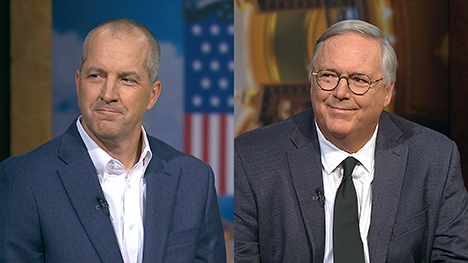
Iowa Secretary of Agriculture candidates Chris Jones (D-Iowa City) and Mike Naig (R-Des Moines) discuss key issues and policy positions.

Jeff Kaufmann, chair of the Republican Party of Iowa, discusses the 2026 election, key races, and the party's work in the final weeks of the campaign.