Jeff Kaufmann, chair of the Republican Party of Iowa, discusses the 2026 election, key races, and the party's work in the final weeks of the campaign.


On this edition of Iowa Press, Jeff Kaufmann, chair of the Republican Party of Iowa, discusses the 2026 election, key races, and the party's work in the final weeks of the campaign.
Joining moderator Kay Henderson at the Iowa Press table is Brianne Pfannenstiel, chief politics reporter for The Des Moines Register.
Program support provided by: Iowa Bankers Association and Robert and Doreen Sheppard.
Transcript
Kay Henderson
Iowa Republicans turned the state solid red over the last decade. Will one party control continue, or will Democrats gain ground? We'll talk with Republican Party of Iowa Chairman Jeff Kaufmann on this edition of Iowa Press.
Announcer
Funding for Iowa Press was provided by Friends, the Iowa PBS Foundation.
The Bob and Doreen Sheppard Family. Proud supporters of educational programing seen only on Iowa PBS.
Banking in Iowa goes beyond transactions. Banks work to help people and small businesses succeed. And Iowa banks are committed to building confident banking relationships. Iowa banks, your partner through it all.
Announcer
For decades, Iowa Press has brought you political leaders and newsmakers from across Iowa and beyond. Celebrating more than 50 years on statewide Iowa PBS, this is the Friday, September 25th edition of Iowa Press. Here is Kay Henderson.
Kay Henderson
This is part two of our series about the election. Last week we had Iowa Democratic Party Chair Rita Hart on this program. This week, our guest is the chairman of the Republican Party of Iowa, Jeff Kauffman taught history for 35 years at Muscatine Community College. He served in the Iowa House of Representatives from 2005 to 2013. In 2014, he became chairman of the Iowa Republican Party. I think you're the longest serving Republican Party chair of the state has ever had.
Jeff Kaufmann
I am, yes.
Kay Henderson
Well, welcome back to Iowa Press.
Jeff Kaufmann
It's always a pleasure to be here with you, Kay.
Brianne Pfannenstiel
Also joining our conversation is Brianne Pfannenstiel, chief politics reporter for the Des Moines Register.
Brianne Pfannenstiel
Mr. Chairman, this past week we saw a couple of high-profile Republicans take some steps to distance themselves from President Donald Trump. U.S. Representative Ashley Hinson, for example, said she's calling for an immediate war to the war in Iran after previously being a pretty staunch supporter of that effort. Some people are looking at this as evidence that the environment has shifted in favor of Democrats. What's your view of the environment on the ground right now in Iowa?
Jeff Kaufmann
You know, I think changes of opinion of that magnitude have a much more complicated scenario than just feeling the political winds. Look, I don't think I haven't heard anyone say, and this is nationally as well as Iowa, that they no longer are concerned with a rogue terrorist nation have having access to nuclear weapons. I think they're listening to constituents. I think that ultimately, there are some byproducts of this, of this war that Iowans are trying to wrap their heads around, and they are complaining. And look. Ashley Hinson and others are doing exactly what they're supposed to do. And that is reporting back to the president, even pushing the president, if they're if they're hearing a message on the ground, that's important. And here's the thing, Brianne. You know, first I hear the Democrats say that Ashley Hinson is tied to Donald Trump. Then I hear Democrats say, well, now he's breaking. Well, you can't have it both ways. I mean, what I see with Ashley Hinson, what I see with Zach Nunn and any others that express differences of opinion, or at least challenge and want further explanation is that they're listening to people on the ground. So I don't necessarily think that's an unhealthy thing for a political party.
Brianne Pfannenstiel
Is the feeling on the ground, you know, we talked about war in Iran. Gas prices are well up above $4 at the moment. Is the feeling on the ground a problem for Republicans and for the president right now?
Jeff Kaufmann
I'm feeling as the party chair, I'm feeling enthusiasm. I'm…the events have never been bigger in terms of those that I'm attending. I feel good about what I'm hearing from our base. Obviously, with 170,000 vote advantage, if our base turns out, I'm not going to say we win, but I think we go a long way towards winning that. I feel good with where we're at right now at this point. Obviously, there are some headwinds you might be asking me about later on. But no, I feel I feel good with where we're at right now. There's a whole lot of days left. Even though on the calendar it may not seem like it, there's a lifetime before November 3rd.
Brianne Pfannenstiel
And when we started out kind of this election cycle, you and I talked a lot about that base turnout and how helpful Donald Trump would be to making sure that Iowa Republicans feel energized trying to get those Trump voters out to the polls. We've seen his approval ratings fall pretty dramatically nationally and in Iowa as well. Is Donald Trump still the draw that he was at the beginning? Do you still want him to be here campaigning for Iowa Republicans before Election Day?
Jeff Kaufmann
If Donald Trump called me right now and said, I'm coming to the fourth district, Jeff, I would offer to pick him up. And I doubt if the Secret Service would let me do that. But yes, I think I think for our base voters and specifically for that slice of base voters, that regardless, I think, of what issues are out there, are going to vote for Donald Trump, but may hesitate if he's not on the ballot. I think he still has a huge role to fill within our base. But obviously, we're going to we're going to we're going to campaign throughout the entire state. And if Donald Trump is coming to Iowa, my invitation is still strongly stands.
Brianne Pfannenstiel
What if his invitation is to the third district? Would that still be?
Jeff Kaufmann
I will pick him up at the airport if the Secret Service will let me.
Kay Henderson
You mentioned the fourth Congressional District. Let's go back in time to 2018 and the last Trump midterm. The candidate for Republicans in that district did not do as well as many had hoped. And Governor Reynolds chastised Steve King after that race for the performance that he had in that race. How crucial is the fourth district?
Jeff Kaufmann
The fourth district is very crucial, Kay. And I said that in Sioux Center when I was with them a couple of weeks ago. When you're looking at a statewide race and you're looking at areas on the eastern side of the state, like Johnson County, for example, Linn County, for example. We have to have our response to that. Our response, as I told them in Sioux Center the other night, was that we have to have turnout in the fourth district. It's Republican rich. It's very, very red, regardless of what the political climate is. I cannot state strongly enough how important that the fourth district is to statewide prospects for all of our candidates, our statewides as well as Ashley Hinson, the gubernatorial, et cetera.
Kay Henderson
For those of us who are old enough to remember 2018, three of the four congressional districts in Iowa were won by Democrats. And in one of those instances, there was a libertarian on the candidate on the ballot, rather. And the Republican candidate after the race made the argument that that prevented them from winning in what was then the third Congressional District. This time around, you have a Libertarian on the ballot for the U.S. Senate on the statewide race. Is that going to be an issue, an outlet for Republicans who might not want to vote for the Republican?
Jeff Kaufmann
I can't imagine any Republican that would say, I'm going to essentially electorally throw away my vote. A Libertarian is not going to win. So if you vote for a Libertarian, you're voting for someone that does not have a chance. If you want a voice, in terms of who's going to be casting the votes. Right now, maybe that will change in a decade, I don't know. But right now, at this point in time, you have a choice between Democrats and Republicans. And I can't imagine a Republican deciding that that that that it's anything other than that Republican. So I think Republicans are want an actual choice on who's going to be casting votes in the United States Congress.
Brianne Pfannenstiel
One advantage we're seeing for Republicans at this point is, is in the money game and their ability to put money behind television advertising. Voters right now might be pretty tired of some of the TV ads that they're seeing. Is there a point where we're reaching the point of diminishing returns with kind of a very saturated political TV market right now?
Jeff Kaufmann
You know, I think about this every year, Brianne. I really do. And the evidence just every year on the analysis still says that the advertising on television, the advertising on radio, et cetera, it still works. Unfortunately, negative advertising works and the statistics are very, very clear. I just I just saw a clip of a, of a pretty hard-nosed progressive it sounded like to me that was complaining that Christina Bohannan, she can't get her to come out and door knock. I think in Iowa, I still think the making it personal approach. And obviously you can't door knock an entire state. You can't even door knock an entire congressional district. I think making it personal still matters. But no, I think we're going to see, get ready, Iowa, because you're going to see a barrage of television ads. And until statistics tell us any different, I think that's going to continue to be.
Brianne Pfannenstiel
Well, and we're entering what is the last kind of phase of this campaign over the next 4 or 5 weeks. What's your advice to candidates as they're in the kind of close here, what should they be doing to really reach Iowa voters beyond TV?
Jeff Kaufmann
Make it personal. Attend as many events as you can humanly attend. And if you cannot attend, have someone there that's a spokesperson for you. Maybe it's a staff person. Maybe it's a legislative candidate that can kill two birds with one stone and say, vote for me and vote for Ashley Hinson or Zach Lahn. And, and I think making sure that there's a two-fisted approach here. Contrast with your opponent. You know, call out the fake moderation of Rob Sand. But at the same time, remind people why you should vote for Zach Lahn. Or I could go down that scenario with any of the candidates. So I think it needs to be a one two punch.
Kay Henderson
The statewide races are sort of overshadowing the race for majority control of the legislature, where Republicans hold a 67 seat super majority in the Iowa House, and they have a near supermajority of 33 seats in the Iowa Senate. How do those candidates break through? And is there a danger here with so much money being poured in a Senate race that could be key to determining the U.S. Senate majority, that these legislative candidates will sort of fall by the wayside?
Jeff Kaufmann
Again, analysis usually…ujsually when you reflect back on legislative rates, the quality of the candidate, the connection of that candidate to that community truly matters. I mean, it probably matters at that legislative level more than anything else, where people actually know the candidate, they can talk to the neighboring town if they happen to live in another part of the district. So I, I still feel I feel good as long as the candidates are working. In legislative races, you can make it personal. In legislative races, you can knock on almost every door. And I think as long as our legislators do that, I believe that, I don't think there's anyone serious, I haven't even heard the most progressive of Democrats suggest that the that the majorities are in jeopardy whatsoever. But, you know, each race to that particular legislator, to those particular people, are as important as any other. And so, of course, you always look at the environment, you always look at the environment in a in a midterm situation. But I know there where I've had the opportunity to talk to many, many legislators and legislative candidates, and they are working as if they're 20 points behind, even if they don't have a poll to indicate where they're at.
Kay Henderson
So what do you make of Democrats who point to their special election victories in the last year as sort of a momentum showing for Democrats?
Jeff Kaufmann
Well, they know better than that. I mean, they, anybody that's even a novel, novice, a historian of special election knows that those are those are tiny, tiny fragments of the actual constituency. They are heavily dependent on the candidates. The candidates are selected at special nominating conventions. So the candidates oftentimes will start out without name recognition whatsoever. I don't see, I spent about 10 seconds reflecting on the on the special election results. Now, those special election areas, now we're spending focus on that. I think at that point, the Democrats had nothing to crow about. I suppose if I’d have been the Democratic chair, I would have been trying to enhance their importance, too. But we all, I at least I am convinced that that's not a foreboding of anything.
Brianne Pfannenstiel
Conservative commentator Steve Deace, who has an Iowa background, shared some thoughts on social media this week that were gaining traction. And he was cautioning that legislators who won districts, won their last 2024 elections by pretty significant margins could still be on the bubble or even underwater going into the midterms in November. And he was, you know, kind of trying to light a fire under folks with that post. Do you think that those fears are unfounded?
Jeff Kaufmann
Well, I mean, to me, it's just Captain Obvious. I mean, that's obvious. I don't think there's any special inside information on saying that you got to make sure that you're taking care of your local politics. And I'm quite certain that that, you know, individual podcasters, no matter who they are, don't have any inside information on actual decision makers. But yes, I would, I've been saying that all along. And that you have to make sure and not take anything for granted. I think that's how Republicans have been successful up to that point. And so, yes, I would say that. But, you know, Steve Deace is one of 100 people that have been saying that all along. I don't see that as particularly a, you know, a neon sign flashing.
Kay Henderson
There was a neon sign flashing at the end of Tom Vilsack's tenure as governor, when you led an effort to override his veto of a bill that dealt with eminent domain. It was about a lake that was proposed to be built to serve water to the city of Osceola and southwest Iowa. There's been a huge debate about eminent domain in this state, in the legislature over the past few years. Now, there's sort of the shifting debate about data centers, which is a little bit adjacent to that. How is that roiling through your party?
Jeff Kaufmann
All politics is local. And I don't mean to answer a fair question, a detailed question, with a cliché. But let me flesh that out just a little bit. I really I really think that every single district, regardless if I think you're going to have a different answer potentially in a in an urban district or a suburban district than what you might in a rural district. I think a lot of legislators are, I mean, I think more than almost anything else, the data center is going to be tied to the geography and to the constituency that you have at home, as opposed to any kind of a general ideological commonality that a that Republicans may have. I know in every county they're having debates. I mean, the individual counties, even the county where I'm a supervisor, we've had debates back and forth on data centers. I think it remains to be seen. I don't believe that there is any one answer to that. But here's a here's an example of where voices are going to drive if there is going to be a legislative response. And in some cases, the legislative response may be let the local folks figure that out.
Kay Henderson
The president has weighed in on this and said, hey, data centers, it's the wave of the future. It's about super intelligence. Does his opinion on this sway any people?
Jeff Kaufmann
It might. But here's another example, Kay. I mean, we've already talked in the program about if you have a difference of opinion with the president or you want to push the president one way or the other and flesh out an argument. I think that's an example where, no, I believe there will be some legislators that will take stands. There will be some lawmakers that take pretty hard stands against data centers. There will be others that will not. I really think that that issue, I think that's going to transcend any given mandate on high. And I believe that's going to be wholly a local issue. And I'm guessing these legislators are being quizzed on it I would imagine pretty aggressively. At least I picked that up in my in Cedar County, where I'm from.
Brianne Pfannenstiel
My colleagues at the Register have been reporting about the possibility that a steel company will be completing a development in southeast Iowa, and that as part of that, there's been some discussion in the legislature about whether they need to convene a special session as early as before the midterms to potentially pass a tax incentive package. Do you think a project like that or that discussion that early is, is a good idea here in Iowa?
Jeff Kaufmann
Well, Brianne, you're going to have to talk to the better looking and smarter Kaufmann about that one. Because my son is the majority leader in the House. I mean, that that's going to that's going to be wholly a conversation that they're going to have at the legislative at the legislative level. I am not, I am not going to be involved in in whether one is called or actually any discussions of whether one is called. You know, as chair, I've been pretty hands off policy unless it's framed in the platform. And so but I, you know, I think that's a fair question to ask legislators. Certainly.
Brianne Pfannenstiel
And, you know, as they talk about the possibility of a special session, there's been concern mainly among Democrats that a special session might be called to potentially limit the powers of a governor, depending on how that governor's race is looking going into November. Do you think it would be a good idea, or would that be a problem to limit those powers further?
Jeff Kaufmann
You know, any special session that I've that I've read about in history or a special session, Kay you just mentioned one that I was heavily involved in, almost always is very specifically focused. I, you know, again, not being a part of the discussion, but putting on the student of Iowa politics hat, I would imagine any discussion would be very focused. That would be my guess.
Kay Henderson
Would it be advantageous for a gubernatorial candidate who's been out there saying, I want to tax data centers differently, I want to retailor economic development packages for the state, to have this kind of debate while he's out there running?
Jeff Kaufmann
I, you know, I think people are going to make their decisions on races, not based on a particular one day in Des Moines, if indeed that occurred. And I'm not I'm not even going to yield that premise because I do not know. But here's the thing. You just asked me that question, fair one. And the fact that you asked me that question actually tells me and allows me to say one more time that a, that a gubernatorial candidate like Zach Lahn is going to stick with what he has been saying. He's going to continue. He's not going to put his finger in the air as the winds blow. The fact that we're talking about what Zach Lahn may think or not think, I think is advantageous and an opportunity to talk about just how independent this candidate of ours actually is.
Kay Henderson
Well, you like to talk about the Iowa Caucuses. So let's talk about that for just a little bit. The Republican National Committee at the midterm convention met and has solidified the calendar for the next presidential election. And they've chosen Iowa's caucuses to be, again, first in the nation on the Republican side. What does that mean for you on November 4th?
Jeff Kaufmann
Be careful what you ask for. You might just get it. Well, I got it. And so what that means literally. And I mean literally. The day after the election, we have to start fundraising. We have to start planning. I was in DC on Wednesday. I just happened to be able to have a visit with Tom Cotton. I just was able to have a visit with Rand Paul. I just was able to have a visit with Rick Scott. Now, I'm sure they wanted to talk to me because of my charismatic presentation. It had nothing to do with me being from Iowa. But no, I mean, obviously we are going to be, at least on the Republican side, we're going to be a topic of conversation nationally. That's a good thing. What it means, though, is unlike New Hampshire, where basically the taxpayers pay for their primary. Here, that means I've just doubled what has to be raised. Or whoever is the chair has to be raised in the before the’ 28 caucuses. What it also means, though, is this state, at least on the Republican side, will once again not be flyover country. And that is a good thing.
Kay Henderson
You just said if you're the chair. Have you made that decision yet?
Jeff Kaufmann
I have not. Nope. I just I, I never count my chickens before they're hatched.
Kay Henderson
Should JD Vance, who came here recently in the month of September and did an event in Council Bluffs, should he be considered the frontrunner?
Jeff Kaufmann
I mean, if you're vice president and you're in front of the cameras constantly, yes. I mean, you've got, you're certainly a front runner in name recognition. Certainly any vice president is going to is going to have those advantages. I would argue that any potential Iowa candidate that is seen on television that is seen as a policymaker actually has that happen. Here's why this needs to start in Iowa. Rick Santorum won these caucuses, too. So did Mike Huckabee. So you can be a front runner early on in name recognition. But these Iowa Caucuses are going to be wide open. And one of the first things I'm going to push at our SCC. And I can't force the SCC members to do this, but my governing board, is that once again, we sign off on a on a guarantee that we are going to be neutral 100% in the in the Caucuses. So we can lay out the welcome mat and say, folks on the Republican side, we value, we value you jumping in and giving our state a look over.
Kay Henderson
I just mentioned the mid-term convention that was held in Dallas early this month. Was it helpful? Was it worth the effort?
Jeff Kaufmann
I think well, here in Iowa, there was you could go if you wanted to. And we did not have we did not have to expend a lot of resources from the party, because people that wanted to attend could pay to attend. I had to miss the second day because I had already said long before I knew this was going to occur, I had told the folks in Sioux Center, Iowa, that I would be there and with the governor, and the invitations were already set. I had to be in Iowa, and I gladly was in Iowa. And I don't know if the president knew that, but I know that he would understand that I wasn't there. So it was totally voluntary. I think it was good to get messages across. I don't know how many Iowans tuned in. But any that did, I think I think it's good that they heard the positive things that the Trump administration has done. So yes. And of course, for me, the highlight was the day before, when made sure in the Rules Committee, which would have been really the last realistic attempt for, for the, the, the typical round of states to, you know, wish they had what we have until they realize they have to pay for it all voluntarily to, to, you know, try to gum up the, the, the process of Iowa becoming first. That did not happen. So I was on a high when I walked in.
Brianne Pfannenstiel
Well, help make us smarter on election night. A somebody who's watched a lot of elections, what's maybe a bellwether county or a city or an area of the state that you're watching that's going to indicate kind of how well Republicans are doing that night?
Jeff Kaufmann
I think probably rural counties that are quickly growing into suburban counties, maybe not quite there. I think those are bellwether. I, you know, I, I'm going to tell you right now in Van Buren County, Iowa, the Republicans are going to win. And I can tell you in Johnson County, write this down, this is going to be what you want to tweet out in this show, I think the Democrats are going to pull it out in Johnson County. But I would look, I would look at those kind of quasi rural suburban counties. I think that that could be a bellwether. And obviously we got sophistication now with the returns coming in that we'll be able to look at individual precincts, too.
Brianne Pfannenstiel
Well, the Republican Party has made big strides over the years as well on absentee voting. Voting either early in person or by mail. We've seen a lot of discussion around that, including President Trump kind of dissuading Republicans, casting doubt on whether that's a viable means of voting. Are you still encouraging Republicans to vote absentee in person or by mail this year?
Jeff Kaufmann
Yes. And let me say something I don't believe I've said publicly yet. And this is not pie in the sky. This is I've got the money in the bank. The Republican Party of Iowa will have the largest, most aggressive get out the vote effort in the history of the Republican Party of Iowa. And a large component of that is absentee voting and chase, if that's where Republicans choose to vote. We want to bank the vote Hard yes on that.
Kay Henderson
Mr. Chairman, thanks for joining us today at Iowa Press.
Jeff Kaufmann
I appreciate both of you. I really do.
Kay Henderson
Before we go, a little programing note for you. We have a busy month of October coming up and we want to tell you about what's in store for you if you follow politics, which I guess you do. We'll start with candidates for the U.S. Senate, a debate, an Iowa Press Debate on October 7th. Then debates for the Second district and the Fourth Congressional District. We’ll finish with candidates for governor debating on Iowa Press on October 27th. All of those…21st, rather. All of those debates are live at 7 p.m. on Iowa PBS and streaming online. We'll also welcome candidates for all of the statewide races to this Iowa Press table over the next few weeks, so you can learn what they are saying on the campaign trail. You can watch those live at 7:30 on Friday or Sunday at noon, or online anytime at IowaPBS.org. For everyone here at Iowa PBS, thanks for watching today.
Announcer
Funding for Iowa Press was provided by Friends, the Iowa PBS Foundation.
The Bob and Doreen Sheppard Family. Proud supporters of educational programing seen only on Iowa PBS.
Banking in Iowa goes beyond transactions. Banks work to help people and small businesses succeed. And Iowa banks are committed to building confident banking relationships. Iowa banks, your partner through it all.
Watch More
Zach Lahn (R-Belle Plaine) and Rob Sand (D-Des Moines) will answer questions from Iowa reporters and discuss their priorities and vision for the state during a 90-minute debate.
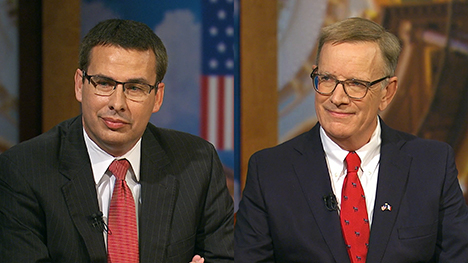
Iowa State Treasurer candidates John Norwood (D-West Des Moines) and Roby Smith (R-Davenport) discuss key issues and policy positions.
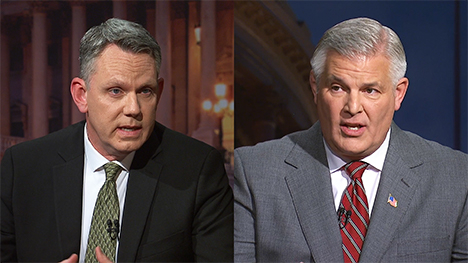
Candidates Dave Dawson (D-Lawton) and Chris McGowan (R-Sioux City) answer questions from reporters and discuss their platforms, concerns and future plans.
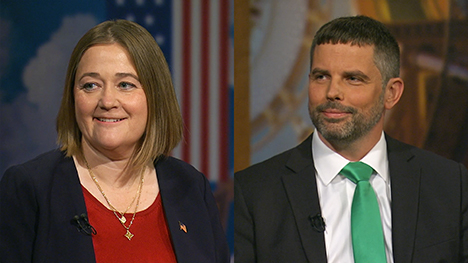
Iowa Attorney General candidates Brenna Bird (R-Dexter) and Nate Willems (D-Mount Vernon) discuss key issues and policy positions.
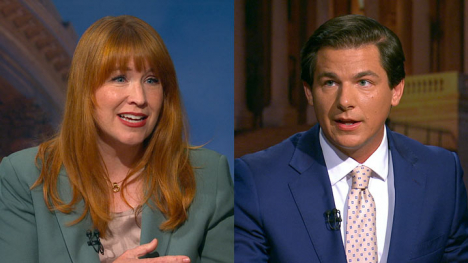
Lindsay James (D-Dubuque) and Joe Mitchell (R-Clear Lake) answer questions from Iowa reporters and discuss their platforms, concerns and future plans.
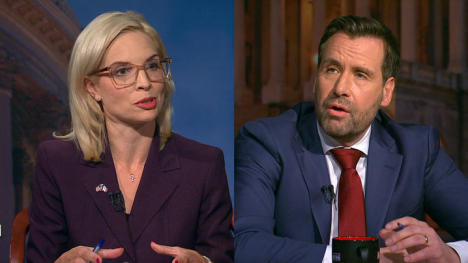
Candidates Ashley Hinson (R - Marion) and Josh Turek (D - Council Bluffs) answer questions from reporters and discuss their platforms, concerns and future plans.