Iowa Secretary of Agriculture candidates Chris Jones (D-Iowa City) and Mike Naig (R-Des Moines) discuss key issues and policy positions.


On this edition of Iowa Press, Iowa Secretary of Agriculture candidates Chris Jones (D-Iowa City) and Mike Naig (R-Des Moines) discuss key issues and policy positions.
Joining moderator Kay Henderson at the Iowa Press table is Donnelle Eller who covers agriculture, the environment and energy for The Des Moines Register.
Program support provided by: Iowa Bankers Association, and Robert and Doreen Sheppard.
Transcript
[KAY HENDERSON] Water quality, a struggling farm economy, food production and safety. Those are just some of the issues Iowa's Secretary of Agriculture must deal with. We'll talk with the two candidates running for that job, on this edition of Iowa Press.
♪♪
[ANNOUNCER] Funding for Iowa Press was provided by Friends, the Iowa PBS Foundation.
[ANNOUNCER] The Bob and Doreen Sheppard Family, proud supporters of educational programming seen only on Iowa PBS.
♪♪
[ANNOUNCER] Banking in Iowa goes beyond transactions. Banks work to help people and small businesses succeed, and Iowa banks are committed to building confident banking relationships. Iowa banks, your partner through it all.
♪♪
[ANNOUNCER] For decades, Iowa Press has brought you political leaders and newsmakers from across Iowa and beyond. Celebrating more than 50 years on statewide Iowa PBS, this is the Friday, October 2nd edition of Iowa Press. Here is Kay Henderson.
[HENDERSON] The Iowa Department of Agriculture and Land Stewardship works with farmers, protects the food supply, animal health and consumers. It also deals with soil and water conservation. Our two guests today are running to be Iowa Secretary of Agriculture for the next four years. Let me introduce the candidates. Mike Naig is a Republican and the current Secretary of Agriculture running for a third term. He was previously the department's deputy secretary. And Chris Jones is the Democratic nominee. He's a research scientist working most of his career on water quality and environmental issues. He is the author of a book titled The Swine Republic. Gentlemen, welcome to the Iowa Press table.
Thank you.
Thanks, Kay.
[HENDERSON] Joining our conversation is Donnelle Eller, who covers agriculture, the environment and energy for the Des Moines Register. Thanks.
[DONNELLE ELLER] Water quality has become a big issue in Iowa politics. Both candidates for governor are bringing it up on the campaign trail. Mike Naig, we'll start with you. How bad is it?
[MIKE NAIG] How bad is what?
[ELLER] The water.
[NAIG] Well, look, first of all, great to be back. And this is a very important topic. And we're going to obviously dig into that. It's been a hot topic on the campaign trail, hearing a lot about it. And certainly, what I'm trying to talk through is what are we doing? What are we doing at the Iowa Department of Ag and Land Stewardship? It's our mission to work with the USDA, with the local soil and water conservation districts, with partners all across the state to improve water quality in the state of Iowa, to implement the nutrient reduction strategy in this state. So, we have to have a long view of these things, and we're making progress, is what I would say. But we need to be very clear eyed about this. We've got a big job ahead of us. And if we want to make sure that Iowans have access to safe drinking water, ultimately we've got to do two things work upstream to prevent pollutants from getting into streams to begin with, but also make sure that we've got modern drinking water treatment capacity in big cities and small all across the state. So, I'm proud of the work that we've done. We've set records for conservation adoption in the last five years, and we're poised for the ability to go further, take the next steps, scale up and accelerate our progress across the state. It's a daunting task, to be sure, but we're working all across the state of Iowa and again, setting records.
[ELLER] Chris Jones you said this race between the two of you is a referendum on water quality. Can you explain why?
[CHRIS JONES] Well, we have a million people here in Iowa drinking water with nitrate associated with the whole suite of cancers. We've got 7000 private wells that have been contaminated with nitrate above the 10 milligram per liter threshold. We have thousands more contaminated with E coli. We have our state park beaches, which are unusable all summer long. We have people that have lost faith in their drinking water, that are spending thousands of dollars for our own systems. And so, this is central to the quality of life here. And I think the condition of our water here is the biggest failure of our state government in the history of the state, our failure to mitigate the quality.
[ELLER] Rob Sand, the Democrat running for governor, has repeatedly said he'll be working with the Republican legislature. Chris Jones if you're elected, how would you convince Republicans to adopt the water quality initiatives that you support.?
[JONES] So firstly, we see the Republican candidate for governor saying a lot of the same things I say about water quality and how we need to break up agribusiness, and we need to rethink agriculture here. And so, I'm happy to see people on the Republican side agree with me on that. I don't think it's a foregone conclusion that the Republicans are going to control the legislature, but nonetheless, if that's the case, I think Republicans represent many of our rural areas, right, and rural people really bear the brunt of a lot of this pollution. Des Moines, we see, has the capacity to cope with this problem. It may not be fair that they have to cope with it, but Des Moines area residents and the water utility here does have the capacity to cope with it. If you live in a small town of 2000 people and your well gets contaminated with nitrate and you need a new well or a new treatment plant, that's a burden. You know, that's a big burden. And so, I think Republican legislators, legislators are, you know, dialed into this and want to do what's best for their constituents. I know that they see this as a quality of life issue. They know that rural residents are leaving the state. Our young people are leaving small towns. Our rural counties are being depopulated. I think there's Republicans in the legislature that are aware of all these things.
[ELLER] Mike Naig, if you're reelected, what new water quality initiatives would you recommend to?
[NAIG] Well, first of all, I'm glad you bring up the governor candidates. And I think you've got a situation where both candidates are Republican and the Democratic candidate for governor are talking about the same things that I am, which is to provide incentives to farmers and work with farmers, not the mandates and taxes that my opponent is talking about. There is an outlier in this race, and it's my opponent, not the two Democratic or not the two candidates for governor. But what have we done? This past session is a good example of something that we can accomplish on a bipartisan basis is when we go to the legislature and say, we need to work again upstream to do more of what's working, cover crops, buffer strips, nutrient management, building wetlands focus on 22 counties upstream from the Des Moines area, but also to and I agree, by the way, that there's a need for treatment infrastructure modernization all across the state. It's not just in the Des Moines area. I hear this all the time when I'm traveling across the state, to expect ratepayers to be able to pay a loan for the type of treatment that they need wastewater, stormwater, drinking water. The legislature doubled grants to small communities, created a low interest revolving loan fund. Exactly for this purpose. And we need to continue to look at how do we bring federal funds in to be able to address this need across the state? It's not just nitrates that we're treating water for, by the way. And I think we have to be we have to be real about that. So, what are we going to -- we are positioned to expand cover crops. Just this year, doubled cover crop enrollment in cost share this year versus last year, 1.4 million acres. That shows momentum. It shows that when we have resources, we can expand our working lands, cattle and conservation program, converting row crop acres that are underperforming or losing nutrients or soil have erosive soil conditions. Getting that converted to pasture or hay ground, trying to deal with this beef herd that needs to expand in the country, but also trying to bring environmental outcomes as well. Those are the types of things that we need to be looking at and expanding.
[HENDERSON] It's been 16 years since voters approved what was called the Iowa Water and Land Legacy Constitutional Amendment. It created a trust fund. The trust fund is empty because it would have required the sales tax to be raised. Zach Lahn, the GOP candidate for governor, has said he wants the trust fund filled so the state can provide, in his words, real incentives to farmers in the most affected areas to adopt practices, to put a dent in the cancer crisis. Mike Naig, is that the right approach?
[NAIG] Well, look, we're ready for additional funding and I'll be asking for that next legislative session if reelected. You know, we need to take cattle and conservation statewide. We showed what we can do when we really stretch the legs on the on the cover crop, a cost share program this year. What I will say is we're ready for more funding, and we've built these programs in a way that we can now scale up in a real way across the state. As it relates specifically to the sales tax, I think too this is something that's going to have to be really looked at by the legislature too. You're going to raise a tax sales tax on Iowans. If we're going to do that, there has to be, I believe, a real conversation around what is the corresponding tax relief that comes as some sort of a package related to that. But on the issue of water quality funding and conservation funding, we're ready for the next step. We can actually take more funding now.
[HENDERSON] Chris Jones your view on what everybody sort of refers to as IWILL?
[JONES] Well, Republicans tried to kill. I will completely in the last legislative session. And so that tells you where the other party is on this. Yes, we need IWILL to be funded. We need the original formula that the taxpayers voted on in 2010 to be honored by our state government. And so, yes, I'm in favor of funding IWIll.
[ELLER] Ethanol is obviously important to Iowa. We use about half or more, depending on your point of view of the crop. And many farmers see it as critical to a critical market for their crop. And it's a way to help consumers lower gas prices. Chris Jones, you're not a fan of ethanol, can you explain why?
[JONES] Well, what has ethanol cost us? Right. It's entrenched. This corn soy system, it makes it difficult to diversify the system. It's directly responsible for a lot of this water pollution. And, you know, I would suggest that it just has not been good for Iowans in general. It has provided a security blanket for farmers. There is no doubt about that. And that's why we need to talk about how we strategize going forward. We know this, that the demand for liquid fuels in the United States is going to decline, along with that, the demand for ethanol is going to decline. I think we're negligent here in Iowa government that we don't talk about what comes after ethanol. Some years, we have 8 to 9 million acres of corn that are going to the ethanol plant. That's one fourth of our state. One fourth of our state's area is being committed to this economic activity. I think we need to talk about now. How do we strategize going forward from ethanol? It's a dead end economically. It's a dead end environmentally. It's a dead end politically. We need to have this discussion now.
[ELLER] Mike, I'm going to let you respond to that. But I also want you to talk about what happens if the Summit pipeline isn't built. What impact does that have to the ethanol industry?
[NAIG] Well, first of all, there's definitely a difference here between us. I don't think that's a surprise to anybody. I mean, we've both been pretty clear, I think on this and look I see ethanol as an upside. This is value added agriculture. We're spinning off important feed ingredients for livestock producers. Corn oil, where you're creating more value. Look, and by the way, we know that this is a multibillion dollar, $5 billion contribution to our state's economy, thousands of jobs affecting real prices, corn prices for farmers, this has been a very good thing for the state of Iowa. And opportunity for more, by the way, fuel prices being what they are, doesn't that just drive home the idea that more domestic energy production, more renewable energy production is a good thing for us in all forms ethanol, renewable diesel, biodiesel. These are things that can be very positive. Wouldn't it be great if, years ago we had been able to access and have year round nationwide access to E15 that consumers could be using all across the country? I mean, we can look for expanded markets around the world. There's more domestic usage to be had. So that's what we should be focused on as it relates to the pipeline. What I continue to hear from the ethanol plants is that there is an upside for carbon sequestration and lowering the carbon intensity of ethanol. That's one way to do it. Iowans have been very clear about that. They don't want the pipeline built using eminent domain. And we need to look at strengthening private property rights when it comes to the use of eminent domain. But I will say this you've got expansion being announced or being talked about in the ethanol industry, and it's not happening in Iowa. So, there is there's a consequence, I think, for where we are right now.
[ELLER] Can summit Mike Naig build the pipeline without eminent domain?
[NAIG] I think they need to. That's I believe that's how it's going to get done if it's going to get done.
[ELLER] Chris Jones, the legislature has tried to resolve this issue, do you believe it can?
[JONES] No, I don't think it can. And I think the pipeline is a bad idea. I think the carbon credits are a bad idea. This is not a climate change solution. The CO2 is going to be used to scavenge recalcitrant oil out of these oil wells. How is that a climate change solution? I just don't see ethanol as being an environmentally or economically viable solution going forward. Yes, it has provided the security blanket for Iowa. Yes, it has created some jobs. But look at the land. We've committed to this. Dave Swenson at Iowa State said the ethanol industry has created about 7000 jobs. How does that -- how do you reconcile that with, you know, 8 or 9 million acres committed to this economic activity? It's the worst jobs program in history if you look at the natural resources that we've had to commit to this.
[HENDERSON] Candidates, we're about halfway through. We have a lot more topics to cover. Some quick answers to the next few questions, if you will. Mike Naig, as you know, Iowa farmers do not pay taxes on diesel that's used on the farm. Should that be extended to all Iowa consumers?
[NAIG] Well, I'd say the situation we're in right now, it's hurting and we ought to pursue. We have to look at every option that's on the table that would actually lower the price. And so, I think, you know, if there's some looking at off farm diesel, off road diesel being used on road that's got a federal enforcement issue there, I think in that situation, it might be better to just look at some sort of a tax holiday. But look, people are hurting. You got diesel that's going into combines and tractors across, well, not right now because it's so wet, but will be hopefully soon. It's basically two times what it was last year. That's a real bite on profitability. And we ought to be looking at anything we can to lower the price.
[HENDERSON] Chris Jones?
[JONES] Well, I think a better idea here is to develop a farming system that's less reliant on fossil fuels. And so that's the way to go. Talking about the tax on diesel fuel is just scratching at the surface. Let's devise some policy here that saves money, saves farmers some real money by developing a system that's less reliant on fossil fuels in the first place.
[HENDERSON] Chris Jones, what's your view of the president's decision to import beef to lower the price of ground beef for consumers?
[JONES] It's one of the stupidest ideas I've ever heard of. I think we don't even know what this meat is. It hasn't been inspected. It's hurt Iowa farmers. It's hurt Iowa beef producers. Let's have some strategic discussion here about the beef industry here. How can we rebuild our beef industry here in Iowa? Let's make Iowa the grass fed state. We could do that. We could brand our meat. We could brand our meat with effective policy. We wouldn't have to worry about this meat coming in from South America. We wouldn't need it. Let's do that here.
[HENDERSON] Mike Naig?
[NAIG] It's a bad idea. Look, we need to -- the signal that needs to be sent to grow the beef herd in this country, which is the smallest since the 1950s, is that there's going to be profitability when investments are made to save back those heifers and build that herd. I think also that there's a lot of folks that think, well, the herd is going to expand out west. Drought has really put a halt to that. If the beef is going to expand in this country, it's going to happen in places east of the Missouri, right? If it's going to happen in Iowa, then we need to look at creating more pasture. That's how and then creating certainty in the marketplace that allows somebody to make the investment over a couple of years that it takes to see the payback on that. That's why we the cattle and conservation, that's why we're trying to work for more pasture ground, get access to CRP for haying and grazing, convert some of those row crop acres to pasture. Investing in meat locker expansion and capacity across the state are two Iowa program giving a market access to more folks to sell direct to consumer. And you know we appreciate what USDA is doing on looking at competition within the packing industry and also investing in those midsize or a little bit larger processing facilities as well. That's the answer, not importing more beef candidates.
[HENDERSON] Candidates, we'll start with you, Mike Naig. Should and could the state sue the companies in the ag sector that people like Zach Lahn and Bernie Sanders referred to as monopolies?
[NAIG] Well, could the state of Iowa. Well, sure. But let's take a bigger view here. I mean, we've got anti-competitive laws and antitrust laws in this country that should be enforced. And DOJ should be engaged in this at the national level. You know, we should always want to be vigilant when it comes to competition in frankly, in every aspect of our lives, not just as it relates to agriculture. So, state of Iowa, if there's a role to play, we should play it. DOJ certainly should be, Congress, all the oversight is something that we should, we should never be afraid to be looking at those things.
[HENDERSON] Chris Jones.
[JONES] Well, we've lost control of our agriculture here in Iowa to the federal government and corporate agribusiness. And so, I'm very much in favor of antitrust that would break some of this up. I'm for that. I think farmers feel pigeonholed by a corporate agribusiness. And yes, I think we need some action there, some antitrust action, aggressive antitrust action.
[ELLER] Let's talk about the Iowa economy, Iowa ag economy. A lot of farms are struggling right now. And some predict that this state could face another farm crisis. Is there something the state should do to address the current challenges and the long run impacts to rural Iowa? Mike Naig, what are your thoughts?
[NAIG] Well, 100%. We're in a -- profitability is very much under pressure in the farm community and has been now for several years. And it's not just one thing. It's not just that prices aren't where we want them to be, it's that input prices remain stubbornly high. And we know inflation is affecting that as well. That's not something that's happened overnight. We've got key supply chains that are disrupted because of the war. And in the Middle East, with Iran fertilizer and fuel. And in the middle of that, you've got uncertainty around policy. We still don't have a farm bill. After waiting how many years now for this and year round nationwide access to E15 trade policy that's been disrupted. All of that contributes to pressure. And it's not one thing that's going to solve that. But again, we need to be a state that's advocating and we need to be working at the federal level to ensure that we are bringing certainty where we can, that policy is supporting market. And then we are looking on the input side of how do we how do we look at these key supply chains and competition within those? And where does where do critically important things like fertilizer and fuel come from in the world? And should more of that happen in the United States?
[ELLER] Chris Jones, what are your thoughts?
[JONES] Well, the question is here for me, has corn and soy and ethanol brought prosperity to rural Iowa? It has not. Every indication is that it has not. In many parts of rural Iowa, it's almost destroyed the society there. And so, we need to focus on developing a different type of production system here that's less reliant on inputs when you can only do two things, which is corn and soy. Guess what? The people that send you, sell you the inputs have you over a barrel. And so, we need to develop a system that's more diverse, that's less reliant on the inputs from corporate agriculture, a more diverse assemblage of crops that's going to be more resilient to climate, more resilient to market forces, more resilient to politics. That's what we need. That's what I intend to do.
[HENDERSON] Let's talk about food for human consumption. Consumers say they want to know where their food comes from, and they also say they want cheap food, which is also mass produced. If it's cheaper, how do you address those desires? Chris Jones?
[JONES] Well, we hear Iowa agriculture claim all the time that we feed the world and we don't even feed Iowa. And so, let's focus on that. What do we need to do to recruit farmers to grow edible foods, to raise livestock in a resilient and humane way that can provide food to Iowans? We need to get these types of farmers access to land. I think we can do that with policy. We see right now we have very little money committed to this activity in Iowa. We need policy that incentivizes these activities. People in our cities desperately, desperately want food that's grown by Iowa farmers. We see we have the second highest cancer rate. One of the first things people think of to avoid their risk of cancer is to eat fresh and locally grown food that's not awash in pesticides and preservatives, to get it here from California and Mexico and Chile and Texas and Florida, we can do this. This is within our means to do this. I intend to develop policies. I'm going to ask for $10 million a year from the legislature to do this to get local foods in the mouths of Iowans and in the mouths of our schoolchildren here in Iowa.
[HENDERSON] Mike Naig your thoughts on the topic?
[NAIG] Well, first of all, pork and beef and turkey and eggs and dairy are absolutely food, as is soy protein. I mean, to say that those are not, is not true.
[JONES] I didn't say that.
[NAIG] Well, but I mean, the whole idea that, hey, we don't we don't feed people. We do. We absolutely do. Now is -- do we have, you know, everything that you find in the grocery store grown in quantity in the state of Iowa? No. And I don't think we're going to given the climate and that sort of thing. But look, this is something I'm very proud of, the work that we've done now related to Choose Iowa, which is the branded program that we launched three years ago for Iowa grown, Iowa made, Iowa raised to do exactly this. Not enough funding for that program, by the way. But there was none before our creation of it. And we have been able to secure millions of dollars for value added ag grants on farm, dairy processing and labor saving technology on small dairy farms, investing in meat locker capacity, local food for schools. We launched that program last year. It is small. $200,000 is not enough, but we're at least doing what we can to connect the dots, providing grants to 125 schools this year to buy local. And, you know, food, working with food banks, with food hubs to Iowa is a platform that we can use to diversify our agriculture, create more of that direct to consumer opportunity, and also create good, great experiences for Iowans as well to get out and have some fun and do some business. This is a platform that we can use, and we need to also be securing, advocating for and securing additional funding for the federal level specialty crop block grants, local food purchasing. I mean, there's lots of opportunity there that we need to advocate for.
[ELLER] This is a big issue, and we're getting short on time. But Iowa State says that 40% of Iowa farmland is owned by people 75 years and older. Mike Naig should the legislature take action to prevent hedge funds and other investors from buying Iowa farmland?
[NAIG] We shouldn't make any bones about it. We want more Iowa ground being owned by Iowans, and we'd like more farm ground being owned by owned by farmers. We have prohibition. There's been lots of talk about foreign ownership. That's one we have actually, have one of the gold standards in this country for a prohibition. Robert Ray signed that into law. This is not something recent. We gave the Attorney General additional power to subpoena and look into that, to ensure that we don't have hidden foreign ownership and LLCs. Look, those are things we need to think about. We need to look at what kind of corporate ownership of farm ground or investor ownership of farm ground is happening. And I think it's absolutely right that we should create incentives for more of that to be Iowa owned.
[HENDERSON] Last word to you, Chris.
[JONES] We need Iowa farmers to own their own ground, plain and simple. And so, we don't need hedge funds owning that ground. We don't need people sitting in air conditioned offices in Minneapolis and Chicago and Kansas City owning that ground. We need policy to get the land ownership patterns that we want. And so, I do think we need some different policy. We need to incentivize people, absentee landowners that currently own that land, We need some policy that's going to incentivize them to divest. This is a way to get land more available to young farmers. And so, I think it is a travesty that so much of Iowa land is not owned by our farmers.
[HENDERSON] Gentlemen, thanks for being here at Iowa Press. We're out of time.
[JONES] Thanks for having me.
[HENDERSON] You bet. This is the first in a series of conversations on Iowa Press with candidates for statewide executive offices. So, stay tuned. Next week, we begin our series of Iowa Press Debates. First up candidates for the U.S. Senate. That will be on Wednesday, October 7th. The following night, October 8th, will have candidates for Iowa's second Congressional District. Then fourth Congressional District candidates on October 14th. Then we'll wrap up Iowa Press Debates with the candidates for governor on October 21st. All of those debates are live at 7 p.m. on the air and online. For everyone here at Iowa PBS, thanks for watching today.
♪♪
[ANNOUNCER] Funding for Iowa Press was provided by Friends, the Iowa PBS Foundation.
♪♪
[ANNOUNCER] The Bob and Doreen Sheppard Family, proud supporters of educational programming seen only on Iowa PBS.
♪♪
[ANNOUNCER] Banking in Iowa goes beyond transactions. Banks work to help people and small businesses succeed, and Iowa banks are committed to building confident banking relationships. Iowa banks, your partner through it all.
Watch More
Schedule Update: Iowa candidates for governor will not debate this week. The debate may be rescheduled.
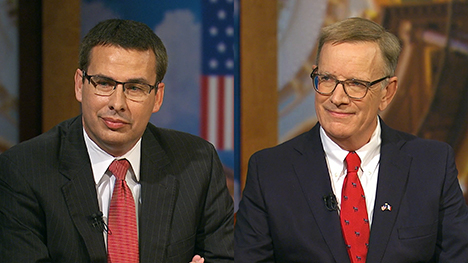
Iowa State Treasurer candidates John Norwood (D-West Des Moines) and Roby Smith (R-Davenport) discuss key issues and policy positions.
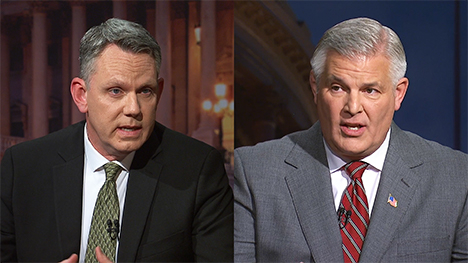
Candidates Dave Dawson (D-Lawton) and Chris McGowan (R-Sioux City) answer questions from reporters and discuss their platforms, concerns and future plans.
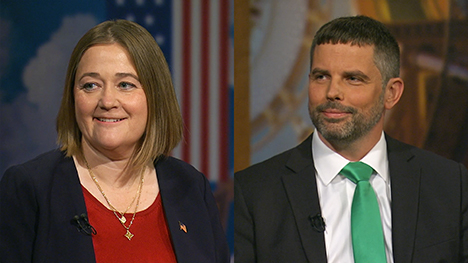
Iowa Attorney General candidates Brenna Bird (R-Dexter) and Nate Willems (D-Mount Vernon) discuss key issues and policy positions.
Lindsay James (D-Dubuque) and Joe Mitchell (R-Clear Lake) answer questions from Iowa reporters and discuss their platforms, concerns and future plans.
Candidates Ashley Hinson (R - Marion) and Josh Turek (D - Council Bluffs) answer questions from reporters and discuss their platforms, concerns and future plans.