Entering the final review of USMCA without Canada. The battle blueberry growers face after harvest. And, commodity market analysis with Brad Matthews.


On this edition of Market to Market ...
Entering the final review of USMCA without Canada. The battle blueberry growers face after harvest. And, commodity market analysis with Brad Matthews.
Transcript
[PAUL YEAGER] Coming up on Market to Market -- entering the final review of USMCA without Canada. The battle blueberry growers face after harvest. And commodity market analysis with Brad Matthews next.
(music)
[ANNOUNCER] I wouldn't be here without my customers.
Yeah, I'd like to thank the customers. They're very dear to our hearts.
It's about the people that you're working with and the relationships that you have.
Thank you. Thank you. Thank you.
Thank you from the bottom of my heart.
(music)
[ANNOUNCER] Tomorrow. For over 100 years, we've worked to help our customers be ready for tomorrow. Trust in tomorrow. Information is available from a Grinnell Mutual agent today.
[ANNOUNCER] Support for Market to Market has been provided by a bequest from Philip Lietz of Alta, Iowa, in recognition of public television's commitment to agricultural programming.
[ANNOUNCER] Market to Market is made possible in part by a grant from the Corporation for Public Broadcasting.
[ANNOUNCER] This is the Friday, May 29th edition of Market to Market, the Weekly Journal of Rural America.
[YEAGER] Hello, I'm Paul Yeager. The attempt at negotiating peace between the U.S. And Iran continues to fuel headlines and markets. The ripple effects from the 90-day old conflict are showing up in this week's economic reports. As inflation keeps up the pressure on consumers. The PCE the Federal Reserve's preferred inflation gauge, rose to its highest level in three years. Prices climbed 4/10 of a percent for the month and 3.8% for the annual reading. With the cost of groceries, electricity and gasoline leading the gains, the orders for items meant to last three years or more moved higher for the second consecutive month. Durable goods expanded 7.9%, led by transportation equipment. The U.S. Shares its two major trading borders with Mexico and Canada. The trade relationship for all three countries originally governed by NAFTA, was recalibrated to become the United States-Mexico-Canada agreement. The deal comes up for review July 1st. The Trump administration says the USMCA has strengthened agricultural trade across North America, benefiting American farmers, ranchers, agribusinesses and food manufacturers. Laurel Bower reports.
[NARRATOR] This week, the office of the United States Trade Representative held the first of three bilateral negotiating rounds with Mexico. The meetings are being held before the upcoming mandatory review of the United States-Mexico-Canada agreement, or USMCA. On July 1st, that all three nations will attend. According to trade representative Jamieson Greer, Canada is not a part of these initial talks. As the U.S. Continues to have what he calls significant trade issues with its northern neighbor.
[IAN SHELDON] And I think the ongoing for tat language between the Canadian Prime minister and the US president and the, you know, the continual, you know, back and throw is a little bit worrying in terms of the robustness of the agreement.
[NARRATOR] Greer says he wants the renegotiated pact to eliminate the current tariff free zones, pointing out that the U.S. Is going to have tariffs as long as there is what he calls a giant trade deficit with the two other countries.
[IAN SHELDON] All in all, I think from agriculture standpoint, it would be unfortunate if we were to undermine I'm speaking as an economist here. It would be unfortunate to undermine this system. Remember that our number one agricultural export market is actually Mexico now. And our number two market is Canada.
[NARRATOR] The USMCA was signed by President Trump on July 1st, 2020, to replace the North American Free Trade Agreement that was enacted in 1994. For Market to Market, I'm Laurel Bower.
[YEAGER] Tis the season for U-Pick Farms. Strawberries are coming into season and blueberries won't be that far behind. But those small farms are more agritourism locations than large scale food suppliers. Those commercial growers face many challenges labor costs and worker shortages are limiting expansion. The pressure is especially true in Oregon, the second largest producer of cultivated blueberries in the U.S.. The question has become whether technology can step in to help. Human hands have long handled delicate produce with precision, keeping fruit fresh and bruise free. But that method of harvest is being contested. Colleen Bradford Krantz has the challenges and debate over machine adoption in our cover story.
[NARRATOR] In 1974, emergency room doctor Paul Norris and his wife, Sandy started farming for one reason their daughter's.
[PAUL NORRIS] I wanted them to be able to be fairly self-sufficient. How to repair things, how to fix things. I just don't think raising them in a city they. They're missing some experiences. They need.
[NARRATOR] Once the family's farm in southern Oregon's Umpqua Valley was established with grazing livestock, sugar beets and alfalfa. Paul Norris wanted to try something new. An extension agent told him, however, that his plan to add five acres of blueberries wouldn't pan out.
[PAUL NORRIS] It was kind of like waving a red flag in front of a bull. So, I think now we have pretty significant planting of blueberries.
[NARRATOR] That significant planting is now about 700 acres of blueberries. That scale allowed the farm to eventually become a direct exporter of the fruit, first to Japan and later elsewhere in Asia and to Canada. Oregon producers together now raise 165 million pounds of cultivated blueberries, second only to Washington.
[PAUL NORRIS] We got into it kind of in the infancy, and it's been fun to develop the program. We helped fund some of the initial research on the antioxidant aspects of blueberries, and it's fun to see the popularity grow.
[NARRATOR] When his daughter, Ellie Norris, joined the family business full time in 2014, she found she loved the challenge of helping run a farm. But she soon faced a key problem in an otherwise healthy industry labor.
[ELLIE NORRIS] We only do hand harvest. Right now, we are, I think, one of the last dinosaurs that only do hand harvest.
[NARRATOR] The family felt that hand harvesting was important because they primarily sell fresh versus frozen blueberries. Quality is more difficult to preserve with fresh. Their customers, especially those in the growing market of South Korea. Expect large, unblemished blueberries.
[ELLIE NORRIS] They do get bruising if they do hit something with a certain amount of force. It's more than you realize, like they look okay, but there is going to be bruising under the skin and that will cause the fruit to decay faster.
[NARRATOR] And although machine harvesters do exist, the family has moved cautiously, watching as the equipment that works nicely for blueberries that will be frozen are gradually improved for fresh blueberries.
[ELLIE NORRIS] We for the first time this season brought in a team with a machine to harvest for fresh and I was impressed with the quality that came out of that. It is something that we are dipping our toes into. It's not something that we are going to jump head first into.
[NARRATOR] But the cost of labor. Norris Farms pays a minimum of about $18 an hour, and the availability of workers is a growing concern. Additionally, Oregon now requires overtime pay for farm workers. If hours exceed 48 per week, that will drop to 40 hours by 2027. The family hires 450 workers to pick from June through September, with another 130 working in their processing center.
[ELLIE NORRIS] If I told you how expensive it is to have hand harvest, I think your hair would fall out. That is a large bill to pay, and it's only going to get more expensive.
[NARRATOR] About 160 miles to the north on the outskirts of Portland, Oregon, state horticulture professor Wei Yang is developing a blueberry tree at the school's North Willamette Research and Extension Center. Most blueberries are naturally a Busch Yang is grafting the rootstock of a variety of wild blueberry called sparkleberry onto the northern highbush variety that Oregon farms such as Norris Farms grows.
[WEI YANG] You're switching from bush type to a tree type. It's much easier to manage harvesting wise. Weed control nutritional irrigation. Yeah, it will be completely a different system if you're using machine harvesting for fresh operations, it could benefit the operation.
[NARRATOR] The goal? To allow machine harvesters to more effectively capture blueberries by encircling a single trunk, rather than multiple stems, which means fewer berries lost on the ground.
[WEI YANG] Currently, if the regular bush. You'll be losing up to 25% better designs, better production systems, trainings. Hopefully we can reduce that. You know, to lower than 10%, which is comparable maybe compared to harvesting.
[NARRATOR] The University of Florida has worked with Yang in recent years to also test southern Highbush blueberries as a tree. Yang said that a plant that works more smoothly with machines could help solve the labor problem and keep U.S. Fresh berry growers competitive.
[WEI YANG] The cost of labor harvesting labor is increasing every year, and also the competition from foreign countries, especially blueberry producing countries like Peru. In recent years, we have to, you know, looking at our harvesting costs.
[NARRATOR] Yang is working to help manufacturers find the ideal design that also works for fresh.
[WEI YANG] We're still using the same idea, same machine, but we want to improve the machine where it can cause less bruising damage so it can store longer.
[NARRATOR] Ellie Norris says she saw a promising enough results last year that in light of the cost of labor, the farm will try machine harvesting again next year.
[ELLIE NORRIS] It's still penciling out now, but like, like every farmer will tell you, it's getting more and more narrow, like you're getting squeezed on this side and you're getting squeezed on this side.
[NARRATOR] For Market to Market, I'm Colleen Bradford Krantz.
[ANNOUNCER] Next, the Market to Market report.
[YEAGER] Overpriced sentiment in wheat and China's interest in U.S. Corn influence. The holiday shortened trading week for the week ending May 29th. The nearby wheat contract lost $0.36 and the July corn contract fell by $0.17. Meal helped add some resilience to the soy complex and helped buffer a big sell off. The July soybean contract sold off a dime, while July meal declined 210 per ton. July cotton, weakened by $1.30 per hundredweight. June Class three milk futures contracted $0.34. The livestock market was lower. August cattle fell $0.33. August feed. 19 $0.90. In the currency markets, the US dollar index was off by 32 ticks. July crude oil weakened by 880 per barrel. Comex gold was up 3830 per ounce, and the Goldman Sachs Commodity Index was lower by more than 42 points to settle at 6.9415. Here now to lend us his insight on these and other trends, as market analyst Brad Matthews. Welcome, Brad.
[BRAD MATTHEWS] Thanks for having me.
[YEAGER] Well, unfortunately, you get the you got to start with a much lower week. And wheat was just lower, lower part of this story has been weather driven. I didn't get the memo that weather improved. So why the sell off?
[MATTHEWS] Well, it's funny you say that, because if you take a look at the seasonal patterns, wheat basically went to a seasonal high, right when it was supposed to. So, we had the bullish report was at May 12th limit up that day. We started off that overnight next day up a little bit, but then that was basically all she wrote. Right? What you're seeing is that they're basically saying, tell us something we don't already know. Give us something new. They've priced a lot of that in the funds got pretty long in the KC wheat, which has been the driver. So, they always say in the wheat complex in a bull market, you want Kansas City to lead over Chicago. Before that rally started, it was at a negative and it got to 70 over once again, right in that time frame in which you're supposed to get a seasonal high. So, once you started to see a little bit of that profit taking from all the longs that they put in, it's just continued. And other outside factors are allowing the funds to continue to pile out of that wheat market.
[YEAGER] Well, that's a theme I'm afraid. We're going to talk about the longs getting out of many things. So, if I'm sitting here watching, we already know that the winter wheat crop is not good. Is there any hope for the spring contract? Is there any hope for the US producer right now?
[MATTHEWS] Price wise, I believe that where we are right now, we've hit a level of support between here and about a dime lower. Now, if that doesn't hold, I will say there's about another $0.40 lower that it can go. But I do believe at some point in time, fundamentals here will take back over. I would say that gives you some form of a synthetic floor opportunities for rebound. But because the highs came when they did and the way that they did, I would say that your first good rally, if guys aren't far enough sold, they need to get more sold on that next good rally.
[YEAGER] And we're still in territory that we've not normally been in for a recent time. So, you just have to we're just off the highs. So, let's flip to corn. If we could. On your drive, you get a chance to see pretty much everything is in. Everything is up. But the problem is there's this weather story developing. But we'll get to the new crop in a minute. Let's go, old crop. Should we be all done with all that old crop? Is there any reason to keep anything left?
[MATTHEWS] Well, the carryout is big, right? So, it's every rally is going to be muted from this point on because farmers have more grain still to sell. And what you saw this week, starting yesterday, we saw more today. You might see a little bit more. Monday is what they call the Rodgers roll. And that is where the index funds your long only funds are moving out of their long positions in the front month and going into a deferred contract. That's why you saw July down a lot more than what you saw, the September and the December down. Now it's supposed to be three days. Monday should be day three. So, we should see the spread start to strengthen back up after that. But yes, your first decent bounce back, which seasonally you're supposed to get, you know, a high typically middle to third week of June, something like that. Need to be looking at cleaning it up.
[YEAGER] So this, this sounds more technical than it is. China's interested in US corn.
[MATTHEWS] Well that's the problem is they say that the White House said that they are right 17 billion. And then you hear these rumors yesterday, which is why we were up about they might be getting rid of or lowering their tariffs on grains. The question is, do they come in and buy? And if they do, when. Right. If they do come in and buy corn, then I would have to think once again, that synthetic floor concept is going to be in. You're going to get a nice spike up. Just that one rumor from the Sunday night we were up $0.21. Problem is, then the trade sat there and said, okay, where are they? Are they buying? Nobody stepped in. Nobody bought China didn't confirm the rumors. So, we went right back down. But yes, that that could be a big wildcard. Still.
[YEAGER] Let's go to new crop then and I'll go back to my weather sentiment. Looking at the drought monitor. It had been the majority of the I states and the Corn Belt had been ideal planting and early growing conditions. However, we've seen the pattern dry up in some spots. When does the market start taking notice of that?
[MATTHEWS] I think it's a little early. In some cases, the market kind of looked at that as in other areas they were too wet. So, the dryness was a good thing. The GDUs, you know, allowing it to grow. But I do think if we're still having this conversation in a week and a half, two weeks, then they're going to start putting some premium in. But before you even get to June 1st is a little too early.
[YEAGER] Okay, so it's early, but what does a producer need to be doing to take advantage of before that could happen? If I'm a buyer or a seller of corn.
[MATTHEWS] If you're a buyer of corn, I think where we are right now to about $0.15 lower is a spot to be accumulating corn. And I believe that because there's once again, we talked about these wild cards, China, if they do step up and buy, you're going to get a rally. You have all the summer to get through, which they say around 80% of the time you get some form of a weather rally, whether it's just a scare, actually production problem, but some form of an opportunity. And if things don't actually have this memorandum of understanding a deal, if that goes south again, with Iran, there are multiple things that can cause the market to go back up. So, this area on corn down to 455 is where I would be accumulating corn to get through the summer months.
[YEAGER] Okay. So that's the low end of things. Where's that top end right now? Not even that's before a weather story because five was a very good number for a while.
[MATTHEWS] I think it five is going to be the number five. Five and a quarter is where corn can get to. If the Iran war gets south again and you put some premium back into it, if the funds buy back some of these contracts that got out of or if China buys some. But if it's a combination, you know, where you have what they call the perfect storm, where the Iran thing goes south, you have a weather problem and China is buying. It's tough to say how high we can go, but it could be quite a bit higher.
[YEAGER] I'm not going to take it easy on you. I have a question that somebody wants to give you. And I think it's tied into what you've just been talking about. Jim and North Iowa wants to know when oil goes up, corn stays steady. When oil goes down, corn goes down. Why the correlation with this cycle?
[MATTHEWS] There's only very little correlation. In the beginning there was a lot of correlation. And then the two had somewhat divorced themselves. And it's more about where are the funds positioned and what are the fundamentals in each individual market. On rallies, there's a lot of old crop corn. You're going to have grain get sold.
[YEAGER] So if the funds position -- So you've already mentioned in wheat, we're already talking about it in corn. There's the one thing that's been said from your side of the table here for the last few weeks is these commodity markets have been boosted by what's been going on with Iran. That's where the inflation has hit commodities. Are you in that camp?
[MATTHEWS] Oh, absolutely. I mean, the funds got to was it 330, 340,000 net long in corn at one point on their peak in a normal year, they get long typically at least once a year. Right. And 220 to 250,000, about as long as they typically get. There's a few outside years, maybe two out of every ten where you're talking three, 50, 400, usually those are very high inflation years. So, the fact that they got to 330, 340 was absolutely the funds driving up price as a hedge against inflation.
[YEAGER] Let's talk beans because old crop China, Brazil, the world. What's the big story right now for that old crop?
[MATTHEWS] Honestly, what you have to take a look at is bean oil. Bean oil is driving the market. Biodiesel demand is fantastic. The crush is fantastic. If you take a look at a bean oil chart and then you go take a look at beans, you'll understand why beans have stayed as firm as they are. You got a very big difference though, between old crop and new crop beans. Old crop beans. After they had the big break from their high, it's really been a lot more sideways to little rally than they failed back into the sideways range, where new crop was able to make new highs and continue to stay around those highs. And just so the guys know here listening 1170 is what I'm looking at right now. If you have a close below 11 70th November beans and you don't have enough sold, that would be my indicator that what I call an upward rotation, which is what we're in right now. We're in an upward rotation, which means the market should continue to try to work its way higher. I'm wrong on being an upward rotation on a Closable 1170. Get more aggressive on sales.
[YEAGER] So that 1170 last I checked below 12. Where do you feel about the 12 on the new crop then?
[MATTHEWS] Well, we're at 1190 today I believe is right around where the settlement was. And if Beano continues to do what it does, I think that we should have opportunities to continue to see a 12 in front of it.
[YEAGER] All right. I'm going to ask you again, if you're in a certain camp, there's this discussion that formed this week about acreage discussions that maybe it wasn't as much of a story. Maybe the inputs didn't cost as much. And I stayed with what my plan is. Maybe I wasn't going to change my plan no matter what. What happened with acres?
[MATTHEWS] Well, they're still high in corn, 95.3 million is a pretty large number. I mean, you go in history. Yeah, it's several million less than last year. But historically that's a big number. So, whether we see any acres switch from corn to soybeans because of the cost or is there something else, I think it's going to be limited. I think in certain cases you could see that. And I do think there might be some. And I'm in the camp, that 95.3 is the highest number we see. We're last year, if you go back to March to the time we got to basically January, it was up every month basically. Right. I I'm in the camp that 95.3 is the highest number we see for the year.
[YEAGER] Speaking of high months and high camps, live cattle seems to be maybe for now, we've seen the peak.
[MATTHEWS] So before the peak came there were some warning signs. The basis started to weaken. It wasn't as strong as it had been in the past. And the other thing that you saw in the previous high, not only did it have a very strong basis, but you had very large open interest. This time when we were going back towards the highs, it was basis weakening up and open interest shrinking in a big way. Those are what we call in the armor. So, I'm not going to sit there and say for sure that the high is in. But what I would say is, I believe that we've seen enough to say, if you don't have things protected, you better get stuff protected. At least some form of a floor, because the risk in the cattle market right now is that how expensive it is for these feeders, how expensive some of this some of the inputs are for them, where the break evens are at. If you happen to have a black swan event and the futures do have a $20 break, it's going to be a bad thing for them.
[YEAGER] You can't predict a black swan. But let's go back to what you said earlier about if there's a memo of understanding with the US and Iran. We've already seen what some of the steam coming out of this valve could do is cattle. One of those first things that we're going to see be caught up in this downward trend.
[MATTHEWS] I feel like if the memorandum of understanding is actually a real thing, you're going to continue to see it more so in the corn and then in the wheat.
[YEAGER] Okay. All right. Let's talk feeder cattle for a minute. Back to weather because we're getting some precipitation in some of these feeding areas and these grazing areas that need it. Is that what is that influence on the market for the feeder cattle.
[MATTHEWS] Feeder cattle right now, you know, a lot of these cattle are coming to the market, going to the feedlots early because of the drought, even some fires they're talking about in Nebraska. And so that has caused some of the issues. Now, I don't know how quickly with some rains they can rebuild that. Right. I feel like feeder cattle though right now, similar to fats, it's being driven a lot by the funds as well. They had a very large long position in both fats and feeders. They have peeled that back some, but there is still quite a bit of risk in that if they continue to get out. Yeah.
[YEAGER] Because we were middle of the week, we were at the 50-day moving average. Now we are below the 20-day moving average, which is probably a warning light that has come on.
[MATTHEWS] It concerns me because they still have a lot of length, especially feeder cattle market. That is a very thin market. I mean, you compare the volume in that to say, a corn market. And it's probably about 5%, 10% of what corn trades in a day.
[YEAGER] All right. Only 30 seconds for this one for hogs. What's going on?
[MATTHEWS] Okay. Hogs are trying to find a bottom during the seasonal low period. Okay. This is the time frame. They try to bottom out. And typically, you look for a rally back into around that Fourth of July period. If you get a 7 to $10 rally, take advantage of it.
[YEAGER] Very good. You got the timing down and everything on your first try. Way to go, Brad.
[MATTHEWS] Thanks.
[YEAGER] All right. Thank you very much. That's Brad Matthews everybody. Thank you so much for him. And I want to let you know that you have been watching the analysis portion of our program. In a moment. Brad and I are going to continue our discussion in an online only segment. You can find that by searching Market Plus with Brad Matthews, wherever that you get your podcasts. You can also go to our website at Markettomarket.org to listen. X marks the spot and we've had our account for years. Give us a follow and engage with our handle at Market to Market. Next week, breaking down the forces, reshaping the cattle market. Thank you so much for watching. Have a great week.
(music)
[ANNOUNCER] Market to Market is a production of Iowa PBS, which is solely responsible for its content.
[ANNOUNCER] Market to Market is made possible in part by a grant from the Corporation for Public Broadcasting.
[ANNOUNCER] Support for Market to Market has been provided by a bequest from Philip Lietz of Alta, Iowa, in recognition of public television's commitment to agricultural programming.
(music)
[ANNOUNCER] I wouldn't be here without my customers.
Yeah, I'd like to thank the customers. They're very dear to our hearts.
It's about the people that you're working with and the relationships that you have.
Thank you. Thank you. Thank you.
Thank you from the bottom of my heart.
(music)
[ANNOUNCER] Tomorrow. For over 100 years, we've worked to help our customers be ready for tomorrow. Trust in tomorrow. Information is available from a Grinnell Mutual agent today.
Trading in futures and options involves substantial risk. No warranty is given or implied by Iowa PBS or the analysts who appear on Market to Market. Past performance is not necessarily indicative of future results.
Watch More
Chris Robinson weighs corn recovery prospects, soybean price levels and the rebound in cattle.
Minnesota’s Keepsake Cidery combines heirloom apples, traditional cider making and direct sales to help a small farm thrive.
New farm relief, a food safety honor, Minnesota cider and commodity market analysis with Chris Robinson.
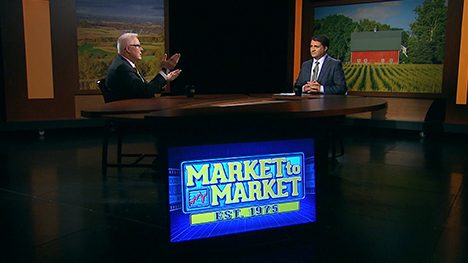
Chris Robinson answers viewer questions on corn yields, crude oil and cattle, and explains his soybean outlook.
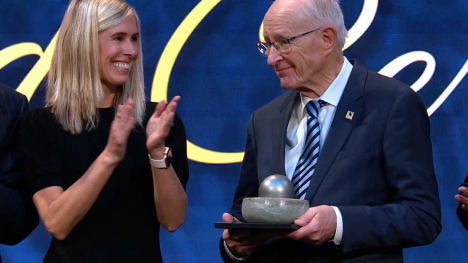
Huub Lelieveld receives the 2026 World Food Prize for six decades of work advancing food safety.
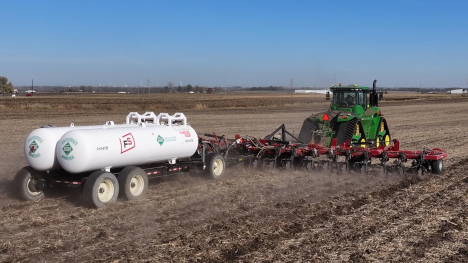
New federal plans target farmers' fuel and fertilizer costs through direct relief and investments in domestic fertilizer production.