This week, the White House announced a bridge payment plan to assist farmers who have lost income due to trade disruptions caused by higher tariffs.


This week, the White House announced a bridge payment plan to assist farmers who have lost income due to trade disruptions caused by higher tariffs.
Transcript
This week, the White House announced a bridge payment plan to assist farmers who have lost income due to trade disruptions caused by higher tariffs.
Sec. Brooke Rollins, USDA: “The bridge that is needed to get from the last administration and what basically happened under the last president and the last US Department of Agriculture to this new golden age for farmers where instead of farming for government checks, they can farm to feed their family and sell their products and pass it on to the next generation. That this bridge is absolutely necessary based on where we are, right now.”
A $12 billion dollar package will be targeted mostly at the major commodities: Wheat, corn, soybeans, cotton, peanuts and rice. $1 billion will be reserved for specialty crops. The funds to make those payments will be coming from import tariffs collected since the start of the trade war.
The bridge payments will be limited to operations with an adjusted gross income under $900,000 dollars, and will be capped at $155,000 per recipient. While the money won’t make farmers whole it will help reduce some of their losses.
Cordt Holub, Dysart, Iowa: "And I think Mr. Trump, I think you brought, I think you brought Christmas to farmers with this bridge payment. We'll be able to farm another year. Help us get by.“
The payment comes at the end of a growing season where none of the major commodity crops are expected to be profitable. The combined production of corn and soybeans in the U.S. is expected to lose $22 billion dollars this year.
The National Young Farmers Coalition and the National Sustainable Agriculture Coalition issued a joint statement:
The Farmer Bridge Assistance Program provides some initial relief, but is insufficient on its own. It effectively excludes most specialty crop growers and does little to prevent the loss of farms or farmland due to acute financial hardship.
The Agricultural Trade Monitor at North Dakota State University estimates that tariffs are adding 9% to the price of agricultural inputs.
The Chinese are behind their originally agreed upon pace for soybean purchases in 2025 but the Trump Administration has moved that deadline to the end of February 2026.
Rollins says farmers will be able to apply for the bridge payments before the end of December and the money will be distributed by February 28, 2026.
For Market to Market, I’m Peter Tubbs.
Watch More
Shawn Hackett weighs storing corn versus selling soybeans and Brazil’s potential weather risks.

Montana residents balance affection for free-roaming horses with safety and property concerns.
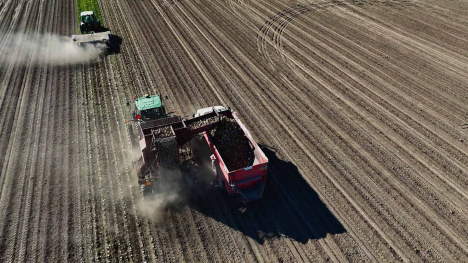
A growers association reports average losses of $500 per acre as sugarbeet harvest gets underway.
Shawn Hackett weighs corn demand, USDA yields and potential November turning points for grains.

Sugarbeet losses, diesel costs, Montana’s feral horses and market analysis with Shawn Hackett.

Global supply disruptions keep fertilizer markets volatile heading into 2027.