Indoor farm limits variables to maximize yields as we profile 80 Acres Farms in Ohio.


The owners and operators of 80 Acres Farms in Ohio take the work into the indoor farm arena to limit variables while trying to maximize yields. Peter Tubbs reports.
Transcript
Joshua Jones, Director of operations, 80 Acres Farms: “Every decision that we make along the way is really focused in on what is best for that plant and that experience for the consumer.”
Salad greens grow under specialized red and blue lighting at an indoor farm in suburban Cincinnati, Ohio. Controlled environment food production has been a growing industry, but delivered plenty of technical and biological challenges and a scarcity of profits.
But ten years of testing and buildout has brought one company to the edge of profitability.
Mike Zelkind, Co-founder and CEO, 80 Acres Farms: “I think 80 acres is the most natural, most efficient way to farm today. Not just leafy greens, but leafy greens, ingredients, tomatoes, anything you need.”
80 Acres has sited its seven farms near distribution hubs of grocery retailers across six states, with a goal of placing clamshells of produce in store displays within 24 to 48 hours of harvest. The company serves over 18,000 retail locations with over 1 million square feet in cultivation.
By shortening the supply chain, consumers gain 7 to 10 additional days of shelf life versus produce that has to be trucked thousands of miles from the field. Most consumers with access to 80 Acres Farms produce are served by a farm within a two-hour drive.
Extended shelf life has become a key driver of sales in a crowded produce section.
Tisha Livingston, Co-founder, 80 Acres Farms, CEO Infinite Acres: “We are not just having the ultra premium shopper. But it really does span, you know, all the shopper profiles we're seeing that, you know, moms with families that want to be able to plan a menu but not have to, like, eat the salad today, but be able to eat it sometime in the next week or even two weeks.”
Productivity of the farms increases by reducing the variables that can affect crop production, but also accelerating the timetable for growth. Plants that need weeks to reach harvest on a conventional farm can be grown by 80 Acres Farms in as few as 24 days.
Tisha Livingston, Co-founder, 80 Acres Farms, CEO Infinite Acres: “Agriculture is hard in general, and growing plants is really hard. I would say that some of the things are philosophy, was making sure that we had great tasting, differentiated product that resonated with the consumer.”
Joshua Jones, Director of operations, 80 Acres Farms: “We have these enclosed environments that we have really rigid control over. So we're controlling for things like the humidity and the temperature and the airflow, the spectrum of the lights, the intensity of the lights, the amount of grow days that we give the nutrient levels and all of that makes a more consistent product.”
This farm produces several hundred thousand servings of produce each week, while using up to 95% less water than a conventional farm.
Joshua Jones, Director of operations, 80 Acres Farms: “Since we have such a short growth cycle, we can turn plants through so much faster that we have a multitude of seasons throughout the year.”
Mike Zelkind, Co-founder and CEO, 80 Acres Farms: “And by having a control grows on the grows on that is a little different. You're looking at the yield curves, you're looking at how crops are growing. And you can modify little things to start perfecting yield, to start perfecting flavor, to start perfect and shelf life. So reflecting nutritional value, little changes make a big difference.”
80 Acres Farms sources seed from established seed producers and leverages tailored growth plans to maximize output.
Field grown produce varieties are often chosen for durability for travel at the cost of flavor and texture.
Tisha Livingston, Co-founder, 80 Acres Farms, CEO Infinite Acres: “A lot of the leafy greens that we're putting into our blended salads would never make the transit. They would never make it from California to Ohio and through the supply chain. And so we can grow things in close proximity to where it's being distributed.”
The grow rooms at each farm site are completely closed systems. Airflow is carefully managed, and the grow rooms can create different temperature and humidity zones within each room to match the needs of individual varieties.
The hydroponic growth system delivers water and fertilizer to the plants from below. The goal is to grow produce from germination to harvest without wetting the leaves - which could lead to fungal problems - a common problem in the industry.
80 Acres Farms think of themselves as farmers first, technologists second, which allows for automating much of the manual labor compared to conventional farming. Germination begins on a compostable medium, and starts are soon moved to trays by machine. Transplanting is now done in minutes versus hours of hand labor. The transplanter also culls plants that are unlikely to thrive.
Infinite Acres, a subsidiary of 80 Acres Farms, is working on standardizing the technology and metrics of the controlled environment food industry. Many food, pharmaceutical and consumer goods companies desire ingredients for their processes to be produced near or within their operations, which lowers risk to their supply chains.
Mike Zelkind, Co-founder and CEO, 80 Acres Farms: “Any consumer product, good manufacturer, anybody who makes a finished good that has to source raw ingredients, if they could have a farm literally attached to their manufacturing facility just to grow the ingredients that they have to source globally, the lack of disruption to the manufacturing facility, the consistency of supply, it's a game changer for a lot of these folks.”
Joshua Jones, Director of operations, 80 Acres Farms: “I love that we're on the tip of the spear in a newer industry. I like that. There's not a road map for us. We really have to solve our problems. We can't rely on other people within a very small industry. There's not a playbook that we can fall back on. It takes real life problem solvers to solve the problems that we have.”
For Market to Market, I’m Peter Tubbs
Watch More
Shawn Hackett weighs corn demand, USDA yields and potential November turning points for grains.
Sugarbeet losses, diesel costs, Montana’s feral horses and market analysis with Shawn Hackett.

Shawn Hackett weighs storing corn versus selling soybeans and Brazil’s potential weather risks.

Montana residents balance affection for free-roaming horses with safety and property concerns.
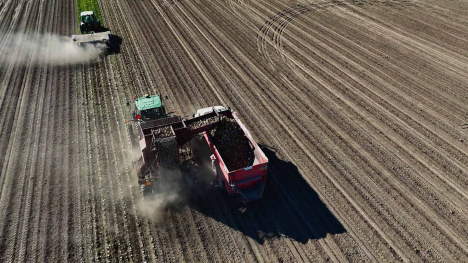
A growers association reports average losses of $500 per acre as sugarbeet harvest gets underway.

Global supply disruptions keep fertilizer markets volatile heading into 2027.