An Iowa farm adds shrimp farming with an algae-based system and direct-to-consumer sales.
Shrimp Farming in Iowa: A New Harvest at Pheasant Run Farm
Share


Eric and Ann Franzenburg raise Pacific white shrimp in 13,000-gallon tanks at Pheasant Run Farm near Belle Plaine, Iowa. Using Midland Co.'s algae-based aquaculture system, the couple is diversifying with fresh shrimp sold directly to consumers and a second sales outlet through Midland. Explore the production process, water monitoring and marketing behind their first shrimp harvest.
Transcript
Harvest looks a bit different at this Midwest farm.
Eric and Ann Franzenburg are pulling crustaceans out of 13,000-gallon tanks. For the east central Iowa couple, this fall represents their first shrimp harvest.
Ann Franzenburg, Pheasant Run Farm - Belle Plaine, Iowa: “People are usually like: ‘What?’ But then most people are really excited about it."
The Franzenburgs have kept a diverse operation since moving back to Eric’s family farm in 1992. They’ve raised hogs, corn, soybeans, fruits, vegetables and flowers, with a focus on sunflowers. Even with this marketing mix, they wanted another higher-value offering to draw more visitors to their rural Belle Plaine farm store.
For a while they looked into aquaponics, a practice that combines growing vegetables and fish. But they struggled to find nearby operations with a long history of success.
Eric Franzenburg, Pheasant Run Farm - Belle Plaine, Iowa: “We actually went to a farm in Indiana, which is still in production today, and looked at their operation. They weren’t doing aquaponics, but they were raising shrimp….Then about two years ago, I heard Jackson Kimle with Midland on the radio talking about shrimp and the production system for shrimp, and when I heard that I said I had to give him a call."
Midland is the central Iowa company founded in 2018 by Iowans Jackson Kimle and Matthew Ellis. They tested their in-tank production ideas with trout before turning to shrimp.
Jackson Kimle, CEO, Midland Co.: “We think it's the biggest opportunity for high-quality product because there's not a lot of high-quality shrimp in the marketplace today, especially in the Midwest. And then…our systems just fit very nicely with shrimp because they're algae eaters."
The company’s key innovation is how it keeps the water clean. Traditional systems grow bacteria on discs to convert ammonia into nitrates. Instead, Midland uses the discs to grow algae, which the shrimp eat.
Jackson Kimle, CEO, Midland Co.: “So what you see is a more efficient system in a symbiotic treatment inside of the system. What you would usually see is a buildup of nitrate, where it just never-ending goes up inside of a system. With algae, you don't have that issue and you're actually reusing nutrients in a more efficient way."
Today Midland fabricates turn-key shrimp systems at an Iowa State University research farm, then installs them on farms and trains the farmers how to operate the system. The company sells some or all of the shrimp raised by the farms. So far, six other farms besides the Franzenburgs’ have joined. All but two are in Iowa, with one in Minnesota and another in New Hampshire.
Eric Franzenburg believes his background raising hogs prepared him for the work and scientific complexity of raising Pacific white shrimp.
Eric Franzenburg, Pheasant Run Farm - Belle Plaine, Iowa: “It’s been a very …steep learning curve for us…Most of my career as a farmer was we had a farrow-to-finish hog operation. And so that actually a lot of aspects of that has helped me in raising the shrimp. But the shrimp aren’t breathing the same air that we are. You know, with hogs and cattle, you can walk into a facility or where your livestock are and you know what’s going on fairly quickly with the air. But with shrimp, we have no idea unless we’re monitoring the water."
Twice a day, they check the tanks’ dissolved oxygen, pH levels and water temperature.
Eric Franzenburg, Pheasant Run Farm - Belle Plaine, Iowa: “Then there's other things that we monitor like alkalinity, nitrates, nitrites, ammonia levels, salinity. And then there's several others that we monitor, maybe on a weekly basis.”
The young shrimp, in the post-larval stage, are about three weeks old when they are flown in from Minnesota Shrimp LLC.
Eric Franzenburg, Pheasant Run Farm - Belle Plaine, Iowa: “Post-larval, they’re very small. You can barely see them…About the size of your eyelash… When we get them they’re probably less than a gram in size. And then, so what we’re trying to do is get them to about 25 grams when they’re ready to harvest."
That takes about 100 days, by which point the shrimp measure 4 to 6 inches.
Eric Franzenburg, Pheasant Run Farm - Belle Plaine, Iowa: “So I think right now we are looking at probably around 7,000 pounds in a year. About seven different harvests with maybe close to 1,000 pounds each harvest… If we think that we can market more, then we will probably look at considering doing more production. But right now, I think we’re pretty good where we want to be."
The Franzenburgs market their shrimp several ways.
Ann Franzenburg, Pheasant Run Farm - Belle Plaine, Iowa: “It’s a two-prong approach. The first prong is to market them directly to the consumer here at the farm. And that's really where we want to focus the sales. And then the other prong is to sell them under the Midland Co. label. We'll try to sell as much as we can fresh to the consumer because we want them to have that experience of fresh seafood right here in Iowa….Then we also have that fall back to sell them into the Midland Co label. They'll still be an Iowa-grown product, but they'll be frozen."
Direct-to-consumer sales happen on planned harvest days, with all orders placed online in advance.
Ann Franzenburg, Pheasant Run Farm - Belle Plaine, Iowa: “We are in a rural location and we don’t want people to drive a distance to get here thinking they’re going to buy shrimp and then, surprise, we’re not harvesting today. So we’re doing it all online as a pre-order….choosing their pickup date and time."
Eric’s advice for anyone considering farm-raised shrimp: be curious, be a hard worker, and be observant, always paying attention to details.
Eric Franzenburg, Pheasant Run Farm - Belle Plaine, Iowa: “I’ve always operated my farm operations under the KISS principle: Keep It Simple, Stupid. And this isn’t that. But no regrets."
Watch More

Brad Matthews discusses fund selling, USDA corn yields, Chinese soybean demand and weather risks.
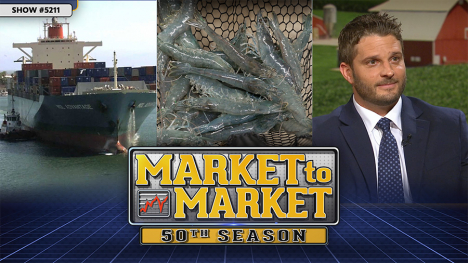
Diesel costs, USMCA renewal, Iowa shrimp farming and Brad Matthews on grain and livestock markets.

Brad Matthews examines grain market lows, Chinese soybean demand and cattle and hog prices.

A think tank backs renewing USMCA, the trade agreement linking the United States, Mexico and Canada.
Rising diesel prices squeeze farm profits as Iowa and Kansas farmers weigh their midterm votes.

Wages aren't keeping up with prices. How negative real wage growth and higher fuel costs are changing what Americans buy, and where businesses feel it most.