Keeping the lights on in the dairy barn is a constant concern with economic and industry consolidation providing full-time stressors.


The cooperative has long been a part of agriculture – including the dairy industry. CROPP Cooperative, home of the Organic Valley brand, is the largest farmer-owned organic cooperative in the country. Its 1,600 family farms produce roughly 30% of all organic milk sold in the U.S. The protein boom is helping drive demand for organic dairy products, but the workforce to get the milking done twice a day is still one of the biggest challenges in the industry, along with pay price stability and supply management. One area of hope for future farmers comes from a new generation stepping up.
Transcript
Yeager: It takes a special kind of person to be involved in the dairy industry. We know the commitment: twice-a-day milking. You have to have those animals taken care of, or otherwise it is not a good situation. There are so many factors facing the dairy industry right now, from the animal to the person who works with the animal, the labor, the family that owns the operation, and the family that may work on it in the future. But let's not forget there's a consumer, one who is very curious about what goes on with their food, and that includes their dairy products. We're going to talk about organic dairies today with Cheree Tauschek. She's the executive vice president of membership for CROPP Cooperative. It's a Wisconsin-based organization; she's in Wisconsin. So of course we talk a lot about dairy, but we're going to really get into that consumer we're always talking about. What is that consumer interested in? It's something that farmers and dairy supporters alike are always thinking about, and again we're going to go back to the protein push we have talked about before here on the MtoM podcast. By the way, I'm Paul Yeager, this is a weekly installment of this discussion. So now let's go talk about the dairy industry and some of the challenges and successes they have had, in this week's MtoM podcast with Cheree Tauschek. Walk me through a typical day.
Tauschek: A typical day as an executive vice president of membership for a cooperative means a lot of touchpoints across our member ownership, all the way from engagement, events, and communication to supply management, supply forecasting, policy, etc. I'd say my favorite part, not that you asked, but I'll tell you anyway, is the moment when I actually get to spend time in the countryside visiting our membership, whether that's through regional meetings or just farm visits.
Yeager: Explain the co-op process and how it works in dairy compared to maybe other co-ops.
Tauschek: Sure. With our cooperative, it is farmer-member owned, one vote per member. More than 90% of our membership is dairy. We do house a number of other pools as well: eggs, feed, beef, pork, etc. Because it is member-owned and member-governed, we have a board of directors that is essentially our highest level of decision-making, but also a number of delegates who help with policy setting and decision-making, everything ranging from on-farm management to pay price. I don't know that it is wildly different from other cooperatives; what I think sets us apart is the member voice that our owners have.
Yeager: What's the biggest concern from a member right now?
Tauschek: Generally speaking, concerns range greatly with the milk supply balance. There is a general fear of what happens when supply outstrips demand versus the other way around, and what my cooperative is doing to protect me, especially when there are economic pressures like inflation. So that's definitely on people's minds. The economic pressures, I would say, are right at the top of the list as well.
Yeager: We often, when we have our guest Naomi Blohm come on from Wisconsin, talk about dairy and the Class III milk futures, and there's always a discussion about the number of animals in production. Given the tight beef situation, we're hearing stories about heifers not going into the dairy parlor but going out to pasture instead. Is that something you get involved with, or at least hear about from members?
Tauschek: We do, and I would say we keep a close eye on it across all pools, not just in conversation with members, understanding that culling rates might go up when you have record beef prices, and that impacts your dairy supply. We have a tightly connected forecasting team, and that definitely helps from an internal perspective as to how we balance those things out.
Yeager: There are price rises for milk on occasion; it's not always down. What's the general sense of the industry today in 2026? If prices go up for milk in general, does that mean there's going to be expansion, a hold, or a pullback?
Tauschek: You're referencing farmer pay price versus consumer price, I'm assuming?
Yeager: Yes.
Tauschek: From a cooperative perspective, I'll take it a little broader, from an organic perspective. One of the key things is a stable pay price. Even when there is a downturn in the conventional market, we attempt to hold price as best as we can, and I think we've proven that as a cooperative in our history, that it's a steady upward trend. Now, that's not to say that things can't happen; before we go to pay price, we go to supply management instead.
Yeager: It's a complicated industry for the outside person. It's an easy statement to say, well, dairy is hard, dairy is complicated, organic dairy is complicated. Is there a simple way to explain to the regular consumer what all of your producers and co-op members go through on a daily basis?
Tauschek: Oh gosh, wow. How long do you have?
Yeager: We can go six hours, seven hours. That's fine.
Tauschek: Let's see, seven minutes. I'm kidding. It's a great question. What our producers go through day to day, there's so much to manage. You can think of it as managing a small business, or not even a small business, a large business for that matter. It's complicated, and then there's also a family dynamic to keep in mind. So it is everything from the herd, the herd health, the land, the cooperative, my peers, my community, and everything in between. I don't know that that specifically answers your question, Paul, but there are so many components to it, it's hard to explain.
Yeager: Well, we can unpack a number of them. Let's talk about the competitive nature of agriculture in general. It used to be there were all these norms we assumed, but farmers considered themselves so individual that sometimes they think of their neighbor as their competitor, when their competitor might actually be somebody in another state. Does that hold with dairy the way it does with, say, a grain farmer, that their competition isn't necessarily down the road but might be six states away?
Tauschek: Yes and no. I think what we see more of is scale of farming versus regionality of farming. From that competitive perspective, there is a lot of concern around consolidation, get big or get out, and I think that is where more of the competitive pressure comes from. That's how I would summarize it.
Yeager: Political ad season is here, and we always hear that family farms are disappearing, family farms are struggling. What's the definition of a family dairy farm right now?
Tauschek: To me, the definition of a family farm is owned and operated by family. In our membership, that can mean a lot of different things. A large piece of our membership is Plain community, we have Amish and English community members. Family could mean multiple family members farming together across an entire family, or it could mean just your immediate family, mom and dad and children. But in essence, it is the immediate family.
Yeager: The dairy farms I knew growing up, granted Iowa doesn't have near the farms that Wisconsin does, but we had enough, and I know that three of the four kids in a lot of those families aren't involved on the farm anymore to provide labor. Does that hold true today, from say the 1980s to the mid-2020s? Is it still farm labor that does a lot of the work, and is there enough of it?
Tauschek: I would argue that there is not enough of it. We see labor as a challenge, and I think it really calls into question whether farming is sustainable for my family. In the organic market, yes, but that doesn't come without challenges. In some of our communities, we do have hired labor, and there are challenges in and of itself to secure that labor. What is fascinating to me is the interest in the younger generation to actually want to remain on the farm. Our cooperative is a big proponent of succession planning and generational transfers, and actually sponsors a number of programs to enable that to happen and to showcase that there is a sustainable living wage through organic farming and being part of a mission-oriented cooperative. Things like our Generation Organic program, where we mentor younger farmers and give them exposure to our governance system, our executive leadership, and their farming community across the entire nation, really help inspire that. Succession planning and generational transfers must be supported in order to address farm labor.
Yeager: You read my mind, because that's exactly where I wanted to go next. I'll speak from my own experience, I'm a child of the 80s, and there wasn't a place for me. Why is there a place for some people now in some operations, and why isn't there in others? Was it just that we didn't do a good job in the Yeager family, and how many families are like what we were, where we maybe didn't plan as well as we could have?
Tauschek: I think it depends on the resources available, and every family is different, with different needs. What is different now, I think, is the resources available to help with planning and those connections, when you consider trade and industry policy that helps too. I think that's the main difference and the advances we've made since a number of decades ago.
Yeager: How old are these programs? I'm guessing they haven't been around very long.
Tauschek: No, I would say since the 80s, probably within the last 15 to 20 years for sure.
Yeager: You mentioned that organic might have a better path, a more optimistic look for, I shouldn't say expansion, but for a continuation of a farm. Why is that?
Tauschek: That comes through sustainable pay price. Organic demands a premium in the marketplace, and generally speaking, consumers today are more aware of what they're putting not just in their bodies but around their bodies, and more conscientious about the planet and being good stewards. We don't see that demand going away, and so we do anticipate those premiums being there for the longer term, enabling that premium on organic pay price, which enables the rest.
Yeager: Where is that demand coming from?
Tauschek: I would say the younger generations are far more conscientious than what we've ever seen.
Yeager: Okay, and I guess I should have asked geographically, where is that coming from?
Tauschek: Oh, sure, that's a difficult question to answer. What we're seeing, obviously based on population density, is from the coasts. However, there's a general uptick in demand nationally within the United States.
Yeager: And that's where I'm going, we hear about policy done in one state or another that might be on the coast, to the left and to the right, both politically and geographically. Does the younger generation really care and want to know where their food is coming from? Do you find that to be true?
Tauschek: Absolutely, yes.
Yeager: Do you get the sense that people want to visit maybe where that farm, where that work is being done, or where that food is being grown? Do they want to really get down and touch the dirt?
Tauschek: Yes, absolutely. What's great is when we do things like hosting farm tours, not just for our customers but pasture walks for the community, we see the delight, really everybody's expression is incredible. I would say yes, absolutely, and I think curiosity is the other piece for the younger generation, really all generations, that drives some of that.
Yeager: The coasts are one thing, but do you have to sell just as much in your local communities that maybe are one or two generations removed from the farm and have forgotten what goes on there and what needs it has?
Tauschek: Yes, I would say that's true regardless of geography, and really creating awareness around where your food comes from. For that reason, we've done a number of brand campaigns surrounding where your food is generated, by whom, and how, to help generate that awareness and general education. I think our cooperative, over its entire history, has done a tremendous job in consumer education.
Yeager: Did your job get easier after Covid, because that's when everybody really started to investigate and were curious about how far that product was traveling, and again, where it's from?
Tauschek: That's hard for me to say. I think it's always been there, maybe more amplified in the last five years, but it's always been there.
Yeager: Do you think that ever goes away? Do we become complacent, I should ask instead?
Tauschek: The optimist in me would like to say no, there's not complacency, and honestly, this is my personal perspective, I wish there would be more curiosity and that people would understand the impact, not just where and how their food is produced, but the impact on the lives of the individuals producing it.
Yeager: Is dairy in general in Wisconsin still a big deal?
Tauschek: Absolutely. You should come visit for June Dairy Month.
Yeager: Maybe, yes, that would be a whole thing, that would be a good event to do. Every time I go to Wisconsin, I love the drives, I love the views, I'm always curious about the operations that go on in dairy. Is everybody still proud of the work that they're doing? I mean, that's why they would do it, right? What else motivates you to get up and milk twice a day?
Tauschek: That's a fantastic question. I think it takes special human beings to do this work, and a tremendous amount of courage to do it and to keep doing it. There has to be a passion. One of the things that stands out to me is we've seen a number of barns go empty and the lights turn off. So it does beg the question: is there pride in the work, is it still a thing, do people still want to do it? I actually believe the answer is yes. It's a question of how do we enable it to happen, and how do we turn those lights back on in the empty barns.
Yeager: See, now that's where I want to ask you the eight-hour question. So how do you get the lights turned back on?
Tauschek: Through a number of different ways. I think first and foremost is understanding, coming back to generational transfers, how we enable the younger generation to stay on the farm, but also how do we help convert conventional to organic, how do we enable land acquisition or enable individuals to have the funds to purchase that land where that empty barn might be sitting. So through a number of different ways, it's peaking the interest of the younger generations, and it's helping through funding as another means to enable that to happen.
Yeager: I guess I should have done this at the very beginning, but give me the definition of organic versus conventional dairy operations. What's the difference?
Tauschek: I'll speak to it specifically. Organic starts at the soil, it starts with the planet, it starts with the animals, the way that we care for the animals and the planet. It is no pesticides, no herbicides, it is what you're able to use. For that reason, I do think it is more challenging and in some cases more costly to produce organic. Even from a grain producer's perspective, when you're not able to use those chemicals, consider the labor needed to weed those fields and take care of the animals. But it starts with genuine care for the planet, starting with the soil and the animals.
Yeager: I think there's been an alignment, because of the movement caring about chemicals, practices, and what's in our bodies. Has that helped bring an awareness of what you were already doing before we had these buzzwords?
Tauschek: Great question. It's always been there. Has it helped? Certainly. But I think it has always been there, Paul.
Yeager: Do you think even if a party is no longer in power, that will still continue?
Tauschek: That is my fondest hope.
Yeager: Is there a generation that can help lead the charge to keep that going?
Tauschek: Absolutely, and I think we're already seeing that. We talked about the awareness of the younger generation, even from a sheer place of curiosity, wanting to know what am I putting in my body, where is it coming from, who's producing it, and how can I be a steward of this planet.
Yeager: I think we've had a couple of stories over the years on Market to Market about dairies and the products they make. It used to just be you did the milk, put it in the tank, a truck came and it went. What's the percentage of farms that still operate that way?
Tauschek: Oh man, I don't know if I can give you a precise answer.
Yeager: Is it half?
Tauschek: No, when I think about the complexity of production and where milk goes today, it's more than half.
Yeager: So that has been, to me, one of the more exciting things to see in the dairy industry, how much more is produced one way and then turned into something else, allowing other value to be discovered. Is that accurate?
Tauschek: Yes. I think about what people value from a nutrition perspective. In recent years, the craze for protein and the value that has for bodies, when you think about milk, it's not just milk anymore. You can go to ultra filtration to pull out those protein values, you can think of healthy fats and butter production, or protein in cheese. So a lot of it is derived from consumer needs as well, that drives where milk is taken, how it's produced, and what it's produced into.
Yeager: Are those miles of production shorter than they used to be, because so much is maybe done more on local operations and not shipped somewhere else to be processed?
Tauschek: I think it depends on where you are in the country. What we have seen, though, is that once upon a time there used to be a creamery in every town; that is no longer the case. What we see more of now is larger production facilities that have greater efficiency. So despite it maybe traveling a few more miles, it is produced with that much larger efficiency and lower emissions.
Yeager: And again, back to what the consumer wants, they want their companies to do those types of things, and so these operations are aligning with the demand. Was it one found the other, or did the consumer find, hey, I like what they're doing, I think I'm going to buy this product because of what that company does?
Tauschek: I think a lot of it comes to raising awareness, Paul, in telling that story and doing planning with partners across industry, whether that is production facilities, whether it's customers, meaning markets versus consumers, that has helped a tremendous deal. It's one found the other, I'd say.
Yeager: I've had a couple of discussions in 2026 about the protein side of this equation, the demand for protein. Dairy is a big part of that discussion. That has to get you pretty excited. What's going to be the biggest contribution you think you'll be able to make?
Tauschek: It does, it does, yes. We have a large portfolio across dairy, whether it is ultra-filtered milk, whole milk, chocolate milk, or cheese, and in that way I think we can meet consumers where they're at and maybe even delight them with additional innovation.
Yeager: Picking a favorite product is like picking a favorite child or relative, but give me two products that really get you excited, maybe new, or a new twist on something that was a standard.
Tauschek: Sure. New for us, you've heard me mention it, is the ultra-filtered milk, we call it Protein Plus. It's absolutely delicious, produced in both whole and skim, and found across the country at this point. The second, and this takes me back to my childhood, I've always been a fan of chocolate milk, and ours is some of the best, I'm not going to lie. And if I may, I'll put a third one in there, this is a seasonal product, our eggnog is to die for. When that becomes available in market, I'm one of the first to be there to buy it.
Yeager: I will tell you, my 16-year-old and his football team last year had chocolate milk after practice. Then last year they did not have it. This year it's back, the team is happy, and chocolate milk is leading the way for him.
Tauschek: Bravo, who doesn't like chocolate milk?
Yeager: You got some teenage football guys who down the chocolate milk as best they can. All right, I'm going to leave you with this. I asked you about ways to turn barn lights back on, but let's say it's political open season and it's fair season, where urban and rural populations are getting together at county and state fairs. What's the best message that someone in your position can give to someone who's not directly involved with the farm right now?
Tauschek: The best message is a consideration of how you support your local farmer, and what that shows up as. Consider what it means to farm as a family farm, and the impact of supporting that family through the purchase of organic dairy. There's impact not just to those families, but to the land around them, the animals, and everything in between.
Yeager: It's a way to keep rural America vital and vibrant.
Tauschek: It's the fabric of rural communities. Yes, absolutely.
Yeager: Cheree, thank you so very much, appreciate your time today.
Tauschek: I appreciate it as well, thank you, Paul.
Produced at Iowa PBS. Production supervisor: Sean Ingrassia. Crew: Reed, Kevin Rivers, Julie Knudsen, Neil Kyer, and David Feingold. Executive producer of Market to Market: David Miller.
Watch More
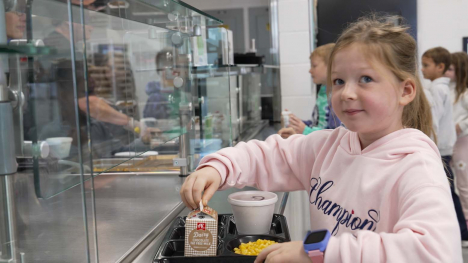
An Iowa school district connects local farms, food hubs and students through the lunch tray.
Naomi Blohm and Ted Seifried question USDA’s corn yield surprise and weigh China’s soybean demand.
Higher USDA yields pressure grain. Plus, opportunities/costs of putting local food on school trays.
How grain prices rally this winter w/Naomi Blohm & Ted Seifried on USDA, China demand & S. America.
Farmers rarely seek mental health help. Farm Dog offers care from people who know farm life.
Wet fields threaten harvest delays, diesel raises farm costs and rural population growth is uneven.