Data centers are spurring debates all over the country especially in a time when grid stress is already happening. Communities have leverage to ask for money back in the developer’s fee along with part of the solar generation, battery usage and water accommodations according to ESP.earth founder Kerry Duggan.
Countering Data Center Demands During Grid Stress
Share


As large tech companies look to add data centers to help drive their growth, the ask comes a time of already stress on the electric grid.There's a checklist before a data center comes to town: money back through the developer's fee, solar and battery for cost and quiet, smart water terms, and a design that doesn't stick out. Think of it like the water tower you never notice — just infrastructure done right. Communities hold more leverage here than most people realize. Kerry Duggan is the founder and CEO of ESP.earth with a background in energy policy at many levels.
Transcript
[Paul Yeager] You've heard us use the term ‘all of the above’ before, right? Whether it's commodities or weather, how about energy? All of the above — when it comes to powering your car, powering your home, giving you AC on a ridiculously hot summer that has boiled up again. That's the topic today here on the MtoM podcast. I'm Paul Yeager. We are going to be talking with the founder of Energy Security Partners, that's ESP.Earth. Kerry Duggan is the subject today, and we are going to cover a whole lot of things when it comes to data centers: who's building them, what you should ask for if you are a community that has one of those big energy companies knocking on your door saying, ‘Hey, we'd like to use your town for a data center.’ She gives you the list of things to ask for if you are that community. But what happens if it's not a magic bullet, or the technology is outdated? We're going to talk about slingshotting forward, but getting action done now. Kerry has spent time in the government, in the private sector, the academic sector — data, heat, semi congestion. We have so many things to cover in this discussion today, so let's just get to it right now. I'm Paul Yeager, this is the MtoM podcast. New episodes come out each and every Tuesday. Now let's get to our full discussion. Part of my other job is to cover women's basketball in the state of Iowa. Do you know anything, Kerry, about the game Iowa used to play called six-on-six girls basketball?
[Kerry Duggan] I've never heard of that.
[Paul Yeager] Oh my goodness. So up until 1993: three guards, three forwards on each end of the court, two dribbles — that's all. But we had girls that scored 100 points a night. It was a lot of scoring, and every type of girl could play. Do you think you could play in a game where you only had two dribbles?
[Kerry Duggan] I'm a sharpshooter, so — absolutely.
[Paul Yeager] All right, okay, let's keep going on that thing. Caitlin Clark's a big deal in Iowa. Where's your best shot at? Where do you shoot from?
[Kerry Duggan] I'm a hash mark shooter.
[Paul Yeager] Nice.
[Kerry Duggan] When I was playing college ball, sometimes coaches made me warm up from the hash mark. So did Clark, so I'm familiar with that.
[Paul Yeager] Yeah, she's done well for herself, and I covered her in high school, so I've seen her a long time. How'd you make the transition into your vocation from playing basketball?
[Kerry Duggan] It's funny you ask that, because I'm actually writing a book — probably the only book I'll write — and I've been reflecting on that. To me, it's just muscle memory. Basketball is about making decisions quickly. You don't have time to build a spreadsheet and figure things out, you just figure them out. The term I use is: see the lane, take the lane. So it's really muscle memory. I'm also a little bit stubborn — I really want to solve problems, I really like to win, and I'm competitive. So I use all of that to figure out solutions for our planet.
[Paul Yeager] Was that your undergrad?
[Kerry Duggan] My undergrad was environmental studies at the University of Vermont, and then my graduate degree was on natural resource policy and behavior at the University of Michigan.
[Paul Yeager] So the two areas you spent time in — Vermont, and you're from Michigan, back in Michigan — how do the two regions view the environment overall?
[Kerry Duggan] I live in Detroit on purpose and out loud, and I've been very blessed. I spent a decade in Washington, but I was sent back home by President Obama to work on some serious issues before the infamous bankruptcy — the streetlights were out, there was a lot of issues, and I was on the federal team helping to solve them. I bring that up because when I came back from Vermont, which is like the green promised land, I came back to Detroit after undergrad and I'm like, okay, I have work to do. So it's been sort of in my heart, especially this place, because I think it's really important, obviously, for the nation, but also to my family. We're generations-ago immigrants, and the city has been very good to my family. I'm trying to be good back.
[Paul Yeager] You mentioned Vermont — we've sent crews to Vermont over the years from Market to Market, and environment is always one of the industries of the state. There's always such good know-how in Michigan too, but it's that transition from lots of entrepreneurs to the regions to your west and south that are much more commodity-driven. In our world we always kind of talk about commodities — is there a different makeup in agriculture and energy views that you have found in those two areas?
[Kerry Duggan] That's a good question. I think right now, in the moment we're in, energy demand and what we're all going through and experiencing — the data center build-out — people are more alert and concerned about things like water and energy. It's like an inflection moment. So a lot of what I'm doing is trying to pivot away from fear and get people to focus on how to get solutions done in their community. One thing I'm talking about is leveraging these hyperscalers right now, and this is across the country because I've been doing cross-country travel on these topics. They're in a political crisis because they can't develop, and by the way, we're in a race against other countries to get compute, because that is the infrastructure of the future, much like the highways were. Data centers are just a box with a brain in it — they used to be in the closet behind you at the office — but the demand for energy to build these out at the scale to compete for compute is what's causing problems. And they can't build when there's a moratorium. That means communities need to sit back, work together, work with their elected officials, who in some cases are very scared right now to lose their job or their pension because of the data center hysteria. But the communities do have leverage. One of my colleagues at the University of Michigan, Sarah Mills, put together a guidebook — it's specific to Michigan, but it's applicable anywhere. The main thing is this: you can ask for things in order to accept a data center into your community. You can ask for a percent of the developer's fee to buy down your tax. You can ask for solar and battery, which is really smart because the sun does not send you an invoice — it's cost effective. And if you pair that with battery, that's actually the most important thing here. A lot of people are concerned about the noise with data centers, and if you put battery on, you get silence. Then there's the water piece, which is a big concern around the country. I think about it like the radiator in your car — I don't have to go in and water it every year, it's a one-time job, and maybe it doesn't even have to be freshwater, it can be gray water. So there's lots of things folks can do. And maybe the last thing I'll say is it doesn't have to be ugly. At the end of the day, it's just infrastructure, like your water tower that you drive by and don't really pay attention to anymore. I was on a panel in Chicago about two weeks ago with a gentleman from Nvidia whose thesis is that this stuff should just fade into the background, and I think that should be the goal. But if it is in your community, it doesn't have to be ugly — you can work with the artist community. There's a lot of leverage right now to do things right and to stabilize the grid, which I know a lot of people don't really understand. So do you want me to take a minute and explain?
[Paul Yeager] I was going to ask — you already kind of started to go in the direction I wanted to talk about, but can we back up for just a moment? We'll get to regions, but tell me what the stress is right now. Is it only data center demand for energy, or are we in certain regions — southeast, southwest, central coast — where energy demand is different? We all know what happened in Texas to that grid system, and how it's different than anybody else, so we've been paying attention. Where's the biggest headline right now when it comes to energy stress on a grid?
[Kerry Duggan] I think it's the combination of the prevalence of data centers vampiring the grid, paired with extreme heat. That's been the story this summer, and you see what's going on with wildfires and everything else. So we're in this time where it's just an inflection point, but the energy demand is there — everyone comes home at 6:00 and turns on their air conditioner, and that stresses the grid. So I'll give you my favorite example of what this really looks like, and you're right, it is region by region, but everyone is kind of in this together. It was really hard to escape the heat this summer, but I described it as this: I'm a Detroiter driving down I-94 at 5:00, it's hot out, I'm stressed, I'm tired, I'm angry, it's bumper-to-bumper traffic, and then a semi tries to merge and get through. That's called congestion, and that's what's happening on the grid right now with the energy demands as they are. The solution goes back to what I said before, which is batteries. If you put solar and battery on a data center, then they can dispatch that at the peak hours of rush hour, and that semi can go down the freeway at 3 a.m. and nobody is there, nobody's complaining, it just goes. That's how we stabilize the grid. There's a term called distributed generation, which is basically like rooftops — you may have heard of net metering, where you can feed back into the grid and actually get paid. That's another way we can stabilize the grid, because it takes a while to build big energy infrastructure, whether it's nuclear, wind, solar, or hydro. If you can do distributed generation quickly — and keep in mind the cost curve has come down on these technologies, solar is decades old now, it's not your grandma's solar anymore — making that affordable, and using this political situation, the hyperscalers are an opportunity to capture and stabilize your grid. In places like Florida or California — let's go with Florida, the Sunshine State — they should have a lot of solar. But when your house gets hit by a hurricane and the power goes out, the grid goes down, the people with solar and battery backup can still keep their medicine in their fridge. I'd love to see these things in every nursing home in the country, to protect our loved ones. So that's kind of how I think about the grid, and it does depend region to region in terms of impacts, but we're all in this boat together right now as a country.
[Paul Yeager] Is the battery solution individual home by home, or is it a utility and community solution that could be used?
[Kerry Duggan] All of the above — we need all hands on deck right now. Distributed generation is the way that we both secure ourselves and stay safe when there's a major disaster, and we have to do it at speed and scale to get ahead of this so people can have their air conditioners on. It's not going to get suddenly cooler next summer. So the more rapidly we can do this, and the more folks get educated about clean energy — I've had the great benefit of working at the U.S. Department of Energy, so I'm more intimate with these technologies. It's really exciting, especially the stuff coming out of places like ARPA-E, those are the tech offices at DOE that are fun to watch, in my opinion.
[Paul Yeager] We've seen there's always a certain percentage that stays within the Department of Energy, Department of Ag, Department of Commerce from administration to administration, but then there's certain people that come in and it changes the direction or research ideas, and all of a sudden what you just did for the last four years is moot. How does the Department of Energy navigate changing political bosses for lifelong employees? You were inside DOE — how do you do it?
[Kerry Duggan] Well, these are interesting times we live in, to say the least. A lot of folks who have exited the Department of Energy and other agencies have really come together as a community. In fact, I helped stand up the official bipartisan alumni group for DOE former employees, and it's been remarkable to see how people have stuck together and made their technical expertise available. But as a rule, yes, there are career employees, everything from HR to all around the seventh floor, and then the political leadership gets to call the shots. But at the end of the day, I think most people forget Congress is the board you're reporting to, so there's a lot of navigation between the White House Office of Management and Budget and agency leadership, but the Hill is still very important for telling the agencies what to do.
[Paul Yeager] You mentioned it's not your grandma's solar energy, but the government has long been involved in alternative energy, whether it's windmills, solar panels, ethanol, alternative forms. The current administration is not exactly a fan of government subsidies — has that been more of a help or a hurt to the alternative energy discussion?
[Kerry Duggan] Well, it's certainly a shock to the system — we had the IRA, and then that got taken away, so there was a lot of enthusiasm about that opportunity. But fast forward seven, eight months, and guess what? Political crisis, extreme heat, people — we have to solve it. So I like to say play to your strengths, or see the lane, take the lane. That's what I'm doing right now: trying to educate folks on what to ask for in this moment, regardless of what's happening in D.C. There's still state and local governments, there could be state and local incentives people should look up. If you really want this stuff in your backyard, put your zip code into a search and find out where you can access the best cost solar and battery. I think that industry is really going to start taking off, and it's a jobs play — the amount of solar and battery we need is a skilled labor workforce, which is exciting.
[Paul Yeager] And I think that's been part of the talking points for those pushing back against the administration — that you've walked away from a lot of jobs in an era when you need all the jobs you can get. From the time we record this to when this publishes, there's a jobs report always looked at by every administration, so yes, that matters. Where are the best, most long-lasting jobs that come in the energy sector? Because go back to the data center — whether it's for Microsoft, Google, Facebook — there's these jobs that come in to build, but where are those jobs to keep going? So where are the long-lasting jobs in this industry?
[Kerry Duggan] You're absolutely right — a data center is just a box with a brain in it, it's probably got a janitor and very few other people working in it. So the labor to build out these huge data centers is thing one. But thing two, and the most important thing in my view right now, is the skilled labor that needs to get trained and put out there to install distributed energy. I think the utility business model is changing in real time because of these colliding situations we find ourselves in, so I hope utilities feel more incentivized as their demand increases with data center growth and air conditioning, to really invest in the workforce and the communities. These jobs are everywhere — you can't outsource putting solar on your roof or ground mounting. And these are not all high-barrier jobs; I've seen this up close with a colleague here in town who is training youth and the disabled community on how to do these deployments. So it's kind of open for everyone, and we just need to get ourselves more organized to do this work.
[Paul Yeager] That's the job side. Let's go back to the batteries. That's the technology side that frightens some people because of whatever makes up the battery. How big of a battery are we talking that would be the best benefit for an individual home?
[Kerry Duggan] Well, a lot of people know the company Tesla — Tesla has a power pack for homes, I forget the brand name, but that's something you could look up. There are going to be different sizes depending on where the deployment is, so it's not super huge for a home, and a lot of people already have generators — they're just generators using molecules, sometimes electrons. But there's even novel technology coming forward, like hydrogen-powered batteries, that I'm seeing for generators. So there's lots of different kinds out there, and I do expect we'll have increasing diversity in what composes a battery. I try to tell people: think about your TV screen in 1999, now think about your TV screen now — things have changed. Think about the refrigerator of the 1950s versus what you have in your kitchen now. So I'd encourage you to look at what our national laboratories are doing every day. I think folks are finally waking up to energy literacy being really important, because they're getting ambushed every month by the utility bill. In a place like Detroit, a lot of people's mortgage is the same price as their energy bill — we call that an energy burden.
[Paul Yeager] I often say on this podcast, on the TV show, that Covid accelerated a lot of things. Is the government pullback in investment accelerating this industry, because there are so many private players saying, yes, we need to do solar and we're going to invest in it, yes, we need batteries and we're going to invest in it — and it's already the private sector, not the government side of the ledger?
[Kerry Duggan] Yeah, and I can tell you, after I did my decade in Washington and my public service — I loved my job, but I love what I'm doing now even more, because I get to see the solutions and help accelerate them around the country, which is really fun. I think that's really what it's going to take: people finding the market opportunity to address extreme heat and data center demand. People are really scared right now, as I said, and I'm grateful for being on your show to teach people a little more about how this works. Developers of data centers — social license is their big problem, and the solution to that is actually working with the community, not sneaking around and then, surprise, we got a data center.
[Paul Yeager] Well, that's actually a topic we're working on for a story right now — who is pro data center, and why?
[Kerry Duggan] Because — okay, let me separate them out. I just gave you some examples of past technology and current technology. Data centers used to be in your office closet, they're not inherently bad; it's the way they've been built in the past that I have an issue with. So it's this, not that, and that's why I'm talking to communities, electeds, and economic development folks about what to ask for at this moment. I sometimes give a speech where I tell people to open their phone and look up the Bullitt Center in Seattle — it's considered the world's greenest commercial building. That's what I would prefer a data center to look like. As I said earlier, it doesn't have to be ugly, and the community should be engaged. I've given a lot of thought to young people and artists in particular, participating to make sure that whatever comes to your town is beautiful and is just infrastructure, and that's how it ends up being. But the opportunity to unlock the rooftops, I think, is the thing right now, and it's a moment. I also think this is our inflection point as a country — you remember how we went to the moon, we didn't use old technology, we had to develop the stuff to get us to the moon, and I think this is my generation's moonshot: to get something right, stabilize the grid, make sure people are safe in their homes, make sure the AC works, and AC technology is also changing — I've seen some really novel technology out there. So I think we're at a moment we can look back on, and we either decide to do things right and engage with the community, or it's going to look a lot the same, and you're going to expect blackouts. There are some communities, and even the federal government, breaking the glass right now and sounding the alarm, but that's not a strategy — reacting to the emergency is important, but that's not your strategy moving forward.
[Paul Yeager] Well, I was going to ask about time, so I guess I will — what is a timeline that we need to act? If there is already a glass being broken to sound the alarm, how quickly does that need to be answered, and how realistic is it to get to that timetable you're about to lay out?
[Kerry Duggan] Well, there is already deployment of distributed generation in some communities, but I'd say the urgency is here and now, yesterday, because people are experiencing blackouts and it's unsafe — people will die when there's a blackout and they can't access their medicine or whatever. So the urgency is now. It's a great idea for folks to communicate with their local elected officials to start having these conversations about how to bring forward this technology, and if you're lucky, get the hyperscalers to pay for it. We're going to talk about cost, but the cost curve has gone down, these technologies are more affordable. At this political moment, I think the hyperscalers need to participate with the community to get what they want and need, and as a nation, we want to win this — we should be paying attention to the infrastructure of the future. People probably didn't like highways back in the day, or the horse-and-buggy community didn't really like the car back in the day, and I'm not even going to talk about a Model T — that's the old way. I have an all-electric Mach-E, so I just want people to reframe this in their head and address their concerns by bringing a solution to the problem. I often say the solution is inside the problem, if we take a beat and think about it.
[Paul Yeager] Let's go back to something from earlier — you mentioned land use. I know specifically in Michigan there has been pushback over solar panels, and that's spread to many other states where people say, ‘I don't want good farmland to now have solar panels on it, it's a much better use for a farm.’ How do you feel that debate needs to go, of who should have solar and who shouldn't when it comes to a farm field?
[Kerry Duggan] Yeah, I've seen some interesting examples around the country. Iowa, you guys have a ton of wind power, and that's very different aesthetically from solar. The other thing is it doesn't have to be a rooftop, it can be ground-mounted — there's a variety of things and new technology coming online, new ways of doing things. As far as land, I don't like the idea of putting more pressure on farm owners and putting a data center in a farm community. I've seen the loud, noisy ones, and that's not great, but there's an opportunity to do them cleanly and power them correctly. I have this funny story — I think about when my mom used to take us to her best friend's house to go swimming during the summer, we would never go empty-handed. So communities should be asking three things at a minimum, maybe for power, batteries, and water. And until those things are solved, we actually have the negotiation upper hand, which is ironic because we're talking about a $1 trillion industry we're trying to negotiate with. So it's an inflection point right now — we've got to get it right, and we've got to do it at speed and scale.
[Paul Yeager] But I think of towns that are 10,000, 20,000 people trying to stand up against a big somebody that's on the Nasdaq. They don't feel like they have much power to push back and ask for those things, but you're saying they have that opportunity, there is some leverage that could be had, but you just need to know what to ask for. What happens?
[Kerry Duggan] So, say in Michigan — we had, for a couple of years, this conversation about reindustrialization. I live in Detroit, not far from the water, where our industrial history was born, so I much prefer to see a data center go into a brownfield than a greenfield. That's also something I would push communities to think about — look at places that are already zoned, or where you used to have manufacturing, and be a good neighbor when you go back to that area, because a lot of the communities that have been highly impacted by industry are often communities of color. So if you're going to go there, you have to be a good neighbor and do things right. I think again, this is a turning point, if we get smart.
[Paul Yeager] And you're talking areas — you can use Detroit as an example, but any of the industrial bases of the upper Midwest, the Rust Belt, there's a lot of areas that don't have factories operational now that could be used for what it is you're talking about. Am I hearing you correctly?
[Kerry Duggan] Yeah, at the end of the day, every community is going to get a data center, because it's just infrastructure. So using this moment to figure out siting and get the community engaged around siting matters. One of the beautiful things about where I live is community engagement is a very necessary process here — or you get pushed back big time, or you get a moratorium slapped in your face. So the community engagement, forcing these companies to earn a social license to be your neighbor, that is the leverage point I was talking about.
[Paul Yeager] Okay, yeah, yeah — you got to make them stay and be a neighbor, not just build it and go.
[Kerry Duggan] Yeah, exactly. The jobs aren't going to stay, but as I said, if we focus on distributed generation and forcing these companies to be better actors, then everybody wins, and that's the future I'm working for.
[Paul Yeager] You mentioned the progress our TV made in 20 years. There's a phrase one of my colleagues likes to use for a data center: he calls them a brown banana — the minute you turn that thing on, it's already outdated. How quickly should something last before you have to redo that data center to make it profitable and efficient? And who should pay that bill?
[Kerry Duggan] Yeah, I think the demand for these things is the hyperscalers' problem — they lose hundreds of millions of dollars every month when they can't develop a new site, so I'd say they're highly motivated to do things the right way because of all the pushback. I think it's almost come as a surprise, because data centers have been around forever, they just haven't been built the right way. So I like to think about phrases like leapfrog or slingshot — we should go from worst case, which is what we've been living with, to world class in our communities. It's beautiful: they buy or bring their own power, they do a one-time water withdrawal, ideally not with fresh water, and they use storage to stabilize the grid so we don't have these rolling blackouts that people are experiencing.
[Paul Yeager] You mentioned water, that's where I wanted to go next. I'm guessing with the slingshot technology you're referring to, we become more efficient and don't need as much water. However, here and now, that's a huge concern — let's look at Nebraska, Dakota, Wyoming, Colorado, where it's dry. Using water for a data center doesn't sound like it would sell very well.
[Kerry Duggan] Right, and that's where you've got to bring forward the demand for doing things the correct way. I use the example of the radiator in your car — that's not a new technology, but that type of application could be used. There's also a variety of new technologies and companies out there who want to be part of the solution — this is a huge market opportunity for anybody on the solution side to help us get this bouquet of clean tech and community engagement. The other thing I think about is farmers — they have to report what they're doing with respect to the community's aquifer and watershed, and we should be asking the same of the developers and data centers, because we can't measure what we don't know. So again, community should get smart. And the other thing I wanted to point out is insurance — a lot more people are thinking about their utility bill and their insurance bill because of impacts by region. If you look at the cost of insurance in Florida or California, things are changing because of increased wildfires and hurricanes and the like. So all of these problems coming at once have been an opportunity — the phrase necessity is the mother of invention, I think that's where we're at right now. We need to do things differently.
[Paul Yeager] What if this is an old economic development discussion — what if community A goes down your checklist of what they need to ask for, and the hyperscaler builder says, ‘Nah, I'll go to community B,’ and community B doesn't ask for it, but community B is right next to community A, so the region doesn't win?
[Kerry Duggan] Yeah, exactly right, which is why it's important that you're doing this podcast and giving me a chance to tell people how to ask for what they deserve. Yes, the hyperscalers are motivated to go to the path of least resistance, but I think the noise out there is so loud that as soon as we get communities smart on this stuff, they're going to know what the leverage point is.
[Paul Yeager] But aren't you a little concerned, though, that there are going to be some communities that already signed because they were so anxious, and they got taken to the cleaners?
[Kerry Duggan] It's a bummer, and I'd love to beat them to the punch, but some of these moratoriums actually give you that time to stop and think. So that's what I'm looking at now: who's got a moratorium, and how can I get trusted messengers from your community who understand this very unique generational opportunity to make the pivot, to use another basketball term.
[Paul Yeager] Well, and I was going to ask you — go back to the beginning, the regional question I asked you, Vermont versus Michigan. Let's finish up with this about areas. It sounds like we don't necessarily need to do something in a farm field, but a brownfield in a bigger city is probably going to be identified first as a place for a data center, a battery facility, whatever it's going to be — it's not going to necessarily be in rural areas as much as it is metro areas. Is that right?
[Kerry Duggan] I think they're going to be everywhere, if I'm being honest, and maybe not all the same size — whether you go to a city or an old industrial site. Ideally, unless they're clean, I wouldn't put them in farmland. So: power, battery, water — let's get it.
[Paul Yeager] All right, Kerry, last thing — best two things I need to watch here in the next six months on this topic.
[Kerry Duggan] Watching people stop with moratoriums and make the demands — keyword leverage. So I would look for communities who are actually successful at negotiating with a $1 trillion industry to help their community tax base. That is my wish and my hope and what I'm working on.
[Paul Yeager] I'll be careful on that — don't get too hot with your shots, coach.
[Kerry Duggan] I'm very retired now. It's all good.
[Paul Yeager] All right, thanks, Kerry.
[Kerry Duggan] Good to see you.
[Paul Yeager] We are produced at Iowa PBS. Our production supervisor is Sean Ingrassia. His crew is Reid Denker, Kevin Rivers, Julie Knutson, Neil Kyer and David Feingold. The executive producer of Market to Market is David Miller. I'm Paul Yeager. We'll see you next time.
Watch More
Those who survived farming in the 1980s Farm Crisis have stories to tell and agriculture today should focus on cash flow, not profit.
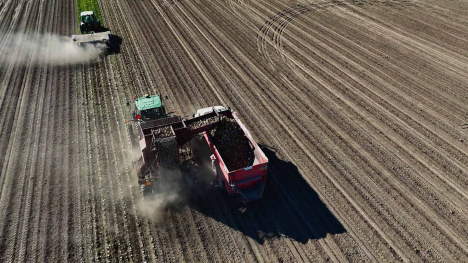
A growers association reports average losses of $500 per acre as sugarbeet harvest gets underway.
Shawn Hackett weighs corn demand, USDA yields and potential November turning points for grains.
Sugarbeet losses, diesel costs, Montana’s feral horses and market analysis with Shawn Hackett.

Montana residents balance affection for free-roaming horses with safety and property concerns.
Shawn Hackett weighs storing corn versus selling soybeans and Brazil’s potential weather risks.