The recent return to higher commodity prices has helped keep the farmland and cash rent market strong.
Commodity Prices Still Driving Farmland Values
Share


The farmland real estate market is holding steady even with higher interest rates for borrowers and their economic and future outlook. There are three factors driving much of the value and it is tied to commodity and cattle prices along with the old standby of supply and demand. Tim Koch, executive vice president and chief banking officer with Farm Credit Services, also helps make sense of the support in sticky rents. Koch also lays out how lending standards have evolved over the past two decades, moving away from lending a flat percentage of farm value toward a margin-based approach built for the long haul. We’ll also try to put a face on the buyer and seller on who is selling and why.
Transcript
[Paul Yeager] Today's MtoM podcast is brought to you in part by the Iowa Economic Development Authority, creating opportunity for business in Iowa by connecting companies, entrepreneurs and communities with the resources to thrive. Learn more at Business Iowa. Oh, those land values — that always seems to be a hot topic among those of you who dial into this MtoM podcast. I'm Paul Yeager.
This is a production of Iowa PBS and the Market to Market TV show. Land values is today's discussion with Tim Koch from Farm Credit Services. He is their executive vice president and chief banking officer of FCS America and also Frontier Farm Credit. So we will discuss land values. We'll talk about credit. We'll talk about factors that are influencing both the sale and the buying of land.
Plus we'll get into rents. And there's a couple of factors at play that are similar but different. We're going to look at a couple of states, highlight them on which land is hot, what type of land is hot, and which one is just stable. That is today's discussion. You can always send me a topic or a guest that you think I should talk to at MtoM for the podcast by emailing Market to Market at Iowa PBS.
Let's get to Tim Koch in today's discussion. A year ago, we discussed small-town Nebraska. We'll skip the Beatrice and Dewitt geography quizzes. Let's just hop into the land right now. As farmers are getting ready to roll, they're going to have conversations with either their renters or their landowners or the bank. So let's start with the overall picture. How are we sitting?
[Tim Koch] Well, if we think about how the economics line up this year versus a year ago, we're in a very different situation. We're sitting in the middle of September. Corn prices are over $5 before harvest. Soybeans are approaching $13. I mean, those are numbers that certainly a year ago, and even earlier in this crop season, we would not have thought we would see. Now diesel prices, fertilizer prices have responded in a very similar manner.
But all in all, if you're going to raise a crop that's somewhere close to your app yield, you're probably feeling pretty good about how your profit and loss is going to turn out. And we can't forget that we've seen some pretty good support payments come through in the form of bridge payments earlier in the year. So all of that adds up to, I think, for those areas that are going to raise a crop, we're going to see pretty favorable economics.
Now, there's also areas that are plenty dry. And so if you were in an irrigation area, irrigation costs were up. And the USDA is telling us that we're going to see yields down probably eight or nine or ten bushels from what we saw a year ago. So weather will always be a determining factor, but just on prices, I think farmers are feeling pretty good. And that's probably reflective of where we're seeing real estate values and those trends right now as well.
[Paul Yeager] It's the smallest things that give us the greatest joy. If that price of corn is higher by a quarter to fifty cents, we feel better — even though an interest rate quarter point might make a huge difference too. So where does the interest rate — because last week on the show, I think the 30-year rate was up over a year. So let's talk about the lending side of the situation. How big a factor are interest rates in land purchases right now?
[Tim Koch] Yeah. Interest rates are always a factor. We're seeing the ten-year bond — that's kind of the benchmark we track to see where those fixed-rate products are going to be. Those have tended to move higher, and once again, that's a little bit different direction than we anticipated they would be. So rates are probably up 50, 60 basis points over a year ago.
That's certainly one of the factors that comes into what rate people are willing to pay for the farm they have to own. Now, we also have to keep in mind that most producers, if they've got existing debt on real estate, have that locked in at some pretty historically low rates. So when you blend the new purchase against your existing purchases, maybe you're talking about a blended rate that's 5 or 6%, not 7 or 8%. And you feel better about that.
But as we talk about interest rates as one of the factors, the other factor that affects real estate values is certainly supply and demand — what's available on the market versus how many people have that itch to buy another farm. And then, what's the overall outlook? What's the producer sentiment? Are they feeling good about their cash flow, or are they feeling a little strained, and they're going to burn working capital, which means maybe they hold off on that purchase for another year.
[Paul Yeager] We'll get into the supply and demand part of that story, because that's part of it. But I want to go back again quickly to the lending side. What's the difference year over year, maybe a five-year trend, of needing financing versus paying cash? Because I know that's been a big story since COVID.
[Tim Koch] Yeah. Well, if we go back even further, to the last time we had a pretty significant economic downturn in agriculture, I think producers understood the importance of working capital. Working capital is cash that you have on the sidelines — you're using your money to finance your crop, whatever that be. And it's been interesting that producers' tone is different when we talk about a land purchase and how much they're going to put into that purchase versus how much they're going to finance. It's, "I'd like to finance as much as I can, because I understand how important my working capital is." Working capital provides options. If I have working capital, I can weather a couple tough years, I can weather a down cycle.
So there was a period of time when a lot of these farms were being purchased with cash. I would say we're seeing a larger propensity of financing right now. And that's because producers have burned through a little bit of cash, but there's still pretty good cash sitting on agricultural balance sheets, and that certainly influences what somebody is willing to pay. So if you think about the cash I've got to put into that, what interest rates are, all of that turns into: I've got to pencil this out and see how it's going to work into my operation. But at the end of the day, real estate purchases are a very long-term investment, and proximity — how it fits into my operation — oftentimes those more emotional things weigh just as much as the financial side. As a lender, we try to think that doesn't really happen, but that is reality.
[Paul Yeager] We could do a whole half hour on the emotional side of this discussion, but we won't. In the name of the organization you work for is "credit" — what's the willingness for credit right now, given the items you've already talked about? Commodity prices are one thing, but inputs and diesel and rates are another. Has that changed, having different discussions with farmers than what you've had in recent times?
[Tim Koch] It really hasn't changed, Paul. Our approach to financing the agricultural landscape is the same today as it was ten years ago, 20 years ago. We look at what's the repayment capacity, what's the break-even, what's the cost structure of an individual producer, and then how does an individual purchase — the additional leverage — impact that. There are certainly exceptions, and we've seen some stress in agriculture across the last couple of years. But by and large, I think the overall economic landscape of agriculture is pretty good in the Midwest. Now, there are certainly some spots — Arkansas makes the news quite frequently. If you were growing rice in Arkansas, maybe things are significantly different than what we're seeing in the upper Midwest.
But our approach to lending is the same. We focus on the long-term cash flow. Going back about 15 or 20 years, we focused more on the ability of the operation to cash flow that purchase, and really moved away from the historical approach of lending a certain value of the farm. There was a point in time where it was pretty consistent that lenders would lend 65 or 70% of the value of that farm. With prices where they're at today, we've had to migrate that toward more of a margin approach — what's sustainable long term, as we think about where profit margins will be, not this year, not next year, but over that next 10 or 15 year window.
[Paul Yeager] Going to make good on my word — we're going to go back to the supply and demand part of what you've been talking about. Which land has the best supply, which land has the best demand?
[Tim Koch] Yeah. So if we think about it on a macro level, the overall supply of available real estate on the market today is down, and we think that's another thing that's supportive of these current prices and even moving prices a little bit higher. Individual pockets drive what type of land — and when we talk about type of land, we're talking about high-quality land or lower-quality land. Year in and year out, the land that drives the best value, the highest returns, the highest margins, is that higher-quality land, and that's certainly where the most demand is.
If we go into a period of time where there's more supply on the market, where producers are maybe more on the selling side than the buying side, that's when we tend to see lower-quality land come up, because if I decide I've got to sell one of my six parcels, I'm probably not selling the best land that I own. I'm picking the piece of land that's maybe a little more marginal, a little chopped up. So we're kind of seeing an equal amount, depending on what's driving the sales activity. But best-quality land certainly continues to demand the best price.
[Paul Yeager] Yeah, and that's long been a discussion point — what's the motivation for the sale? Is it a family situation, a relative, a sibling, or whatever has changed their mind? On your most recent survey, the one-year number was actually down, but in South Dakota, the two-year growth was 19.2% over the last two years. What's the big driver there? Is it a type of land that's driven South Dakota higher?
[Tim Koch] Yeah, I think there's a couple things there. First, let me touch on Iowa. To say that the Iowa market has drifted lower a little bit shouldn't necessarily be a cause for alarm or a signal we're headed somewhere. Iowa tends to lead on the way up, and it tends to lead on the way down. The other thing I'd say is if you think about what our numbers reflect, there's probably a margin of error of 1 or 2 percentage points in there — so we even consider Iowa to be flat.
But let's talk about your question about South Dakota. A couple of things influence that. Over a two-year window, a 19% increase is certainly very significant. When you break those numbers down, South Dakota was up on cropland, but the bigger driver of that large increase has been pasture and grass. And that's reflective of what's happened in the beef market, specifically in South Dakota, with calf prices being so strong and profitability returning to that cow-calf sector.
[Paul Yeager] And that's probably, I'm guessing, a little bit of the Colorado influence, western and northwestern Nebraska, parts of Kansas — not necessarily the full — and I know Oklahoma's out of your region. But yeah, the cattle market has driven a lot of attention from someone looking, especially in areas that aren't in the South, where there had been historic droughts in Oklahoma and Texas.
[Tim Koch] Yeah, I looked through those numbers a little bit before we jumped on this call. Overall, real estate values increased about 3.5% across the upper Midwest, that geography we're in. But if you compare the increase in cropland values to pasture land values, those pasture values were up two to, in some instances, three times what the cropland values were. So you're really looking at crop values up 1 to 2%, and grass and pasture values up six, seven, eight — even in some areas ten, 11, 12%. So a very significant influence. And once again, as we talk about the factors that drive that, economics are a big piece of it. The cow-calf producers, the ranchers, have been on the sidelines for a while waiting for that opportunity.
[Paul Yeager] Tim, if I really wanted to go after a whole bunch of clicks, I'd do this whole section on beef, because that's seemed to elicit an incredible reaction from people right now about all the economics involved. But we'll stick with land, in our lane. Let's go back to Iowa and some of the grain-producing states. I want to talk about South Dakota and Minnesota when it comes to land for crops, row crops. We look at the Corn Belt as it continues to move north a little bit — how has that played out in some of your study in those areas, as the crop makeup changes?
[Tim Koch] I think that's another driver. As you go to some of those northern states in the Corn Belt, we've seen varieties drive much higher yields and much better production in South Dakota, Minnesota, and across into North Dakota. The growing season has elongated — that's been helped by genetics, but Mother Nature has also driven that with some warming weather patterns in those areas.
So no doubt about it — when you look at where there's been the most value, northwest Iowa is generally the highest-priced farm ground. If you see somebody post an article or want to talk about a record price, it's generally in northwest Iowa. There's the moisture and the quality of ground. But you don't have to go too far into South Dakota, and you can get similar yields at a much better value on real estate. And I think people are starting to see that. The other thing that's driven the South Dakota market over the past five or six years is the influx of dairies into that I-29 corridor. Dairies need a place to spread manure, certainly need the corn silage. So we've seen that increase in dairy cows in South Dakota, and across into Minnesota, also be a pretty significant driver of farmland values.
[Paul Yeager] I hadn't quite realized all of that dairy traffic was a big part of that, and it logically makes sense in what you're speaking of. So if we know the majority of the movement — I guess what we've kind of talked about is dependent on certain items — are all those items the same that you talked about going to be what drives us up or down historically on land? Is it always the traditional factors, or is it one of those huge pops? I'm not asking about the oil patch in North Dakota pops — is there something else that plays into a factor here as you look at trends?
[Tim Koch] The three key components that drive real estate values: supply and demand, economics — not just today, but the future outlook — and then interest rates. Now, they're not always equal. But if you think about the macro real estate market and the macro environment, those are the factors that most influence that. Now, we can talk about individual pockets, and there are individual things that drive that, with alternative use for real estate. Alternative energy, data centers — that's where you can see some very localized change in values, but generally not reflective of a broad market movement.
[Paul Yeager] Yeah. Data centers, energy, solar — that is an absolute hot topic as well. I always look at the op-eds to kind of see what the sentiment is in the newspaper, and one of them is about rents — that rents haven't changed as much. Maybe that's just someone hoping for lower rents, not economically based. Where are you seeing rents right now?
[Tim Koch] You know, rents have been pretty sticky. I think producers were hoping they'd get a little bit of relief from rents. In the past couple of years we've seen rents move, and it's not surprising when you look at the value of real estate going up. At the end of the day, some of the returns — if we look forward to negotiating 2027 rents — we always root for producers to ensure they can find that fair rental rate. But as corn prices have now moved above $5, landlords generally pay attention to that as well. They also pay attention to the level of government support and ad hoc program payments. So I try not to get into the prognostication business about where those are going, but suffice it to say, I'd be surprised if we see much of a drop in rental rates moving into 2027. We talk about the current futures price for December corn being over $5 — that price is available for December of '27 as well. So I think there's certainly some opportunities out there. We'll see what happens with prices and when we get done with the conflict in the Middle East. But I think there will be some optimism around 2027 as well.
[Paul Yeager] Well, that goes back to the very first thing I talked about — that conversation with the banker and with your landowner. If you have to go in and the landowner says, "Well, I'd like to say I saw it on Market to Market, that it was going to be up over $5" — because I think that's who watches our show sometimes, or those who own land who might not be directly involved. So let's talk to them for a minute. Your farmer, your producer, is going to be dealing with that higher energy cost and the input and the fertilizer side of this equation. Matt Bennett just talked about this last week — he even said it on air — the cost to use fertilizer is actually better than it has been in years. Nobody wants to hear it, even though they still see the high price. So it's a complicated discussion that's going to go on between landowners and the renter.
[Tim Koch] It certainly is. That's nothing new. Landowners want to maximize their return, producers want to maximize their return. And I think long-term, stable relationships usually win the day there — producers and landlords that understand there's a great amount of volatility that exists in the corn and soybean markets, wheat markets, cattle markets, whatever that is. So just how it looks today doesn't necessarily drive what it's going to be at the end of the year. This year it looks like it's going to be the opposite — we've seen a 30 or 40% increase over the last year in crop prices. So hopefully the yields are there when people get in the field, and that'll drive a certain level of cash flow that's better than what they thought.
The other thing that's different, I think, that factors into those conversations with landlords, is we've got a crop insurance program that provides a little bit of a safety net. You kind of understand at least where that fall price and the spring price are going to be. When you're having some of those conversations, you can look out and see what you can expect, and that helps — marketing some of those bushels a little earlier.
[Paul Yeager] So one of the big drivers of inflation over the last year has been fuel and energy, and that's a really hot topic as we speak here today. What's the role of inflation — general inflation — when it comes to land decisions, both for the buyer and the seller?
[Tim Koch] Yeah, I think inflation generally comes into that profitability, or that forward-looking sentiment, factor. I don't know that land — we don't generally see land following an inflationary trend. It's usually a result of some of the other components. Now, the piece that's also driven a little bit by inflation is interest rates. The Federal Reserve has been pretty stern in their belief that inflation is too high, it needs to come down, and interest rates are one of the tools they frequently use to try to manage where those rates are — whether it's buying securities, selling securities, or driving the short-term interest rate environment. And that's, we talked about early on in our conversation, interest rates have moved higher, and that's been largely driven by the Fed's discussion around where rates are, where they need to be, and how they get inflation back in check.
[Paul Yeager] I'm going to give us both a disclaimer here, Tim — we're recording this before the Federal Reserve makes their next decision on interest rates, before this comes out. So, haha, we didn't know what was going to happen. But let's say what's likely to happen is interest rates are going to go up — the president doesn't want that. Usually the markets then have a little bit of a hiccup and a reaction. You can't look at day-to-day in your long-term view of land in your business, right?
[Tim Koch] You're right. It looks like, as we sit here today, the Fed — at least the market thinks it's more probable that the Fed will increase rates than hold them or certainly reduce them. Now, we view interest rates as driven by longer-term fixed rates — I believe the markets have already priced that in, so I'm not sure we'll see long-term rates move as much. But an increase in short-term rates just means financing that higher-priced diesel fuel, or my inventory, is going to cost more. So it does play into the overall economic situation. But I do believe we'll probably see long-term rates hold a little more steady, even if the Fed increases rates. I think the long-term market is trying to figure out what the Fed's going to do, and once we have a sense of where they're going, we could see a little bit of this premium come out of the longer-term bond market. But that's not a prediction — that's just a possibility of what we could see, because the market's trying to figure out and search for what the Fed's going to do. When we have a sense of that, we'll see a little more stability.
[Paul Yeager] Okay, I've asked you ridiculous questions — now I'm going to keep going with one more. Are the dentists done buying the land? Because — you know what I'm saying — it's that indicator of those who don't traditionally buy land, seeing it as an investment. Is that still happening right now?
[Tim Koch] We are not seeing much investor influence on this market. This market is largely, if not exclusively, driven by agricultural producers, or what I'll call agricultural investors. It's not dentists — it's people that own land or are much more active in that. And you don't have to look very far to figure out why. Returns on ag real estate at these prices and these rental rates aren't very good, and the stock market's been doing pretty well. If you go back three or four years, the stock market is probably averaging over 10%, and I think that drives: do I want a 1 or 2 or 3% return on real estate, exclusive of any inflation in that, or do I put that in CDs, which have been higher, or the stock market, which generates larger returns? So once again, we're not seeing an investor-driven market at this point in time, but we haven't for the last several years.
[Paul Yeager] Oh, you say not for the last several years?
[Tim Koch] No — I think this has largely been a producer-driven market. Now, once again, there are pockets and areas where that can be different. But just like there's that really odd sale that nobody understands, that was either much higher than anybody expected — and we've also seen a few that have been much lower than anybody expected, and everybody scratching their heads saying, why didn't that farm sell very well. But I don't have the exact numbers in front of me, the last two or three years it's been almost exclusively producers or agricultural investors, not your traditional investor looking for diversity in their asset base.
[Paul Yeager] Yeah, I think I've told you this — the land behind me is my home place. I think it was up for sale two years ago, and it was somebody who was local. The five last buyers in on the bid were within ten miles of the land. There wasn't an outside person — not a major indicator, just an anecdote, but northeast Iowa. So let's close with this, Tim — give me three things to watch as we close out 2026 here in this last quarter.
[Tim Koch] You know, I think if we close 2026, a few things to watch are: where's this inflation headed? As producers start to think about 2027, what's fertilizer doing, what's my seed cost doing — I think that'll be a significant driver. We talk about how landlords pay attention to crop prices; so do those other suppliers in those markets. And certainly the Middle East will be a driver in that. Interest rates are always relevant to producers — what's inflation look like, what's the Federal Reserve's sentiment. And then the last thing we always have to pay attention to is what the weather pattern looks like. If you think about a scenario where you've got high-priced fertilizer, a little uncertainty if you're in the western part of the Corn Belt about what moisture levels might be as we think about planting — those, weather, interest rates and inflation are nothing new, but those are the things our producers have to always pay attention to and be mindful of as they make those longer-term decisions.
[Paul Yeager] Always good to get a pulse check on what's happening there in the land. These are always extremely hot topics that people like to listen to — they always like to know the trends. So Tim, I appreciate you squeezing me into your schedule.
[Tim Koch] Glad to do it. Thanks, Paul.
[Paul Yeager] Today's MtoM podcast was brought to you in part by the Iowa Economic Development Authority, creating opportunity for businesses in Iowa by connecting companies, entrepreneurs and communities with the resources to thrive. Learn more at Business Iowa.
We are produced at Iowa PBS. Our production supervisor is Sean Ingrassia. His crew is Reid Denker, Kevin Rivers, Julie Knutson, Neal Kyer and David Feingold. The executive producer of Market to Market is David Miller. I'm Paul Yeager. We'll see you next time.
Watch More
Karen Braun examines soybean trade stakes, harvest pressure and tight cattle supplies.
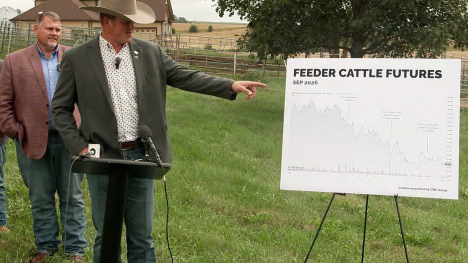
The Iowa Cattlemen’s Association introduces a 2027 plan to support cattle herd growth.
Karen Braun weighs the 2027 acreage battle, input costs and U.S.–China trade signals.
Local dirt tracks generate millions for rural businesses while preserving racing traditions.
The bill advances 12–11 as lawmakers remain divided over SNAP provisions.
Farm Bill progress, cattle herd rebuild, dirt track economics and a pivotal China summit for grain.