New tariffs emerge as business owners sue for import fees. The increasing dominance of two row crops in the U.S. And, commodity market analysis with Sue Martin.


On this edition of Market to Market ...
New tariffs emerge as business owners sue for import fees. The increasing dominance of two row crops in the U.S. And, commodity market analysis with Sue Martin.
Transcript
[Paul Yeager] Coming up on Market to Market. New tariffs emerge as business owners sue for import fees. The increasing dominance of two row crops in the U.S. and commodity market analysis. With Sue Martin next.
[MUSIC]
[Announcer] I wouldn't be here without my customers.
Yeah, I'd like to thank the customers.
They're very dear to our hearts.
It's about the people that you're working with and the relationships that you have.
Thank you. Thank you. Thank you. Thank you from the bottom of my heart.
[MUSIC]
[Announcer] Tomorrow. For over 100 years, we've worked to help our customers be ready for tomorrow.
[MUSIC]
[Announcer] Trust in tomorrow. Information is available from a Grinnell Mutual agent today.
[Announcer] This is the Friday, February 27th edition of Market to Market, the Weekly Journal of Rural America.
[Yeager] Hello, I'm Paul Yeager. Home buying is an integral part of the economy, and the lending rate is often looked at as an indicator for how willing buyers are to go through the resistance. In a 30-year loan. That hurdle fell below 6% for the first time this week and more than three years. That's according to Freddie Mac. Another big indicator is inflation pressure. Friday's producer price index added half a percent on costs paid at the wholesale level. Now, when an administration is writing the biggest speech of the year, numbers like those can support or weaken the credibility of their bosses. Remarks. Article two, section three, clause one of the Constitution requires the delivery of a state of the Union. Tuesday's installment was longer than any one delivered before. The traditional lines on strength and vitality rang out, as did some texts that could be viewed as more fiction than fact. Peter Tubbs looks at the speech and the latest wrinkle in the tariff story.
[Narrator] The effects of last week's tariff ruling by the Supreme Court continue to ripple across economic and political waters.
[Narrator] In his state of the Union speech Tuesday, President Trump again incorrectly claimed that exporting countries pay tariffs on goods imported into the U.S. importers and American consumers pay the tariffs on imported goods.
[President Trump] I use these tariffs took in hundreds of billions of dollars to make great deals for our country, both economically and on a national security basis. Everything was working well. Countries that were ripping us off for decades are now paying us hundreds of billions of dollars.
[Narrator] The court's 6 to 3 ruling found the tariffs placed by the Trump administration under an emergency powers law to be unconstitutional. Thousands of companies have sued the government for refunds of tariffs paid over the last ten months. The U.S. Treasury has collected over $130 billion in tariffs over that time, 10% tariffs placed in the wake of the Supreme Court's ruling went into effect on Tuesday, will remain active for 150 days, and any extension would require congressional action. The new tariffs fall under a section of the Trade Act of 1974. The American Farm Bureau released a statement encouraging the Trump administration to avoid using tariffs to settle trade disputes due to tariffs, increasing the prices of inputs used in agriculture. The European Parliament, also delayed further action on its deal with the United States.
[Alberto Rizzi] Many of the reasons that made the difficult deal palatable to the Europeans are not on the table anymore. Which means it's going to be difficult to find an adequate framework for the for the next deal, or to safeguard most of this one. I don't think the EU is keen to discard it, but also sees now very little value in the deal that last year seemed a relatively good point.
[Narrator] For Market to Market. I'm Peter Tubbs.
[Yeager] USDA provided acreage estimates last week at their annual outlook forum. Much like rural America, change is happening slowly on what's being grown. Crops shift north and south as hybrids allow for shorter seasons and a chance for some producers to cash in on more profitable crops, leaving other products in the seed bags. This week's cover story has two aspects for you. The first, in a few seconds. The other is that our website of Markettomarket.org. This is where you will find the complete breakdown of all row crop projections analyzed in this report. The full database is publicly available now. Here's Colleen Bradford Krantz with our report.
[Narrator] America's cropland is slowly shifting of the nation's top ten crops by planted acres. Only three have gained ground in the last quarter century. Corn, soybeans and canola. The rest hay, wheat, cotton, sorghum, rice, oats and barley have all lost acres to these expanding crops. Development or other uses. Since 2000, lost ground doesn't always mean lost production thanks to improved yields, but it does show how clearly the nation has shifted from four dominant crops to just two. As corn and soybeans push into new territory, primarily replacing wheat and hay. Bruce Haynes, who farms 800 acres near Mitchell, South Dakota, reluctantly dropped hard red winter wheat from his crop rotation a few years ago.
[Bruce Haines] Typically, a third of my crop would have been wheat. And so, you know, I would have been farming 240 acres of wheat a year. None. This year. It's been three years since I raised wheat.
[Narrator] He's not alone. This animation from USDA's Cropland Crop Tool, set to run from 2007 to 2024, illustrates how wheat is disappearing from eastern South Dakota.
[Bruce Haines] You know, in this country, we've been raising wheat since the settlers got here at the turn of the century, and all of a sudden, you know, marketing challenges and weather challenges of profitability kind of stands in the way of, of wheat acres. And so, we've moved more into the soybean and corn rotation, the wheat acres that we have now are probably half of what we would have had five, six, seven years ago. No, it's really sad. I really, really enjoyed raising wheat.
[Narrator] Projecting forward. Corn and soybeans could jump from a combined 58% of cropland acres today to 68% by 2050. Though Dietary Preferences Policy shifts economic forces and weather could change that picture, Haynes, a board member for the South Dakota Soybean Research and Promotion Council, isn't worried about corn and soybean dominance. He says farmers must make smart economic decisions, not emotional ones.
[Bruce Haines] I don't think it's a concern because I think that there's a large shift in the biofuels and, you know, the petroleum market. I think that we all understand that what we used to get from the ground below in petroleum, now we have to raise those biofuels from the ground above.
[Narrator] A soybean crushing plant. High Plains processing recently opened near Haynes Farm, eliminating the need to ship soybeans by rail to West Coast ports.
[Bruce Haines] We have those renewable fuel plants. Those are local markets. And so, within three miles of my farm, they're going to crush 35 million bushels of soybeans. And, you know, we know that market is going to be there.
[Narrator] That kind of infrastructure encourages more farmers to plant those crops. And when other crops disappear from a region, the supply chain infrastructure often goes with it, making them harder to bring back. Some argue nations can specialize if the world functions as a smooth global market. Others worry that politics, weather or conflict could disrupt that trade. Sarah Kardon, research and policy director at Farm Action, sees signs that USDA's becoming more willing to also support higher value, labor intensive crops like fruits and vegetables products. The U.S. increasingly imports.
[Sarah Carden] The recently announced bailout of $12 billion included $1 billion explicitly for specialty crop producers. As a set aside, that's an exception. That's not you know, if you go back to like the era of Trump won and we had a trade war and a bailout that wasn't there. So that's a big change, right? Just this acknowledgment that there are other types of producers out there that have high input costs. They do have market challenges.
[Narrator] Without greater crop diversity. Cardin worries the U.S. will continue to deepen its agricultural trade deficit.
[Sarah Carden] They were projecting in 2020 for a $32 billion agricultural trade deficit, because specialty crops are more valuable, you would only need to shift about 0.4% of the cropland into specialty crops just to balance that trade deficit.
[Narrator] Cardin says global specialization works until something changes. Nations then discover how dependent they have become on one another.
[Sarah Carden] That's very much like our relationship with Mexico, for instance. They we grow a lot of cheap corn for them to import as feed, and they grow a lot of fruits and vegetables for us to import. We've lost sovereignty, they've lost sovereignty. It creates a problematic power dynamic. I think.
[Narrator] Experts say there's a small degree of agronomic risk in relying so heavily on just two crops. Florida's loss of 90% of its citrus production due to a virus and insect combo offers a reminder of nature's unpredictability. Since 2015, the USDA has offered whole farm revenue protection insurance, in part designed to encourage greater agricultural diversity. Farms or ranches selling at least three distinct commodities or products can qualify for higher levels of protection under this federally subsidized insurance program. Adoption has been slow, however, only about 2250 farms had the policy. As of 2024, though it has climbed in recent years. In December 2025, the USDA Office of Inspector General found that the Risk Management Agency couldn't prove that its partner, independent crop insurance agents, were consistently offering the program to producers. The WMA agrees with the orders that it now must require agents to track that they offer all insurance options. In the meantime, Haines continues watching for the right moment to bring wheat back into his rotation.
[Bruce Haines] It's one of my favorite things to grow is in the springtime is wheat. There's nothing more beautiful than a wheat field. If you're raising it just to be pretty, that's good. But if you're raising it for cash, there's a there's a shortcoming in that.
[Narrator] For Market to Market. I'm Colleen Bradford Krantz.
[Announcer] Next, the Market to Market report.
[Yeager] Improving weather in the Plains took out some of the rally in the grains before a couple of export sales offered some support for the week ending February 27th. The nearby wheat contract added $0.11 in the May. Corn contract gained $0.09. Biofuels obligations from EPA moved across the street for review, providing a boost to the soy complex. The May soybean contract improved by $0.18, while May meal strengthened by six. 70 per ton. May cotton expanded by $0.06 per hundredweight over in the dairy parlor. April class three milk futures lost a penny. The livestock market was mixed. April cattle sold off nine. 77. April Feeders cut 13. 85 and the April Lean hog contract gained $2.05. In the currency markets, U.S. Dollar Index weakened by 12 ticks. April crude oil found $0.58 per barrel. Comex gold increased one. $69.90 per ounce, and the Goldman Sachs Commodity Index was up by more than 11 points to settle at six 1040. Here, now, to lend us her insight on these and other trends is regular market analyst Sue Martin. Hello, Sue.
[Sue Martin] Hi there.
[Yeager] Since we since I wrote that story, the intro to wheat, a major thing has changed. Just in those moments. Global tensions again have risen to the top of the big story in wheat. What is going on?
[Martin] Well, it's all centered around Iran. We ended the week with disappointing talks with Iran, but we'll have more talks next week. However, I think we're putting the groundwork in for the just in case. This past week on, I think it was Wednesday, the U.S. moved. I think it was 11. There was 12 to begin with. F-22s into the airfield or whatever base in southern Israel. One of them had to turn around and go back because of mechanical issues. So, 11 made it. Also, there's the international airport at Baghdad stopped allowing people to come into the airport. And then we've pulled our people out of the embassy in both Iran and in Israel, but also other countries around the world are pulling their people out of the embassies. So, it's.
[Yeager] It's a serious thing in a hurry. And so that puts the stress on with Russia and Ukraine. We've had that deal. So, we're if I'm a producer watching these stories, regardless of what it is, am I taking some type of position right now?
[Martin] I think we got further to go. I think you will see wheat trade at $6 and it's not super far away. And in the meantime, if war did break out, wheat is a very it's a food item. It's very important. And you might be seeing countries around the world all of a sudden getting protectionist thinking. You know, maybe we need to get some wheat in our coffers to have food on hand.
[Yeager] Well, Japan's going to have some U.S. corn coming to it after some export sales this week. What else is impacting corn?
[Martin] Well, I thought it was interesting because today on Friday, we had foreign ag service report a sale of 275,000 metric tons of corn to unknown destinations. Now we've been having off and on sales going to unknown destinations. Of course, I tend to be an optimist, but I think that's Chinese. China needs corn, and as of the latter part of December through the month of January into February, China had bought triple the amount of sorghum from the U.S. that they did. The whole marketing or calendar year last year. And so, I you know, their weather was horrific, both in corn and wheat country. They started off very dry and then ended up in floods. And so bad that the government stepped in to help farmers get the crops out. So, the quality isn't there. In the meantime, the hog production hasn't slowed down in China much to the dislike of the government. It's increased. And so, the price of pork in China, they compare it to the price of tomatoes second lowest on record. And so, you know, there just is a need for corn. But also, there's a need for soymeal. Now China doesn't tend to import soymeal. But on Friday they made an agreement and it started back in January. But they lowered the tariffs down I think 85% on canola. And of course, canola meal. I thought that was interesting. Taking canola meal because they tend to like to crush their own soybeans. And so, they are importing beans. Of course, we know they're huge buyers. This week out of Brazil. One thing that's interesting in Brazil is that the dollar to the real to the dollar relationship has gotten very narrow. 5.2 I think it is to one, which means that the farmer is not happy about that. He sells his beans in dollars and therefore he's not getting as many dollars for his beans. And he buys his inputs in reals. Well, when they're going into harvest, they don't need inputs. They need money to pay for the beans. So, they're not selling beans right now. They're being very slow to move forward.
[Yeager] Which creates an opportunity then for the U.S. I mean, we had a couple of questions about China. People like, well, should we even rely on them. But the U.S. government is possibly providing some cover for sales with this Renewable Volume Obligations language that's come across to OMB. Are you how bullish are you on beans right now, Sue?
[Martin] Well, you know, my long-term charts are looking very friendly. And the potential is still yet to come. It's real important because quarterly data it's we're so far we're inside the range of the last quarter of last year. But we're narrowing in even on Friday we closed right at the highs up $0.10 and not very far from the highs of December. So, we're probably 6 to $0.08 away from that high. If you're talking a lead contract, if you look at the March contract specific, that high was 11 72.5, but very easily to be struck this next week. You take those highs out, then you're starting to move this market out of that inside range for the quarter. And of course, it's real important how we close at the end of the quarter, which also coincides with the meeting between President Trump and President XI. Now, I know that the South China morning post trade send a kind of a downplay message.
[Yeager] That's the one with no agenda. There's not been too many talks between the two countries.
[Martin] Yes. And to be honest with you, what I see it as is propaganda trying to get the prices lower so they can come in and buy beans because I think they will fully buy the beans from the U.S. Now we have to keep in mind. Yes, China is going to buy beans from Brazil, but those beans will probably be going to privates, not state-owned enterprises like Kafka and Single Grain. And so, I, I believe China will buy those beans and the funds keep adding in to their positions for beans as well. But it's interesting because every time we get a break, it's like the market gets quiet and then next thing you know, it's floating right back up. And of course, that old saying, never sell a quiet market or kick a sleeping dog. They both bite. I think we'll see $12 plus beans. In fact, I think new crop beans will see $12 plus. And then if we have an occurrence of weather that coincides, then we're going to have something even more dynamic. Maybe beans go to 13, possibly higher.
[Yeager] And that could impact both beans and corn on the weather side. And that's a weather story I do want to get to in Market Plus. I need to quickly just mention this cotton market and why all of a sudden this thing is having life?
[Martin] Well, it's interesting because Cotton Acres, which beans will pull some of those acres. Cotton acres are expected to be down in the U.S., down in Australia, down in India. And of course, China is cutting back on Cotton Acres as well. And Brazil's you know, they they've been gaining in cotton acres because they come in behind the beans. And so, it's interesting because we're looking at what could be about 40% reduction in acres. And then in the meantime, the biggie is the funds are heavy, heavy, almost record short. They're like 121,524 contracts or something close to that. On the short side, a week ago, I haven't seen, of course, the commitment of traders report to end this week, but that should help spin the market higher as well. I'm friendly cotton.
[Yeager] Well, nobody seems to be too friendly cattle or feeders this week. A big sell off. Is this just profit taking or is there more to it?
[Martin] No, I think actually the market we had cycle window timing on Thursday and the market rallied two days before that into it into Wednesday, which I would have rather seen the market go down and then see the prices go back higher. The indicators I follow on the daily are so low, and they've been that way since about, I want to say, the 28th or so of January. And they're just I need to be patient and let them turn and prove that they're going to go positive. But I've been a chicken to sell because of it. And I even pulled shorts to quick on Wednesdays or Thursdays break. And I should have waited another day. Well, we made higher highs in February and we've closed the month lower. That means you're going to see another push lower in March, and then we'll see what we're made of. But what's interesting is on Elliott Wave charts, we're pushing down towards a wave for a large wave for there's two of them. And then here's a high at new highs at a five. I'm wondering, is it possible we still see higher highs yet this year? It's going to be interesting because feeders haven't been able to fulfill that finish that gap. While fats did make higher highs. But the February's expired here on Friday, $12 higher than the April Fats. That's huge. And a huge spread. Cash ended up down $3 or well, 2 to $4 this week. And of course, the cutout kind of fizzled out because they think that it was catching buying because of the Greeley, Colorado auction or.
[Yeager] The strike, a potential strike which will have to pick up, as always, our time flies. Thank you Sue.
[Martin] I could talk forever.
[Yeager] I know, and we'll get you in a minute here in Market Plus because you've been watching the analysis portion of this program. We'll continue here in our online only segment. Find it by searching Market Plus with Sue Martin. Wherever that you get your podcasts. And you can go to our website at Markettomarket.org as well to listen. We've been on X so long, we started as a Twitter account. Join us at Market to Market to see our postings. Next week we are going to give you the story of building an agriculture program, feeding a changing local community. Thank you so much for watching. Have a great week!
[MUSIC]
[Announcer] Market to Market is a production of Iowa PBS, which is solely responsible for its content.
[MUSIC]
[Announcer] I wouldn't be here without my customers.
Yeah, I'd like to thank the customers.
They're very dear to our hearts.
It's about the people that you're working with and the relationships that you have.
Thank you. Thank you. Thank you. Thank you from the bottom of my heart.
[MUSIC]
[Announcer] Tomorrow. For over 100 years, we've worked to help our customers be ready for tomorrow.
[MUSIC]
[Announcer] Trust in tomorrow. Information is available from a Grinnell Mutual agent today.
Trading in futures and options involves substantial risk. No warranty is given or implied by Iowa PBS or the analysts who appear on Market to Market. Past performance is not necessarily indicative of future results.
Watch More

Huub Lelieveld receives the 2026 World Food Prize for six decades of work advancing food safety.
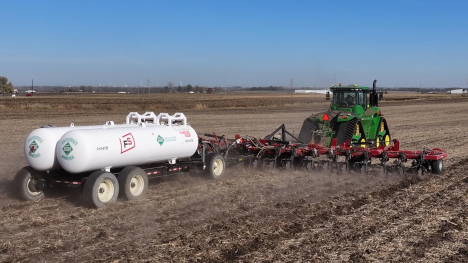
New federal plans target farmers' fuel and fertilizer costs through direct relief and investments in domestic fertilizer production.
Chris Robinson weighs corn recovery prospects, soybean price levels and the rebound in cattle.
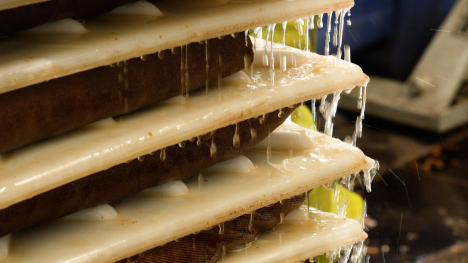
Minnesota’s Keepsake Cidery combines heirloom apples, traditional cider making and direct sales to help a small farm thrive.

New farm relief, a food safety honor, Minnesota cider and commodity market analysis with Chris Robinson.
Chris Robinson answers viewer questions on corn yields, crude oil and cattle, and explains his soybean outlook.