Agriculture gets sorted to the side during high-stakes negotiations with China. The yeas have it - E15 is approved in the House but not without some pushback. Revving up fans, drivers, and rural communities on the dirt track. And, commodity market analysis with Naomi Blohm.


On this edition of Market to Market ...
Agriculture gets sorted to the side during high-stakes negotiations with China. The yeas have it - E15 is approved in the House but not without some pushback. Revving up fans, drivers, and rural communities on the dirt track. And, commodity market analysis with Naomi Blohm.
Transcript
[Paul Yeager] Coming up on Market to Market -- agriculture gets sorted to the side during high stakes negotiations with China. The yeas have it -- E15 is approved in the House, but not without some pushback. Revving up fans, drivers and rural communities on the dirt track. And commodity market analysis with Naomi Blohm, next.
[MUSIC]
[Announcer] I wouldn't be here without my customers.
Yeah, I'd like to thank the customers. They're very dear to our hearts.
It's about the people that you're working with and the relationships that you have.
Thank you. Thank you. Thank you.
Thank you from the bottom of my heart.
[MUSIC]
[Announcer] Tomorrow. For over 100 years, we've worked to help our customers be ready for tomorrow. Trust in tomorrow. Information is available from a Grinnell Mutual agent today.
[Announcer] Support for Market to Market has been provided by a bequest from Philip Lietz of Alta, Iowa, in recognition of public television's commitment to agricultural programming.
[Announcer] Market to Market is made possible in part by a grant from the Corporation for Public Broadcasting.
This is the. Friday, May 15th edition of Market to Market, the Weekly Journal of Rural America.
[Yeager] Hello, I'm Paul Yeager. The headlines of the week came from half a world away, but the economy followed the president to China. Inflation stickiness appears to be thickening the existing home market edged up 2/10 of a percent in April, as mortgage rates stayed high and inventory remained low. Consumer prices climbed as well, driven largely by higher gasoline costs. The CPI rose 6/10 of a percent for the month and 3.8% year over year. Wholesale inflation hit even harder, up 1.4% for the month and 6% for the year. Retail sales added half a percent in April, but again, higher fuel costs accounted for most. For most of that expansion, the U.S. Brought titans of industry looking to do business in China as part of their delegation. This did include the CEO of Cargill, Brian Sykes, who was part of the group asking for more purchases of soybeans, beef and corn. Immediate gratification of agricultural announcements did not come to fruition, even with vows to meet again this year. As Laurel Bower reports.
[Narrator] President Trump met with Chinese President XI this week in a highly anticipated two-day summit to discuss divisive issues such as the Iran war, trade, technology and Taiwan.
[MUSIC]
[Narrator] Both presidents used the platform to address their differences in an effort to avoid a repeat of the trade war ignited last year, after Trump added tariffs to products imported into the U.S.. The agricultural sector was paying special attention to the talks and whether or not there would be a deal where China would buy more U.S. Farm products. U.S. Soybean exports to China, a huge market for American farmers, declined at one point amid the dispute, with few breakthroughs made on this trip, the trade truce reached by Trump and XI in October of last year will likely be extended. Key aspects of that deal included China's agreement to resume buying U.S. Soybeans and other agricultural products, and a tariff truce where the U.S. Dropped threats of 100% duties on certain items and a decrease in average tariffs on Chinese goods from 57% to 47%. Soybean prices moved higher this week as the summit began, but dropped sharply on Thursday as the market was disappointed by a lack of concrete. New Chinese agricultural purchase agreements. Despite initial reports of progress for the beef sector, Reuters is reporting a sudden policy reversal occurred when China renewed, then quickly revoked export licenses for hundreds of U.S. Beef plants. The move signaled there were still deep-seated trade tensions between the two superpowers. For Market to Market, I'm Laurel Bower.
[Yeager] The Senate now has two bills that rural America would like to see action on sooner rather than later. The farm Bill was the first, but it was missing language on the year-round sales of E15 leadership promised farm state lawmakers a vote on the issue, and this week they delivered Peter Tubbs reports.
On this vote, the yeas are 218. The nays are 203. The bill passed without objection. The motion to reconsider is laid on the table.
[Narrator] This week, the U.S. House approved a bill to amend the Clean Air Act to allow the year-round sale of gasoline blends with 15% ethanol, commonly known as E15 language, for year-round. E15 was originally in the house version of the farm bill, but was pulled from that measure in order to gain enough votes for passage of the bill last month. Nationwide year-round sale of E15 has long been a goal of the ethanol industry. Most sales of the higher ethanol fuel occur at the 3000 gas stations in the country that are properly equipped to dispense the blend, mostly in the Midwest. Roughly 2% of the gas stations in the U.S. Can sell. The blend, marketed as unleaded 88. Roughly one third of U.S. Corn production is distilled into ethanol. Opponents to the bill believe the current structure of the RFS may create higher demand for corn and lower demand for soybeans. Fuel industry analysts believe that the additional sale of E15 could shave a few cents off the price at America's pumps. The average price of gasoline in the U.S. Has risen 63% since the start of the war, to over $4.35 per gallon, almost $2 higher from before the initial offensive on Iran. The bill now heads to the Senate, where its future is uncertain. For Market to Market, I'm Peter Tubbs.
[Yeager] The dirt, dust and sounds are big selling points of auto racing. Teams spend the week under the hood tuning up a winner when the lights come on for race night, the adrenaline peaks for fans and their favorite driver who's behind the wheel. Big money is set to run at the Indy 500 in a couple of weeks, but local sales of auto parts, tickets and beverages are also part of the financial fabric of the dusty oval. John Torpy has our cover story.
[Narrator] Underneath the fun and excitement surrounding the rituals of dirt track racing at local speedways are the spinning wheels of economic good. Small town racetracks bring to their communities.
[Karen Bailey] You know, oftentimes people think of racing as the big superspeedways, which we all see and know and love. But the fact is that there's 1500 other smaller racetracks all around the country serving our communities. And so.
[Narrator] Karen Bailey Chapman is a senior vice president at Specialty Equipment Market Association, an automotive industry trade group that supports motorsports to help shine a light on the fiscal importance of the sport. SEMA set out to quantify how weekly events at racetracks contribute to the economies of surrounding communities.
[Karen Bailey] For every race car you see out there, there's parts that are being sold by manufacturers around the country. There's venues that also employ people to make it all happen. And then, of course, the, the outer part of, of that impact is, you know, from a hospitality perspective. And so, we really wanted to, to really focus in on what the story behind the story is and the fact that it's, you know, I think there's a lot more that goes into what you see every weekend at your local racetrack than just the cars racing around.
[Narrator] According to a 2025 study by SEMA subsidiary Performance Racing Industry Motorsports, across the country contributes over $69 billion to the U.S. Economy. The study revealed that in Iowa, the total economic output of motorsports neared $1.7 billion last year.
[Narrator] In Marshall County, Iowa, home to Marshalltown Speedway. Performance Racing Industry calculates the financial boost from motorsports to the community at more than $15 million annually. You know.
[Jerry Vansickel] For 63 consecutive years, there's always been racing in Marshalltown. It's always happened. But these racers bring when they come to town, they're stopping at their gas stations. They're stopping at restaurants. It does impact the economics of the city.
[Narrator] With its high banked turns, the quarter mile Marshalltown Speedway is nicknamed the Bucket List track, a track drivers want to race at least once. The attraction to the oval track and its legacy have helped cement the Speedway's relationship with the city of Marshalltown.
[Jerry Vansickel] And we are lucky here. We have a lot of community businesses that support the racetrack.
[Narrator] From replacement parts and fresh tires to fuel and food owning and driving. Any race car can be an expensive investment, which often only yields the thrill of racing.
[Jerry Vansickel] Some of these guys have got, you know, 70, 80, $90,000 invested in their in their race car, which is, you know, for the weekly racer is a hobby. It's not, you know, they're, they're not getting rich. They're doing it to have fun. They're doing it to, they're passionate about it.
[Narrator] Vansickel adds the passion for motorsports can be seen as a linchpin. Connecting the drivers and the fans.
[Jerry Vansickel] The reality is you can't go drive a car at 100 mile an hour into a corner out on the street, but you can come and watch somebody here do it.
[Pat Rachels] You don't really have the opportunity to sort of overanalyze stuff. That's in a nutshell, why I love coming dirt racing.
[MUSIC]
[Jerry Mackey] We appreciate you all coming out. We appreciate you all being here. We wish everybody the best of luck tonight.
[MUSIC]
[Pat Rachels] Pat Rachel's, China Grove, North Carolina, original hometown of Knoxville, Iowa. I mean, the whole experience is awesome, right? I mean, I love everything about it. I mean, my favorite part probably is in, in the heat of the race. Everything happens fast. You don't really have time to weigh your options, right? It's you just, you're just making decisions and going things flying. Things are flying at you. And it's, it's always different. Every lap is different. That's probably my favorite part about it.
[Narrator] Pat Rachel's is a second-generation owner driver who had a hold of a steering wheel before he could walk. Rachel has carried his love of racing into adulthood as a senior engineer for Toyota Racing Development in North Carolina. His work supports multiple teams in NASCAR and other professional Toyota racing crews. When the opportunity presents itself, Rachel's finds his way to his favorite dirt track in the country, the Southern Iowa Speedway.
[Pat Rachels] So, it's almost two completely different worlds. At the NASCAR level, everything is so fine-tuned and there's so many people and resources behind a single car. Millions of dollars and, you know, tens or hundreds of engineers and mechanics. At this level, it's you and a couple of your buddies do it all. You just have to go with it. You know, you make it work and you get to the racetrack and, and, and everybody at the racetrack is in the same situation. When you race, you know, at a local level like that. And that really makes the camaraderie tighter because everybody's living what you're living to get to the racetrack. And so, you end up developing some really good friendships.
[Jerry Vansickel] You know, racing is about family. If you've got a racetrack in your community and you've always thought, why should I go? Just go to support it. It supports community. It supports the people that are passionate about it. And a lot of times it is a business and it supports that business, and it keeps that avenue open for the people who really enjoy it. Every week.
[Narrator] For Market to Market, I'm John Torpy.
[Announcer] Next, the Market to Market report.
[Yeager] USDA slashed the size of the U.S. Wheat crop to the lowest in 54 years, as the drought in the plains remains for the week ending May 15th, the nearby wheat contract added $0.17 and the July corn contract fell by $0.16. The waning optimism of trade deals from China sent the bulls to the exits. The July soybean contract sold off $0.31, while July meal improved 1460 on the week. July cotton weakened by $4.37 per hundredweight. June Class three milk futures declined $0.30. The livestock market was mixed. June cattle gained $5. August feeders cut 278 and the June Lean hog contract held on for a 12-cent gain. In the currency markets, the U.S. Dollar index increased by 142 ticks. June crude oil jumped 11%, or $10.06 per barrel. Comex gold fell $172.60 per ounce, and the Goldman Sachs Commodity Index put on more than 27 points to settle at 75761. Here now to lend us her insight on these and other trends is regular market analyst Naomi Blohm. Hello.
[Naomi Blohm] Hello.
[Yeager] The wheat story really wasn't that much of a surprise for the weather side of things, right? We knew it was going to be low, just not how low? But did the market maybe not expect that much of a reduction?
[Blohm] Well, it was a really bullish USDA report. So, the big point, the big takeaway two part, of course the winter wheat market still stealing the show. And that production overall was down about 300,000,350 million bushels from the year prior. So that's what spurred that wheat market so much higher for Kansas City wheat and that market. Still in a really nice uptrend line. But the other factor of this is that now for all wheat in the United States, our ending stocks are near 760 million bushels. And that's really, really quite friendly. So, the wheat market had every reason to have the rally that it's had and just has seen profit taking Thursday and Friday, I think probably in conjunction with the Chinese lack of Chinese news. So, we saw the end of week profit taking.
[Yeager] I'm going to stick you though with a however, because I think, however, you were interested in something this morning, you said there was a huge bearish key reversal forming in the July Chicago wheat. What this. What's the significance of that?
[Blohm] Yeah. So that was on Thursday's market this week for the July Chicago wheat futures. It was a big topping signal a bearish key reversal market had made a new high for the week and then finished dramatically lower than the previous day's low. And so, when we see that on charts, that's a very, very classic textbook topping signal to say that the market is run out of gas. And it also coincides with the seasonal for July, Chicago wheat futures and Kansas wheat futures that mid-May. That market has a tendency to see a pullback. Then to the end of May and then some kind of a recovery bounce after that. So, I think we're in that window. The question will be though for that Kansas market how much of a pullback does it have. Because that story is going to be friendly for a whole year.
[Yeager] Well and then I was going to ask how much longer is that friendliness story. I mean because how long can the drought story live?
[Blohm] Yeah. So, I would I would say from a standpoint of, you know, the Kansas City wheat futures probably see a pullback lower in conjunction with the Chicago wheat. And the pullback, though it may be another buying opportunity because we're in this country. We're going to not have enough of that hard red winter wheat quality that we need. So that is going to be a problem. But then when you also step back and look at the big picture, there's enough wheat yet in the world. So, we're not we're not in a situation where the wheat price needs to go sky high from here, but it'll keep good demand under the Kansas City wheat market and good demand under the prices there as well.
[Yeager] So, is that the last of the positive news? We're going to talk about the rest of the day. Because the corn market old crop granted, there's not as many people still with old crop, but there still is. And there's still a market for that. Let's any positives in old crop this week for you?
[Blohm] Yeah. So, for old crop corn, we're still dealing with that 2.1-billion-bushel carryout. And that's just that, that wet rag that's hanging over the marketplace. And it's going to keep any fire from trying to happen with corn markets right now. So, 2.1-billion-bushel carryout for old crop and for new crop. The USDA told us 1.9-billion-bushel carryout. So still very, very comfortable levels. So, we don't have a bullish story for corn right now. The USDA report was of course negative. And so, we had a weekly bearish reversal this week on weekly charts for the December contract. And December Corn tried a few times to get through that $5 handle. But it just couldn't do it. So, I'm really hopeful that producers out there had an opportunity to make some sales at that $5 mark, because that might be as good as it gets for the short term. Barring weather this summer.
[Yeager] Well, that's where I was going to go. We booked you weeks in advance, but your appearance, you have talked to us before in the past about the peak of that December contract has been earlier and earlier than we traditionally think.
[Blohm] Yes, yes.
[Yeager] We're sitting tonight, May 15th. It's 26 over.
[Blohm] I'm going to say I feel that it may be, unless there's a dramatic weather event this summer or the Middle East flares up again. So again, that December contract, when you look at it from a weekly chart perspective, $5 is such a hard number to get through. It'll take a combination of friendly commodity news between corn, beans and wheat for it to continue higher. But in the past five years, the December contract found its high in early to mid-May. So, we're here. We're in that seasonal window. Wouldn't surprise me if corn prices just linger a little bit lower into next week. But then what time? What can often happen is at the end of May, going into June, we get a nice recovery bounce, but then just make sure you take advantage of that recovery bounce. Because then by Father's Day in June, it's usually all over again unless there's a weather event and as dry as it is out west, we might have a weather event.
[Yeager] There's one side of the story in equation. In the equation for beans is there's going to be news coming out of China or the Or. We didn't get any news. Nothing's happening. Nothing's going to support this bean market. What's the market think is the story?
[Blohm] Yeah. And that was the hope that we would see some specific quantity of Chinese demand. And because we did not get that the November beans did not have a reason to get through that $12 major resistance levels on charts. We are the soybean market on weekly charts also posted a bearish reversal this week. So, we have major technical signals saying that for the short term here, we might have as good as it's been going to be for prices. And we might see some lower prices here. In the short term. We have comfortable levels of soybeans in this country. We have record carryout still globally. And you know I do think China is going to show up and buy. But if I'm China, I'm going to wait until August because that's seasonally when the beans then have a tendency to be the cheapest. And then that's when South America is out of theirs. And now they have to come to the United States. And I think that China not only will meet their 25 million metric tons, I feel like they're going to actually be a little bit more aggressive. Beyond that. And I think that come August, they'll come in and buy some corn, they'll buy some sorghum. And I just feel like it's going to be a good export market to China, but not until mid to late August.
[Yeager] Okay. So that's one side of geopolitical. I got another one that I think Stephen Wisconsin wants to ask you, is the Iran war supporting the commodities and the crude oil market at these levels, or are there other fundamentals?
[Blohm] So, it's a combination of both. So, with crude oil prices still being firm, that is lending support to commodities in general, as the fund, the fund traders like to buy bushel baskets of commodities. And when we have high priced crude oil, that usually lends itself to support for the grain markets. But outside market influences. Also, the investors are looking for ways and places to put their money. Commodities in general are still quite cheap in the ag space. On the grain side of things. So, there's a couple of multi-point facets happening there. But again, short term, I feel like we're going to see the grain market have this a little bit of a correction, but a correction, you know, into the end of August, it may just be setting us up for an extreme longer term bull cycle. Again, a lot of it depends on the weather this summer, but the demand is there and it's insatiable.
[Yeager] What's the market cycle we're in right now for the dairy market?
[Blohm] Well, it is an interesting market there where the demand on the dairy side is solid. We actually had cheese exports that were up 30% from a year ago for the month of March, and it was a record month of March. So, the demand for dairy products on our exports between butter and cheese powder is just phenomenal. And we have really strong domestic demand as well. But the reason that the milk market just struggles to have any significant rally is that milk production is just historically strong. The last milk production report had milk production, up 2.3% from the month prior. Next week, Friday, we will have the next milk production report, so we'll see if that theme continues. But that milk market just right now, again, well supported by the demand but just struggles to get much over the $18 mark in the front month contracts.
[Yeager] Also next week, cattle on feed live cattle market. Is this a I won't say a tap dance, but part of that choppiness going side to side right now.
[Blohm] Yeah. 240 to 250 is what the August live cattle contract has just been going back and forth between. Anytime we get down to that lower level, it's really good support. The buyers show up. The demand is there cash market still really, really strong. I think you're going to see cash markets strong until we get through the buying needs for the summer grilling. So, once we get past the Fourth of July, then we'll see where we're at after that. But it was interesting. You know, China opening up the licenses again for the meat packers and potentially importing down the road. I think that sends a good signal. And the story, of course, still broken record of low supplies here in this country. But just that demand. So red hot protein in general in this country, you just can't get enough of it.
[Yeager] Or not. The hog market.
[Blohm] So yeah, hog prices have been trending lower for two months. But last week they put in a really nice bullish key reversal. And they have been testing support levels the last couple of weeks. But that bullish reversal from last week tells me that we have firm footing in place. And we usually start to work into a seasonal run higher over the next couple of weeks. So, the market a little disappointed that we didn't see anything specific from China in terms of purchases or demand, but in general, pork demand is there. And hey, it's graduation season. How many how much pork are you going to have over the next few weeks? Right. A bunch, yeah, absolutely.
[Yeager] Naomi, great to see you. Thank you very much for the time.
[Blohm] Thank you.
[Yeager] All right. Naomi Blohm everyone, and you have been watching the analysis portion of our program. And in a moment, we will continue our discussion in an online only segment. Find it by searching Market Plus with Naomi Blohm wherever that you get your podcasts. You can also go on to our website at markettomarket.org to listen. The season of outdoor work and experiences is the perfect place to stay connected to rural America. We have three options to narrate your walk around or a parts run. Check out the Market Analysis, Market Plus and the MtoM wherever that you get. Your podcasts next week. The ticking clock facing the dairy industry. Thank you so much for watching. Have a great week.
[MUSIC]
[Announcer] Market to Market is a production of Iowa PBS, which is solely responsible for its content.
[Announcer] Market to Market is made possible in part by a grant from the Corporation for Public Broadcasting.
[Announcer] Support for Market to Market has been provided by a bequest from Philip Lietz of Alta, Iowa, in recognition of public television's commitment to agricultural programming.
[MUSIC]
[Announcer] I wouldn't be here without my customers.
Yeah, I'd like to thank the customers. They're very dear to our hearts.
It's about the people that you're working with and the relationships that you have.
Thank you. Thank you. Thank you.
Thank you from the bottom of my heart.
[MUSIC]
[Announcer] Tomorrow. For over 100 years, we've worked to help our customers be ready for tomorrow. Trust in tomorrow. Information is available from a Grinnell Mutual agent today.
Trading in futures and options involves substantial risk. No warranty is given or implied by Iowa PBS or the analysts who appear on Market to Market. Past performance is not necessarily indicative of future results.
Watch More
Chris Robinson weighs corn recovery prospects, soybean price levels and the rebound in cattle.
Minnesota’s Keepsake Cidery combines heirloom apples, traditional cider making and direct sales to help a small farm thrive.
New farm relief, a food safety honor, Minnesota cider and commodity market analysis with Chris Robinson.
Chris Robinson answers viewer questions on corn yields, crude oil and cattle, and explains his soybean outlook.

Huub Lelieveld receives the 2026 World Food Prize for six decades of work advancing food safety.
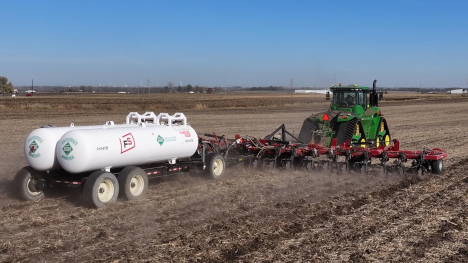
New federal plans target farmers' fuel and fertilizer costs through direct relief and investments in domestic fertilizer production.