After the meeting in Arkansas earlier this month, government officials and policy pundits have been trying to figure out what to do next.


After the meeting in Arkansas earlier this month, government officials and policy pundits have been trying to figure out what to do next.
Transcript
After the meeting in Arkansas earlier this month, government officials and policy pundits have been trying to figure out what to do next.
One of the biggest questions for row crop farmers is when will the Chinese step back into the U.S. market and buy a large portion of a predicted record large crop of soybeans. South America is still filling orders at a time when U.S. output should be on China’s books.
This week, the U.S. extended a line of credit to Argentina to help them with its struggling economy. At the same time, the Argentine government dropped its export taxes. In just two days, $7 billion worth of Argentinian beans were purchased by China, ignoring the U.S. stocks already for sale.
Iowa State University economist Chad Hart thinks Argentine government officials from different departments weren’t talking to each other while a deal was being hashed out with the U.S.
Chad Hart, Professor of Economics, Iowa State University: “…it makes sense for Argentina because they were searching for any way to help themselves out financially. But yeah, it just sort of comes as a sort of double whammy for us because what it did was, you know, here we are getting ready to provide support for them and then they make this move that definitely damages our ability to deal with the largest problem we've got arguably in trade.”
This week, President Trump met with the president of Argentina at the United Nations pledging support for their country and economy.
Hours later, Trump announced financial assistance for U.S. farmers.
President Donald J. Trump: “We're going to take some of that tariff money that we made. We're going to give it to our farmers who are saving for a little while, going to be hurt until it kicks in. The tariffs kick in to that benefit. So we're going to make sure that our farmers are in great shape.”
The Argentinians have since put the export taxes back in place after China bought the dip.
American Soybean Association President Caleb Ragland demanded action. In a statement, he said
“U.S. farmers cannot wait and hope any longer. ASA is calling on President Trump and his negotiating team to prioritize securing an immediate deal on soybeans with China. The farm economy is suffering while our competitors supplant the United States in the biggest soybean import market in the world.”
Hart believes all is not lost. Mexico has increased purchases of soybeans along with continued support for corn, and he sees some of the crop going to biofuels. While these and other ideas are not enough to offset lost marketshare, Hart thinks the Chinese will be back for U.S. soybeans in the next six months.
Chad Hart, Professor of Economics, Iowa State University: “That product will need to move and eventually we'll set the price to get it to move. So that means that we will discount our price to move the product along because we don't want it to spoil and capture no value from it. It's better to make a sale at $8 a bushel than it is to watch it spoiling at $0 a bushel for it.”
For Market to Market, I’m David Miller.
contact: [email protected]
Watch More

Global supply disruptions keep fertilizer markets volatile heading into 2027.
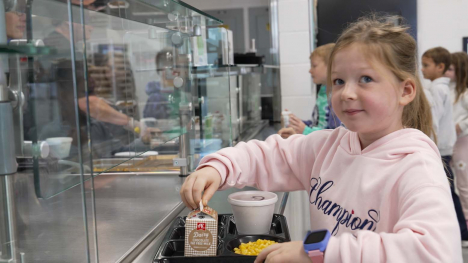
An Iowa school district connects local farms, food hubs and students through the lunch tray.
Naomi Blohm and Ted Seifried question USDA’s corn yield surprise and weigh China’s soybean demand.
Higher USDA yields pressure grain. Plus, opportunities/costs of putting local food on school trays.
How grain prices rally this winter w/Naomi Blohm & Ted Seifried on USDA, China demand & S. America.

Farmers rarely seek mental health help. Farm Dog offers care from people who know farm life.