Bull markets led by cash, packer leverage, fertilizer, shipping, basis, herd size and the status of the southern border are topics we hit on our Market Plus with Jeff French and Ross Baldwin as they discuss the economic and commodity markets in this web-only feature.


New crop soybeans rallied to multi-year highs, and analysts Jeff French and Ross Baldwin recommend locking in sales before a key upcoming US-China trade meeting. The concern is a "buy the rumor, sell the fact" scenario playing out once negotiations conclude. Also a heavy discussion on the livestock market with new world screw worm in this web-only feature.
Transcript
Paul Yeager: Welcome back to the table for the Friday, April 10th, 2026. Market Plus Jeff French. Ross Baldwin. Sorry Ross, I had to almost cut you off there.
Ross Baldwin: That's fine. It went by way too quick.
Yeager: We didn't even let we didn't even let Jeff get the last word in. Normally we respect him and we say, here. You should apologize to Jeff. We were talking about cash and futures in the livestock market. What's your opinion right now? Well, just define why one is screaming or not screaming over another right now.
Jeff French: On the cattle? I mean it is a great bull market. When cash leads us higher. I mean that is a great bull market. New contract highs on Friday. Charts look like they want to move higher. I mean I just I don't see anything that's stopping this. The Packers seems like they've lost all leverage here in the last couple of weeks. But yeah very strong clothes. What stops it is the consumer when they back off demand. And I just it has not happened right now.
Yeager: Will the fuel story change that maybe in how the consumer feels about a steak twice a week versus three times a week?
French: Definitely will. It definitely will. And that's why President Trump I mean he's just harp on it daily. I mean, he wants the Straits open because he knows with the midterms not too far along that it could have some serious consequences. So yeah, fuel prices, that trickles down to everything. Absolutely.
Yeager: And it's and it's the products that we have now. It's, we'll get to fertilizer in a minute. Hold on for just a minute. Ross. The one last thing mentioning the Packer JBS, the workers in Greeley agreed to go back. Still no deal, though. Did one side have to. Did the Packer need did JBS need those workers back more than the workers?
Baldwin: The fact that they went back, they ended the strike and went back to work without a new deal shows that the workers needed to go back. And JBS was the, I would say, the ones that were in control on this situation.
Yeager: And so does that mean anything at all with influence on the market of just that one plant?
Baldwin: So there had been, there had been rumors and reports, not even rumors. They, JBS, was running at that plant even while the strike was going on at a limited space. But they did have workers crossing the picket lines. They did have other workers that were just showing up every day, where they were able to continue to slaughter cattle at that plant. But for the industry, getting that plan, all the workers off strike and back at that plant and that plant running harder than what they were. It's a positive for the industry, and we've seen that play out over the last couple of weeks when the the packers got to see some positive margins here over the last month and they stepped out and they've slaughtered more cattle. And it came at a time when they hadn't bought very many cattle for the previous few weeks. And we've seen it play out over the last two weeks with what cash has done. Every time they they sit back because it feels like they get a little bit of leverage. They don't buy as many cattle. And generally it's because cash sells off. So we watch cash pull back to 235, stay there for three weeks, and the feedlots don't do much. And the Packers eventually have to step back out and start paying higher money to get cattle.
Yeager:: So it sounds like the market's working.
Baldwin: The market's working. It is right now. The supply and demand situation across live cattle and feeder cattle is alive and well alive and well. And it's working extremely good.
Yeager:: You agree?
French: Yeah it is. I mean it's talk about the choice/select relationship though. I mean you have select trading over choice. That doesn't happen very often. You know choices really come down here a little bit. But we are going into our best demand time of the year.
Baldwin: That's the one biggest positive right now for the beef industry. When we talk about high prices and the impact that gasoline and diesel could have on the consumer, because there's no question when fuel prices get this high, it it hits your pocket. Everybody across the country, it hits your disposable income. But the best thing we have going for us right now with the high beef prices is we have peak demand for the beef industry right around the corner.
Yeager:: Yep. All right. One of the questions we had is another big concern. And that is relationship to fertilizer. And that is Mitch. And Iowa is going to lead us off here this late in the game. Jeff, how much of an impact do you see that the elevated fertilizer prices are actually having on corn acres for this year.
Speaker: For this year? You know, I think it's minimal. I mean certainly it's going to affect some. But I you know, nine out of 10 guys had the fertilizer on last fall. In my opinion. So I think it's more of a ‘27 issue. And we got a lot of time. And a lot of things can happen before, you know, we're planting ‘27 corn. So I think it's minimal. But yeah, there's going to be probably some acres that switch. The biggest. The biggest factor though will be what happens here with the weather here in the next six weeks.
Yeager: So that's still the lead. And I wanted to ask you about the ‘27 story. What is the biggest influence on the ‘27 story? Is it strictly fertilizer? Is it economic concerns? Long term? Short term?
French: Well, they're not really focusing on ‘27. I mean it will be a story moving forward. But that's a long time from now. But yeah, certainly fertilizer will be a big issue. But then, you know, we're going into the 26 growing season. You know Mother Nature is going to control things here on out.
Yeager: You're good on the fertilizer story being maybe not as big of a deal for agriculture right now as it is maybe for next year.
Baldwin: I totally agree with Jeff. It's for this year. Like Jeff said, the majority of fertilizer’s all locked in and it's going to have a minimal impact. There could be a small impact for sure, but it's minimal.
Yeager:: I think the last time you were here, you were just about ready to go to the producer conference that your company provides. Could you imagine having the discussion in that room if you would have the situation right now? Because what was the big story that week when, when you were down there, do you. I know so much has happened since late January.
Baldwin: Back then, I mean, the cattle markets, I mean, it just it's been nonstop chaos, I would say. But back then, yeah, going into that conference, it was all about what was going on in the cattle markets. Obviously, that was the beginning of February. So we were coming off of the supply and demand report from January, which showed the huge production that we had this last year. But it really, I would say not not a lot's changed since then from the volatility and the chaos standpoint, but it's just a little bit of new chaos in the markets versus what it was back then.
Yeager: Speaking of chaos, let's talk about prying that crop out of the farmer's hand right now. Let's talk about the basis, Joel in Minnesota. What's going on with the basis? Is this trying to pry the grain out of the hands?
French: Well, I mean, if you look at it nationwide, I mean, it's awfully weak. And what that tells me is that the farmer's still holding a lot of old crop corn. I mean, that just flat out I look at it very simply, and that's what it's telling me.
Yeager: Does the basis. Let's go to the weather for a minute on the influence of that, because that becomes a shipping story. If the Missouri or whatever shuts is lower earlier and it impacts the Mississippi, and then all of a sudden we have a different option, we're not going to put it on a rail because that's going to cost. How does that factor into this at all?
French: It factors into it. But with these rains that are supposed to fall here over this weekend, that won't be a factor. Any low levels. But yeah, basis right now nationwide is weak, but that's what happens when you have a big rally and you had old crop go up to multi month highs. You had new crop at two and a half, three year highs. So that's what happens on big rallies, especially when there's you know, 2.1 billion bushel carryout. I mean we have plenty of corn.
Yeager: All right. We were supposed to ask Joel's question in the television program. My apologies to the boss for that one. Ross, are the cattle herd numbers going in the next 12 to 24 months increasing, decreasing or sideways.
Baldwin: Over the next 12 months? I would say stabilizing at best. And we're likely going to get tighter over the next 12 months, over the next 24 months. There's too many unknowns around that. And the biggest thing that could change it over the next 24 months, and I would say even into Q4, is obviously the US-Mexico border. Brooke Rollins two weeks ago came out and she was at a producer meeting down in the South, and she said there, there is some strong conversations going around on getting parts of the border, portions of the border reopened, and the port that she alluded to was the Douglas, Arizona port, which is the farthest port away from the closest confirmed case. And she said two weeks ago, producers won't have to wait very long. You should hear within the next 3 to 4 weeks around that plan, if that's going to happen, which should be within the next two weeks. So that would be the biggest thing, is what kind of a reopening can we see if we see it 24 months down the road, but for the remainder of 26, supplies are going to remain tight. I mean, we're just stabilization would be the best case scenario I would see for the industry.
Yeager: Speaking of the Screwworm, we haven't said those words, but last week we did kind of talk about it a little bit. Where's the heat on that right now?
Baldwin: The cases are completely ramping up. Obviously the weather is warmer, but the month of March saw cases dwarf what Jan and Feb was combined for cases within 400 miles of the US border. So confirmed cases, I mean they continue to ramp up. It's obviously a very hot topic because we're not seeing evidence where it's being pushed back southward. And from what we've seen over the last 12 months, until these new sterile fly production facilities get online, we're not going to see the Screwworm pushed back south. The Mexico facility is scheduled to come online early summer, which will be another 100 million sterile flies produced. The USDA currently produces 100 million in Panama, so that'll get it up to 200. But then the more air base sterile fly production facility is not scheduled to come online until 2027. So then ultimately, what they want to get the Moore Air Base, it's going to start as 100 million. They want to get it up to 300 million, which would put total production at 500 million sterile flies per week, which is what we were producing back in the 60s and 70s when it was eradicated from the US. So we're still a ways away for a full reopening. I struggle to see a full reopening until the USDA has evidence that it's being pushed back down south, and right now, containment seems to be the best case scenario.
Yeager: We're talking like a firefighter or something like you. He mentions containment, but that's absolutely what has to happen in that story. Mitch and I was going to close us out here for you, Jeff, how do you recommend producers approach marketing this year when it comes to new crop beans? We talked a little bit about that in the program.
French: New crop beans. I mean, again, we sold some on the rally. I mean, 1170, 1150 that's a good price that works. I would look to sell some here before this China meeting. I just I we've seen it before. Buy the rumor sell the fact. And again, I think in my opinion that 84.7 million acres. You know that planting intentions. I think that will be the low mark for buying acres. And you know, there's there's been a lot of build up in price because the expectation that China is going to buy the additional 8 million metric tons, you know, we're going to have to see if that comes to fruition because I the economics right now just don't point that they would buy the beans from us, but maybe they do. We'll just have to see. But big meeting next month coming up.
Yeager: But if we get that two weeks out, three weeks a week out and that changes again, does that change the dynamic? The dynamic dramatically.
French: I don't think so right now. I mean we've hit, you know, two and a half year highs on that new crop. You know this is a price that works for guys. I mean this is going to be a price that you should not let get away. In my opinion.
Yeager: Good advice. Jeff French, great to see you. Thank you so much. Ross Baldwin.
Baldwin: Thanks, Paul. Good to see you.
Yeager:: Good to have you both here. Thank you for watching, everyone. I want to let you know that next week we're going to talk about the dairy industry as they look to find balance as they navigate the tastes that have churned. And that has allowed for some fresh optimism. And we're going to talk with Ted Seifried about the commodity markets. Thank you so very much for joining us. Have a great week.
Trading in futures and options involves substantial risk. No warranty is given or implied by Iowa PBS or the analysts who appear on Market to Market. Past performance is not necessarily indicative of future results.
Watch More
Wednesday's USDA report traditionally is quiet on yield, but risk is in the air according to Kristi Van Ahn-Kjeseth.
Wheat stalls, corn struggles and cattle turns cautious, according to Kristi Van Ahn-Kjeseth in our Market Analysis segment.
The Farm Bill fails to make it out of the Senate Agriculture committee.
Iran casts a shadow over the jobs report.
A grocery store keeps a community from turning into a food desert
And commodity market analysis with Kristi Van Ahn-Kjeseth.
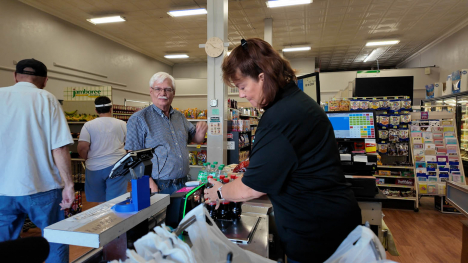
Facing closure, Gowrie's only grocery store was saved by 60 residents and $250,000.
A battle over SNAP kept the Senate Farm Bill from advancing before August recess.

Data centers are spurring debates all over the country especially in a time when grid stress is already happening. Communities have leverage to ask for money back in the developer’s fee along with part of the solar generation, battery usage and water accommodations according to ESP.earth founder Kerry Duggan.