The Iran conflict's impact on fertilizer markets, the economic maturity of ethanol, and why maritime shipping may be the most overlooked near-term demand opportunity for corn farmers right now. All of this is happening against a backdrop of tightening margins and generational transition on the farm. CoBank economist Jacqui Fatka is our guest this week.
Biofuels at a Crossroads With Policy and Politics Again at Play
Share


History may not repeat itself in agriculture, but it’s rhyming again. A glut of grain, softening demand and shifting policy are creating familiar pressure points for producers heading into planting season. Tensions with Iran are adding new uncertainty around fuel and fertilizer, while higher interest rates tighten the margin for error. CoBank farm supply and biofuels economist Jacqui Fatka breaks down why this moment echoes the past and where it diverges in critical ways. Plus, why the future of the Grain Belt may be tied to the sea, as biofuel policy evolves and ethanol continues to grow beyond government support.
Transcript
Announcer: Iowa Soybean Association is driven to deliver for Iowa's 40,000 soybean farmers. We're proud to provide objective agronomic research, a helping hand with soil and water stewardship, and timely industry news powered by the soybean checkoff. Learn more at iasoybeans.com.
Yeager: Time to talk about inputs, renewable fuels and economics. It's all coming together. It's just like it's another MToM podcast. I'm Paul Yeager. This is the Market to Market TV show, podcasts that we bring to you each and every Tuesday in audio and video form. Today we're going to be talking about those farmers that are in the fields, like the one behind me and those that are trying to navigate the waters of Iran in the Strait of Hormuz. And what the impact that has done for fertilizer. And then we're also going to talk about renewable fuels, the volume Sustainable Aviation Fuel, ethanol. Which one has a better outlook? Which one has some challenges, which ones performing better right now and could in the near future? Jacqui Fatka is going to join us today. She is the farm supply and biofuel economist. She's with CoBank and an Iowa native. So of course we have to start talking about the Hawkeye State. But from her position with CoBank we will look at it from an economics side. And we'll talk carrots and sticks like we always do. But those are the topics that we have. If you have any feedback for me, send it to me in an email, [email protected]. And if you have seen this intro, also send me an email and tell me where you listen to this podcast or if you're a YouTube viewer instead, just kind of curious, don't forget to sign up for that Market Insider newsletter. But now let's get to our conversation with Jacqui. All right, Cass County is always fun, but when I hear that you actually came to Market to Market and saw a show taping, you were young, but it clearly stuck with you, right? What's your Mark Pearson story?
Fatka: Yeah. So I just remember, I got to go. It was an organization called Speak Out for agricultural when I was in junior high, and I got to do some of the back editing, actually, I remember seeing a video of how a hot dog is created and some of the B-roll, and I think I might not have eaten hot dogs for a little bit because I was like, oh, that I didn't know.
Fatka: Yeah. So I just remember, I got to go. It was an organization called Speak Out for agricultural when I was in junior high, and I got to do some of the back editing, actually, I remember seeing a video of how a hot dog is created and some of the B-roll, and I think I might not have eaten hot dogs for a little bit because I was like, oh, that I didn't know. But, being able to I remember watching the video, a taping of it and then obviously it would come out later. And so I remember just watching it when it came out with my family and just thinking how amazing it was to see, oh, yeah, this is what we were doing earlier and putting all those pieces together. And I ended up going to Iowa State and and getting an ad journalism degree with a focus on agriculture. But really those early days, of that, that experience has always stuck with me. Market to market has always been so special to me. And and love the great work that you guys do, to help educate farmers. And, and when I go back home to my home farm on Sunday mornings, it's still on Market to Market. I love I love to catch it when I'm back in the state as well.
Yeager: Well, we just made a promo for the show. Thank you. Jacqui. That's all we need. That's, that's what we have. But I will. I'm going to tell you a little secret. The show hasn't really changed that much in our production since the since that era. We're very much still it's still the it's still the news and the analysis that hasn't changed because agriculture as we're going to get into has evolved right now. There's always a topic. I was just telling this story last week. We were doing some 50 year look backs, and I would pull episodes from 85, 90, 95 to, the issues were the same. What? Where are the exports? And they're problematic. There's an input issue, there's high interest. There's where are we going to sell our market dropped that into any year. And that's the case. Why is it always we have the same topics?
Fatka: You know, I think I've been talking a lot about there's a cyclical cycle to agriculture. Right. We have highs and lows. We know that most farmers have to balance those highs and lows. I grew up in the 90s. I was a child of the 80s and 90s. So when we raised hogs, you know, those hogs, there was a period of time where we were losing money every time we sold a hog. But that helped us balance our corn production and soybean production. Right. But also out of that, as I said, I was born in the 90s. What happened in 2000? We were desperately needing new demand, and that's when biofuels came about. And, we, you know, you can't blame, corn farmers for wanting to find a new demand opportunity when corn was $2. They couldn't feed that to their animals enough to balance the fact that corn was $2. And exports have always been so important. But creating that new demand and and were back to a kind of a new, similar situation, that $2 plateau of corn that we saw in those late 90s, early 2000 where we needed that offset to bring us to a new profit opportunity for rural America. We're back to that with $4 corn, right? $4 corn isn't doing it anymore. We need that new demand. So do we find that with exports? We find that with new demand for expanded biofuels use, new biofuels use, diversification is always been an important part, but we've shifted, right? Like I grew up, we had corn, soybeans, hogs and cow calf. We had all of those. And, and over the years, partly because of biofuels and just the consolidation and changing agriculture, you know, we do have fewer livestock farms that are combined with grain farms. It is that an opportunity to return to that is there are new ways, you know, over in Nebraska, right? We've got Costco farms that that brings chicken. A lot of those young farmers come back. You know, when my brother came back to the farm, the cow calf operation became his, we joked we got out of hogs when all the cheap labor went to college. So we didn't have hogs after too long. After, those, we had we had hoop barns. And so being able to the cheap labor was kind of important. Jokingly we say that, but obviously the hog market was struggling. But being able to have young families come back, the the livestock sometimes offers that opportunity. And the cyclical part. Right. The cyclical part of livestock is usually offsetting the, the, the, the grain sector. And we're seeing that now where there's some profit opportunities for cattle obviously. And and finding that opportunity to, to balance the highs and lows is really the important part. But I think we still have some structural things that I see changing in agriculture right now beyond just the cyclical, where we always see highs and lows. We're also seeing some things that are changing how those highs and lows operate, as well.
Yeager: Well, as long as you can have somewhat of a central spot and not as far out of a wave, right? That gives you some stability and planning. So what am I about to say? I think would be considered by your family a square thing? Do we really need biofuels right now for a farmer? Because there's such instability with the policy from administration to administration? There's a skeptical view by some who live in, in these rural states. And then there's just, well, maybe that's there's better use for the land. Those questions are real right now.
Fatka: You know, I often say, we again, 20 years of watching this, right? I still remember counting those votes for the office of the Renewable Fuel Standard in 2005, and again, when it updated in 2007. What you saw happen in rural America because of the RFS, you cannot deny we had more money coming into main streets. We had, you know, opportunities where again, new generations could come back to the farm because there was an opportunity to make a living on the farm. So I think biofuels is undeniably, a crucial part of especially corn and soybean producers. So much of the value of the corn and soy is now tied to biofuels. And yes, we do have some uncertainty because of the regulatory side. But let's just look at ethanol right. What the RF did is it created a mandate that that established really getting to 10% inclusion rate. And and you and I have been in this industry for a long time. We talked about that 10% blend well for ever. Right. We're over that 10% blend. Well. We don't have a problem with meeting that 10%. Now. You know, we're kind of fighting over giving E15 the opportunity to put E-15. But Iowa as an example, one of the highest states of E15 sales clearly listed, top of mind when you're driving through, seeing that super unleaded. Righ? That E15 was at a discount and that encourages adoption. Right. So that's not really regulatory certainty. That's capitalizing on the affordability part of that. Right. Most consumers going through Iowa are not necessarily Klink on the idea of, oh, this is E15. I'm going to support my local farmer. Now, farmers are, but most consumers aren't because it's an affordable option, and that's why they're buying it.
Yeager: Is it affordable because the government has helped it? Or is it that the market is mature enough to make it close? And, and help the consumer have a lower option?
Fatka: Yeah. So I think ethanol is definitely, the markets have matured and that's why it's able to be, feasible right now when you look in. And that's why, again, in 2005, 2007, ethanol had been around for about 20 years. Prior to that, there was a tax, at, the volume extra, the excise tax. Right. So there was a little bit of government support per gallon blended to help kind of get it off the ground to get it established and efficient. And now what we're seeing, because again, we're over that 10% wall. We had the mandate that helped push us to get adoption pretty fast, but then it helped improve efficiencies. And so really, I think if you took away all government support today for ethanol, you would still have, high usage. And, because of the affordability, because of the efficiencies, what's going on? Plants have been able to improve, their economics to make things, more efficient without having any government support. So I'd say ethanol, it doesn't really need much government support now. Now, the biodiesel and the renewable diesel, that's a little different. And then addition to you're looking at sustainable aviation fuel. So again what's the next layer. What's the next opportunity to build demand. And you have to create a lot of times I talk about a carrot and a stick. You have to have the stick and the carrot at the right level to get it to be efficient, to get it off the ground. And we don't like sticks here in the US. We like, carrots that help you. And that's what a tax credit is. Right. So the, the tax credit kind of helps pull things along. But the mandate the RF s really was that stick. And if we want to build those next layers of opportunities for biofuels, whether that's the biodiesel, renewable diesel side, sustainable aviation fuel, maybe maritime, fuel, those are going to need both those carrots and the sticks to be able to establish, efficiencies and to help drive costs down and make it more cost competitive, where the government uncertainty doesn't have as much of an impact.
Yeager: I'm not going to ask you the science of the future of ethanol and biodiesel, but from an economic standpoint, which one has longer legs and better, opportunity to help the American farmer long term?
Fatka: So, I mean, it's kind of two different, categories. So I mean, when you're looking at ethanol, I see the next layer is for ethanol. Future use would be sustainable aviation fuel, even though the so today renewable diesel plants can use the same feedstocks as south plants. So the half a process is really the only process it's making in large quantities. The fuel. But it's about 4 to 6 times more expensive to make safe than renewable diesel. So this is where the government incentives come in. When you stack all of the different low carbon fuel standards from California, when you tax 45 tax credits, state incentives on top of that, that's where you start to try to make it cost competitive. So today those feedstocks are constrained. Meanwhile, corn producers can produce lots of corn. And if we could get the alcohol to jet costs down for South, I think there's a lot of opportunities. I'm actually more bullish on maritime. We could use the actual ethanol that we are producing today without changing the the the composition of it. We can use the actual ethanol today on dual fuel ships. We could ship it out to ports. We're already exporting our ethanol. Right. So I am actually a little more bullish on near-term opportunity with maritime. If we were to get that, if we have the number for ethanol use in maritime ships right now, .00 1%, very, very small, if we got to just 5%, which, their total mark is 70 to 80 billion gallons, right? That's 1.5 billion bushels of new demand for corn, 1.5 billion bushels. Right. Think about what our carryout is. Right. And again, corn farmers are pushing yields continuing to grow. And in these tight margin environments that actually is just making more supplies. Right. So what's a farmer trying to do. They're trying to produce their way out of debt, which is just added to our supply. So we've got to have these new demand. And that's why I'm really bullish near-term on maritime SAF from alcohol to jet. We're years out from that. Just because we've done pre-commercial. We've got to be able to get those efficiencies down. We've Congress government has tweaked in a maybe not so competitive way to take away some of those incentives, be able to encourage staff. So there's just a few more headwinds, I feel on the alcohol to jet right now. Maritime gives me a little bit more hope, maybe in the near term, that we could start to build out that capacity.
Yeager: All right. I don't know how much you like hypotheticals, but they're always fun from my standpoint. What if when we talk about Iran, we did not have the renewable fuel sector in the United States that we had? Would we be seeing even larger font on these headlines about gas prices and oil challenges?
Fatka: Well, I think sometimes people forget, that the U.S. has actually ramped up their their own gasoline oil production. Right. So we have become less reliant on the Middle East. And some of that has just maybe you look back and the, the, the Persian Gulf War, the previous wars in that area, we recognized that we needed to to ramp up. So that's not easy. But the biofuels was also born out of that. Right. I still remember when President Bush mentioned ethanol in his state of the Union. Right. And that was because of national security. And so biofuels was really marketed as another way to diversify our, our, you know, our fuel supply. And I think today that is still true. I think, you know, what if, I think it is continuing to improve the dynamics of adoption, right. Again, it's it's cheaper when you look at e-15 in the state of Ohio. Oh. Here in Ohio, we've it's 50 to $0.60 cheaper. I'm sure it's very similar to there in Iowa. The affordability when you see these prices get so high, being able to have a biofuels, that is at a, a good price, that's affordable. Yeah. Great opportunity to to talk about that importance of diversification in our fuel supply. And I think that's, that's really important to be able to continue to carry that message of, you know, without that, yeah, we could see much, much higher impact, and world wide, I think that's also going to build biofuels adoption worldwide. The dynamics the, the the calculations work better from all things. Right. Even back what we were just saying about Saff, when the, when the cost of oil is cheap, you have less incentive to look for alternatives. But when you have higher prices, you need those alternatives. And again that's a little bit what we saw back in the early 2000s, coming out of of what happened and helped to fuel biofuels and growth. And I think we're again at that same opportunity today.
Yeager: This one could be political because the president has cut out, he's just struck down renewable wind projects and other, renewable side of things. Really, windmills is the one he doesn't like, but in, in and higher electricity costs that are coming, is that going to end up because of higher price here force more investment that the government didn't have to do. Is that same thing going to happen here in fuel with is this an unintended consequence that's coming out of what happened in Iran?
Fatka: I think we're going to probably see a lot of unintended consequences for quite a while, and we won't even be able to to fully know what, how to point the finger at at what caused what. I think bottom line, the duration of this Iran conflict is going to, to determine how much, how many unintended consequences we see, you know, and, and just the ripple effect that will continue. We know that we have an energy crisis in this country. Not I shouldn't say energy crisis. There are certain pockets because of all these data centers coming online. A lot of, pressure to provide more, more energy. And how we do that is also going to impact farms. Whether that's solar farms on farmland, whether that's windmills. But again, diversification for a farmer. Some of those are good opportunities to diversify their revenue stream. If they can figure out how to have those leases, whether that's solar or wind. But we have to make sure we have those right guardrails. And I think that's what a lot of the industry is trying to figure out and helping educate this administration onto, before we completely block out, a particular type of energy source, making sure that we, understand all the things that that rely on that and the opportunity is, you know, balancing, balancing both the good and the bad of of whatever those, trade offs might be for a particular energy source, whether those biofuels, wind, solar or all of those can all play an important part.
Yeager: Last week on the show, I asked, Chris Robinson. I said, what's the percentage of farmers that have already pre-purchased their fertilizer? How much is this spike impacting them? Who is it impacting? I guess I'm not asking for that percentage, because now I'm starting to see that show up in other feeds of. Oh, yeah, people are thinking about that. So is this conflict in Iran going to change the sourcing of, let's just say, your family or mine that's searching for fertilizer, working in large or small co-ops. Is this one of those intended or unintended consequences that's coming?
Fatka: You know, so I saw we do have some lower imports from the Gulf and this is a world, you know, we don't have as much exposure with potash and ammonia, and nitrate, you know, those those we potash. Most of it's coming from Canada. So we're, you know, but some of the map and down, you know, those are a little bit more exposed to some of the issues. So few things within this whole situation. Everybody's comparing this to Ukraine war, right? That was the last time we really saw a huge run up. Changes the the differences, though between the Ukraine war in this situation. That was a reshuffling of the fertilizer, right? We weren't shutting down production. We were just there was Russia was being shut out of certain markets of that fertilizer. So you saw fertilizer reshuffling what we're seeing out of this situation. It's not reshuffling. It's shutting down. And again, duration. How long does it shut down? We need that natural gas to also be able to produce some of these products. The natural gas facilities have been, bombed. And if that last 3 to 5 years, this is not just something that's going to impact right now. So that's one thing that we're looking at the spring. Right? Can we get through the spring? I think we're going to get through the spring. We might see a little bit lower application, but we had a good fall. There's still some stuff that's, you know, in the hands of where it needs to be. It's always hand-to-mouth in some ways, right, of getting it where it needs to go in the spring and weather impacts that. Right. We have a huge two weeks of beautiful weather. We probably would have a hard time getting fertilizer in even if we didn't have a war in Iran. Right. So, you know, that's always a concern. What I'm more concerned about is what happens this summer if this is still going on. You know, a lot of times the 2027 crop year fertilizer is locked in late summer, early fall. And if we still have $4 corn for 50 corn and we have $1,000 gap urea, we're going to we're going to have a lot harder time justifying those cost. And that's, you know, do we see more biologicals? Do we see a lot of shift in reducing, applications? Is there trials that are going on this year with some of those things? So as ag retailers are working for the 2027 crop year, that they have some data to be able to take to their growers to say, hey, we know that this is a higher cost and this might be harder for you to manage. We've been doing some trials on this. We've been looking at this, because again, there's a lot of stuff, opportunities that maybe this this would shift some gears again, diversifying away from maybe some of those, imports in on the fertilizer components. Can we find new application methods. Is there, new products that can help with the nitrogen fertilization? Those are all the questions that I'm going through in my head of not what this means for this season. What does this mean for next season? Do we see a change in how we we operate again, because commodity prices are not doing what they did in 2022. Back to that Ukraine situation, right? It was a reshuffling of the fertilizer. The commodity were impacted because they do have commodity. They have grain production that was impacted by that war. That's not the same situation now. So we're not seeing $8 corn like we did back then. So those are the things that I'm watching and keeping my eye on as we look forward.
Yeager: I don't know which of the 52 things you just said for me to follow up on is the most important, but let's put all 52 things right there that you just said back into balance sheets, or understanding what a farmer in Atlantic Iowa is going to decide of what am I going to grow next year? Can I afford to do it? Do I need to find an alternative? Those are real things that are going to come real quick. What's the biggest headline then that they're going to have to navigate? And when does the lender start to pull back on possibly not writing, adding a zero or the market doesn't go up another $0.30? Or when do we start seeing it? I mean, we already are, but when do we see it more? And it becomes much more real and long term?
Fatka: I think from a farmer level executing, knowing your cost of production, I think farmers are getting better about that. But right now that is paramount because every farm is different, right? You can't just say, well, it cost me X amount of money for all my operations. Your farm, my farm, every farm is different, right? Every almost any chunk.
Yeager: We talk about that often and we talk about backyard-itis and what's your debt level across the street? Your neighbor is not necessarily your competitor. It's the one in Ohio. In Iowa. Yes?
Fatka: Yep. So each farmer knowing their cost of production for each farm and really maybe even within that farm. Right. And I'm not I'm talking about plots. Right. When I say farm, I'm not talking about their entire farm operation. I'm talking about, you know, the back 40 over here, the new farm. We all have our different names. I, I love, I know all the different names, the farm, you know, all the all the different. We called one for a new farm for about 20 years. And then there was a couple other new farm. So we have to stop calling it the new farm. But knowing your cost of production, and then being able to execute on your green marketing plan. Right? So that's a really important part. But the ad hoc payments that we have from Washington, DC are not making anyone whole. You know, they are really not making any one hole. But that's been an important component going into two lenders because you asked about the lenders. The problem is, is I asked 12 questions. I know it's all right.
Fatka: I'm good with that. I usually ask no questions in my one question to you. I used to be a journalist, so I'm, I'm well, well adapt to that. But the timing of those payments has been troubling in some ways. Right. Like last year and during fall when a lot of producers probably should have been selling maybe more soybeans off the combine, they were seeing reports of, well, maybe we have a huge trade deal with China now. We now know that we didn't really get meaningful new purchases with that, but it it the sentiment created the different buying and selling behavior from an input standpoint for producers as well as what they're selling off of the combine. And, you know, back to fertilizer. Some of the higher costs. We were going into the Syrian conflict where farmers were more behind, a little bit more reluctant to pull the trigger on buying inputs this year because they thought maybe would come down. Well, that that was a costly decision this year. So as we head into next year, because that's the question, right? How do we take what we've seen and make the right decisions going forward? So I say no, your cost of production execute on your grain marketing plans. We're still probably going to get little rallies in the market making the right decisions on that. You know, adjusting your cost of production. Where do you see I saw a lot of, equipment is running 2 to 3 times the number of hours that they did before. A lot of farmers. That's an easy way for them to run that equipment longer and make those. But where else? Maybe walking away from, a piece of land that you were renting because the rent's too high. You can't pencil that out. Walking away from buying that piece of land. What kind of working capital? You know, most of those government payments, right? They're not going to buy new equipment. They're paying down debt or adding to strained working capital. So the timing of a lot of this is, it is really going to see where how far we go in that cycle. Right. Do we go really far down or really far up? From a debt standpoint, working capital, those are there. There was a lot of money that was made a couple of years ago, too. And so I think that's something to write here. If you're just looking here in the middle. Yeah, it feels bad. But we made some pretty good money a couple of years ago.
Yeager: Is there a certain age, a farmer or position, a farmer that can withstand more?
Fatka: I mean, definitely those farmers who have paid off a lot of their land, you know, land values continue to climb. And so again, if you have and interest rates on that land is also higher. Now, you look back in 2020, what were interest rates. Practically nothing. And we're at, you know, seven eight 9% interest rates depending on what you're doing. And now that's not the 1,820% that we saw in the 80s. And so, you know, a lot of times when I'm presenting and showing, you know, our debt to asset ratio is pretty good. And really those farmers who own a lot of their land have paid off. A lot of that land can also add more land by spreading out some of that risk, too. You know, I always joke my, my dad is 75 and I'm like, well, because he'll call him. I bought another farm, dad, now you have to farm for another ten years. You can't. But and and the other thing too, you at the end of the year, I'm like, well, did you make money on that farm? And he's like, well, not yet, but that's because it's, you know, he he adds that into the other farms. He's balancing out what he owns with what he just purchased. And in those more established farmers who have the ability to do that, are better positioned. But again, how that transitions to the next generation, it's much harder for my brother to be able to, to buy additional land without counting some of that equity that, that my dad's already been able to, to establish within the land base. So I think but on the flip side, land is almost 40% more than cash rent. So if you get a cash rent, that's the right price. Maybe it's better to cash rent right now, or find that really great investor that wants you to farm their land, and you don't have to take on the risk of that working capital as well.
Yeager: But the renter, the one who's paying the rent, I've heard has been they are more in a challenging spot, than some of the other ones. So. But yeah, I don't know if that's changed.
Fatka: No, I think, I mean, I think, my dad did get one of his landlords to negotiate a rate $10 lower. And I was like, well, I was in a room of farmers not too long ago, and none of them said that they were that lucky. I think it's hard for landlords to be willing to, to reduce down, their cash rent. And when farmland values are so inflated. And some of that too is probably because of there's a lag and in that too. But government payments are probably adding to some of that land value inflation as well. And and that's we keep thinking and maybe we're going to get to a leveling point in farmland values like we saw in 2013 through 2015, you know, was pretty level. But again we keep you know, surprised went up nationwide last year a couple percent again. And and that's that's a big thing to you on on how that transitions do we have more farmers that say, I'm I'm stepping out. I can't keep losing money as a farm. So I'm going to sell my farmland and get some money for that. That could be an interesting, where we see things in the next couple of years of a lot of those aging farmers, decide to get out, because because of the current economic situation on the farm level.
Yeager: But the aging farmer is likely the one that's still in a position that can withstand another year. And another year. I want to I wanted to lop off 40 years off your dad's age and say, what's the 34 year old farmer able to withstand? It's not the same thing. Which gets me to your employer. On the lending side, if we could finish up with this. How? At what point? That's the question. At what point does the lender look at this a little a little more skeptically and not as much writing loans like they did?
Fatka: You know, Farm Credit System was born out of the 80s of strength. And then, my grandfather, who's 100 and still lives at the home farm that he was born on, just turned 100 and February. Was helped by the Farm Credit Administration in the 80s when he about lost his farm. And I think a lot of those older farmers know that, too. They they are being wise in their money. So from a lending standpoint, farm credit is still going to be here to lend money, but there is going to be additional capital requirements to do that. And, being able to have a good understanding of back to production costs. Right. Executing on your marketing plan, knowing, knowing the variables and being able to to communicate that to your lender. I think the farm credit system is going to continue to do that. We have some different interesting financial other alternative financing to that. Farmers are starting to tap into whether that's equipment. Financing or ag retailers that are providing some financing. And it might be a little bit more variable in how you're getting your operating loan. It might not be all from one spot. And, and that's a question to would you, do we have to, big, big part of today's farmers, the makeup of that farmer is also a lot of off farm income. And being able to balance your payments at the farm because they might need to take an off farm job. Health care costs are really high. A lot of our farm income helps pay for that, but also just having a steady income stream when the farm may not be able to provide that. I see that as a again, a structural change within the industry of of more off farm income coming in to balance that, that, that farming operation, especially for those smaller mid-size operations. We're seeing that as more of a primary indicator of where their income is actually coming. Is off farm.
Yeager: Something that your brother and your son have both picked up on. I mean, they have the off farm income, too, even if it's a fifth generation farm. So, I mean, that is a huge difference from the 80s. That's, that is was seen a little more of the oh my gosh, I can't believe they had to taken off. No, that's how that's the reality of it today.
Yeager: Yep.
Fatka: Yep. Definitely a reality. And in a changing part of agriculture but not necessarily in a in a negative way. But as I my son is 19 going back to the farm, he's working on the local co-op. That was clear when he came, when he came with the understanding that he would like to someday come back full time to the farm. You have to have some kind of income stream that you're bringing to the operation that's not fully being pulled from the operation. And I think a lot of, transition discussions and new generations is are coming back. That is becoming a growing part of what they're seeing as well.
Yeager: For some reason, I think we'll have to talk again, because there's going to be changes in everything we just covered. So I look forward to that next time. Jacqui.
Fatka: Absolutely. It was a delight to talk with you today, Paul. Thank you so much.
Yeager: The production team at Market to Market is led by Sean Ingrassia. His crew is Reid Denker, Kevin Rivers, Neil Kyer, Julie Knutson and David Feingold. The executive producer of Market to Market is David Miller. I'm Paul Yeager. We'll see you next time.
Watch More
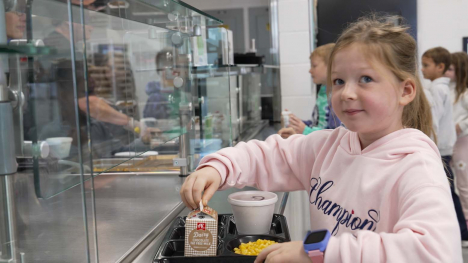
An Iowa school district connects local farms, food hubs and students through the lunch tray.
Naomi Blohm and Ted Seifried question USDA’s corn yield surprise and weigh China’s soybean demand.
Higher USDA yields pressure grain. Plus, opportunities/costs of putting local food on school trays.
How grain prices rally this winter w/Naomi Blohm & Ted Seifried on USDA, China demand & S. America.
Farmers rarely seek mental health help. Farm Dog offers care from people who know farm life.
Heavy rain leaves western Corn Belt fields soaked, threatening harvest delays and crop quality.