FBN's Charles Baron discusses how AI is transforming farm decision-making in 2026, from an AI advisor named for Norman Borlaug to price transparency that has saved farmers more than $500 million. Plus: tariffs, input costs, and why some farmers are still leaving serious money on the table.
Norm Takes to the Field in Helping Growers Save Money
Share


Farmers have long pondered big decisions from the tractor cab and 2026 has provided much to mull over with fertilizer and energy prices leading the way dramatically higher. Charles Baron with Farmers Business Network is back to highlight the ways his company is aiding in decisions with the help of technology as efficiency leads the way. AI may be driving the tractor in a literal and figurative way right now with the help of Norm. We’ll explain the reference that changed agriculture decades ago and today.
Transcript
There's a new way to stay connected and know what's happening with Market to Market. When you subscribe to Market Insider, one email and a lot of information awaits you, go to Markettomarket.org and subscribe to Market Insider.
Yeager: Allow me to consult my pen and paper for a conversation about technology. AI on the farm with a repeat guest, Charles Baron of the Farmers Business Network. He and I have discussed technology before, but we're going to see what's happening here in 2026. They recently had their farmer to farmer conference — we'll find out what is on the mind of the farmers they've been doing business with. How is technology changing? We're going to talk chemicals, fertilizers, seed planting, farmer decision-making, and marketing — how those things have evolved since the ten years they've been operational. And we're going to talk about Norm, because that's really what it is. We'll find out who Norm is named after — it's not just a generic name, it has very specific meaning. That is what we're going to talk about today on the MToM podcast. I'm Paul Yeager. This is a production of the Market to Market TV show from Iowa PBS. Each and every Tuesday, new episodes come out. You can watch them in video or audio, and we always want to hear from you. If you have an idea on a subject or want to weigh in on the topic, send me a note: [email protected]. Now let's get to Charles on this installment of the MToM podcast.
Farmers love a good conference, Charles. You had one recently. The farmer to farmer is one of your big events. What was the theme you wanted to make sure was taken home by people this year?
Charles Baron: We had a great event in Omaha — brought the event back after a couple of years off. The theme was "Farming for Your Life." It's been a tough couple of years in the market with a lot of volatility, and just making sure producers are set up for the year ahead. We know there's lots of anxiety on the farm — that's not a news story this year — but trying to make sure producers have the best view of what they could be expecting in the market over the next 12 months. Commodities markets have been lower than producers would like. There are some bright spots with cattle — a lot of our ranchers are doing much better and have much stronger local markets right now. But fundamentally, getting folks ready for the year.
Yeager: You can walk out of that conference and the information is already outdated. We can record a show on a Friday afternoon and before we even publish it, things have changed. How does one navigate so much rapid change — let's use the word volatility?
Baron: Everyone's got to have their own system for monitoring and getting on top of the market right now. With the inputs world, that is getting heavily driven by what's happening macroeconomically and by tariff policy. In the last few months, even the day we walked out of the conference, the Iran war kicked off. You suddenly saw fertilizer spike pretty massively. Manufacturing sectors in China and India — which are major raw producers for the chemical market — started having energy crunches, supply shortages, and manufacturing delays. We saw technical prices go up almost 13% within that month just on the base ingredients going into many popular chemicals. And then you saw fertilizer spike. The world's changing very quickly. I think producers try to have the best picture possible of what to expect and look at what tools they have to hedge and manage outputs and manage costs. If you have a moment when you can lock in a nice spread, we always try to advise farmers when they should be taking action. That's remained a pretty prudent strategy.
Yeager: There's a number floating around that somewhere in the 80 to 85% range of farmers had their chemical and fertilizer needs pre-purchased — not necessarily meaning they took delivery. So why is there still a story about volatility for that remaining 15 to 20%?
Baron: That's primarily on the fertilizer side, where you saw spot prices really spike — primarily in products like urea, a lot of nitrogen prices. In chemical, the products farmers are going to be using this season are mostly here already — they've arrived to the US, they're in warehouses if not already on the farm. So the supply situation is a little more stable from that standpoint. But if you're a retailer going back into the market to purchase if you don't have enough supply for the year, those prices are now going to be materially higher — 10, 15, 20% higher than if you were purchasing four or five months ago. What we saw this year was, because of pressures on commodity prices and cash flow on the farm, a lot of farmers buying as they need it and buying the smallest amount needed, saying, "I don't know what my acreage mix is going to be, so I'm going to delay my purchases as much as possible." But when you do that, you open yourself up to more exposure on price shocks. There's a natural window right before planting where many farmers say, "Okay, time to make the decision — got to get everything I need." And there's a big rush to buying. But once you get to end season and fungicides or insecticides that are more purchased on demand, you could continue to see those prices move around for growers.
Yeager: I didn't ask you this ahead of time, so forgive me if this is out of left field — but in relationship to chemicals, there's also a story about state houses and Congress, regulations of certain chemicals that may or may not remain available. Anything you can track or advise farmers on?
Baron: Right now it's a fairly stable market in that sense. We dealt with this two years ago with dicamba, where it suddenly came off the market two months before planting and there was a dash to scramble for substitutes. There isn't a situation like that this year. Folks have the products they're going to be using, know what they're going to be using, and can have a good degree of certainty around that.
Yeager: Fair enough. That is a thing that's changing — I'll get a press release saying such-and-such legislature is going to strike this down, and that puts a shiver of fear in some farmers. Let's go back to the farmer conference. When producers were navigating all these things, what were some of the other takeaways when it was their turn to share?
Baron: There's obviously a lot of anxiety on the farm right now. Cash flow is tight, credit has been tight, input costs have been high. Producers are really focused on where they can control their operation — what do they actually have control of. A lot of markets in ag are just fundamentally out of their control. The cost of seed moves independently of macroeconomics, trade, and the price of corn. That's probably one of the bigger frustrations — it doesn't matter what the price of corn is, the price of seed keeps going up. Fertilizer, farmers feel very much like price takers, very exposed to energy markets and global flows. Chemical, you have a little more control — you have branded-to-generic substitution you can look at. We've found very heavy savings for growers when they do that. The average branded-to-generic savings, when you look at the branded spot price versus the generic spot price, has been upwards of — over the last 15 years, relative to the price of grain, a grower may feel it's taking a healthy share of their budget, but in absolute terms we're at a very low, very affordable level. Then you get to crop switching — how am I going to adjust my plan based on the market I'm facing? We saw a lot of delays in making those decisions this year. Normally producers might try to line up 80% of their acres and leave 20% in play for a last-minute decision. We saw a lot of delays around that, borne out both by our planting estimate we released just last week and by what the USDA showed. We anticipate a pullback in corn from last year, but not as far as the USDA estimates. Our corn estimate was 95.5 million acres, just a little higher than what USDA came out at. And a healthy switch to beans, but again not quite as far as what the USDA estimated.
Yeager: Do you ask reasons why?
Baron: We don't ask specifically why, but with fertilizer costs being what they are, that's going to drive even more switching to beans.
Yeager: Cotton has had this rally in late March, early April that's been interesting — it's too late to be buying acres. But that decision, how many acres are really up for grabs to change after a certain date? There's just not a lot. You can leave a field neutral to give you an option, but then that leaves you exposed going into the open fertilizer market to cover whatever your change has been. A farmer can't really win in some of these situations.
Baron: You obviously have fixed costs you've got to cover. It's a difficult position. When you're looking at a crop that may be operating below the cost of production, that's a tough situation. You want to look at where you're going to minimize your overall outlay and what purchases to delay. You've seen pullbacks in equipment and machinery purchases pretty heavily. But there are some bright spots — the tariff regime has stabilized a bit. Six months ago we were dealing with wild uncertainty; the proposed tariff was upwards of 125% on foreign imports, and you would see a massive reduction in foreign purchasing. That's stabilized a bit. The market can adapt to a level, but the certainty and predictability of that level is really the most important thing so folks can adequately plan and the supply chain can adjust. Sitting there with a tariff that could be 10%, 25%, or 125% — that was the situation four or five months ago. That's stabilized a bit, so the predictability of what's going to be in the market from an input standpoint is higher, but costs are up.
Yeager: This is probably an oversimplified transition, but how has AI or technology helped take all this information and allow someone who's growing food and fiber to make more sense of things right now — has it become more predictable in trying to make decisions?
Baron: What AI is doing is putting an ability to synthesize information at a level and speed that's never happened before, in everybody's hands. If you want an immediate, accurate, up-to-date snapshot on the market, you can hit an AI system for that, and it's going to be quite good. We've been building an AI grain marketing advisor that helps growers with local basis prices and updates. Your ability to access information has never been better. That doesn't change the reality of the market, but a producer fundamentally has more tools at their disposal. The really hard questions — where AI gets incredibly valuable for a farm — is really bringing the whole picture together. That's something we've been very focused on. When we launched our AI advisor Norm, you'd have farms coming in saying, "I'm a cotton, rice, soybean farmer in Arkansas — give me an optimal rotation, predict market prices, and design me a business plan and P&L for the next five years." That's an incredibly hard problem if you don't have all the pieces together — the soil, the markets, the performance, the genetics, the machinery costs and hours. But that's what a farmer has been trying to do. When a grower is building out a business plan for their farm to take to the bank, they're doing that in a spreadsheet, in their head. Now you have systems built over the last 25 years with precision ag and market information — FBN has built many of those systems for our growers — and now you have the ability to start putting that whole picture together for a farm. That's where the unlock gets remarkable. If something could exist in a spreadsheet, it can be replicated in AI virtually instantly, and most farms with minimal technical ability will be able to do that. We're working to create that exact kind of experience inside the FBN platform. If you're running your farm on spreadsheets today, you have an incredible new set of tools available.
Yeager: Did you say it's called Norm?
Baron: Yes — Norm, for Norman Borlaug.
Yeager: Oh, even better! I thought it was just a great farm name. Okay, let's talk about Norm for a minute. I've had the most success using AI tools in things I didn't expect, but it still hinges on the data and the accuracy of that data. So how do you beef it up — can I put in the soil score, county data — to get accurate decisions?
Baron: In FBN, all that information is already in the FBN system. We have a platform that analyzes every field in the country. We have a platform called FBN Seed Finder that can look at every seed in the market and how it's performing. You can drop your fields in and see all your soil types and compositions, drop in your fertility files, as-planted files, and harvest files. The system doesn't yet put all those pieces together, but that's what we're working on. In FBN today, you can identify the highest-performing seed for every one of your soils and every one of your fields. We've seen the average yield gain when farmers use FBN Seed Finder to make planting decisions is upwards of 10% — quite substantial. Now imagine being able to do that tied to your farm's P&L or a real-time view on the markets. You can say: what's the price of the seed, what's its expected yield, what's the optimal planting population, and let's design a full farm program, risk-adjusted based on the real-time market outlook. That's the kind of decision-making we're going to be able to help a grower execute. Then you connect what's going on on the farm with markets, weather, and machinery, and you'll be able to help a grower adapt in real time to exactly what's taking place around them.
Yeager: Because you're mentioning a lot of the baseline stuff, but there are variables that change — wheat dropped yesterday because of anticipated rain in three days. That's all real information you're working to update to best make a case. Give me a good success story — how someone saved or earned an extra 20 or 30% — without giving away exactly who it is.
Baron: We did some analysis having just passed our ten-year mark in the market. We found that the average savings for folks when they purchase from FBN was upwards of 13%, and that's totaled to over $183 million of savings just on crop protection. On lending, we found about $187 million of savings through lower rates. And FBN overall has paid out nearly $100 million in premiums to growers through our grain platform. Across our ten-year impact analysis, we estimate we've brought north of $500 million back to the bottom lines of our members who have actively purchased — not just all farms in the market, because when FBN publishes transparent prices, overall prices come down in the market too. Most commonly, the savings come because farmers aren't being brought those offers from their retail partner. If they're working with a limited set of historical suppliers, that partner isn't always leading with the lowest price available. People just want to be treated fairly — give me the price, make sure it's good, don't make me haggle to find out what the lowest price actually is. FBN does that fundamentally differently. There's a price in the market — typically our best price — with volume discounts on top of that. That gives the producer more certainty when they go to purchase.
Yeager: But Charles, I have a great relationship with my salesperson — I got a hat, I have Pēru knives. How could I turn that away?
Baron: One of the great stories when we started — we went through a group of growers who were all working with the same agronomic group and planting two different brands of seed. We found the average combined yield gain and cost savings from switching from variety A to variety B was going to be north of $10 an acre. These were big farms — 5,000 acres plus up in North Dakota. We said, "This is pretty obvious — you're all working with the same consultants, planting the same products. Why aren't you more heavy on this brand?" And someone raised their hand and said, "Well, I got an elk hunting trip." We said, "How many of you got the elk hunting trip?" And about half the hands went up. Producers make decisions for a lot of reasons — they may have relationships, be given gifts and trips, and they may like that. That's fine. But they may be overpaying pretty massively. In that case, 5,000 acres at another $10 an acre is $50,000 — you could do a lot of guided hunts for that. You have to understand what you're paying for and where it's coming from. Farmers are paying for all of it — the expensive marketing, the events, the advertisements. Having more transparency in the market makes it more competitive and helps farmers get to the bottom-dollar cost.
Yeager: The common thing in business is competition makes us better, and the consumer is supposed to win when there's competition.
Baron: That's one of the shocking things in agriculture — you have components that are still largely not open markets. Seed and chemical is a $26 billion industry in North America, and very few prices outside of FBN are posted online. The seed industry — almost none. That's by design. Seed companies are typically not allowed to market online or distribute outside of regions. In chemical, this has been a perennial problem — you have to go in and haggle for the deal. FBN created a system of near-national pricing on these inputs that creates a benchmark everyone has to shoot at. We've seen over the years that price variances in the market have come down just simply by FBN existing. When we started doing our price transparency analysis on chemical seven or eight years ago, you would see a five- to seven-times spread on some products — literally a farmer could be paying five to seven times what another farmer is paying for a product like Aim. Even on a commodity product like glyphosate, you could see a two- to three-times difference. We've seen that spread narrow every year. The industry has absolutely sharpened its pencil and there's more stable and consistent pricing in the market. But when we did the analysis this year, the top swing was about 183% — a farmer paying basically 2.8 times what another farm is paying. It's narrowed, the market's more competitive, but there's still lots of money on the table for growers in these negotiations.
Yeager: If you're listening to or watching a podcast, you've adopted some form of technology — that's a fair assumption. But not every farmer has been willing to embrace it. Let it be known, there are plenty of farmers who have embraced AI and some who are being left behind by not embracing it — not necessarily FBN specifically, but if your neighbor or competitor is doing this and you're not, you could get left behind. Is that accurate?
Baron: I think so. That was the case with the internet, with precision ag, and AI is no different. At our farmer to farmer AI training sessions, we had farms coming out building their own software — some very technical farms. And the cost of doing that and the ability to do that is basically going to almost zero. If you wanted to build an app for your farm and had a little technical ability, you can do it with AI. If you can run a spreadsheet, you can build a very basic AI dashboard that would be quite capable for a farm. Now, that doesn't mean it connects into a bigger system with live data — it doesn't do what FBN does — but it's remarkable. And you don't have to be at that level to get the advantages of AI. The models and tools have gotten exponentially better since ChatGPT came out about three years ago. What started with was a curiosity of a chatbot that would give wishy-washy answers, hallucinate, and make things up — that's largely changed now. If you use Grok, Claude, Gemini, or one of these systems, they are remarkably good at removing hallucinations and can give you very pointed analysis and advice. It is absolutely in everybody's interest to be experimenting with them and figuring out how to use these tools on the farm. We did examples with growers where we took multiple 100-page soil test reports, dropped them into models, and built out fertility programs. That's now right at your fingertips.
Yeager: Goldman Sachs and Morgan Stanley have been making comments in the wake of doomsday predictions about AI changing the job market. There's skepticism on some of these tools. Are you finding pushback when you talk about the benefits? Farmers are a good, skeptical bunch — that's what makes them so fun.
Baron: There's always skepticism — "Should I really be using this? How can I use it?" The confusing thing when you talk about AI is whether it's just a chatbot or whether you have to be very technical. AI is an underlying set of technologies and models that will impact virtually everything in agriculture — not just what you interact with, but computer vision and autonomous tractors, quantitative genomics and seed breeding, hyperpowered marketing and market intelligence and hedging strategies. It touches all of those things. You don't have to be a super user to get advantages of it. You can just ask more specific questions of a model and get better answers than you would from Google. You can ask it to do harder research. It's remarkably good at filling out forms — something we're looking at as well. And when you look at the general public, there's tons of anxiety about what AI means for the job market, what it means for employment. We see it as everybody being able to be much better at their job, do more, do it faster, have more quality control, and automate certain very human-intensive components — without the human necessarily going away. Every company on Earth wants to do more, has a huge backlog of projects, wants to go faster, do more with less. You see the pace of innovation and capabilities accelerate. Some things can be automated, but there are also great examples of companies where that doesn't mean jobs are eliminated. Ikea reduced a lot of their frontline customer support calls with AI, then retrained those people to be interior designers and decorators.
Yeager: AI has come to the tractor cab. We don't need the driver as much — it's more of an operator checking screens. It's already changed farming and reduced job responsibilities; we've had auto steer for years now. So it's already come to the farm not just in the spreadsheet but in the job itself. Now, if you can find an AI that can pick up rocks in northeast Iowa like I did as a kid, then we'd have a real winner, Charles.
Baron: There is actually a company doing that now. Devin Lammers — the CEO is a former FBN guy — they use computer vision to do rock mapping and then autonomous robots to go pick up the rocks.
Yeager: I was born way too late. That's the way it goes, Charles. Always good to catch up on technology and what's happening at FBN. Good to see you, thank you.
Baron: Great to see you. Thanks a lot.
Yeager: We are produced at Iowa PBS. Our production supervisor is Sean Ingrassia. His crew is Reid Denker, Kevin Rivers, Julie Knutson, Neil Kyer, and David Feingold. The executive producer of Market to Market is David Miller. I'm Paul Yeager — we'll see you next time.
Watch More
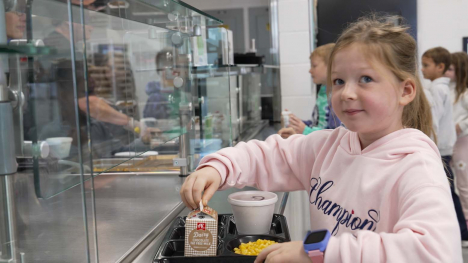
An Iowa school district connects local farms, food hubs and students through the lunch tray.
Naomi Blohm and Ted Seifried question USDA’s corn yield surprise and weigh China’s soybean demand.
Higher USDA yields pressure grain. Plus, opportunities/costs of putting local food on school trays.
How grain prices rally this winter w/Naomi Blohm & Ted Seifried on USDA, China demand & S. America.
Farmers rarely seek mental health help. Farm Dog offers care from people who know farm life.
Sue Martin examines grain stocks, harvest risks, soybean demand, energy costs and livestock markets.