Data paints farmers further behind with the price spikes in fertilizer and fuel. Oversight comes to the committee room for the CFTC. The dairy industry finds balance as new tastes churn fresh optimism. And, commodity market analysis with Ted Seifried.


On this edition of Market to Market ...
Data paints farmers further behind with the price spikes in fertilizer and fuel. Oversight comes to the committee room for the CFTC. The dairy industry finds balance as new tastes churn fresh optimism. And, commodity market analysis with Ted Seifried.
Transcript
[Paul Yeager] Coming up on Market to Market data paints farmers further behind with the price spikes in fertilizer and fuel oversight comes to the committee room for the CFTC. The dairy industry finds balance as new tastes churn. Fresh optimism and commodity market analysis with Ted Seifried, next.
[Announcer] I wouldn't be here without my customers.
Yeah, I'd like to thank the customers. They're very dear to our hearts.
It's about the people that you're working with and the relationships that you have.
Thank you. Thank you. Thank you.
Thank you from the bottom of my heart.
[MUSIC]
[Announcer] Tomorrow. For over 100 years, we've worked to help our customers be ready for tomorrow. Trust in tomorrow. Information is available from a Grinnell Mutual agent today.
[Announcer] This is the Friday, April 17th, edition of Market to Market, the Weekly Journal of Rural America.
[Yeager] Hello, I'm Paul Yeager, limited inventory and high mortgage rates have been the two biggest factors in the housing market for months. March was no different as the number of sales of existing homes dropped 3.6%, which is a nine-month low. Higher energy prices have come to the wholesale side, with the producer price index adding half a percent. In March. The inflation indicator also put on 4% in the year over year snapshot, the highest since February of 2023. March was the third consecutive reading below growth neutral in the Rural Mainstreet Index from Creighton University. The index, however, did climb to 47.9 as more than half of the banks surveyed say their local economy was in recession. The fragile ceasefire with Israel and Lebanon may provide some room to negotiate between the U.S. And Iran. The far-reaching effects of the 40-day war are still being felt by U.S. Farmers. The war premium has added to the price of fertilizer and fuel, especially for those with purchases left to make as the spring season hits full stride. Here's David Miller.
[Narrator] Standing water in Midwest fields is only adding to the challenges facing farmers this season, as the ripple effect of the war with Iran is piled on top of existing financial burdens, according to a study conducted at the start of April by the American Farm Bureau, only a small percentage of the nation's farmers pre-booked their fertilizer ahead of the 2026 planting season. Just 19% of southern producers made early purchases of fertilizer, while Midwestern row crop farmers pre-booked 67% of their input needs. Faith Parham compiled the data.
[Faith Parum] I'm not sure that I expected, you know, such high numbers and the regional variation. And so, I mean, we knew things were bad out there. We knew they were having a tough time affording fertilizer and getting it. But again, that variation is very stark.
[Narrator] The study also revealed those running smaller operations were less likely to lock in a price. In the Midwest, 49% of the growers on farms under 500 acres made early input decisions, and just 16% of their southern counterparts did the same. One thing was true across 70% of the 5700 farmers that responded, the cost to purchase all of the inputs needed for this season's crop was out of their reach.
[Faith Parum] That may end up in a yield loss. I think we'll really have to wait to see how some of this other data comes out after planting and after application, to see how big that would be. If it's just slight decreases in application, it might not affect yields that much.
[Narrator] For Market to Market. I'm David Miller.
[Yeager] The emergence of prediction markets has created a new opportunity for investors and speculators. It has also opened the door for questions about insider trading, data release and transparency. Peter Tubbs reports from the Capitol Hill hearing involving the head of the CFTC.
[Narrator] The House Agriculture Committee heard testimony from Michael Seelig, the chairman of the Commodity Futures Trading Commission. Many of the questions focused on farmers access to trading and pricing data, and enforcement of insider trading on prediction markets.
[Rep. David Rouzer] Or your testimony highlights agriculture markets and how CFTC can improve use. Specifically mentioned working on timely publishing of reports and data, so the market has the best information possible. Can you speak about your goals? With the commitment of traders report and how it would help improve the market?
[Michael Selig] Absolutely. I think this is a really important issue to our agricultural community. I've met with many farmers, ranchers and producers who feel that they don't have access to the transparent information that they need. We, of course, are producing these reports and generating reports on a daily basis, but we only publish them on a weekly basis. And so, we are evaluating whether to start pushing these out on a more frequent basis, and hope to update you on that very soon. But it's a top priority for us.
[Rep. Jim Baird] How is the how is the CFTC ensuring these markets remain transparent, liquid and free of manipulation?
[Michael Selig] Congressman, we take this responsibility very seriously. We've got to comprehensively surveil our derivatives markets, whether it's markets for digital assets, grains, metals or anything else. We don't discriminate on the product. We're making sure that the markets are well surveilled and we're policing fraud, manipulation, insider trading, and all of these markets.
[Rep. Shontel Brown] Do you think you have sufficient guardrails to address insider trading?
[Michael Selig] Yes. In terms of insider trading, our statutes are very clear. We have very broad authority to police for fraud, manipulation and insider trading, and we are building out our surveillance capabilities to be able to more effectively police in these markets.
[Narrator] For Market to Market. I'm Peter Tubbs.
[Yeager] The drive for protein is everywhere. New U.S. Dietary guidelines push for full fat dairy to be on top of the new food pyramid. Consumers have called for foods with fewer ingredients, and that new demand has helped. The bottom line for those who make yogurt, butter and cottage cheese, several Wisconsin companies set amid the state's milking parlors have taken that milk and transformed it into a high demand and now highly awarded series of products. Winning ribbons and trophies may not directly tie to higher milk prices, but it can't hurt for a group of dairy producers who are often battling razor thin margins. As Colleen Bradford Krantz reports in our cover story.
A gold medal winner, salted butter and a silver medal for flavor.
[Narrator] When sisters Jennifer Orchard and Julie Bacon found out in March that they had won first place for salted butter at the World Championship cheese contest, it was the right good news at the right time for their young Wisconsin company, Royal Guernsey Creamery.
[Jennifer Orchard] We were blown away because it was our first time entering in the world contest and we won a gold medal with our salted butter, a silver medal with our signature butter in the flavored contest. So, we were really proud that we can be too small artisans making butter, and we still can have a place on the worldwide level.
[Narrator] The dairy industry has had some good news of its own. After years of declining fluid milk consumption in the U.S., a few dairy products have seen demand take off in the last decade. Butter is one of them. From 2014 to 2024, butter consumption rose 24% from 5.5 pounds to 6.8 pounds per person. A 50-year high cottage cheese consumption grew 13% over that same period, and while yogurt hit its record level in 2013, it has hovered near that peak ever since.
[Jennifer Orchard] We're seeing a big push towards moving back to real ingredients, simple ingredients, quality ingredients, which dairy really encompasses. So, when we talk about butter, butter is a simple product. We're just cream and sometimes salt.
[Narrator] But while Jennifer and Julie celebrate in their butter barn, the view from the nearby shed tells a different story. That's where Julie and her husband, Ed Bacon, raised the cows and where the economics look different. While some of their milk goes toward the butter, most is sold through their co-op. Conditions have improved since the early 2000, when expenses clearly exceeded income. More recently, margins have hovered near the breakeven point. Farmers have managed this even as the national average milk price dropped about 6% between 2014 and 2020. Four.
[Julie Bacon] The price for our milk is about basically what we used to get in the 70s, and. But machinery and all our other input costs have really just gone through the roof, and that's causing farmers, especially dairy farmers, to be extra efficient. We really watch every penny.
[Narrator] Even as some dairy products grow in popularity, the industry still faces declining beverage milk consumption, down 20% between 2014 and 2024.
[Julie Bacon] If demand goes up and the supply isn't there, obviously the price goes up. And right now, we're seeing an oversupply of milk. So right now, we're milk prices are not very good at all.
[Narrator] Cottage cheese demand has pushed at least one western Wisconsin creamery to its limits. Westby Co-operative Creamery produces 14 million pounds annually, but it still can't keep up with demand.
[J.D. Greenwalt] We are running at absolute max. We run 24 hours a day, seven days a week, 365 days a year. We are at capacity until we add more volume, but I can tell you we have more requests every single week. We haven't found where that peak is to even start coming back down off of.
[Narrator] To meet that demand, the creamery supplied by 88 farms has launched a $15 million modernization project that will increase cottage cheese production by about 50% when it is completed this fall. The creamery, which also makes yogurt and sour cream, will produce 21 million pounds of cottage cheese annually.
[J.D. Greenwalt] And I am sold out already. I have a potential customer is going on. Beyond that, if we continue investing. But I cannot make enough cottage cheese.
[Narrator] Greenwalt said until about 2015, cottage cheese had been losing popularity, appearing mainly in buffets and lasagna recipes. He credits Good Culture, a brand whose cottage cheese is made by the Westby Creamery, with helping turn that around with its marketing that highlighted its high protein, clean label appeal.
[J.D. Greenwalt] Right at the same time, TikTok kind of got popular and people were putting a lot of TikTok recipes and making ice creams and pizza crusts and breads and pancakes. And that really prompted a huge revival in cottage cheese.
[Narrator] An hour southeast in Richland Center, Wisconsin, Schreiber foods has seen the U. S non yogurt demand hold relatively steady over the past decade. After seeing consistent growth in the preceding years.
[Andrew Tobisch] More people are starting to make yogurt a regular part of their daily eating routine, and it's something that that has a lot to offer. It brings protein to the table, which helps us feel more full. It has live cultures that help with digestion. So those are things that people are looking for.
[Narrator] Schreiber foods, a $7.5 billion global company that makes dairy products under other company's labels, doesn't see interest in yogurt fading anytime soon.
[Andrew Tobisch] From what we're seeing, it's growing everywhere. So, it doesn't matter where you are. Europe here in the United States, we can't keep up. We're producing as much yogurt as we possibly can right now. So, and we're investing. So, we're increasing that capacity. That just takes time.
[Narrator] Westby Co-operative Creamery member owner Gail Klinkner and her husband, Rob, raise cows at their Pine Prairie jerseys and Holsteins farm near Viroqua, Wisconsin. They've long bred their dairy cows for high fat and protein content, exactly the kind of milk that performs well and cottage cheese production over.
[Gail Klinkner] The course of the last 10 to 20 years, we've seen a lot of shifts, a lot of market volatilities up and down. And growing up on a dairy, I'm not sure that I felt that it was that hostile of an environment, really. But as we've been on our own, we've definitely seen some very low lows and some high highs, and it's really riding that out..
[Narrator] Increased product demand at the consumer level doesn't always translate quickly to farm profitability, but Klinkner is cautiously optimistic.
[Gail Klinkner] I think sometimes the milk price lags behind what's going on. Consumer trends, I think it's very stable and getting stronger as the need for cottage cheese rises in those sales come online. From my knowledge that it's only going to explode and price support from there should continue to improve as we go forward.
[Narrator] For Market to Market. I'm Colleen Bradford Krantz.
[Announcer] Next, the Market to Market report.
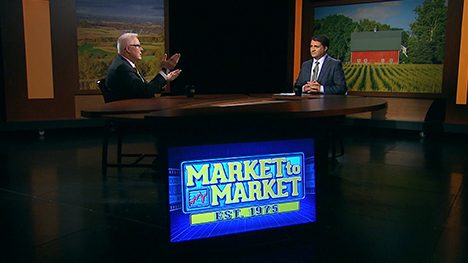
[Yeager] Extended dryness in the Wheat belt provided the fuel for a rally in grains, with corn getting a small bump in the final session for the week ending April 17th. The nearby wheat contract gained $0.20 and the May corn contract added $0.08. B oil gave and took away some rallies to the soy complex. The May soybean contract lost $0.09, while May meal was even on the weak. May cotton improved by $4.26 per hundredweight. May class three milk futures fell by $0.02. The livestock market was lower. June cattle shed 205 May. Feeders cut 735 and the June lean hog contract, weakened by a nickel in the currency markets, the US dollar index lost 75 ticks. May crude oil sold off nearly 15%, or 1442 per barrel. Comex gold added a $106.80 per ounce, and the Goldman Sachs Commodity Index was up by nearly 32 points to settle at seven 2795. Here now, to lend us his insight on these and other trends is regular market analyst Ted Seifried. Hello, sir.
[Ted Seifried] Hello, Paul. How are you?
[Yeager] Good to have you here.
[Seifried] Good to be here. Thanks for having me.
[Yeager] Wheat is always that thing we talk about first, and sometimes it's by necessity. That would be this week. Dryness continues. We've got this huge line in a certain area. Is that the main driver in the movement of wheat?
[Seifried] Yeah, I would say so. Right. Crop conditions are really bad. And anytime we have crop conditions really bad at this time of year, it usually has a negative impact and a pretty significant negative impact on yield. So that is certainly coming into play for wheat. Now we know that the underlying fundamentals for wheat are we've got a big supply here in this country. There's a lot of wheat in the world. But these are bearish fundamentals that have been known for a while. So, I'm going to say, Paul, that this is a case of less bearish fundamentals. I don't know if this is a case of wildly bullish fundamentals. Yes I do think we are hurting the production and what our overall wheat crop is going to be. But if you look at our balance sheet, we basically could go a whole year without growing wheat and still sustain our demand, the demand side of the balance sheet. So again, I think it is a less bearish outlook for wheat than what we were talking about a couple of months ago. That is mostly being driven by weather at the moment.
[Yeager] Is this enough momentum for or enough movement for someone to make some type of decision, whether it's a sale or a place of position somewhere?
[Seifried] Yeah. You know, certainly we are well off the lows and this is a much better value proposition than what it had been. So, I think making some sales here is pretty smart. That being said, you know, we had tried to break back to the downside again on a bit of an improved forecast. What at the time was a bit of an improved forecast, but then we've really snapped right back up. So, you look at this, this last month of trade or so, and it looks like a level of consolidation rather than a topping formation. So, I want to be measured in my sales for wheat. Right now. I look at the chart and I see some optimism there. And then I look over at the row crops. And I think corn in particular. Maybe we could get some help here in the relatively near future.
[Yeager] Help for corn.
[Seifried] Well, no corn help for wheat.
[Yeager] Corn help for wheat because that's what I was going to ask about. Corn is. So given what you just said, that doesn't sound like to give much reason. That's the reason maybe corn didn't move as high with wheat.
[Seifried] There's a couple of things that have been holding corn back. One is we had a 17-billion-bushel crop last year, according to the USDA, and there's a lot of bushels that we have to get through before we can get really excited about corn. We've had wonderful demand. But when you have a 17-billion-bushel crop, there's a lead time where we have to chew through that supply of corn. So that's part of it. Also, I think the fund's got a little bit too long, a little bit too early, and maybe for the wrong reasons, right. They got excited about the energy portion of corn based on the war in Iran and Strait of Hormuz being closed up and oh wow, energies are going through the roof. And while corn does have a significant portion of its balance sheet that is dedicated to energies in the form of ethanol, you cannot put raw corn kernels into a gas tank and run a car, right? There's a process that has to happen. Corn has to be ground into ethanol, just like soybeans have to be processed into soybean meal and oil. It's not something that you can go from one day to the next and say, oh, we're going to double our output of ethanol. It's just not a thing. And I think Wall Street's maybe realized that they've trimmed some of their bullish bets on corn. And I think this is now a much more healthy atmosphere or climate to maybe see a more seasonal rally for corn going into our planting season in the first half of our growing season. So, I like what's happened in corn. We've come back off the highs. I think we're set up for good things to come maybe going forward. I think the activity that we saw this week kind of feels like a bit of a bottom. The one potential monkey wrench that we have in this whole equation is South America. I mean it's always South America, but in particular, you look at what the recent estimates for Argentina have been coming from the Argentinian reporting agencies, namely the Rosario Grain Exchange and the Buenos Aires Grain Exchange. And oh boy, are they very aggressively increasing that Argentinian crop. Part of that is because they got better weather from about middle of February. February. On another part of that, Paul, is they're citing increased acreage about 4% higher than what they had originally thought, which, by the way, if that sounds familiar, you just have to go back to our last growing season to see that, how that happens. And that's wild. It's wild to me to think that that can happen in two of the major exporters in two consecutive crops where acreage is just so much bigger than what was originally expected. But either way, you know, you have the Buenos Aires grain exchange at 62 million metric tons as of their last estimate, which was earlier in the week. That's 10 million metric tons higher than the USDA. And you have the Rosario Grain Exchange at 67 million metric tons, 15 million metric tons higher than the USDA. And Argentina's is important because while they don't grow as much corn as Brazil, they are a very big exporter of corn, and they will be competition for us at the very tail end of our marketing year and going into the next.
[Yeager] Let's stay on South America then. But on the impact of soybeans and does any of what you just said impact us on beans or do we does beans have an independent story of South America right now?
[Seifried] Well, I'm going to say that the soybean yields for Argentina are better than they were expecting in, say, February. But unlike corn, where it saw a huge acreage increase, corn or soybeans were sort of the were at a loss for that. So, the estimates for soybeans are really staying the same from all their reporting agencies and ours for that matter. USDA. So, it's not really a soybean story. The soybean crop was good. It just isn't growing in massive levels like it is for corn. That will still be competition. The question, I think, for soybeans is more about the products. And what does Argentina do this year? Are they going to do another repeat of the soy dollar? Last year? They had very compelling reasons to do that politically. But if they like the results that they had last year, they may try to do that again this year. And if they do, that adds a lot to our products, that adds a lot to our crush margins. And yeah, I mean, look, crush margins have been very, very, very, very good for soybeans. Crush has been really rocking. And so yes, it could have an effect on our soybeans. But for the moment, I think we have to say this is not our export season for soybeans. Brazil just finished or Brazil now has this last crop, which it it's good. The Brazilians still think it's in the mid one 80s where we're hanging out at 180. From the USDA perspective, could be a little bit bigger than the USDA is thinking, is what I'm saying. And the Argentinian production numbers aren't falling, even though they're finding that they there was more corn acreage and maybe a little bit less bean acreage, but the yield is offsetting that for soybeans.
[Yeager] Let's move to livestock because Friday was a pretty a jarring day. And that was before report. A couple of reasons. There was. Well, you tell me why are the reasons on.
[Seifried] Yep, yep. Look, I think you had kind of a perfect storm for the second half of the week for the cattle complex. Right? One, we made a new high for June, June live cattle and then didn't really, you know, break out in a big way to the upside. So, when you have speculative traders funds that are very long in the cattle complex, they see that and they say, okay, this is a good place for us to maybe take profits. This is an overbought market. Let's take a little bit of profits here. Well, that rolled into Thursday. And on Thursday we were hearing that a Mexican official was saying that the USDA was making plans to reopen the border. And that put a lot of pressure on the cattle complex, especially feeder cattle. But then after the market on Thursday, you had a tweet from the USDA. It's amazing how we do all these all these things and tweet nowadays. Paulw or X. Yes, whatever posts, social media. How's that? There you go. By the way, you had the USDA refuting that saying, no, that's not a thing that was not accurate. So, then it was like, okay, well, how are markets going to respond on Friday? Are we going to completely take back the technical damage that was done on the rumor or the misspoken truth that happened on Thursday? And the answer to that was really not, at least not at first. We were down sharply. And I think that's the market saying, well, okay, USDA, but where there's smoke, there's fire and where there's concern or uncertainty, you have liquidation of positions. And in this case, with the funds being very, very long, that's long liquidation. So, you had funds kind of running for the doors just for the possibility that the USDA might, in fact, be looking at reopening that border sometime in the relatively near future, even though they're saying that they're not. However, also on Friday, you had Iran also on social media, Paul, saying that the Strait of Hormuz is open. They're happy with what's going on with Israel and Lebanon as far as the ceasefire is concerned. And you had crude oil down sharply, but you had equities up very sharply. You had the Dow up over 1000 points at one point. And by about midday, I think, in the cattle complex we said, well, okay. The USDA said they're not reopening the border. And even if they do, or even if they're considering it, that probably won't happen for a little bit. In the meantime, look at the equities markets. That's a big vote of confidence for consumer demand here domestically in the states. And so, you had those value buyers coming back into the cattle complex. And we ended up bouncing way off of our lows. So, a very volatile day started with a panic flush out, I think ended with some value buying based on, you know, what are still bullish fundamentals. And the cattle on feed report, which came after the close, also confirmed that.
[Yeager] In the final few seconds, I can say cattle on feed on feed 99 plus 93 fed 94. I'll get your take on those in Market Plus as well as your thoughts on the hog market and all of the other questions. Thank you Ted.
[Seifried] Hey. Thanks, Paul.
[Yeager] All right. Appreciate it. You have been watching the analysis portion of our program. And in a moment we will continue our discussion in an online only segment. Find it by searching Market Plus with Ted Seifried, wherever that you get your podcasts. You can also go to our website of markettomarket.org to listen. We've had a resurgence of discussions taking place on our Facebook page. When you get there, you'll find links to our content. And we notice that many of you have registered opinions on the news of the day as well. Join us at facebook.com Market to Market. So, remember to keep it civil, please next week, one egg producer is expanding his supply chain, one small farm at a time. Thank you so much for watching. Have a great week.
[MUSIC]
[Announcer] Market to Market is a production of Iowa PBS, which is solely responsible for its content.
[Announcer] I wouldn't be here without my customers.
Yeah, I'd like to thank the customers. They're very dear to our hearts.
It's about the people that you're working with and the relationships that you have.
Thank you. Thank you. Thank you.
Thank you from the bottom of my heart.
[MUSIC]
[Announcer] Tomorrow. For over 100 years, we've worked to help our customers be ready for tomorrow. Trust in tomorrow. Information is available from a Grinnell Mutual agent today.
Watch More

Huub Lelieveld receives the 2026 World Food Prize for six decades of work advancing food safety.
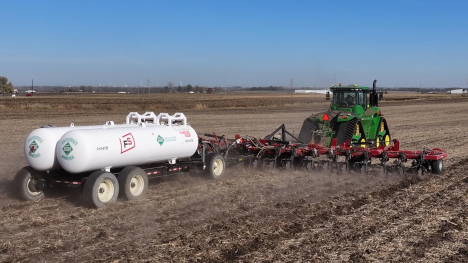
New federal plans target farmers' fuel and fertilizer costs through direct relief and investments in domestic fertilizer production.
Chris Robinson weighs corn recovery prospects, soybean price levels and the rebound in cattle.
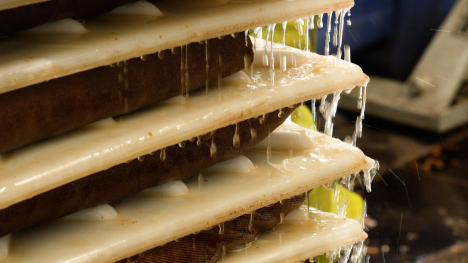
Minnesota’s Keepsake Cidery combines heirloom apples, traditional cider making and direct sales to help a small farm thrive.
New farm relief, a food safety honor, Minnesota cider and commodity market analysis with Chris Robinson.
Chris Robinson answers viewer questions on corn yields, crude oil and cattle, and explains his soybean outlook.