The Supreme Court was the site of the highest level legal challenge to President Donald Trump’s sweeping tariff agenda.
Tariffs have their day in court as U.S. agriculture works for expansion in old markets
Share


The Supreme Court was the site of the highest level legal challenge to President Donald Trump’s sweeping tariff agenda.
Transcript
The Supreme Court was the site of the highest level legal challenge to President Donald Trump’s sweeping tariff agenda.
The case centers on whether or not Trump can use the nearly 50-year old International Emergency Economic Powers Act to impose tariffs. The justices expressed skepticism that he has this power to use the Major Questions Doctrine, the same policy former president Joe Biden tried when offering partial forgiveness to student loan debt.
(use short bite of Trump on AF 1)
The president has warned that the United States will be rendered “defenseless’’ and possibly "reduced to almost Third World status" if the Supreme Court strikes down the tariffs he imposed this year on nearly every country on earth.
Donald Trump, U.S. President: “...but if you look at China by putting a large 100 percent tariff over and above the tariffs they already paid. They came to the table, they talked. We made a wonderful deal for everybody. Our farmers, as you know, with the soybeans at levels that nobody has ever seen before, we were able to make phenomenal deals. If we didn't have the tariffs, we wouldn't have been able to do that.”
Reporter: So then do you agree then that Americans are paying those tariffs?
Donald Trump, U.S. President: “I think, no, I don't agree. I think that they might be paying something, but when you take the overall impact, the Americans are gaining tremendously. They're gaining through national security. Look, I'm ending war because of these tariffs.”
The result of the arguments won’t likely be revealed for several weeks or even months.
Tariffs won’t likely be going away. Trump could impose tariffs under other statutes but there would be limitations slowing speed and blocking severity.
Before their day in court, the White House released a long list of what the U.S. and China agreed to last week in South Korea. Included were a Chinese suspension of limits on the export of rare earth elements and an increase in imports of U.S. agricultural products. This includes a 12 million ton purchase of U.S. soybeans over the next two months. In recent days, China has purchased American wheat but has yet to purchase any beans. Brazil, however, has sold 20 cargoes bound for Chinese ports. Despite the truce, any new loads of soybeans will still be subject to a 13% import tariff.
The U.S., among other moves, agreed to lower tariffs on Chinese imports imposed to curb the flow of fentanyl by 10 percentage points for the next year, but a 10% reciprocal tariff will remain in effect.
Even with import duties still in place, U.S. businesses opened a showcase in Shanghai to continue promoting American agricultural products.
Jim Sutter, CEO, U.S. Soybean Export Council: (1:47) “...we have sort of turned the page and there are new opportunities now. And I think from our U.S. soybean industry, we are very pleased. We expected that this was a short-term bump in the road, but now we are very happy to have our U.S. soy from our 500,000 soybean farmers to be coming back into China.”
China remains the world’s largest buyer of soybeans. In 2024, the Middle Kingdom purchased nearly half of all U.S. soybean exports.
Erick Zheng, President, AmCham Shanghai: “And we don’t like tariffs, tariffs are not good for anybody, and certainly there will be no winners in a trade war. So we are in a truce, technically speaking, so hopefully we can have a more stable relationship between the two countries go forward.”
For Market to Market, I’m David Miller
contact: [email protected]
Watch More
Shawn Hackett weighs storing corn versus selling soybeans and Brazil’s potential weather risks.

Montana residents balance affection for free-roaming horses with safety and property concerns.
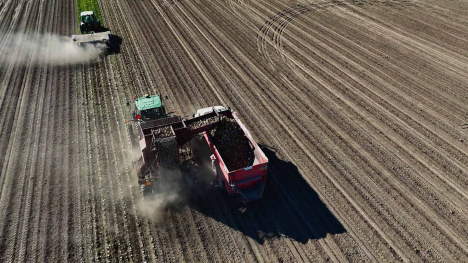
A growers association reports average losses of $500 per acre as sugarbeet harvest gets underway.
Shawn Hackett weighs corn demand, USDA yields and potential November turning points for grains.

Sugarbeet losses, diesel costs, Montana’s feral horses and market analysis with Shawn Hackett.

Global supply disruptions keep fertilizer markets volatile heading into 2027.