Passing a dairy farm on to the next generation can be hard, but two operations in Wisconsin are making it work in different ways.
Two Wisconsin Dairy Farms, Two Different Succession Plans
Share


It's an age-old question: What do you do with the farm when the older generation is ready to move on? It can be tricky, and every operation is different. Four Hands Holsteins and Rosy-Lane Holsteins, LLC, are two Wisconsin dairy farms creating unique ways to make succession work for their operations.
Transcript
In 1930, according to USDA, there were 167,000 dairy herds in Wisconsin. Today, there are under 5,000. While farm numbers have decreased, milk production has increased. The dairies that remain, in many cases, are larger and run by people who are confronted with increasingly complicated financial and operational decisions. One of those decisions: How to pass the farm on to the next generation.
A recent report from Dairy Herd Management found that only two in five dairy operators have a defined succession plan. That means, nationwide, roughly 60% either lack a plan or are unsure if they have one.
Joy Kirkpatrick is a Farm Succession Outreach Specialist.
Joy Kirkpatrick, University of Wisconsin-Madison Extension - “I focus on, when I work with farm families, on what I call a three step process. The question is, where are you now, where do you want to be and then how do you get there?”
Experts like Kirkpatrick say one of the most important parts of this process doesn't involve a lawyer, an accountant, or a financial statement. It starts with a conversation.
Joy Kirkpatrick, University of Wisconsin-Madison Extension - “What I find is being able to learn how to communicate more as business partners versus family. I think that is a key part.”
In Amery, Wisconsin, Four Hands Holsteins is working through a model that has defined American agriculture for centuries: the ownership of a family farm moving from one generation to the next.
Rick Dado, Four Hands Holsteins - “It really starts with farmers themselves in a positive picture of the lifestyle and the business to their children or other potential heirs or participants in business, and also to try to create a fiscal responsibility, so it’s sustainable.”
The 1,500-acre operation milks around 450 registered Holsteins. Its name comes from Rick and Gwen Dado’s four children, who grew up helping on the farm. Two of the kids, Bethany and Trent, decided to return to the dairy.
Bethany Dado Senn, Four Hands Holsteins - “They walked into the situation with a lot of grace and understanding that it has to be a two way street. There’s compromises that the farm owners will make and there’s compromises that the transitioning children will make as well. When we sat down at the table to have this first transition discussion, my sweet, sweet father brought forth a survey for all of us to take, and it included what our expectations were for the diary, where we saw the dairy in the short and long term future and how we saw interacting with each other.”
Their succession plan wasn’t something that happened overnight. It was a gradual process and one, according to Rick and Gwen, that will continue for generations to come.
Gwen Dado, Four Hands Holsteins - “We’re thinking about our steps. We’re thinking about the end game. And we know it’s a little bit at a time. The management is going to be a little bit at a time for Bethany. And when Trent gets back, boots on the ground, you know, it’s going to be a bit at a time and we get that. And I think they understand that too.”
The approach taken by Four Hands Holsteins is only one way of addressing one of the most difficult questions in farm succession: ‘How do you keep a family together while making business decisions?’
Bethany Dado Senn, Four Hands Holsteins - “It was very clear on the table from the get go that if at any point there is something that damages family relationships, we cut it right there because at the end of the day, the family dynamics are more important than anything else. It has taken a lot of honesty and strong conversations amongst us and those are still ongoing.”
Nearly 300 miles away, in Watertown, Wisconsin, Rosy-Lane Holsteins built its succession strategy around partnership rather than traditional family inheritance. Founders Lloyd and Daphne Holterman began bringing non-family partners into the ownership structure years ago. Tim Strobel became a partner in 1999, Jordan Matthews joined in 2013, and Sam Peetz in 2024.
Jordan Matthews, Rosy-Lane Holsteins, LLC - “The motto was hopefully give it to your children. And at the time, they were 40 years old and they had young children who were single digit ages, and they didn’t know if this was the right fit. They had seen a few models out East where it’s quite common. In Wisconsin, not common at all. People who brought in, you know, top level talent and first thought, wow, we could work with this. And you know, wow, I want this person to be on our farm because they are the best fit for it.”
The Holtermans transition ownership through a multi-generational LLC based on merit rather than lineage. Non-family successors earn the right to buy business equity after proving their value in management roles.
Jordan Matthews, Rosy-Lane Holsteins, LLC - “I think is a little token for people that are interested in ownership roles or an investment opportunity that they they're going to be here for longer. And we need this farm to continue to succeed for ten and 15, 20 years. These buyouts don't happen quick, easy and forever.”
Today, Rosy-Lane supports more than 30 families, farms on thousands of acres, and manages roughly 2,400 animals across two locations.
Jordan Matthews, Rosy-Lane Holsteins, LLC - “You know, the Holtzman family moved here in in the 60s. And, you know, look at us now. We're we're 67 years later and there's no finish line in sight, right? We want to be here for another hundred years.”
Both dairies have found different ways to navigate farm succession but it all began with everyone sitting down and talking.
Bethany Dado Senn, Four Hands Holsteins - “I’ve watched my parents really get outside of their zone a little bit as I bring different changes and suggestions to the table. You know, they’re very open to that and I’m really appreciative of that. And I want to give them the confidence to know that the farm is in good hands when they decide that it’s time to retire.”
For Market to Market, I’m Laurel Bower.
Watch More
Global supply disruptions keep fertilizer markets volatile heading into 2027.
Higher USDA yields pressure grain. Plus, opportunities/costs of putting local food on school trays.
How grain prices rally this winter w/Naomi Blohm & Ted Seifried on USDA, China demand & S. America.
An Iowa school district connects local farms, food hubs and students through the lunch tray.
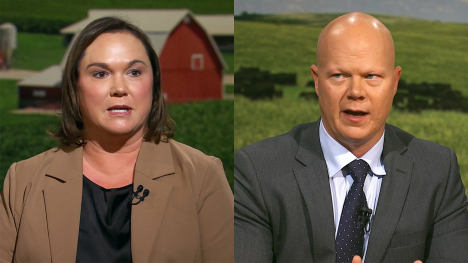
Naomi Blohm and Ted Seifried question USDA’s corn yield surprise and weigh China’s soybean demand.
Farmers rarely seek mental health help. Farm Dog offers care from people who know farm life.