Several thousand residents are still waiting for power and drinking water to be restored.
Kentucky Cleans up After Flooding as Feds Announce $1 Billion for Climate Projects
Share


Cleanup continues in Eastern Kentucky, where flooding killed 37 people last week. Over 1,300 people have been rescued by various agencies, with over 400 being rescued by aircraft. Several thousand residents are still waiting for power and drinking water to be restored.
Transcript
Cleanup continues in Eastern Kentucky, where flooding killed 37 people last week. Over 1,300 people have been rescued by various agencies, with over 400 being rescued by aircraft. Several thousand residents are still waiting for power and drinking water to be restored.
Between eight and 10 inches of rain fell on the region in a 24-hour period as a series of training thunderstorms - storms that follow rapidly one after another - passed over the region. Another four inches fell on July 31st.
The National Weather Service in Jackson, Kentucky reported its wettest July on record, with a total of over 14 inches of rain in the month.
Water systems in multiple towns were destroyed, and multiple roads and bridges will need expensive repairs. Thirteen counties in Eastern Kentucky were declared disaster areas by the Federal Government. State officials are utilizing lessons learned when a series of tornadoes struck Western Kentucky in December of 2021.
Climate scientists suggest that heavy rain events are becoming more common as the earth’s atmosphere warms, increasing its capacity to hold moisture.
For Market to Market, I’m Peter Tubbs.
…and I’m Josh Buettner.
This week, the Biden Administration detailed efforts to respond to the kinds of flooding disasters in Kentucky and wildfires currently raging in states like California - which officials claim have been exacerbated by climate change.
Vice-President Kamala Harris: “Today, our administration is investing more than $1 billion through FEMA to fund climate resilient projects in 343 cities, towns and counties around our nation.”
Along with $160 million for flood mitigation assistance, the move doubles spending on the Building Resilient Infrastructure and Communities, or BRIC, program announced by the president last month as part of $2.3 billion in funding to support state, local and tribal projects which reduce climate-related hazards said to help spur extreme weather.
Drought has gripped a majority of the American West throughout the spring and summer of 2022, but biologists say decades of arid conditions and overuse have depleted the Rio Grande - one of North America’s longest rivers. The U.S. Fish and Wildlife Service has been relocating silvery minnows, whose habitat is literally shrinking, from shallow pools of water adjacent to the drying waterway. The government has stocked the endangered species in the past, but researchers say natural ecosystems are trending toward collapse.
John Fleck/Water Policy Researcher/University of New Mexico: “Climate change is coming at us so fast right now that it’s outstripping those tools that we have developed over the last few decades.”
Biden also declared a federal emergency last month after the U.S. Virgin Islands warned of unusually high amounts of sargassum, an invasive brown algae the United Nations attributes to rising water temperatures, nitrogen fertilizer and sewage runoff. The seaweed has plagued a desalination plant there struggling to meet demand amid drought, can kill wildlife and has dented the Caribbean tourism industry.
So far, Jacksonville, Florida and Miami-Dade County have both received federal funds to alleviate flooding and beef-up infrastructure near areas which generate significant economic activity.
Vice-President Kamala Harris: “We can build a more resilient future. That’s within our sights. And in the process, yes, we will create millions of good jobs in the clean energy economy.”
Watch More

Montana residents balance affection for free-roaming horses with safety and property concerns.
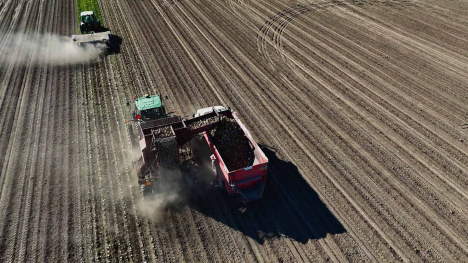
A growers association reports average losses of $500 per acre as sugarbeet harvest gets underway.
Shawn Hackett weighs corn demand, USDA yields and potential November turning points for grains.

Sugarbeet losses, diesel costs, Montana’s feral horses and market analysis with Shawn Hackett.

Shawn Hackett weighs storing corn versus selling soybeans and Brazil’s potential weather risks.

Global supply disruptions keep fertilizer markets volatile heading into 2027.