Kristi Van Ahn-Kjeseth discusses the economic and commodity markets in this web-only feature with topics of wheat, corn, soybeans.


Kristi Van Ahn-Kjeseth discusses the economic and commodity markets in this web-only feature with topics of wheat, corn, soybeans.
Transcript
[Paul Yeager] Welcome to the table for the Friday, February 6th, 2026 installment of Market Plus. Joining us now, Kristi Van Ahn-Kjeseth Christi, we're recording this on Thursday, so we'll take whatever happens Friday and we'll just talk about it in the newsletter Monday. However, I do want to talk about two things to start. One was a demand question when you were talking about the soybean situation, if China comes through with their intention, explain it to me again in simple English. What could happen if they try to suck up all the excess beans we have in this country?
[Kristi Van Ahn-Kjeseth] Yes. So right now our carryout is 350 million, and if they increased their purchases by 8 million metric ton, that would be I think it's like 294 million. And so, we would have a carryout level of 55, 56 million bushel. Obviously that's not doable. And so, the answer is what do you do? There's a couple different ways ration, which means we'd have to cut back on Massive Crush. And I just think crush has been so strong. I don't know if you would see them be able to back off of that. So, you'd have to incentivize them to back off price level. So, you would have to see a pretty substantial rally or we start to import more beans, which is actually very doable in this given situation with the footprint that Cargill's or Adm's have in both Brazil and the U.S., that you could really shuffle some beans around and try and figure that out. So, it's kind of that mix of those three. But long story short, we don't have 8 million metric ton of beans for them to buy right now. And you know, I don't see it actually happening. But even if they bought half of that, even they bought the four, it does make the dynamic a little bit on the friendly side, obviously. I said in the earlier segment that we moved to 100% marketed, so we, you know, this is to us is that situation that we don't believe that there's follow through. However, if there is, we would use breakout zones to say, let's get some length on, let's get some calls on. If you really broke out to above those recent highs from back when they started their purchases, we would take it a little bit more seriously. But it's just hard for me to believe that they would want to come in here and buy that many more beans. When South America has a large crop coming, obviously we don't have the crop in the bag yet in Brazil, but all private estimates, a growing season. Everything is pointing at a very large crop that the beans are available to China.
[Yeager] So given what you just said, given what could happen because we could get a tweet or a phone call from either party, that changes that story dramatically. If I'm a producer watching this, how do I worry about that? The bottom could fall out. Not that the top is going to come off.
[Van Ahn-Kjeseth] Yeah. And so, I you know, I think that you're looking at this situation and just saying, okay, we were below the 200-day moving average before this news broke. The charts were not looking good for soybeans. And so, you were kind of fearful I think what this story does is it kind of just lifts the bottom up a little bit, saying, hey, there is a possibility that they could buy. So, this price probably can't get too low, or maybe they'll carry through with that. So, I think it kind of shifts the window of trade for soybeans, where before you had it down here and now it's kind of gradually bumped up. I think that when everything shakes out, even though they're talking about this season of increasing 8 million metric ton, it probably just makes it a little bit more friendly moving forward for the fact that they could not be done by and still buying some. It's just going to make that carry in for next year smaller.
[Yeager] And it starts to mess with the algorithms of 200-day, 100 day moving averages and lifts things up and triggers more buys and sells. Wow. Good luck. Have fun at work on Monday, Christy, let's get to a couple of questions. Let's go. Mike W and Iowa, if we could please. Is there much hope for new crop corn and beans? Or should we be getting aggressive on these short rallies? Another translation from Pete in the control room. When do you just walk away?
[Van Ahn-Kjeseth] Yeah, I think that I'm actually pretty optimistic for higher prices for soybeans. I just I think that you've tightened up those carryout levels for the carry in. I don't think the acres are going to be there. So, I'm looking at more somewhere between 1150, $12 before I start to move on. Some marketing opportunities for new crop soybeans. If we can get there. Right. We you know, there's still a lot of price action that needs to happen before we get there. Corn, on the other hand, you're looking at such a huge carryout right now and the potential of okay, so let's say we don't have overly large corn acres next year, we're still going to have a decent amount of corn acres. And so, you look at that situation, it's really hard to try and get that carryout level down on corn, even with robust demand like we have seen. So, corn, I'm a little bit more fearful of, you know, our targets on marketing for corn, for new crop for 75, for .91 and 509 if we can get there. So, you know, I'm looking at those situations of let's say you get 475, we get a 30-cent carry, you're above $5 out to July. If you can capitalize on that. So, I'm looking at more of I wouldn't do anything right now in corn. But my thought process and my targets are not that far away.
[Yeager] Okay. Let's move to another Mike. Mike's the popular name. Trust me, these are all different people. Mike. See, in Iowa is this been news this week by the rumor and sell the fact.
[Van Ahn-Kjeseth] That's how we handled it. I you know, obviously you saw a nice carry through on Thursday. But overall, when I look at this situation, I just have a hard time thinking that whole 8 million metric ton is going to materialize.
[Yeager] Let's go to Phil in North Dakota. We're going to skip one there and go up. This one's you can answer it with a little bit of wheat here as we work towards planting intentions as the cost of inputs reached a high enough level that it will affect what gets planted. I'm thinking about wheat especially. Does that mean more corn and beans?
[Van Ahn-Kjeseth] Yeah, I think the writing on the wall is wheat is going to be a specialty crop before you know it. I just don't think you're going to get it. And, you know, being in North Dakota, I just think the spring wheat profitability is absolutely not there. And so, I think you're going to see that dwindle. I have heard more people talk about sunflowers for the first time in a couple of years for places like North Dakota, really upping those. When I first started, there were a lot of soybean or sunflower acres, then started to dwindle down. So, I think you're going to look at some of those. But overall, when you look at it, I think you stick to your core corn and soybeans, but especially if you're on rented land, it's really hard to put the soybean pencil on there. And so, I just think that's why I have that philosophy of the acres numbers that we could get. But I do think people are going to look at some specialty crops in some situations because of inputs.
[Yeager] Scott and Wisconsin has the question that you have a great answer. I'll just here it is. Scott, here's your question. As input costs are high, I'm thinking of leaving some land fallow with a cover crop instead of planting a crop and taking a year of rest to boost yields in 27. What are your thoughts on that?
[Van Ahn-Kjeseth] I think that this gets talked about a lot, but never materializes. And I think by nature I don't really know farmers that actually rest. They might talk about resting, but I don't actually ever see a farmer that's in their nature to work really hard. And so, for them to not plant those or to put a cover crop, I think the logic behind it is smart. If you could get a bunch of people to get it together, but it's just never going to happen. And when everything shakes out, I think that it's just in the nature that what a what a producer wants to do is raise a good crop.
[Yeager] And it might not be the farmer's decision, right? It might be the banker's decision.
[Van Ahn-Kjeseth] Right. And but a banker is still going to want some form of income coming from that. And I just don't know if a cover crop is going to cover it.Unless some type of government program comes. But I don't see that coming anytime soon.
[Yeager] Okay. Let's do Mike the other Mike in Iowa, this was the first Mike to write. He sent me an email and I'm going to summarize here a little bit. We talked, had a nice conversation about profitability. If there's no turnaround in prices, how does one begin the honest and comprehensive discussion on cash flow?
[Van Ahn-Kjeseth] Yeah.
[Yeager] So, the next 12 minutes are yours, Kristi, I'll just sit back.
[Van Ahn-Kjeseth] This is, you know, a conversation that we're actually having quite a bit because I think right now is a time frame a lot of farmers are meeting with their bankers on operating loans. So, they're having these conversations, and some of them are being a little bit of a harder conversation. You're coming on two very hard years for a producer. And to be honest, if you did not do your marketing early for corn, you've kind of been stuck here for a while. We've had a couple short term rallies, but they have not been big rallies by any means. So, you're stuck here. So how do you have that conversation? We always start with the fact that if you are early in the season and that price is profitable, you have to do something there, right? So, start on a chunk of it and do that profitability from there. I think you have to have very realistic targets and be a scale up seller. You know, I think a lot of people, it's very hard for them to digest selling. And then for example, you know, like Thursday's trade selling and then seeing beans up $0.20 and then you get frustrated and then you freeze and you don't sell anymore because you're mad. You sold $0.20 lower. And I think that's why it's so important to kind of take that emotion out, know where your profitability is, and work those orders to sell, whether that's in an account, whether that's at an elevator, one of the two of them, and set those targets and, and stick to them. I think it's very easy to but sometimes you have people say, well, I think I might adjust that, that order a little bit higher. And sometimes that does work out. But I just think being diligent on your marketing and being diligent on being a scale up seller and working those orders is the way to do it. Now, his question what if you never get to those targets? It's very important to have a line in the sand where you're saying, I am not willing to sell below this. And so, if we come in here and we start to breach this level, that you sell something there and that's hard to do, that is a very tricky thing to do. But I think it's so important and actually probably more important than the scale up seller is knowing when to throw the towel in and say, I'm doing something here.
[Yeager] And that's the hardest thing. I would think that you have to say and have that conversation with someone.
[Van Ahn-Kjeseth] Yeah, it is very it's very tricky. And, you know, there are times, you know, especially for soybeans, you know, when you're asking them to be sold out of soybeans. At this point, a lot of them are saying, hey, I'm not even making money here. And that is really hard. But in the other logic, when you're looking at the farm as a whole and if you're having profitable trade action on corn, sometimes you have to do that and be like, I'm willing to sell at break even or a little bit lower on this commodity because I know I can make it up for this. And looking at the farm is a business and that is the best thing you can do is look at your farm as an actual business and say, I know that I wouldn't let a business go bankrupt. I know that I wouldn't let a business consistently do poor decision making. I need to make sure I'm doing something here. And those are tricky conversations.
[Yeager] Well, thanks for going along with our tricky questions. Thank you. Conversation. Good to see you again. Thank you. Good to see you making the trip. With no snow down here.
[Van Ahn-Kjeseth] It's fantastic. I feel like I'm on a tropical vacation.
[Yeager] Well, you should stay again back to Monday. You should come on Monday. 60 degrees here. Oh it's crazy. All right Kristi. Thank you.
[Van Ahn-Kjeseth] Thank you.
[Yeager] All right. That's going to do it for our Market Plus with Kristi Van Ahn-Kjeseth. Next week we're going to talk about the overall effect of one communities packing plant closure. And Karen Braun will be with us to break down the markets. Thanks for joining us. Have a great week.
Trading in futures and options involves substantial risk. No warranty is given or implied by Iowa PBS or the analysts who appear on Market to Market. Past performance is not necessarily indicative of future results.
Watch More
Wednesday's USDA report traditionally is quiet on yield, but risk is in the air according to Kristi Van Ahn-Kjeseth.
Wheat stalls, corn struggles and cattle turns cautious, according to Kristi Van Ahn-Kjeseth in our Market Analysis segment.
The Farm Bill fails to make it out of the Senate Agriculture committee.
Iran casts a shadow over the jobs report.
A grocery store keeps a community from turning into a food desert
And commodity market analysis with Kristi Van Ahn-Kjeseth.
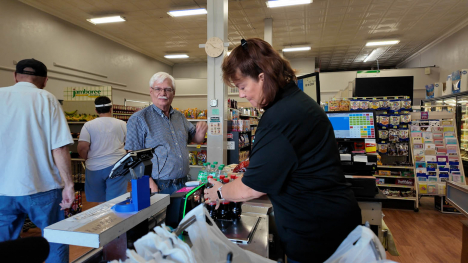
Facing closure, Gowrie's only grocery store was saved by 60 residents and $250,000.
A battle over SNAP kept the Senate Farm Bill from advancing before August recess.
The weather’s influence on the market may be closing soon, according to Dan Hueber in Market Plus.