This week, the Polk County, Iowa supervisors released their scientific assessment study of the water quality in the Des Moines and Raccoon Rivers, which merge in downtown Des Moines.


This week, the Polk County, Iowa supervisors released their scientific assessment study of the water quality in the Des Moines and Raccoon Rivers, which merge in downtown Des Moines.
Transcript
This week, the Polk County, Iowa supervisors released their scientific assessment study of the water quality in the Des Moines and Raccoon Rivers, which merge in downtown Des Moines.
The study finds that over 70 percent of the nitrate in the two rivers comes from agricultural sources, either animal manure or fertilizers. The study also calculates that 13% of the nitrogen applied to farm fields in the watersheds migrates into the rivers.
The study, which took two years to complete, reports that both the Des Moines and Raccoon rivers remain polluted with high levels of nitrate despite decades of voluntary and government programs to improve the water quality of these rivers.
Matt McCoy, Polk County, Iowa Supervisor: “The cost of addressing these problems is enormous, but the consequences of not addressing them is not an option.”
Iowa Secretary of Agriculture Mike Naig released a statement in response to the study which says in part,
Sec. Mike Naig, Iowa Department of Natural Resources: “We’re not interested in stoking animosity between rural and urban neighbors. Agriculture, conservation, recreation, urban and rural development, and business growth can and must co-exist in Iowa.”
Iowa Farmers Union President Aaron Lehman believes a rural and urban partnership is necessary to solve the problem.
Aaron Lehman, Iowa Farmers Union: “Farmers have to be a, a big part of that solution, but they won't be able to do it with current, with the, without having a public investment…. So rather than having the dichotomy of whether this is, farmer versus urban issue, we need to say that we're all on the same team and we all are going to be pushing in the same direction on it.”
On June 12th, high nitrate concentrations in both rivers forced the Central Iowa Water Works to institute a ban on lawn watering and cut backs for high-volume water users.
The CIWW uses filtering systems to remove enough nitrate to meet EPA rules for safe drinking water. However, it does not have the capacity to keep nitrate levels below EPA limits and meet full summer water demand without requiring curtailed water use.
For Market to Market, I’m Peter Tubbs.
Watch More

Huub Lelieveld receives the 2026 World Food Prize for six decades of work advancing food safety.

Minnesota’s Keepsake Cidery combines heirloom apples, traditional cider making and direct sales to help a small farm thrive.
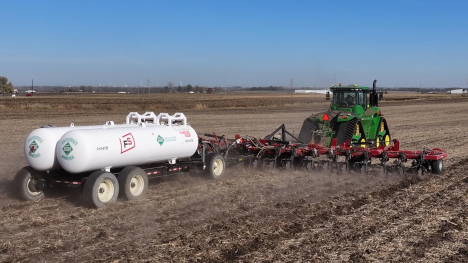
New federal plans target farmers' fuel and fertilizer costs through direct relief and investments in domestic fertilizer production.
Chris Robinson weighs corn recovery prospects, soybean price levels and the rebound in cattle.

New farm relief, a food safety honor, Minnesota cider and commodity market analysis with Chris Robinson.

Chris Robinson answers viewer questions on corn yields, crude oil and cattle, and explains his soybean outlook.