Dairy producers are keeping fewer dairy replacement heifers, which is expected to continue to drive prices for the young milk cows higher.
Dairy Experts Anticipate Upcoming Shortage of New Milk Cows
Share


Many dairy producers are also benefiting from high beef cattle prices, but also know some of them will struggle to find enough new milk cows down the road.
Transcript
In January, the nation’s dairy farmers reported keeping 18% fewer heifers to serve as future milk cows than they did eight years earlier. The downward trend has been consistent over that entire time period.
Corey Geiger, Lead Dairy Economist, CoBank - Omro, Wisconsin: "This is a dynamic situation taking place in dairy farms, in the collective US dairy industry: replacement heifers, all dairy heifers, are at the lowest level since 1978. So we swung the pendulum a little too far making beef-on-dairy calves.”
Beef-on-dairy refers to when producers breed dairy cows to Angus or other beef bulls. Those calves are then raised for beef instead of future milk production. The strategy has become increasingly popular as beef prices surged in 2023, fueled in part by the smallest national beef herd since 1961.
Corey Geiger, Lead Dairy Economist, CoBank - Omro, Wisconsin: "As beef prices started going up, dairy heifers are actually more valuable in feedlots than they were in dairy barns because it was costing about $2,000 a head to raise them so that’s kind of when the beef-on-dairy movement began…This past year, the National Association of Animal Breeders reported that there were 9.8 million units of beef bull semen sold in the U.S. And … almost 80% of that was sold to dairy farmers. So there are a lot of these beef-on-dairy calves, and their prices are getting higher and higher."
But even with fewer dairy replacement heifers, the U.S. dairy herd overall has grown, increasing by 212,000 head from a year ago.
Corey Geiger, Lead Dairy Economist, CoBank - Omro, Wisconsin: "The dairy cow herd is actually at the highest inventory here in over 30 years at 9.6 million units. If I'm talking to dairy farm audiences, I'll say it, in some cases, the cow’s uterus has more value than the cow herself because of the value of the black-hided calf… The only way to grow the dairy herd is to retain dairy cows. So we pulled back on dairy cow culling…What does that mean on U.S. dairy farms? Our cows are getting older.”
At Hansen’s Dairy in Hudson, Iowa, the Hansen family has been breeding a small percentage of their dairy cows to beef bulls for more than a decade. One of the owners, Blake Hansen, says while most of Hansen’s Dairy’s beef-cross calves are processed with the meat being sold directly to consumers, he has seen prices climb for others who sell at livestock auctions or to packing plants.
Blake Hansen, Hansen’s Dairy - Hudson, Iowa: "Bull calves are incredibly high – Holstein bull calves that is. And then, of course, the black-hided calves are even higher yet…It’s the best thing that’s ever happened to the beef farmers and dairy industry as far as I’m concerned. We’ve been waiting for a long time for this price increase because there’s been many years they haven’t been making much money at what they do. "
Hansen believes the trend could eventually tighten milk supplies and lift milk prices.
Blake Hansen, Hansen’s Dairy - Hudson, Iowa: "That’s going to limit the supply of…heifers in general and then that’s also going to limit the supply of milk down the road because farmers aren’t going to have the supply of heifers to replace their cow herd. For now, the price of milk is somewhat low, but I think by the end of the year or into 2027, we are going to have some really high milk prices because of the shortage of heifers."
Geiger, who believes USDA’s replacement heifer data underrepresents the shortage, says the shrinking pipeline of future milk cows is likely to continue unless beef prices weaken or dairies begin running very short on replacements.
Corey Geiger, Lead Dairy Economist, CoBank - Omro, Wisconsin: "And this year we're going to have 438,000 fewer dairy replacements becoming milk cows compared to last year. And this won't rebound until 2027, when we see an improvement of 285,000.”
The shortage is already driving replacement heifer prices sharply higher. Some say that could eventually force some dairy producers to step back a bit from beef-on-dairy.
Corey Geiger, Lead Dairy Economist, CoBank - Omro, Wisconsin: "We have to change a little bit about how we are caring for dairy cows as this herd gets older. Eventually we have to pay the piper. In this instance, we're going to have to cull these older cows. And that's why dairy farmers really need to take a look at their replacement inventories...In 2015-16, replacements were at $1,400-$1,500. It was cheaper to buy them than to raise them. Well, now that price in October went up to a record $3,100…Those are steep, steep prices."
This early May auction in Withee, Wisconsin saw some dairy heifers selling for over $4,000 a piece. Auctions all over dairy country are getting these kinds of prices.
Some dairies are already responding by spending a bit more on pre-selecting genetics to have female calves.
Julie Bacon, co-owner, Bacon’s Rolling Acres - Columbus, Wisconsin: "It's really kind of surprising because milk prices are so low, but we're still seeing record high prices for heifers. Especially like the ones ready to go right into the milk line. And personally, our farm is expanding and we are breeding more using sexed semen to try to get more heifer calves. But you are still sacrificing – because you could be selling a beef calf – as an opportunity cost there."
The question remaining for producers is how long that window stays open.
Corey Geiger, Lead Dairy Economist, CoBank - Omro, Wisconsin: "The first … indicator it may be over is when … the cattle ranchers start retaining heifers. So I think: make hay when the sun is shining as a lot of farmers will talk about. And this beef-on-dairy run is the time the sun is shining, and it's time to make some hay on it."
By Colleen Bradford Krantz, [email protected]
Watch More
An expanded response to the spread of the screwworm. Indoor farming looks to survive the hype and harvest profits. And, commodity market analysis with Mark Gold.
There's still no new supply of land being built, but the demand side keeps strong as new entrants are looking for places to build data centers, hunting blinds and places to park other investment gains. Doug Adams, the CEO of National Land Realty looks at the big picture playing out now and a four-letter word is the big influence.
We get to the China and weather story, but first our Market Plus with Mark Gold includes a special thank you in addition to thoughts on corn, soybeans and wheat.
The wheat, corn and soybean market struggle while cattle and feeders find footing. Here's our Market Analysis with Mark Gold.
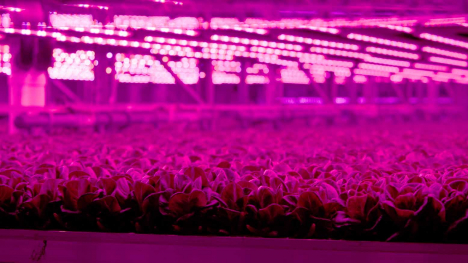
Indoor farm limits variables to maximize yields as we profile 80 Acres Farms in Ohio.
Secretary of Agriculture Brooke Rollins appeared before the Senate Agriculture Committee and the big topic was NWS.